Punnett Square Calculator
Draw the Punnett square for a monohybrid, dihybrid or trihybrid cross such as AaBb × AaBb, with genotype and phenotype ratios and exact probabilities.
Calculator
AaBb: 4 kinds of gamete.
AaBb: 4 kinds of gamete.
A capital letter for the dominant allele and a small one for the recessive, one pair per gene: Aa for one gene, AaBb for two, AaBbCc for three.
- Phenotype ratio The phenotypes in the smallest whole numbers, fewest recessive traits first, the order textbooks print them in. The table below names each one.
- 9:3:3:1
- Genotype ratio The genotypes in the smallest whole numbers, in the order AA, Aa, aa at each gene.
- 1:2:1:2:4:2:1:2:1
- Square Parent 1’s kinds of gamete across the top and parent 2’s down the side. Each gene at which a parent is heterozygous doubles its kinds of gamete, and every box is equally likely.
- 4 × 4 = 16
- Classes How many different genotypes the square holds, and how many phenotypes they show.
- 9 genotypes, 4 phenotypes
Parent 1, AaBb, makes 4 kinds of gamete, each 1/4: AB, Ab, aB, ab
Parent 2, AaBb, makes 4 kinds of gamete, each 1/4: AB, Ab, aB, ab
| Gametes of parent 2 | AB | Ab | aB | ab |
|---|---|---|---|---|
| AB | ||||
| Ab | ||||
| aB | ||||
| ab |
- A_B_ 9/16
- A_bb 3/16
- aaB_ 3/16
- aabb 1/16
Phenotypes
| Phenotype | Genotypes | Boxes | Probability | Percent |
|---|---|---|---|---|
| A_B_ | AABB, AABb, AaBB, AaBb | 9 | 9/16 | 56.25% |
| A_bb | AAbb, Aabb | 3 | 3/16 | 18.75% |
| aaB_ | aaBB, aaBb | 3 | 3/16 | 18.75% |
| aabb | aabb | 1 | 1/16 | 6.25% |
Counted real offspring? Test your counts against 9:3:3:1 in the chi-square calculator, which opens with this ratio filled in.
Genotypes
| Genotype | Phenotype | Boxes | Probability | Percent |
|---|---|---|---|---|
| AABB | A_B_ | 1 | 1/16 | 6.25% |
| AABb | A_B_ | 2 | 1/8 | 12.5% |
| AAbb | A_bb | 1 | 1/16 | 6.25% |
| AaBB | A_B_ | 2 | 1/8 | 12.5% |
| AaBb | A_B_ | 4 | 1/4 | 25% |
| Aabb | A_bb | 2 | 1/8 | 12.5% |
| aaBB | aaB_ | 1 | 1/16 | 6.25% |
| aaBb | aaB_ | 2 | 1/8 | 12.5% |
| aabb | aabb | 1 | 1/16 | 6.25% |
One offspring’s chance
Or pick its box in the square.
Working, by the product rule
- Parent 1, AaBb, is heterozygous at 2 genes, so it makes 2² = 4 kinds of gamete, each 1/4.
- Parent 2, AaBb, is heterozygous at 2 genes, so it makes 2² = 4 kinds of gamete, each 1/4.
- The square is 4 × 4 = 16 boxes, each 1/16.
- Gene A: Aa × Aa gives AA 1/4, Aa 1/2, aa 1/4, so A_ 3/4.
- Gene B: Bb × Bb gives BB 1/4, Bb 1/2, bb 1/4, so B_ 3/4.
- P(AaBb) = P(Aa) × P(Bb) = 1/2 × 1/2 = 1/4
- Check: 4 of the 16 boxes are AaBb, which is 4/16 = 1/4.
- Its phenotype, A_B_, also includes AABB, AABb and AaBB.
- P(A_B_) = P(A_) × P(B_) = 3/4 × 3/4 = 9/16
Genes that assort independently are separate events, so their chances multiply. Counting boxes in the square gives the same answer, which is the check.
These ratios assume genes on autosomes that assort independently, two alleles per gene, gametes that are all equally likely to form and to be fertilised, and offspring that are all equally likely to survive. Linked genes, sex-linked genes and lethal combinations do not follow them.
Citing this tool
Last updated . Add the date you accessed it as well, which a citation of a page that can change asks for. If a specific result matters, cite the permalink from the tool’s share row instead of this page: it reproduces the exact parameters.
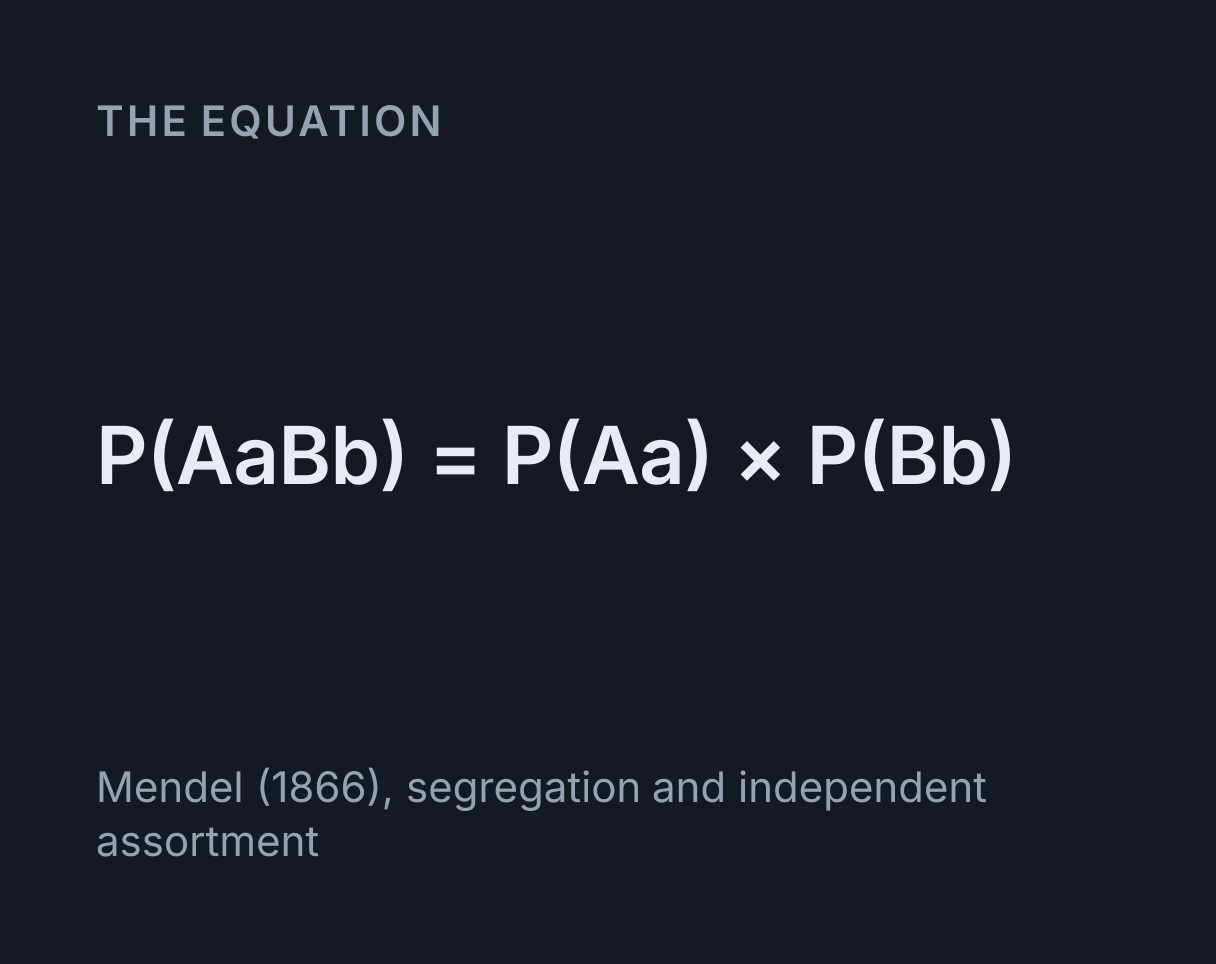
The equation
Mendel (1866), segregation and independent assortment
What a Punnett square calculator does
A Punnett square calculator takes two parents’ genotypes, such as AaBb and AaBb, lists the gametes each
can make, and fills a grid with every combination of them, so that each box is one equally likely
offspring and counting boxes gives the probability of every genotype and phenotype. For AaBb × AaBb with
complete dominance that is 16 boxes, nine genotypes and the phenotype ratio 9:3:3:1. The same
probabilities come from multiplying gene by gene, P(AaBb) = P(Aa) × P(Bb), which is why the
square and the product rule always agree.
The grid takes its name from the Cambridge geneticist Reginald Punnett. His book Mendelism, in its 1911 edition, calls it the method “sometimes termed the ‘chessboard’ method”: each parent’s series of gametes is written into the squares themselves, one across every row and the other down every column, so that each square pairs one gamete from each parent and “all the possible combinations are represented and in their proper proportions”. The calculator draws the layout textbooks use today instead, with each parent’s gametes written once, along the top or down the side.
How to use it
Type each parent’s genotype with one pair of letters per gene, a capital for the dominant allele and a small letter for the recessive one: Aa is heterozygous, AA and aa are homozygous, and AaBbCc is heterozygous at three genes. Both parents need the same genes, in any order. For each gene choose complete dominance, where AA and Aa look alike, or incomplete dominance or codominance, where the heterozygote has a phenotype of its own. Naming the traits is optional and changes only the labels, and the example buttons load textbook crosses, among them the ones this page works through.
The calculator lists each parent’s gametes, draws the square with parent 1’s gametes across the top and parent 2’s down the side, colours each box by phenotype when there are no more than eight phenotypes, and counts the genotype and phenotype classes as whole-number ratios, fractions and exact percentages. Choose any offspring genotype, from the list or by picking its box, to see its probability worked out by the product rule and checked against the count of boxes. When a cross has from two to 16 phenotypes, a link under the phenotype table opens the chi-square calculator with that ratio already entered, ready for counts of real offspring.
Worked example: Mendel’s round and yellow peas
In his 1866 paper Gregor Mendel crossed peas with round, yellow seeds and peas with wrinkled, green
ones, then raised the hybrids and let them self-fertilise. He wrote round as A and wrinkled as a, yellow
as B and green as b, so the hybrids were AaBb and the cross is AaBb × AaBb, the calculator’s
default. The Mendel’s peas button names his traits.
Each parent is heterozygous at two genes, so it makes 2 × 2 = 4 kinds of gamete, AB, Ab, aB
and ab, each 1/4 of the time. The square is 4 × 4 = 16 boxes, each 1/16. Counting them gives
nine genotypes in the ratio 1:2:1:2:4:2:1:2:1 and four phenotypes: 9 round yellow, 3 round green, 3
wrinkled yellow and 1 wrinkled green in every 16, which is 56.25%, 18.75%, 18.75% and 6.25%. By the
product rule the round yellow share is P(A_) × P(B_) = 3/4 × 3/4 = 9/16, and the double
recessive is P(aa) × P(bb) = 1/4 × 1/4 = 1/16.
Mendel counted 556 seeds from this cross: 315 round yellow, 108 round green, 101 wrinkled yellow and 32 wrinkled green. The 9:3:3:1 ratio predicts 312.75, 104.25, 104.25 and 34.75, and the chi-square statistic comes to 0.47 on 3 degrees of freedom, far below the 7.815 needed to reject the ratio at the 5 percent level.
His single-gene counts sit as close. Hybrids for seed shape alone, Aa × Aa, gave him 5474 round and 1850 wrinkled seeds, the ratio 2.96:1 against the 3:1 the square predicts, which the percent error calculator puts at 1.4% short. The spread of repeated counts from one sample to the next is what the standard deviation calculator measures.
Why multiplying works: the product rule
The law of segregation says a parent passes on one allele of each gene, each with probability 1/2, and
the law of independent assortment says the allele a gamete takes at one gene tells you nothing about the
allele it takes at another. Both follow from how chromosomes separate at meiosis. Together they make each
gene a separate event, so the chance of an offspring is the product of its chances gene by gene. From
AaBbCc × AaBbCc an aabbcc offspring has probability 1/4 × 1/4 × 1/4 = 1/64, and one with all
three dominant traits 3/4 × 3/4 × 3/4 = 27/64, exactly what counting the 64 boxes of the 8 by
8 square gives.
Mendel wrote the counting rule down himself: when two parent stocks differ in n characters, their hybrids’
offspring fall into 3ⁿ classes among every 4ⁿ individuals. So a cross between parents heterozygous at every
gene gives 9 genotypes in 16 boxes for two genes and 27 in 64 for three. With complete dominance those
genotypes show 2ⁿ phenotypes, in the 3:1 ratio expanded once per gene: 9:3:3:1 for two genes and
27:9:9:9:3:3:3:1 for three. Past three genes the square becomes unwieldy, 256 boxes for four, but the
product rule does not: the chance of all four dominant phenotypes is (3/4)⁴ = 81/256.
Incomplete dominance and codominance
Dominance describes how the genotypes look, not how they are passed on, so switching a gene from complete to incomplete dominance changes the phenotypes and leaves the square itself untouched. In snapdragons, red crossed with white gives pink, and pink crossed with pink gives red, pink and white in the ratio 1:2:1, which is the genotype ratio itself; the Snapdragon colour button loads that cross. Codominance gives the same 1:2:1, with the heterozygote showing both parental forms rather than a blend, as in the MN blood group, where a person with one M and one N allele expresses both equally.
The two can be mixed in one cross. With gene A completely dominant and gene B incompletely dominant, AaBb × AaBb gives six phenotypes in the ratio 3:6:3:1:2:1. The letters keep their capital and small forms even where neither allele is dominant; which allele gets the capital is then only a label.
From letters to DNA
Each letter stands for an allele, one version of a gene’s DNA sequence, and the two letters of a pair sit at the same place on a pair of chromosomes. The sickle-cell allele of the haemoglobin gene HBB differs from the usual one by a single base, GAG to GTG in one codon of the coding strand, which turns one glutamic acid in the protein into a valine; the DNA to protein translator reads both codons. The DNA double helix explorer shows the molecule the sequence is written in.
What this does not cover
The square assumes genes on autosomes rather than on the sex chromosomes, genes that assort independently, two alleles per gene, gametes that are all equally likely to form and to be fertilised, and offspring that are all equally likely to survive. Each assumption fails somewhere.
- Linked genes. Genes close together on one chromosome are inherited together more often than chance allows, so their gametes are not equally likely. Bateson, Saunders and Punnett found this in 1905 for flower colour and pollen shape in sweet peas, the “coupling” of Punnett’s Mendelism. The counts then miss the ratio, and a chi-square test, which the chi-square calculator runs, is how the miss shows.
- Sex-linked genes. A gene on the X chromosome, such as white eye colour in fruit flies, gives different ratios in sons and daughters, which a square of autosomal letters cannot show.
- Multiple alleles. The ABO blood groups have three alleles and rabbit coat colour has four. This calculator takes two alleles per gene.
- Epistasis. When one gene masks another, the genotypes here are still right but the phenotypes group differently. Coat colour in mice gives 9:3:4 from AaCc × AaCc, because the 3 A_cc boxes and the 1 aacc box are all albino.
- Lethal combinations. The Curly allele of fruit flies kills its homozygotes, so a cross of two heterozygotes leaves survivors in the ratio 2:1 rather than 1:2:1.
- Populations. A square is one cross between two known parents. How common an allele is across a population is the question the Hardy-Weinberg calculator answers.
Common mistakes
- Putting both alleles of a gene in one gamete. A gamete carries one allele of every gene, so AaBb makes AB, Ab, aB and ab, never Aa or Bb.
- Giving a homozygous parent an allele it lacks. AABb makes only AB and Ab. A small a in any of its gametes is an allele it does not carry.
- Mixing up the two ratios. Aa × Aa is 1:2:1 in genotype and 3:1 in phenotype. For this cross the two match only under incomplete dominance or codominance, where the heterozygote has a phenotype of its own.
- Adding where you should multiply. Across genes, chances multiply. Within one gene, the
routes to the same phenotype add:
P(A_) = P(AA) + P(Aa) = 1/4 + 1/2 = 3/4. - Reading a ratio as a promise. 3:1 gives each offspring a 3/4 chance of the dominant trait; it does not say how many in a family will have it. Among families of four children from Aa × Aa parents, only 27/64, about 42%, have exactly three with the dominant trait.
- Taking dominant to mean common. Dominance is about which phenotype a heterozygote shows. How often an allele turns up in a population is a separate question.
Common questions
What is the phenotype ratio of a dihybrid cross?
9:3:3:1, when both parents are heterozygous for two genes that assort independently and each gene shows complete dominance. Of the 16 equally likely boxes in the AaBb × AaBb square, 9 show both dominant traits, 3 only the first, 3 only the second and 1 neither, while the genotypes run 1:2:1:2:4:2:1:2:1 across nine classes. Mendel’s own count from this cross was 315 round yellow, 108 round green, 101 wrinkled yellow and 32 wrinkled green peas, 556 seeds in all, close to the 312.75, 104.25, 104.25 and 34.75 that 9:3:3:1 predicts.
How do you find the probability of one offspring genotype?
Multiply the chances gene by gene, because genes that assort independently behave as separate events. From AaBbCc × AaBbCc, an aabbcc offspring has a chance of 1/4 × 1/4 × 1/4 = 1/64, and one showing all three dominant traits has 3/4 × 3/4 × 3/4 = 27/64. This product rule gives exactly what counting boxes in the full 8 by 8 square gives, and it answers the question without drawing 64 boxes.
What does incomplete dominance do to a Punnett square?
It changes the phenotypes but not the genotypes. The square is drawn exactly as before, but the heterozygote has its own intermediate phenotype, so Aa × Aa gives three phenotypes in a 1:2:1 ratio instead of two in 3:1, as in the red, pink and white flowers of the snapdragon cross textbooks use. Codominance gives the same 1:2:1 counts with the heterozygote showing both parental forms rather than a blend, as the M and N blood group alleles do. The calculator sets each gene’s expression separately.
How many boxes does a trihybrid Punnett square have?
64, in an 8 by 8 grid, when both parents are heterozygous at all three genes, because each makes 2 × 2 × 2 = 8 kinds of gamete. Those 64 boxes hold 27 different genotypes and, with complete dominance, 8 phenotypes in the ratio 27:9:9:9:3:3:3:1. A parent that is homozygous at a gene makes only one kind of gamete for it, so its side of the square halves for each such gene: AaBbCC makes 4 kinds, and AaBbCC × aabbcc needs only a 4 by 1 grid.
How can I tell whether real offspring fit the ratio?
Run a chi-square goodness-of-fit test on your counts, with the ratio from the square as the expectation. For Mendel’s 556 peas against 9:3:3:1, the statistic comes to about 0.47 on 3 degrees of freedom, far below the 7.815 needed to reject the ratio at the 5 percent level, so his counts fit it well. The degrees of freedom are one fewer than the number of phenotype classes. A poor fit is informative too: linked genes, a lethal combination or a miscounted class all show up that way.