Time Dilation Calculator
Find time dilation, Δt = γΔt₀, and length contraction, L = L₀/γ, from a speed in c or km/s, with the Lorentz factor γ = 1/√(1 − v²/c²) and the working.
Calculator
γ = 1.6667. The speed fixes γ, so the dilated time and the contracted length follow.
Lorentz factor, γ
Dilated time, Δt years
Contracted length, L ly
- Speed as a fraction of c, β v/c. The Lorentz factor depends on this alone.
- 0.8
- Speed
- 239,830 km/s
- γ − 1 How much longer Δt is than Δt₀, as a fraction. At everyday speeds it is very nearly half of β².
- 0.66667
- Δt − Δt₀ How far the moving clock falls behind the clocks it passes.
- 2 years
- Distance covered in Δt vΔt: how far the moving clock travels while the observer’s clocks record Δt.
- 4 ly
- L₀ − L How much shorter the moving length is measured, along the direction of motion only.
- 1.6 ly
Working, with your numbers
- β = v/c = 0.8
- γ = 1 / sqrt(1 - β^2) = 1 / sqrt(1 - 0.8^2) = 1.6667
- Δt = γ x Δt₀ = 1.6667 x 3 years = 5 years
- L = L₀ / γ = 4 ly / 1.6667 = 2.4 ly
γ depends on the speed alone. Once it is known, a time is multiplied by it and a length divided by it, and that is all either effect is.
Citing this tool
Last updated . Add the date you accessed it as well, which a citation of a page that can change asks for. If a specific result matters, cite the permalink from the tool’s share row instead of this page: it reproduces the exact parameters.
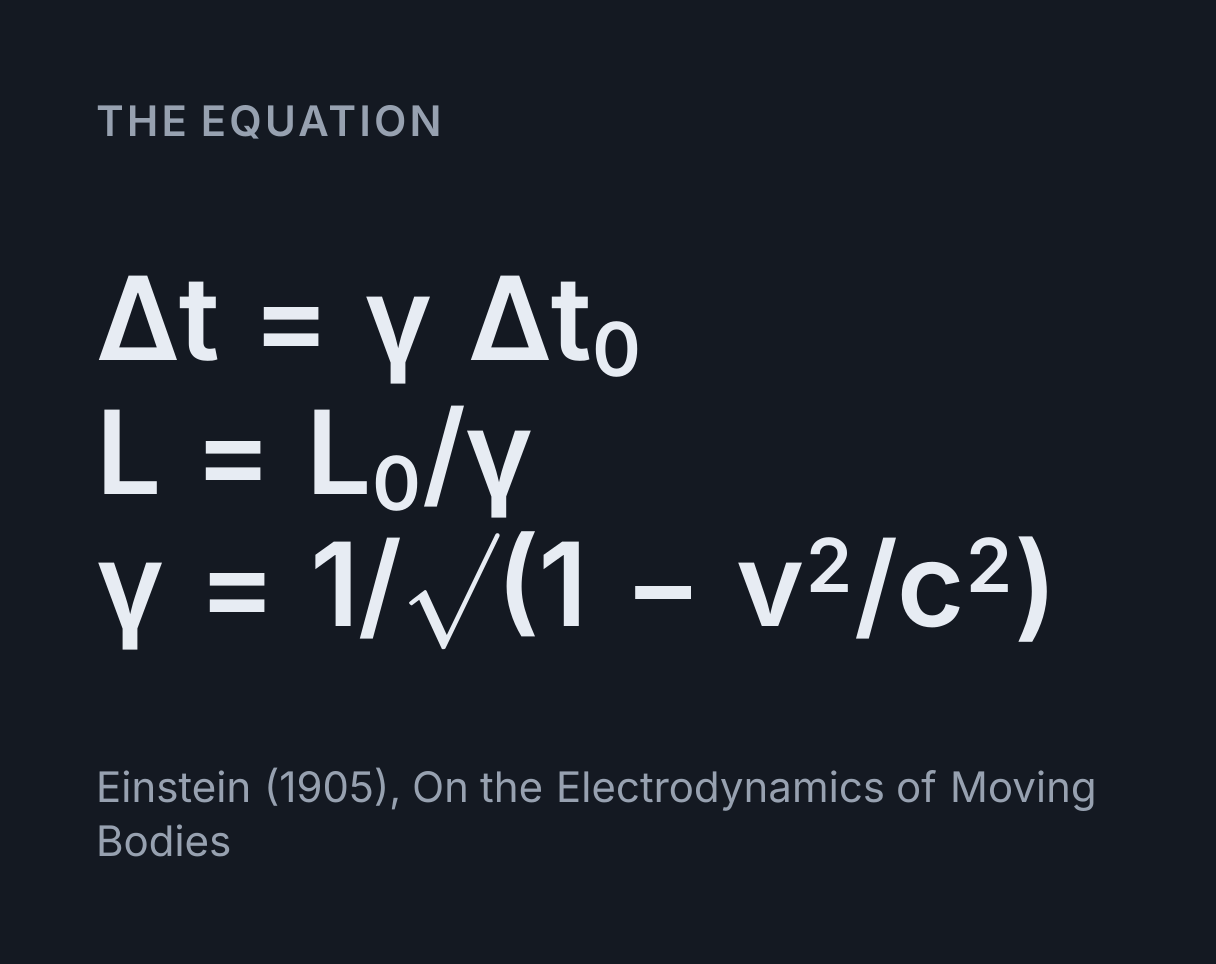
The equation
Einstein (1905), On the Electrodynamics of Moving Bodies
How to calculate time dilation
Multiply the time on the moving clock by the Lorentz factor: Δt = γΔt₀, with
γ = 1/√(1 − v²/c²). At 0.8c, γ is exactly 5/3, so 3 years on a moving clock
last 5 years by the clocks it passes, and a length of 4 light-years at rest is measured
as L = L₀/γ = 2.4 light-years along the direction of motion.
Both effects come from one number, γ, and γ depends only on the speed as a fraction of
the speed of light, β = v/c. A time
is multiplied by γ and a length is divided by it. Einstein derived both in section 4 of
his 1905 paper on the electrodynamics of moving bodies, the source named under the
equation above.
How to use the calculator
Fill in what you know and leave the rest blank. The speed can be fixed in any one of four ways: by the speed itself, as a fraction of c or in km/s, m/s or km/h; by γ; by both times; or by both lengths. Once one of those fixes it, every blank box beside a filled partner is worked out. Filling in two of them at once is refused rather than one being quietly ignored, because the two could disagree.
- Proper time, Δt₀, is the time between two events on one clock that is present at both, the clock travelling with the moving object. It is always the shorter of the two times.
- Dilated time, Δt, is the same interval measured by the observer the object moves past, using clocks at rest in the observer’s frame.
- Proper length, L₀, is measured in the frame where the object, or the distance between two places, is at rest. It is always the longer of the two lengths.
- Contracted length, L, is the same length measured along the direction of motion by an observer it moves past. Lengths across the motion do not change.
Under the answers, the readings give γ − 1, the time the moving clock falls
behind, Δt − Δt₀, the distance it covers in the observer’s time, and the
length lost, L₀ − L. The working shows every line with your numbers, and
the permalink in the share row reopens exactly the same calculation.
Worked example: a trip to a star 4 light-years away at 0.8c
At 0.8c, β² = 0.64, so 1 − β² = 0.36, its square root is 0.6,
and γ = 1/0.6 = 5/3, about 1.6667. From Earth, the trip of 4 light-years at
0.8c takes 4/0.8 = 5 years. On board it takes 5/γ = 3 years.
The crew see the same trip another way. To them the distance between Earth and the star
is contracted to 4/γ = 2.4 light-years, and 2.4 light-years at 0.8c takes 3
years, the same 3 years their clock records. Time dilation for one observer is length
contraction for the other. This is the calculation the page opens on: 3 years of proper
time give 5 years, and 4 light-years give 2.4.
Worked example: why muons reach the ground
Muons made by cosmic rays high in the atmosphere have a mean life at rest of 2.1969811 µs
(Particle Data Group, 2024). Without time dilation, a muon at 0.998c would travel only
about 657 m in 2.197 µs. At that speed γ is 15.819, so the ground’s clocks see it live
γ × 2.197 µs = 34.755 µs, in which it covers about 10.398 km. In the
muon’s own frame the explanation is the other effect: 10 km of air is contracted to
10 km / γ = 632.14 m. The “Muon at 0.998c” preset reproduces every one
of these figures.
The effect has been measured directly. Bailey and colleagues (1977) timed muons circling the CERN Muon Storage Ring at γ = 29.33 and found lifetimes of 64.419 µs for positive muons and 64.368 µs for negative ones. Against the lifetime at rest, the positive muons agree with Einstein’s factor to a fractional error of 2 × 10⁻³ at 95 percent confidence. Typing γ = 29.33 gives the speed, 0.9994186c, and a dilated lifetime of 64.437 µs from the rest value. To see what a lifetime means for how many survive, use the half-life calculator.
Time dilation at everyday and orbital speeds
At everyday speeds γ is 1 plus something tiny, very nearly β²/2, and that is
where most calculators go wrong. Working out 1/√(1 − β²) and then subtracting
1 in ordinary double-precision arithmetic keeps about six figures of γ − 1 at 3.874 km/s,
about four at an airliner’s 250 m/s, and none at 1.4 m/s, walking pace, where
1 − β² rounds to exactly 1 and the answer comes out as zero.
This calculator never subtracts two nearly equal numbers. It uses
γ − 1 = β²/(s(1 + s)) with s = √((1 − β)(1 + β)), which is the
same quantity rearranged, not an approximation. It also reads the digits you type exactly,
so 0.9999999999999c keeps its 1 − β of 10⁻¹³ rather than the rounded value a computer
would otherwise hold. Where five figures of γ would read as 1, it prints
1 + x instead.
A GPS satellite moves at about 3.874 km/s, so γ is 1 + 8.3493 × 10⁻¹¹ and its clock loses 7.2138 µs a day to its speed alone, the “GPS satellite” preset. That is not the whole story: gravity, which this calculator does not model, makes the satellite clock run fast by more than its speed makes it run slow, and Ashby (2003) describes how the satellite clocks are set lower in frequency on the ground before launch to allow for both. The orbit simulator shows where orbital speeds come from.
What this does not cover
This is special relativity at one steady speed. It does not integrate a journey with acceleration, so the twin paradox is covered only leg by leg: each observer measures the other’s clocks running slow while they move apart steadily, and the asymmetry comes from the traveller’s change of frame at the turnaround, which is not modelled here. It leaves out gravitational time dilation, which needs general relativity, and what an observer would actually see, which adds the Doppler shift and the travel time of the light.
Energy and momentum carry the same factor: kinetic energy is (γ − 1)mc²,
which falls to ½mv² at low speed, and momentum is γmv. The
kinetic energy calculator and the
momentum calculator use the classical forms.
The true momentum is larger than mv by the fraction γ − 1 exactly, and at low
speed the true kinetic energy is larger than ½mv² by about 1.5 times γ − 1.
Nothing with mass reaches c, so a speed of c
or more is refused.
Common mistakes
- Swapping the proper and dilated times. The proper time is on the clock that is present at both events, and it is always the shorter. The calculator refuses a dilated time shorter than the proper time.
- Dividing a time by γ, or multiplying a length by it. Times grow and
lengths shrink:
Δt = γΔt₀andL = L₀/γ. - Forgetting to square the speed. γ uses
v²/c², so at 0.8c the term is 0.64, not 0.8. - Mixing units in v/c. The speed and c must be in the same unit. Here the speed can be typed as a fraction of c, which avoids the division altogether.
- Contracting lengths across the motion. Only the length along the direction of travel shrinks.
- Rounding γ to 1 at low speed. The effect is then in γ − 1, not in γ, and it should be carried as its own number.
Converting units first? Use the time conversion table.
Common questions
What is time dilation?
Time dilation is the slowing of a moving clock as measured by an observer it moves past. An interval Δt₀ on the moving clock, the proper time, lasts Δt = γΔt₀ by the observer’s clocks, where γ = 1/√(1 − v²/c²) is the Lorentz factor. It is always at least 1, so the moving clock always records the shorter time.
How do you calculate the Lorentz factor?
Divide the speed by the speed of light to get β = v/c, then take γ = 1/√(1 − β²). At 0.8c, β² is 0.64, 1 − 0.64 is 0.36, its square root is 0.6, and γ = 1/0.6 = 5/3, about 1.6667. The calculator also works backwards, from γ to the speed.
How much time dilation is there at 99 percent of the speed of light?
A factor of about 7.0888: at 0.99c, one year on the moving clock lasts about 7.09 years by the clocks it passes. A length along the motion is measured at about 14.1 percent of its length at rest, because it is divided by the same factor.
What is the formula for length contraction?
L = L₀/γ, which is L₀√(1 − v²/c²). L₀ is the proper length, measured where the object is at rest, and L is the length measured along the direction of motion as it moves past. Lengths across the motion do not change.
Does each observer see the other’s clock running slow?
Yes. While two observers move apart at a steady speed, each measures the other’s clocks running slow by the same factor γ. The twin paradox is settled by the travelling twin’s change of frame at the turnaround, which a single steady speed does not model.
How much does a GPS satellite’s clock lose to its speed?
About 7.2 µs a day. At about 3.874 km/s, γ − 1 is 8.3493 × 10⁻¹¹, and a day of 86,400 s times that is 7.2138 µs. Gravity makes the satellite clock run fast by more than this, so on balance it gains, and Ashby (2003) describes how the clocks are set lower in frequency on the ground before launch to allow for both effects.