Atom Economy Calculator
Calculate percent atom economy from the molar masses of the desired product and the reactants, with the waste mass and the figures for common reactions.
Calculator
Its relative formula mass, Mr, is the same number. Type the formula into the molar mass calculator to get it.
The number in front of the desired product in the balanced equation: 2 for 2C2H5OH.
Each reactant’s molar mass times its coefficient in the balanced equation, added together. The same sum over all the products gives the same total.
Working, with your numbers
- AE = n x M(product) / sum of M(reactants) x 100
- = 1 x 56.077 / 100.086 x 100
- = 56.029 %
Values are converted into the units the equation is worked in before the arithmetic.
- Mass in other products The reactant total less the desired product, per mole of reaction as written: the mass that leaves as by-products or waste.
- 44.009 g/mol
- Mass of desired product The coefficient times the molar mass, per mole of reaction as written.
- 56.077 g/mol
- Share wasted 100 percent minus the atom economy, the share of the reactants’ mass that cannot end up in the desired product however good the yield.
- 43.971%
Citing this tool
Last updated . Add the date you accessed it as well, which a citation of a page that can change asks for. If a specific result matters, cite the permalink from the tool’s share row instead of this page: it reproduces the exact parameters.
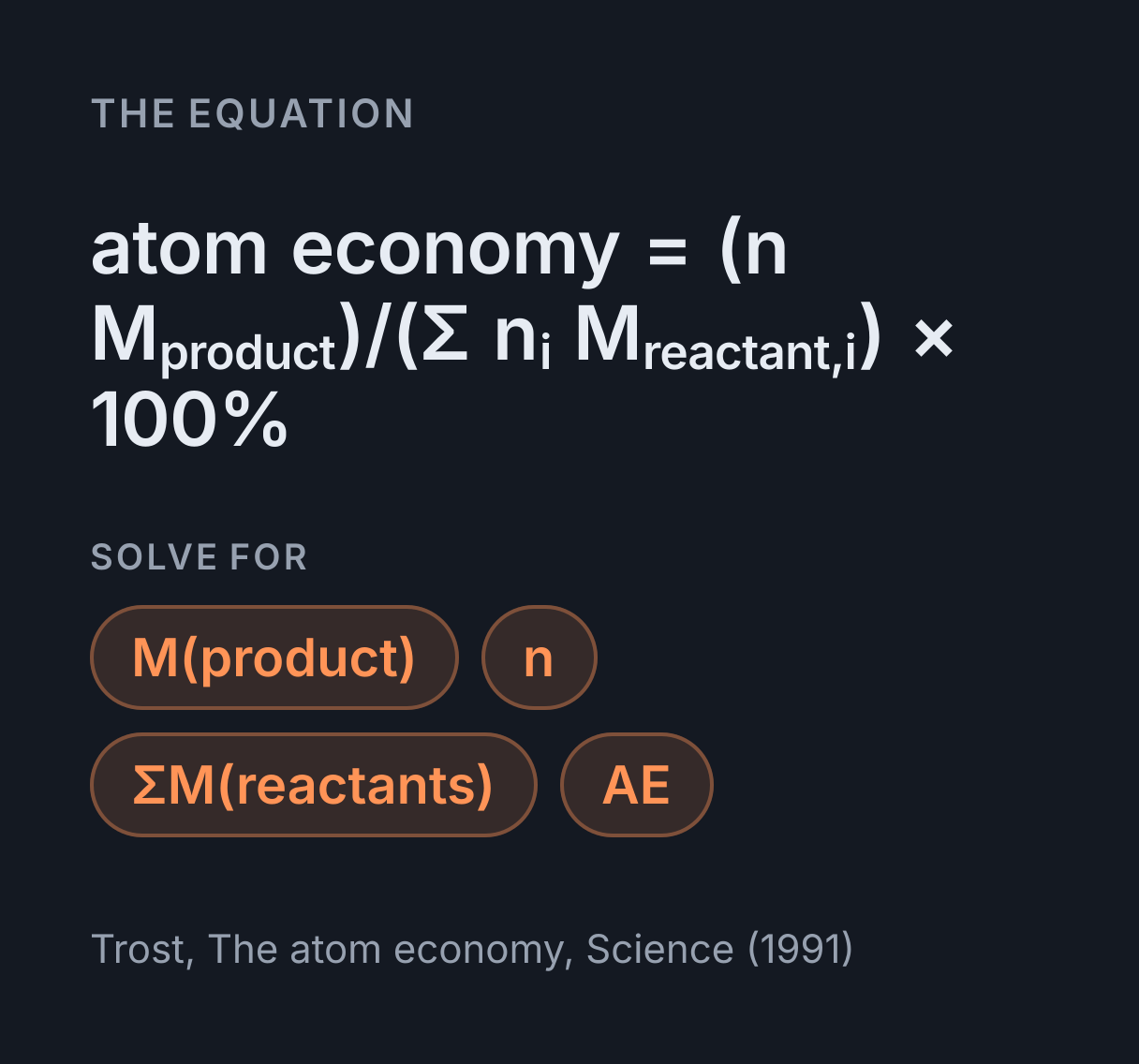
The equation
Trost, The atom economy, Science (1991)
What is the atom economy formula?
Percent atom economy = (coefficient × molar mass of the desired product) ÷ (sum of coefficient × molar mass for every reactant) × 100, read from the balanced equation. It is the share of the reactants’ mass that can end up in the product you want rather than in by-products, so a reaction with a single product scores 100 percent.
Working it out from a balanced equation
Take the coefficients from the balanced equation, since they are part of the calculation. Multiply each reactant’s molar mass by its coefficient and add the results, then do the same for the desired product alone. For limestone decomposing, CaCO₃ → CaO + CO₂, that is 56.077 g/mol of quicklime against 100.086 g/mol of limestone, the figures the calculator opens on. The molar mass calculator gives each molar mass from its formula with the same IUPAC atomic weights, and the chemical equation balancer finds the coefficients when the equation is not balanced yet.
Mass is conserved, so the reactant total equals the same total over the products: for limestone, 56.077 + 44.009 = 100.086. Adding up the products as well is a quick check, because two totals that disagree mean the equation is not balanced. Relative formula masses, Mr, are the same numbers as molar masses in g/mol, so a question that gives Mr values can be entered as it stands.
Atom economy of common reactions
Each percentage below is worked by the calculator above from the molar masses the site’s formula parser gives for each formula, so it agrees with the molar mass calculator.
| Reaction | Balanced equation | Desired product | Atom economy |
|---|---|---|---|
| Quicklime from limestone | CaCO₃ → CaO + CO₂ | CaO | 56.0% |
| Ethanol by fermentation of glucose | C₆H₁₂O₆ → 2C₂H₅OH + 2CO₂ | C₂H₅OH | 51.1% |
| Ethanol by hydration of ethene (ethylene) | C₂H₄ + H₂O → C₂H₅OH | C₂H₅OH | 100.0% |
| Iron in the blast furnace | Fe₂O₃ + 3CO → 2Fe + 3CO₂ | Fe | 45.8% |
| Ammonia by the Haber process | N₂ + 3H₂ → 2NH₃ | NH₃ | 100.0% |
| Hydrogen by steam reforming of methane | CH₄ + H₂O → CO + 3H₂ | H₂ | 17.8% |
| Chlorine by electrolysis of brine | 2NaCl + 2H₂O → 2NaOH + H₂ + Cl₂ | Cl₂ | 46.4% |
| Aspirin from salicylic acid and acetic anhydride | C₇H₆O₃ + C₄H₆O₃ → C₉H₈O₄ + C₂H₄O₂ | C₉H₈O₄ | 75.0% |
Two pairs are worth comparing. Ethanol made by fermenting glucose has an atom economy of 51.1 percent, because carbon dioxide leaves with nearly half the mass, while ethanol made from ethene and steam reaches 100 percent, since nothing else forms. Atom economy is one measure among several, though: fermentation runs on sugar from crops, a renewable feedstock, and ethene comes from oil or natural gas. Hydrogen from steam reforming scores only 17.8 percent, because the carbon monoxide made alongside it outweighs the three molecules of hydrogen more than four to one.
Atom economy is not percent yield
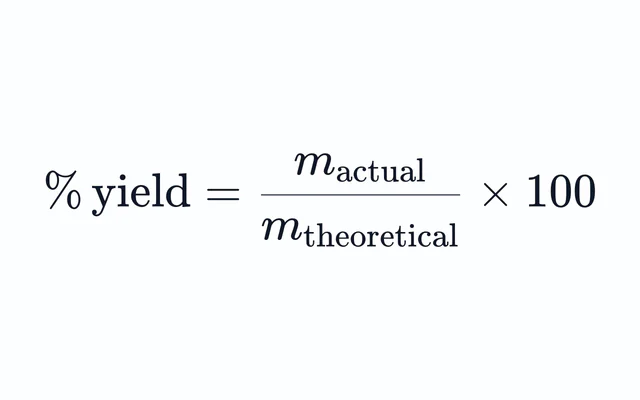
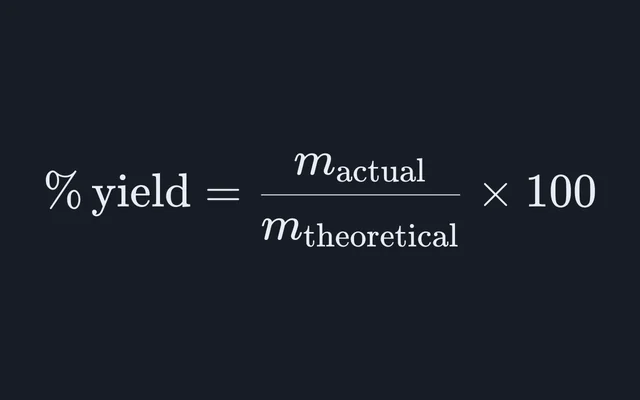
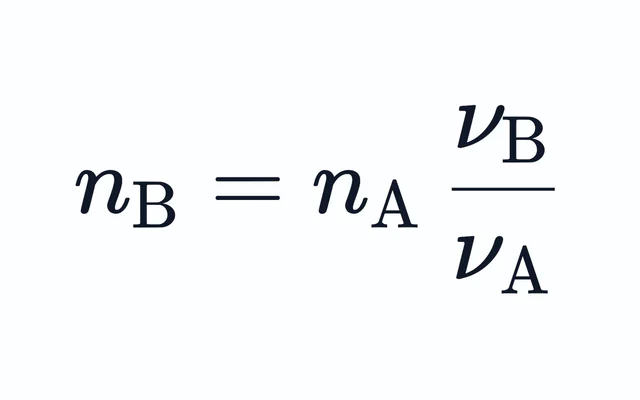
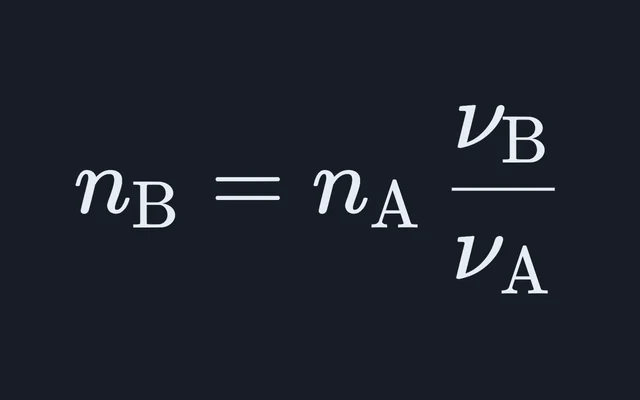
The two measure different losses. Atom economy is fixed by the equation before anything is weighed: it counts the mass that has to leave as other products even if every molecule reacts as written. Percent yield is measured afterwards, and counts the product lost to incomplete reaction, side reactions and handling, against a theoretical yield from the mole ratio, which the stoichiometry calculator works out. A reaction can score well on one and badly on the other, and the share of the reactant mass that ends up as product is closer to the two multiplied: 100 percent atom economy at a 60 percent yield still turns only 60 percent of the reactant mass into product.
Common mistakes
- Leaving out the product’s coefficient. Fermentation, C₆H₁₂O₆ → 2C₂H₅OH + 2CO₂, gives two ethanols for each glucose. Without the 2 the answer is 25.6 percent instead of 51.1.
- Counting each reactant once. In the blast furnace, Fe₂O₃ + 3CO → 2Fe + 3CO₂, the carbon monoxide counts three times: 159.687 + 3 × 28.010 = 243.717. Counting it once gives 59.5 percent instead of 45.8.
- Dividing by the other products. The denominator is every reactant. Putting only the other products in the second field gives a ratio of product to waste, 127 percent for limestone, and the calculator refuses an atom economy above 100.
- Reading a high atom economy as a good yield. Atom economy assumes the reaction goes exactly as written. The amount actually collected is the percent yield, measured separately.
How to calculate percent atom economy
- Write down the formula:
AE = n × M(product) ÷ ΣM(reactants) × 100 -
Gather the values it needs. The calculator above starts with these:
- Molar mass of desired product: M(product) = 56.077 g/mol
- Coefficient of desired product: n = 1
- Sum of reactant molar masses: ΣM(reactants) = 100.086 g/mol
-
Substitute them and work through the arithmetic:
- AE = n x M(product) / sum of M(reactants) x 100
- = 1 x 56.077 / 100.086 x 100
- = 56.029 %
-
To find one of the other values instead, rearrange the formula for it:
- Molar mass of desired product:
M(product) = AE × ΣM(reactants) ÷ (100 × n) - Sum of reactant molar masses:
ΣM(reactants) = n × M(product) × 100 ÷ AE
- Molar mass of desired product:
Worked examples
Each one runs through the calculator above, so the arithmetic here is the arithmetic it does.
What is the atom economy of making ethanol by fermenting glucose?
- AE = n x M(product) / sum of M(reactants) x 100
- = 2 x 46.069 / 180.156 x 100
- = 92.138 / 180.156 x 100
- = 51.143 %
51.1 percent. Glucose gives two ethanols, C₆H₁₂O₆ → 2C₂H₅OH + 2CO₂, so the 2 multiplies the 46.069 g/mol of ethanol. Left out, the answer halves to 25.6 percent. The rest of the mass leaves as carbon dioxide.
Why does making ethanol from ethene and steam have 100 percent atom economy?
- AE = n x M(product) / sum of M(reactants) x 100
- = 1 x 46.069 / 46.069 x 100
- = 100 %
C₂H₄ + H₂O → C₂H₅OH has a single product, so all 46.069 g/mol of reactants ends up in it. That is the most an atom economy can be, and it says nothing about the yield, which is measured separately.
Practise this with Chemistry Practice Problems, questions generated from this calculator and 9 other calculators in Chemistry.
Common questions
Why does an addition reaction have 100 percent atom economy?
Because it has a single product, so every atom in the reactants ends up in it. Ethene and water making ethanol, and nitrogen and hydrogen making ammonia, lose no mass to other products on paper. The yield can still fall short: in the Haber process only part of the gas reacts on each pass through the reactor, which is why the unreacted gas is recycled.
Can atom economy be more than 100 percent?
No. The desired product is made from the reactants, so it cannot weigh more than all of them together. A figure above 100 percent means a reactant was left out of the sum, a coefficient was missed, or the other products were used as the denominator instead of the reactants. The calculator refuses such a result rather than showing it.
What is the difference between atom economy and percent yield?
Atom economy is worked out from the balanced equation before the reaction is run, and counts the mass that must leave as other products even if everything reacts as written. Percent yield is measured afterwards, and compares the product actually collected with the most the reaction could give. An efficient process needs both to be high.
Why is a high atom economy better?
Mass that leaves as by-products was bought and processed and then has to be sold, treated or disposed of, so a reaction that keeps more of its reactant mass in the product usually wastes less material. Atom economy is the second of the twelve principles of green chemistry that Anastas and Warner set out in 1998.