Bond Enthalpy Calculator
Estimate ΔH from bond enthalpies, bonds broken minus bonds formed, in kJ/mol or kcal/mol, with a cited table of average bond energies and worked examples.
Calculator
Add up the bond energy of every bond in the reactants that the reaction breaks, each times the number of moles of that bond.
Add up the bond energy of every bond the products gain. Enter it as a positive number: the calculator subtracts it.
For the equation as written: H₂ + Cl₂ → 2HCl is −185 kJ for two moles of HCl, which is −92.5 kJ per mole of HCl.
Working, with your numbers
- dH = sum of bonds broken - sum of bonds formed
- = 679 - 864
- = -185 kJ/mol
Values are converted into the units the equation is worked in before the arithmetic.
- Reaction is Exothermic when the bonds formed release more energy than the bonds broken take in, so ΔH is negative and the surroundings warm up. Endothermic the other way round.
- Exothermic
- ΔH in kcal/mol Using the thermochemical calorie, exactly 4.184 J, the one chemistry tables use.
- −44.22 kcal/mol
Citing this tool
Last updated . Add the date you accessed it as well, which a citation of a page that can change asks for. If a specific result matters, cite the permalink from the tool’s share row instead of this page: it reproduces the exact parameters.
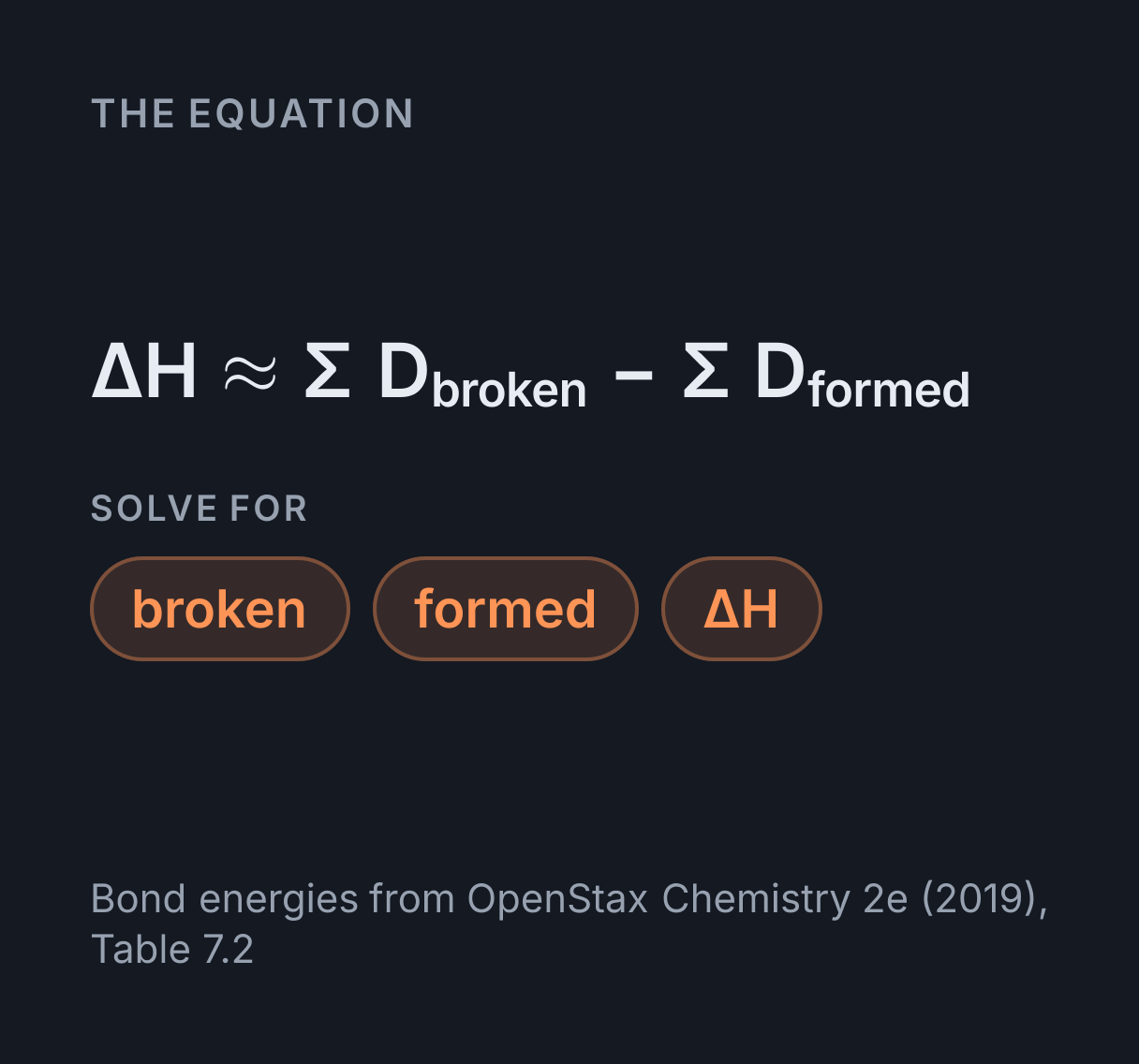
The equation
Bond energies from OpenStax Chemistry 2e (2019), Table 7.2
What is the bond enthalpy formula?
ΔH = Σ(bond enthalpies of bonds broken) − Σ(bond enthalpies of bonds formed), in kJ/mol. Breaking bonds takes energy in and forming them gives energy out, so a negative ΔH means the new bonds are stronger in total and the reaction is exothermic. Average bond enthalpies give an estimate, not an exact value.
Counting the bonds
Draw every molecule with all its bonds, because each bond counts once for every time it appears, coefficients included. In H₂ + Cl₂ → 2HCl, one H−H and one Cl−Cl bond break, 436 + 243 = 679 kJ, and two H−Cl bonds form, 2 × 432 = 864 kJ, so ΔH = 679 − 864 = −185 kJ, the figure the calculator opens on. The 2 in front of HCl is why two H−Cl bonds count. The Lewis structure generator shows the bonds in a molecule whose structure is not obvious.
A bond that survives the reaction unchanged can be left out of both sums, since it adds the same amount to each. When ethene and water make ethanol, only the C=C and one O−H break, and one C−C, one C−H and one C−O form: 611 + 464 − (345 + 415 + 350) = −35 kJ, the same answer as counting every bond in every molecule.
Average bond enthalpies
The values below are every row of Table 7.2 in OpenStax Chemistry 2e (Flowers, Theopold, Langley and Robinson, 2019), in kJ/mol, licensed CC BY 4.0. Each is an average over the same bond in many different gas-phase molecules, so one bond in one molecule can differ from it: the four C−H bonds in methane average 415 kJ/mol, but OpenStax notes that the first takes 439 kJ/mol to break. Exam boards and other textbooks print slightly different tables, so when a question gives its own values, use those.
| Bond | kJ/mol | Bond | kJ/mol | Bond | kJ/mol |
|---|---|---|---|---|---|
| H−H | 436 | C−S | 260 | F−Cl | 255 |
| H−C | 415 | C−Cl | 330 | F−Br | 235 |
| H−N | 390 | C−Br | 275 | Si−Si | 230 |
| H−O | 464 | C−I | 240 | Si−P | 215 |
| H−F | 569 | N−N | 160 | Si−S | 225 |
| H−Si | 395 | N=N | 418 | Si−Cl | 359 |
| H−P | 320 | N≡N | 946 | Si−Br | 290 |
| H−S | 340 | N−O | 200 | Si−I | 215 |
| H−Cl | 432 | N−F | 270 | P−P | 215 |
| H−Br | 370 | N−P | 210 | P−S | 230 |
| H−I | 295 | N−Cl | 200 | P−Cl | 330 |
| C−C | 345 | N−Br | 245 | P−Br | 270 |
| C=C | 611 | O−O | 140 | P−I | 215 |
| C≡C | 837 | O=O | 498 | S−S | 215 |
| C−N | 290 | O−F | 160 | S−Cl | 250 |
| C=N | 615 | O−Si | 370 | S−Br | 215 |
| C≡N | 891 | O−P | 350 | Cl−Cl | 243 |
| C−O | 350 | O−Cl | 205 | Cl−Br | 220 |
| C=O | 741 | O−I | 200 | Cl−I | 210 |
| C≡O | 1080 | F−F | 160 | Br−Br | 190 |
| C−F | 439 | F−Si | 540 | Br−I | 180 |
| C−Si | 360 | F−P | 489 | I−I | 150 |
| C−P | 265 | F−S | 285 |
How close the estimate is
OpenStax shows how rough the method is with its own figures. For two moles of hydrogen chloride, bond energies give −185 kJ, close to the −184.6 kJ from the enthalpy of formation. For methanol made from carbon monoxide and hydrogen, they give −107 kJ against −90.5 kJ. For burning methane they give −682 kJ, while the enthalpies of formation in the same book’s Appendix G give −802.55 kJ with the water formed as a gas.
Bond energies describe molecules in the gas phase, so compare like with like: when a product condenses, as water does, it releases further energy that no bond energy includes. Enthalpies of formation are measured for each substance, which makes them the route to an accurate ΔH. Bond energies are for reactions whose enthalpies of formation are not known, and for seeing which bonds drive the energy change. The Gibbs free energy calculator takes ΔH on to whether a reaction is spontaneous.
Common mistakes
- Subtracting the wrong way round. ΔH is broken minus formed. Formed minus broken flips the sign and makes an exothermic reaction look endothermic: +185 kJ for hydrogen chloride instead of −185 kJ.
- Forgetting the coefficients. In CH₄ + 2O₂ → CO₂ + 2H₂O, two O=O bonds break and four O−H bonds form, because there are two oxygen molecules and two water molecules.
- Entering bonds formed as a negative number. Bond energies are always positive, and the minus sign comes from the formula, so the calculator takes both totals as positive numbers.
- Counting a double bond as two single bonds. C=O is 741 kJ/mol in this table, not 2 × 350 = 700, so each bond order needs its own value.
How to calculate enthalpy change from bond enthalpies
- Write down the formula:
ΔH = Σ broken − Σ formed -
Gather the values it needs. The calculator above starts with these:
- Total energy of bonds broken: 679 kJ/mol
- Total energy of bonds formed: 864 kJ/mol
-
Substitute them and work through the arithmetic:
- dH = sum of bonds broken - sum of bonds formed
- = 679 - 864
- = -185 kJ/mol
-
To find one of the other values instead, rearrange the formula for it:
- Total energy of bonds broken:
Σ broken = ΔH + Σ formed - Total energy of bonds formed:
Σ formed = Σ broken − ΔH
- Total energy of bonds broken:
Worked examples
Each one runs through the calculator above, so the arithmetic here is the arithmetic it does.
What is the enthalpy change for burning methane, from bond enthalpies?
- dH = sum of bonds broken - sum of bonds formed
- = 2656 - 3338
- = -682 kJ/mol
Four C−H and two O=O bonds break, 4 × 415 + 2 × 498 = 2656 kJ, and two C=O and four O−H bonds form, 2 × 741 + 4 × 464 = 3338 kJ, all from OpenStax Table 7.2. The answer falls well short of the −802.55 kJ that enthalpies of formation give with the water as a gas, a reminder that average bond energies give an estimate.
What H−Cl bond enthalpy does a measured ΔH of −184.6 kJ for 2HCl imply?
- sum of bonds formed = sum of bonds broken - dH
- = 679 - (-184.6)
- = 863.6 kJ/mol
863.6 kJ for the two H−Cl bonds that form, so 431.8 kJ/mol each, within 0.2 of the table’s 432. Working back from a measured ΔH, with the H−H and Cl−Cl bonds broken known, is how a bond energy is found for a bond no table lists.
Practise this with Chemistry Practice Problems, questions generated from this calculator and 9 other calculators in Chemistry.
Common questions
Why is breaking bonds endothermic and making bonds exothermic?
Atoms joined by a bond have less energy than the same atoms apart, so pulling them apart needs energy put in, and letting them bond releases the same amount. That is why every bond energy in a table is a positive number for breaking the bond. Whether a whole reaction is exothermic depends on which is bigger: the energy taken in to break the reactants’ bonds or the energy given out forming the products’ bonds.
Why does a bond enthalpy answer differ from the textbook value of ΔH?
Because a bond enthalpy from a table is an average over many molecules, while a measured enthalpy change belongs to one reaction. The C−H bonds in methane do not each take 415 kJ/mol to break: the first takes 439. Bond enthalpies also describe gases, so a reaction that forms a liquid or a solid releases extra energy they do not include. Enthalpies of formation give the accurate figure.
Are bond enthalpy and bond energy the same thing?
For this calculation, yes, and courses use the two names for the same tabulated numbers. Strictly, bond enthalpy is the enthalpy change for breaking the bond in the gas phase, and bond energy is often taken as the internal energy change, which for one bond splitting into two gaseous fragments is smaller by RT, about 2.5 kJ/mol at 25 °C: less than many of the differences between one table of averages and another.