Efficiency Calculator
Calculate efficiency from useful output and total input, as energy or power, or find either one from a percentage, with the energy wasted shown.
Calculator
The energy or power that goes where it is wanted, in the same unit as the total input.
All the energy or power supplied, useful and wasted together: joules with joules, watts with watts.
Useful output as a percentage of total input: at most 100, and below it for every real motor, lamp or engine.
Working, with your numbers
- efficiency = useful / total x 100
- = 400 / 500 x 100
- = 0.8 x 100
- = 80 %
Values are converted into the units the equation is worked in before the arithmetic.
- Wasted energy or power Total input minus useful output, in the unit of the two values: joules wasted from joules, watts wasted from watts.
- 100
- Share wasted 100 percent minus the efficiency: the part that spreads into the surroundings, most of it as heat.
- 20%
- Efficiency as a decimal The same ratio without the × 100. It has no unit, because the units of the two values cancel.
- 0.8
Citing this tool
Last updated . Add the date you accessed it as well, which a citation of a page that can change asks for. If a specific result matters, cite the permalink from the tool’s share row instead of this page: it reproduces the exact parameters.
The equation
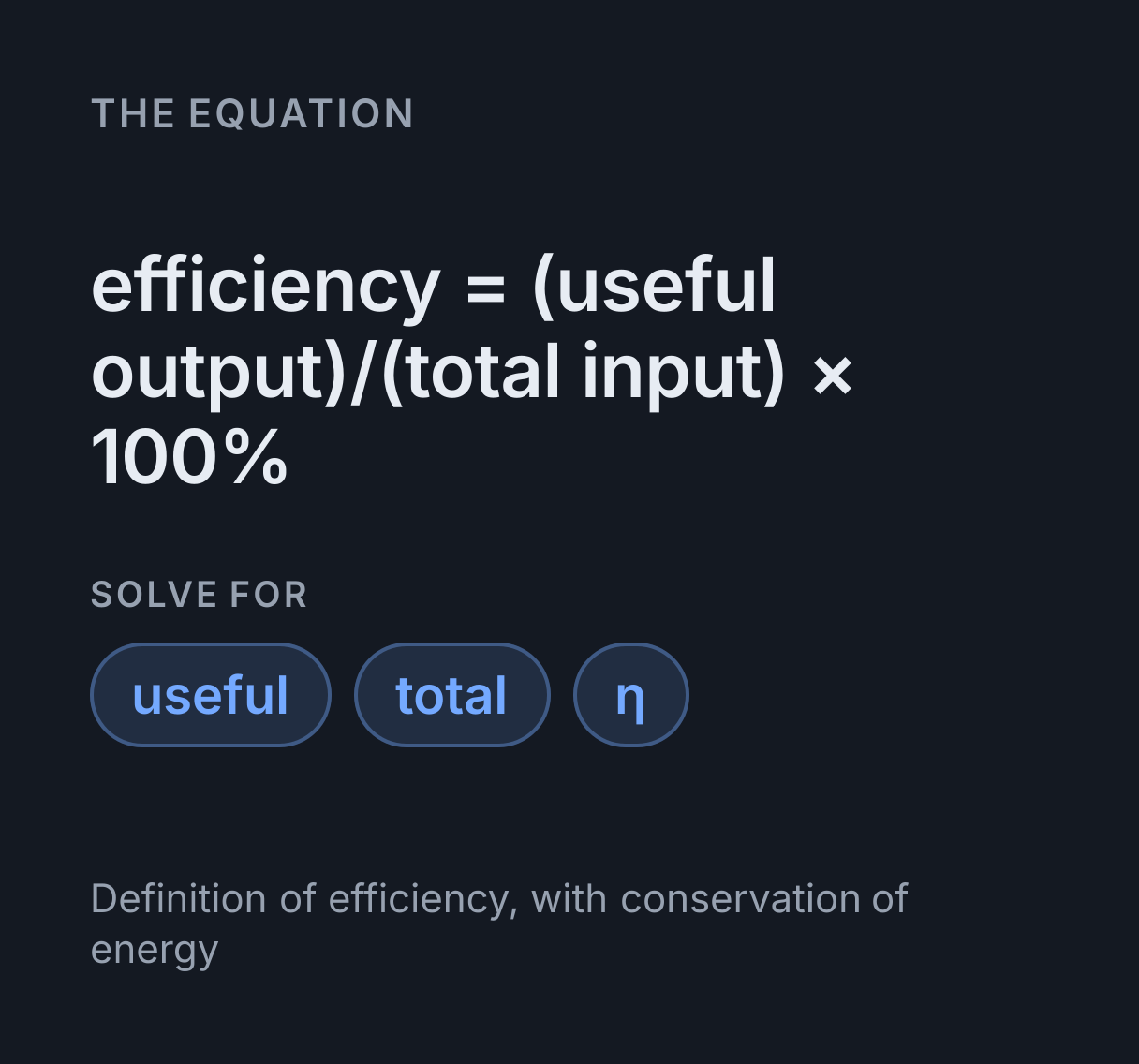
Definition of efficiency, with conservation of energy
What is the efficiency formula?
The efficiency formula is efficiency = useful output ÷ total input × 100, which gives a percentage. The two values can be energies in joules or powers in watts, provided both are in the same unit. The rest of the input is wasted, mostly as heat, so wasted energy = total input − useful output.
Energy or power gives the same answer
Efficiency is a ratio of two amounts of the same kind, so their units cancel and the answer has none of its own. Over any stretch of time each energy is the matching power multiplied by that time, and the time cancels too, so a motor that takes in 400 W and delivers 300 W is 75 percent efficient whether you divide the powers or the energies over an hour. That is why the two fields take no unit. Enter joules with joules, kilowatt-hours with kilowatt-hours or watts with watts, and the useful output, the total input and the waste all come out in that unit.
Why no device passes 100 percent
Energy is conserved, the principle Julius Robert Mayer, James Joule and Hermann von Helmholtz established in the 1840s, so the total input always equals the useful output plus the energy wasted. The waste is not destroyed. It spreads into the surroundings, mostly as thermal energy from friction, air resistance and the electrical resistance of wires, and once spread out it is very hard to put to use again. A useful output larger than the input would be energy from nothing, so the calculator refuses one; the usual way to enter one by accident is to type the two values in different units.
A Sankey diagram draws the same bookkeeping: one arrow for the input, splitting into a useful arrow and a wasted arrow whose widths add up to the width of the input. The share wasted readout is the wasted arrow’s width as a percentage of the input’s.
Heat pumps are not more than 100 percent efficient
A heat pump can deliver more heat than the electrical energy it uses, because most of that heat is moved in from the outside air or the ground rather than made from the electricity. Its heat output divided by its electrical input is called the coefficient of performance, not an efficiency, and it is normally above 1. Entered here, those figures are refused as an output larger than the input.
Raising efficiency
Cutting waste means dealing with wherever the energy goes. Lubrication reduces friction in a
machine, and insulation reduces the heat a kettle or a house loses. In a circuit the waste is
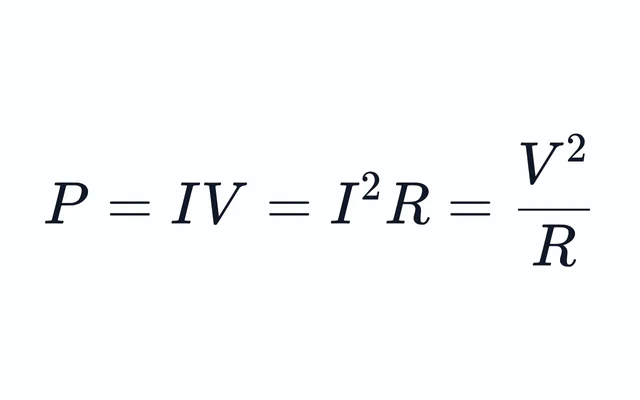
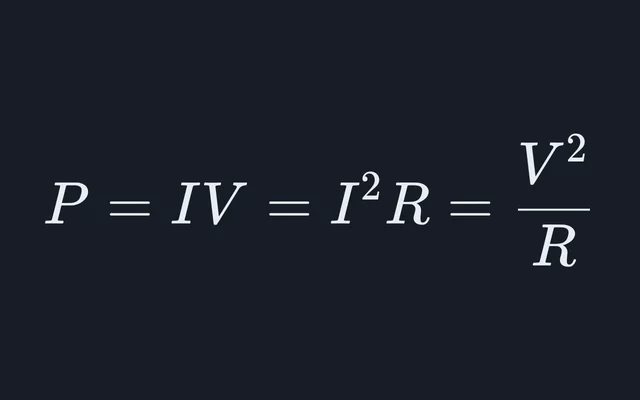
resistive heating, P = I²R, so a thicker cable, which has less resistance, and a
higher voltage, which carries the same power on less current, both help. An LED lamp gives the
same light as a filament lamp on a small fraction of the power, because far less of its input
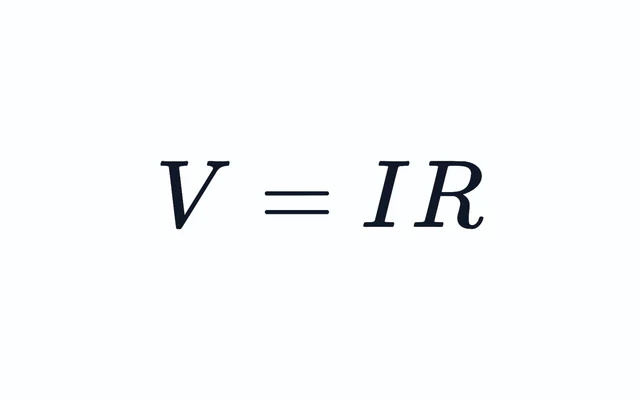
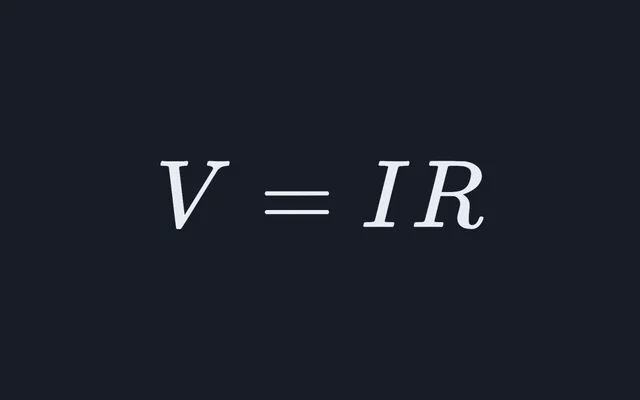
becomes heat. The Ohm’s law calculator and the
electrical power calculator give the resistance
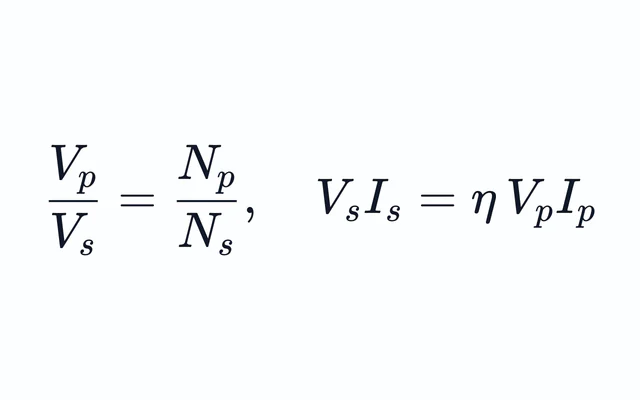
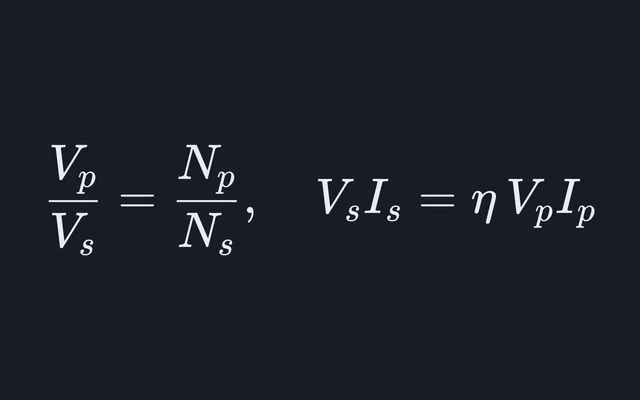
and the power in a circuit, and the transformer
calculator shows the current falling as a transformer steps the voltage up.
Common mistakes
- Dividing input by output. For 300 J useful out of 400 J, 400 ÷ 300 gives 133 percent, which is impossible. Useful output always goes on top: 300 ÷ 400 is 75 percent.
- Mixing units. Kilojoules against joules, or kilowatts against watts, puts the answer out by a factor of a thousand or gets it refused. Convert both values to one unit first.
- Writing a decimal with a percent sign. 0.75 and 75 percent are the same efficiency, but 0.75 percent is a hundred times smaller. Multiply by 100 before adding the sign.
- Counting every output as useful. A lamp also gives out heat and a motor also makes noise, but those are waste. The useful output is only the part the device is for: the light, or the motion.
How to calculate efficiency
- Write down the formula:
η = useful ÷ total × 100 -
Gather the values it needs. The calculator above starts with these:
- Useful output: 400
- Total input: 500
-
Substitute them and work through the arithmetic:
- efficiency = useful / total x 100
- = 400 / 500 x 100
- = 0.8 x 100
- = 80 %
-
To find one of the other values instead, rearrange the formula for it:
- Useful output:
useful = η × total ÷ 100 - Total input:
total = useful × 100 ÷ η
- Useful output:
Worked examples
Each one runs through the calculator above, so the arithmetic here is the arithmetic it does.
What is the efficiency of a 1.5 kW kettle that puts 1,350 W into the water?
- efficiency = useful / total x 100
- = 1350 / 1500 x 100
- = 0.9 x 100
- = 90 %
90 percent, once the 1.5 kW is written as 1,500 W. Typed as 1,350 against 1.5, the output looks 900 times the input and the calculator refuses it. The missing 150 W warms the kettle itself and the air around it rather than the water.
What useful power does a 2 kW electric motor give at 85 percent efficiency?
- useful = efficiency / 100 x total
- = 85 / 100 x 2
- = 0.85 x 2
- = 1.7
1.7 kW, in the unit the input was typed in: entering 2 for 2 kW gives the answer in kilowatts too. The other 0.3 kW goes into heating the windings and bearings and into noise, which is why a working motor runs warm.
How much energy must a 25 percent efficient engine use to do 50 kJ of work?
- total = useful / (efficiency / 100)
- = 50 / (25 / 100)
- = 50 / 0.25
- = 200
200 kJ, found by dividing by the efficiency. Multiplying instead gives 12.5 kJ, an input smaller than the useful output, which energy conservation rules out. The other 150 kJ leaves the engine as heat in its exhaust and cooling system.
Practise this with Mechanics Practice Problems, questions generated from this calculator and 18 other calculators in Mechanics.
Common questions
Can efficiency be more than 100 percent?
No. Energy is conserved, so no device gives out more useful energy than it takes in, and every real machine falls short of 100 percent. A figure above 100 usually comes from one of two places: values entered in different units, such as watts against kilowatts, or a heat pump, whose heat output over its electrical input is a coefficient of performance rather than an efficiency.
Where does the wasted energy go?
Into the surroundings, almost always as thermal energy. Friction in bearings and gears, air resistance, sound, and the heating of wires that carry a current all spread energy into the air and nearby objects, warming them slightly. It is not destroyed, since energy is conserved, but once spread thinly it is very hard to collect and use again, which is why it is described as dissipated.
What is the difference between efficiency and power?
Power is how fast energy is transferred, in watts, and efficiency is the fraction of it that is useful, with no unit. A 2 kW motor and a 200 W motor can both be 80 percent efficient, giving 1.6 kW and 160 W of useful power. Multiply a power rating by the efficiency as a decimal for the useful power, and subtract that from the rating for the power wasted.