Transformer Calculator
Solve the transformer equation Vp/Vs = Np/Ns for a voltage or a number of turns, with the secondary current, power and losses at any efficiency.
Calculator
The AC voltage across the input coil, as an rms value: 120 V from a US or Canadian outlet, 230 V in the UK and Australia.
The AC voltage across the output coil, as an rms value.
Turns of wire on the input coil.
Turns on the output coil. More turns than the primary steps the voltage up; fewer steps it down.
The rms current into the input coil. Only the current and power readouts use it.
Output power as a percentage of input power: 100 for an ideal transformer. Only the current and power readouts use it.
Working, with your numbers
- Vs / Vp = Ns / Np
- Vs = Vp x Ns / Np
- = 120 V x 50 / 500
- = 12 V
Values are converted into the units the equation is worked in before the arithmetic.
- Secondary current Is = η × Vp × Ip ÷ Vs, with η as a decimal: 95 percent is 0.95. At 100 percent this is Vp × Ip = Vs × Is.
- 2.5 A
- Current ratio, Is ÷ Ip η × Np ÷ Ns, with η as a decimal. Divide a known secondary current by this to find the primary current.
- 10
- Input power Vp × Ip, from rms values. With a motor or electronics as the load this is volt-amperes, and the watts can be lower.
- 30 W
- Output power Vs × Is: the input power times the efficiency.
- 30 W
- Power lost Heating in the windings and the iron core. Zero only for an ideal transformer.
- 0 W
- Turns ratio, Np : Ns Fewer turns on the secondary: the voltage goes down and, in an ideal transformer, the current goes up by the same factor.
- 10 : 1, step-down
Citing this tool
Last updated . Add the date you accessed it as well, which a citation of a page that can change asks for. If a specific result matters, cite the permalink from the tool’s share row instead of this page: it reproduces the exact parameters.
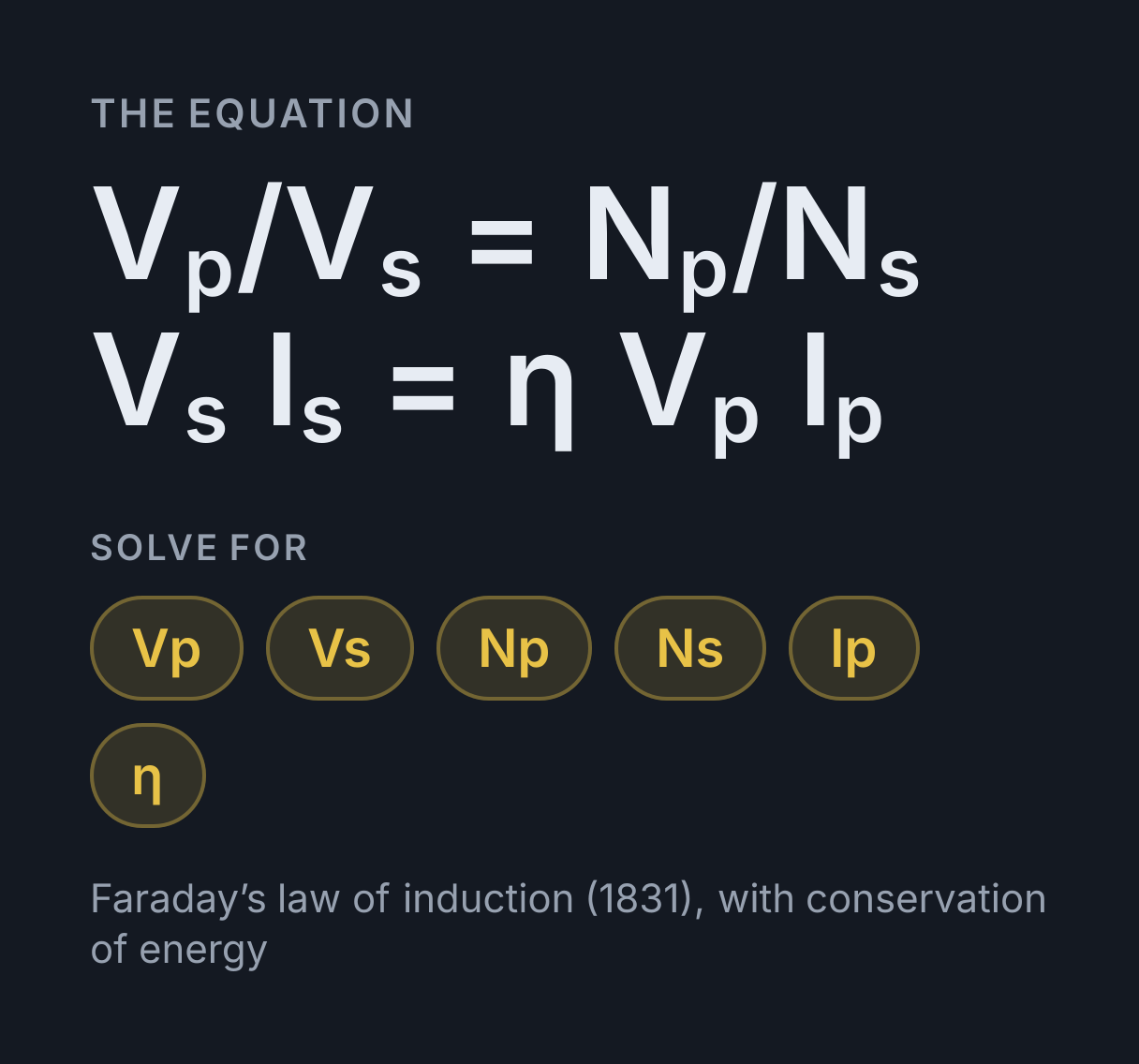
The equation
Faraday’s law of induction (1831), with conservation of energy
What is the transformer equation?
The transformer equation is Vp / Vs = Np / Ns: primary voltage over secondary voltage equals primary turns over secondary turns, so Vs = Vp × Ns / Np. An ideal transformer wastes no power, so VpIp = VsIs, and stepping the voltage up by some factor steps the current down by the same factor.
Why the turns ratio sets the voltage
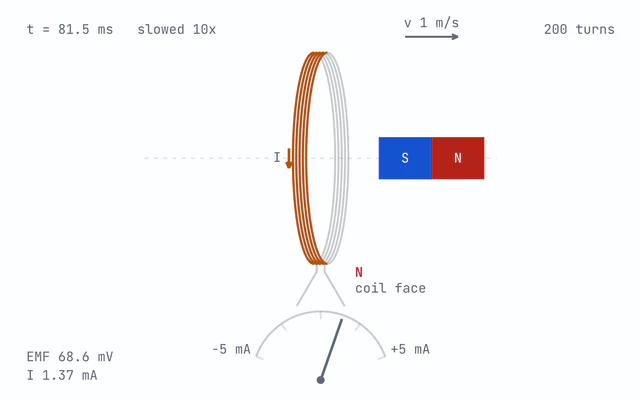
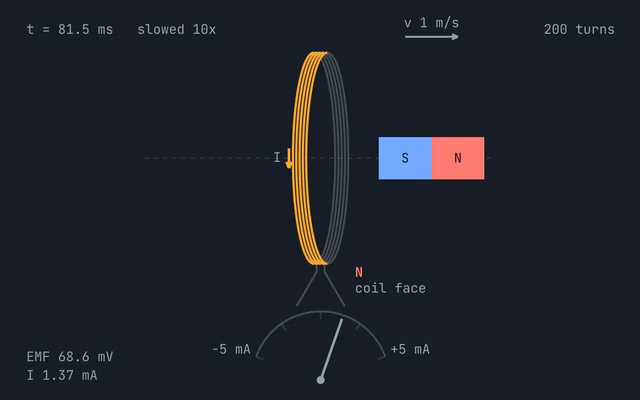
An alternating current in the primary coil sets up a magnetic flux in the iron core that keeps reversing, and the core carries that flux through the secondary coil. In an ideal transformer, where all of the flux passes through both coils, Faraday’s law of induction gives every turn of either coil the same induced EMF. A coil’s voltage is that EMF per turn times its number of turns, so the voltages stand in exactly the ratio of the turns. Faraday found the effect in 1831 with two coils wound on one iron ring, the arrangement a transformer still uses.
More turns on the secondary than on the primary makes a step-up transformer, and fewer makes a step-down one. The turns ratio readout writes the ratio as Np : Ns, so 10 : 1 is a step-down and 1 : 10 a step-up. Voltages here are rms values, the ones a meter or a nameplate shows.
Currents, power and efficiency
Enter the primary current and the calculator gives the power going in, Pin = Vp × Ip,
and the current the secondary can supply. A real transformer loses some of that power: resistive
heating in the copper windings, and eddy currents and repeated magnetization in the iron core,
which is built from thin insulated sheets to keep the eddy currents small. The efficiency field
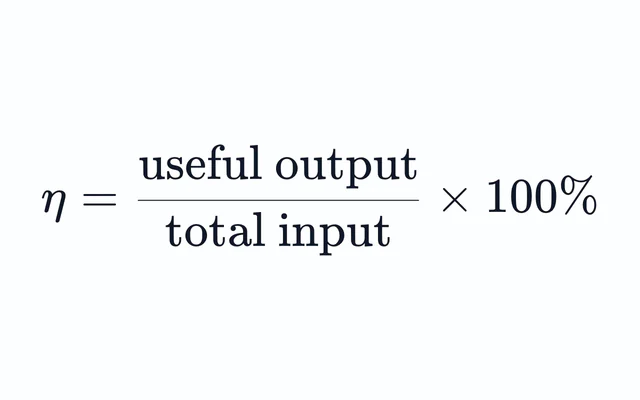
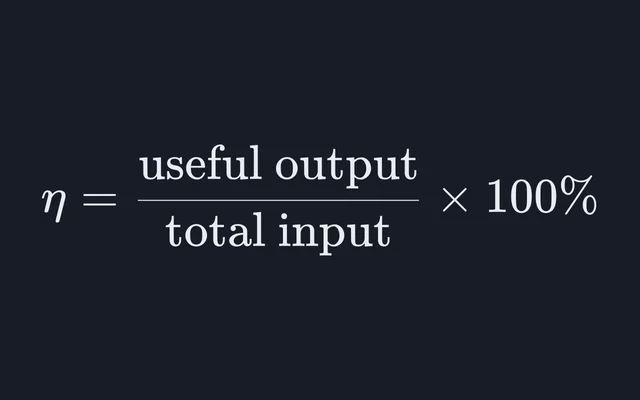
scales the output, Pout = η × Pin and Is = Pout ÷ Vs, with η as a
decimal. The calculator holds the secondary voltage at the turns-ratio value and takes the whole
loss from the current; under load, a real secondary voltage also sags a little below the ratio.
To find η from measured input and output power, use the
efficiency calculator.
To find a current when the turns are not given, choose either number of turns as the unknown, then enter both voltages and the primary current. The current and power readouts use only the voltages, the primary current and the efficiency, so any turns figure gives the same answer. For the current through a load on the secondary, or the power it draws, work from the secondary voltage with the Ohm’s law calculator or the electrical power calculator.
Why power lines run at high voltage
The power lost as heat in a transmission line is I²R, where R is the
resistance of the line. A step-up transformer at the power station raises the voltage by some
factor, which lowers the current by that factor for the same power, so the heating falls by the
factor squared: ten times the voltage leaves a hundredth of the loss. Substation and pole-top
transformers then step the voltage back down in stages, in the US to the 120 V and 240 V a house
is wired for, and in the UK and Australia to 230 V.
Common mistakes
- Connecting it to DC. A transformer needs a changing flux. A steady direct current makes a steady flux, which induces nothing in the secondary, and the primary, with only the resistance of its wire to limit the current, can overheat.
- Expecting a step-up to make extra power. Raising the voltage ten times divides the current by at least ten. The output power can never be more than the input.
- Leaving kilovolts in volts. Typing 11 for an 11 kV supply with the unit left on V makes every voltage a thousand times too small. Pick kV in the unit menu.
- Mixing peak and rms values. Nameplates and meters give rms values, and the 120 V of a US outlet peaks at about 170 V. Use rms values on both sides so the power readouts mean what they say.
- Reading V × I as watts for every load. With a motor or electronics on the secondary, V × I is apparent power in volt-amperes, and the real power in watts can be lower. That is why transformers are rated in VA or kVA.
Converting units first? Use the electric current and voltage conversion tables.
How to calculate the secondary voltage of a transformer
- Write down the formula:
Vs = Vp × Ns ÷ Np -
Gather the values it needs. The calculator above starts with these:
- Primary voltage: Vp = 120 V
- Primary turns: Np = 500 turns
- Secondary turns: Ns = 50 turns
-
Substitute them and work through the arithmetic:
- Vs / Vp = Ns / Np
- Vs = Vp x Ns / Np
- = 120 V x 50 / 500
- = 12 V
-
To find one of the other values instead, rearrange the formula for it:
- Primary voltage:
Vp = Vs × Np ÷ Ns - Primary turns:
Np = Ns × Vp ÷ Vs - Secondary turns:
Ns = Np × Vs ÷ Vp
- Primary voltage:
Worked examples
Each one runs through the calculator above, so the arithmetic here is the arithmetic it does.
What voltage do 200 primary and 5,000 secondary turns give from 20 kV?
- Vs / Vp = Ns / Np
- Vs = Vp x Ns / Np
- = 20,000 V x 5000 / 200
- = 500,000 V
500 kV, one of the voltages long-distance US transmission lines run at. Only the ratio of the turns sets it, so 20 and 500 turns would give the same answer on paper. Real windings need enough turns to keep the magnetic flux in the core below saturation, which is why a coil is not wound with the smallest pair that has the right ratio.
How many secondary turns give 5 V from 120 V with 1,000 primary turns?
- Ns / Np = Vs / Vp
- Ns = Np x Vs / Vp
- = 1000 x 5 V / 120 V
- = 41.67 turns
41.67 turns, which no coil can have, so the calculator shows what the nearest whole numbers give: 41 turns makes 4.92 V and 42 makes 5.04 V. Rounding up leaves a small margin, since a loaded transformer’s output sags slightly below the turns ratio.
How many primary turns does a 120 V to 6 V transformer need for 30 secondary turns?
- Np / Ns = Vp / Vs
- Np = Ns x Vp / Vs
- = 30 x 120 V / 6 V
- = 600 turns
600 turns. In a step-down transformer the primary is the high-voltage side, so it carries the most turns. Writing the ratio the wrong way up gives 30 × 6 ÷ 120 = 1.5 turns, a figure small enough to show at once that something has gone wrong.
Practise this with Electricity Practice Problems, questions generated from this calculator and 11 other calculators in Electricity.
Common questions
Does a step-up transformer increase power?
No. It raises the voltage and lowers the current by at least the same factor, so the power out is at most the power in. A transformer that stepped 120 V up to 1,200 V without cutting the current tenfold would be making energy from nothing. In a real one a little of the input becomes heat in the windings and the core, so the output power is slightly below the input.
Why does a transformer only work with AC?
Because induction needs a changing magnetic flux. An alternating current runs through 60 cycles a second in the US and Canada and 50 in the UK and Australia, so the flux in the core never stops changing and keeps inducing a voltage in the secondary. A steady direct current makes a steady flux, which induces nothing once it has settled, and the primary then draws a large current limited only by the resistance of its wire.
What is the turns ratio of a transformer?
The number of turns on the primary coil divided by the number on the secondary, written Np : Ns. In an ideal transformer it equals the voltage ratio Vp : Vs and is the inverse of the current ratio. A ratio above 1, such as 10 : 1, steps the voltage down, and one below 1 steps it up. Some textbooks define it the other way up, as Ns : Np, so check which a question uses before substituting.
How efficient are real transformers?
Very, by the standard of other machines. The losses are resistive heating in the copper windings, which grows with the square of the current, and eddy currents and repeated magnetization in the iron core, which a core of thin insulated sheets keeps small. Large power transformers are commonly above 99 percent efficient. Small ones lose a larger share, so for a small transformer the efficiency field is worth setting below 100.