Fractional Excretion of Sodium (FENa) Calculator
Calculate FENa from urine and serum sodium and creatinine in mg/dL or µmol/L, plus FEUrea for patients on diuretics, with the working shown.
Calculator
From a spot urine taken close to the blood sample. mEq/L and mmol/L are the same number for sodium.
Serum or plasma, which are the same for this. mEq/L and mmol/L are the same number for sodium, since it is monovalent.
In the same unit as the serum creatinine: both in mg/dL, as US reports print them, or both in µmol/L. A urine creatinine reported in mmol/L goes in multiplied by 1000.
mg/dL or µmol/L, matching the urine creatinine. Only the ratio of the two enters, so the unit cancels. 1 mg/dL is 88.4 µmol/L.
Only used for FEUrea. In mg/dL beside a BUN in mg/dL, or a urine urea in mmol/L beside a serum urea in mmol/L.
Only used for FEUrea, and in the same unit as the urine value. A whole urea in mg/dL is 2.14 times the BUN, so it pairs only with a whole urine urea in mg/dL.
Working, with your numbers
- FENa = (UNa x SCr) / (SNa x UCr) x 100
- = (20 x 2.8) / (140 x 80) x 100
- = 56 / 11,200 x 100
- = 0.5%
Values are converted into the units the equation is worked in before the arithmetic.
- FEUrea FEUrea = (UUN × SCr) / (BUN × UCr) × 100 = (400 × 2.8) / (56 × 80) × 100. From the two urea fields, so it describes your patient only if you entered theirs.
- 25 %
- FENa reads as Espinel (1976) found a FENa under 1 percent in prerenal azotemia and over 3 percent in acute tubular necrosis, in oliguric acute renal failure; some references put the upper line at 2. Diuretics raise it, and contrast, acute obstruction, sepsis and glomerulonephritis can hold it under 1 without a prerenal cause.
- Under 1%, prerenal pattern
- FEUrea reads as Carvounis (2002) found a FEUrea under 35 percent in 89 percent of prerenal patients given diuretics, where only 48 percent had a FENa under 1, and a tubular necrosis average of 58.6 percent. A later study (Pépin 2007) found it far less specific, so it supports a reading rather than settling one.
- 35% or under, prerenal pattern
- Urine to serum creatinine UCr / SCr, the same in either unit. Miller (1978) read above 40 as pointing to prerenal azotemia and below 20 to acute tubular necrosis, in acute oliguria. It cannot fall below 1.
- 28.6
- Urine to serum urea UUN / BUN, the same ratio whether both are urea nitrogen, whole urea or mmol/L. Miller (1978) read above 8 as pointing to prerenal azotemia and below 3 to acute tubular necrosis, in acute oliguria.
- 7.14
Citing this tool
Last updated . Add the date you accessed it as well, which a citation of a page that can change asks for. If a specific result matters, cite the permalink from the tool’s share row instead of this page: it reproduces the exact parameters.
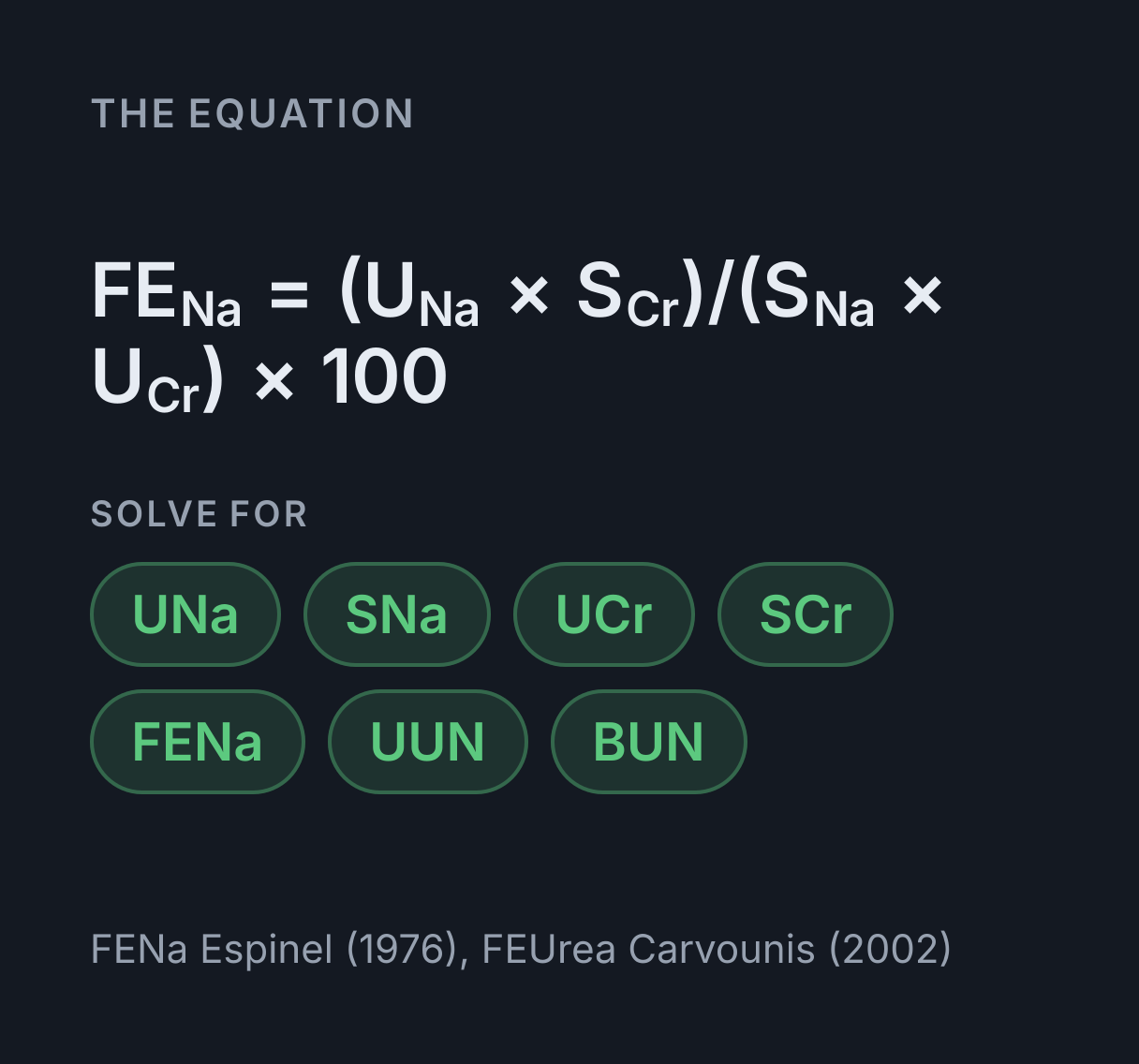
The equation
FENa Espinel (1976), FEUrea Carvounis (2002)
How do you calculate FENa?
FENa = (urine sodium × serum creatinine) / (serum sodium × urine creatinine) × 100, the percentage of filtered sodium that reaches the urine. Use a spot urine and a blood sample taken together. In oliguric acute kidney injury, a FENa under 1% points to a prerenal cause and over 3% to acute tubular necrosis (Espinel, 1976).
Why a spot sample is enough
The sodium excreted depends on the urine flow and the sodium filtered on the filtration rate. A spot sample measures neither, and the formula does not need them.
sodium excreted = UNa × V, where V is the urine flowsodium filtered = SNa × GFR, since sodium passes the glomerulus freelyGFR ≈ UCr × V / SCr, the creatinine clearance
Dividing the first line by the second, with the clearance standing in for GFR, puts V on the top and the bottom, so it cancels and no timed collection is needed. The tubules also secrete a little creatinine, so its clearance runs slightly above the true filtration rate, but Espinel derived the thresholds from FENa values calculated with creatinine, which puts that bias inside them.
Units: why mg/dL and µmol/L both work
The two creatinines only ever appear as a ratio, so their unit cancels, provided both are in the same one. US laboratories print serum and urine creatinine in mg/dL, and those go in as printed. Laboratories in the UK, Canada and Australia commonly print serum creatinine in µmol/L and urine creatinine in mmol/L, a thousandfold apart, so the urine value needs multiplying by 1000 first. Left unconverted it lands below the serum value, which is physiologically impossible because urine flow never exceeds the filtration rate, and the calculator refuses it instead of returning a FENa in the thousands. It also warns when urine creatinine is more than 1000 times the serum value, the size of error a serum creatinine in mg/dL beside a urine creatinine in µmol/L produces.
Sodium needs no conversion, since mEq/L and mmol/L are the same number for a monovalent ion. The urea pair for FEUrea follows the creatinine rule: a BUN with a urine urea nitrogen, both in mg/dL, or a serum urea with a urine urea, both in mmol/L. A whole urea in mg/dL is 2.14 times its BUN, the trap the serum osmolality calculator explains, so it pairs only with a whole urine urea.
Reading the result
Espinel’s patients were in the oliguric phase of acute renal failure, and the 1 and 3 percent lines come from them. A value between the two decides nothing on its own. Some references draw the upper line at 2 percent instead and call 1 to 2 indeterminate; this calculator keeps the lines from the paper it cites.
The bands only mean something once kidney function has fallen acutely. In healthy people FENa is usually under 1 percent and rises with a salty diet (Steiner, 1984), so a low value with a normal creatinine is ordinary sodium balance, not a sign of poor perfusion.
Miller and colleagues (1978) set out the companion indices for acute oliguria. A urine sodium under 20 mEq/L, a urine to plasma creatinine ratio above 40 and a urine to plasma urea nitrogen ratio above 8 pointed to prerenal azotemia; a urine sodium over 40, a creatinine ratio under 20 and a urea ratio under 3 pointed to acute tubular necrosis. A significant number of patients fell between those lines, and for them FENa and the renal failure index still told the two apart. The two ratios are among the readouts above.
When FENa misleads
A FENa says how hard the tubules are holding on to sodium, and several things other than volume depletion change that. Zarich and colleagues (1985) concluded that no single urinary index separates prerenal azotemia from intrinsic injury in every case.
- High despite a prerenal cause. Diuretics block sodium reabsorption directly, so the urine carries sodium the kidney would otherwise keep. In one series only 48 percent of prerenal patients given diuretics had a FENa under 1 percent (Carvounis, 2002). Chronic kidney disease can do the same (Steiner, 1984).
- Low after contrast. In contrast induced acute renal failure, FENa stayed under 1 percent for up to five days while kidney function was clearly worsening (Fang, 1980).
- Low in early obstruction. Acute urinary tract obstruction is on Steiner’s list of causes of a low FENa that do not respond to fluid, and on the list Zarich and colleagues compiled.
- Low in other settings. Values under 1 percent have also been reported in sepsis, acute glomerulonephritis, pigment nephropathy from myoglobin or hemoglobin, hepatorenal syndrome, heart failure, transplant rejection and some nonoliguric tubular necrosis (Steiner, 1984; Zarich, 1985).
FEUrea for patients on diuretics
Urea is reabsorbed mainly by passive forces rather than by the transporters diuretics block, so its fractional excretion should hold up after a diuretic where sodium’s does not. Carvounis and colleagues tested that across 102 episodes of acute renal failure. FEUrea averaged between 24 and 28 percent in both prerenal groups, with or without diuretics, against 58.6 percent in acute tubular necrosis, and 89 percent of the diuretic group were under 35 percent. Their cut-off for a prerenal cause is 35 percent or less, and the FEUrea readout above shows its substitution with your numbers.
A later prospective study did not reproduce that performance. Pépin and colleagues (2007) found a FEUrea specificity of only 33 percent in patients given diuretics, and FENa did better in patients who had none, so they concluded FEUrea could not replace it. Read a low FEUrea as support for a prerenal cause, to weigh beside the rest of the picture.
Common mistakes
- Mixing creatinine units. A serum value in µmol/L beside a urine value in mmol/L is out by 1000, and one in mg/dL beside the other in µmol/L by 88.4.
- Calling a high FENa tubular injury after a diuretic. Check the drug chart first, and read FEUrea beside it.
- Calculating it without acute kidney injury. With normal function a low value is expected, and a higher one can follow a salty diet.
- Pairing a BUN with a whole urea. The FEUrea comes out wrong by a factor of 2.14 in one direction or the other.
- Using samples taken hours apart. The formula assumes the urine and the blood describe the same moment, which is harder to claim when creatinine is changing quickly.
Worked examples
Each one runs through the calculator above, so the arithmetic here is the arithmetic it does.
What is the FENa if urine Na is 20, serum Na 140, urine Cr 80 and serum Cr 2.8 mg/dL?
- FENa = (UNa x SCr) / (SNa x UCr) x 100
- = (20 x 2.8) / (140 x 80) x 100
- = 56 / 11,200 x 100
- = 0.5%
Under Espinel’s 1 percent line, which reads as prerenal only in acute oliguric kidney injury with no recent diuretic. With normal kidney function the same 0.5 percent means nothing, because healthy kidneys usually keep FENa under 1 percent anyway.
What is the FENa with creatinine of 400 µmol/L in serum and 5.0 mmol/L in urine?
- FENa = (UNa x SCr) / (SNa x UCr) x 100
- = (60 x 400) / (135 x 5000) x 100
- = 24,000 / 675,000 x 100
- = 3.556%
The urine creatinine goes in as 5000 µmol/L, so both creatinines share a unit and it cancels. UK, Canadian and Australian reports often print the two a thousandfold apart; entered as 5, the urine value sits below the serum value and the calculator refuses it rather than return about 3556 percent.
What urine sodium gives a FENa of exactly 1% at a serum sodium of 140?
- UNa = FENa x SNa x UCr / (100 x SCr)
- = 1 x 140 x 100 / (100 x 2)
- = 14,000 / 200
- = 70 mmol/L
A urine sodium of 70 mmol/L is above the 40 that Miller (1978) read as pointing to tubular necrosis, yet with urine creatinine 50 times the serum value, inside his prerenal range, it sits exactly on the 1 percent line. Urine sodium alone moves with water reabsorption; FENa divides that out.
Practise this with Lab and Clinical Calculation Practice Problems, questions generated from this calculator and 20 other calculators in Biology.
Common questions
What is a normal FENa?
FENa has no fixed normal value, because it follows sodium intake. In most healthy people it is under 1 percent and rises with a salty diet (Steiner, 1984). That is why the 1 and 3 percent lines only mean something in acute kidney injury: a FENa of 0.4 percent in someone with normal kidney function is ordinary sodium balance, not evidence of poor kidney perfusion.
Why is FENa unreliable after diuretics?
Because diuretics block sodium reabsorption directly, so the urine carries sodium that an underperfused kidney would otherwise keep. In the 2002 series by Carvounis and colleagues, only 48 percent of prerenal patients given diuretics had a FENa under 1 percent. Their FEUrea, which depends mainly on passive reabsorption, was under 35 percent in 89 percent of the same patients, which is why this calculator shows FEUrea beside FENa.
Is FEUrea better than FENa?
Not reliably. In the study that set the 35 percent cut-off, FEUrea outperformed FENa, especially after diuretics. A later prospective study by Pépin and colleagues in 2007 did not reproduce that: FEUrea had a specificity of only 33 percent in patients given diuretics, and FENa performed better in patients who had none. A low FEUrea is best read as support for a prerenal cause beside the clinical picture, not as a replacement for FENa.
When can FENa be under 1 percent without a prerenal cause?
In several settings that are not simple volume depletion. Steiner (1984) and Zarich and colleagues (1985) list contrast nephropathy, acute urinary obstruction, acute glomerulonephritis, pigment nephropathy from myoglobin or hemoglobin, sepsis, hepatorenal syndrome, heart failure, transplant rejection and some nonoliguric tubular necrosis. After contrast, Fang and colleagues found the low value could last up to five days while kidney function was clearly worsening.
Do I enter creatinine in mg/dL or µmol/L?
Either, as long as the urine and serum creatinine share a unit, because only their ratio enters the formula and the unit cancels. US reports print both in mg/dL. Laboratories in the UK, Canada and Australia commonly print serum creatinine in µmol/L and urine creatinine in mmol/L, a thousandfold apart, so multiply the urine value by 1000 first. Entered unconverted, the urine value falls below the serum value, which cannot happen, and the calculator refuses it.