Winters’ Formula Calculator
Find the expected pCO2 in metabolic acidosis by Winters’ formula, enter the measured pCO2 in mmHg or kPa, and see if a respiratory disorder coexists.
Calculator
From the blood gas or the chemistry panel. mmol/L and mEq/L are the same number for bicarbonate, since it carries a single charge. Typical reference interval 22 to 26.
The centre of the band Winters’ formula predicts. The band runs 2 mmHg either side of it.
Arterial pCO2 from the same blood gas. Normal 35 to 45 mmHg, or 4.7 to 6.0 kPa. Choose kPa if the report uses it.
Working, with your numbers
- pCO2 exp = 1.5 x HCO3 + 8, plus or minus 2
- = 1.5 x 12 + 8
- = 18 + 8
- = 26 mmHg, so 24 to 28 mmHg
Values are converted into the units the equation is worked in before the arithmetic.
- Respiratory response The measured pCO2 is inside the band, so the respiratory response is the size this metabolic acidosis alone produces. There is no evidence here of a second, respiratory disorder.
- Appropriate compensation
- Expected range Winters’ formula, 2 mmHg either side of its centre. Compensation is a biological response with scatter, so the band is the prediction.
- 24 to 28 mmHg
- Expected range in kPa 1 mmHg = 0.1333 kPa. UK and most European reports give pCO2 in kPa.
- 3.2 to 3.73 kPa
- Measured minus expected How far the measured pCO2 sits from the centre of the band. Just outside the band is weaker evidence of a second disorder than well outside it.
- 0 mmHg
Citing this tool
Last updated . Add the date you accessed it as well, which a citation of a page that can change asks for. If a specific result matters, cite the permalink from the tool’s share row instead of this page: it reproduces the exact parameters.
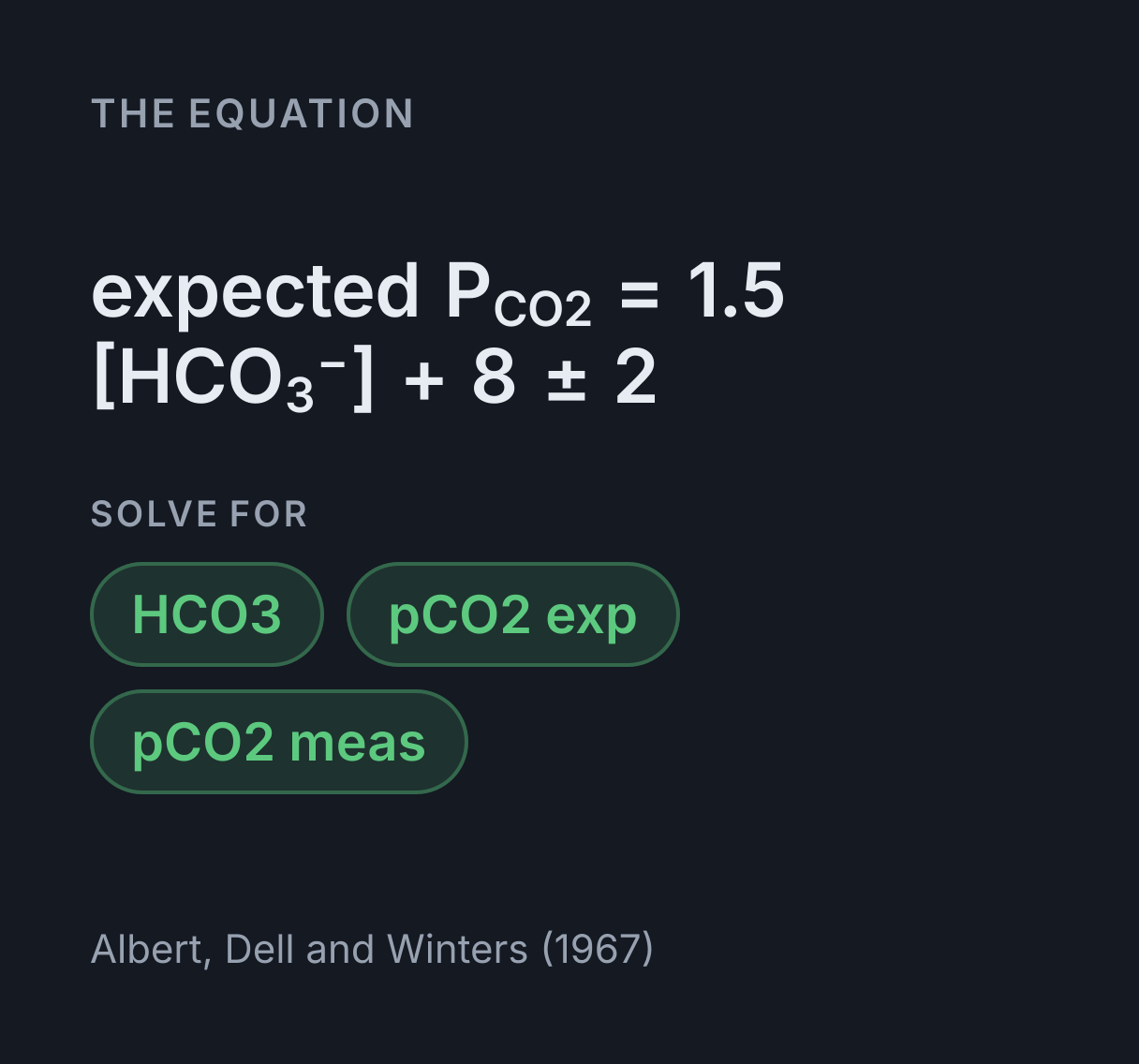
The equation
Albert, Dell and Winters (1967)
What is Winters’ formula?
Winters’ formula predicts the arterial pCO2 that respiratory compensation should produce in a metabolic acidosis: expected pCO2 = 1.5 × HCO3− + 8 ± 2 mmHg, with bicarbonate in mEq/L or mmol/L. A measured pCO2 above that range signals a concurrent respiratory acidosis, and one below it a concurrent respiratory alkalosis.
Reading the three results
The calculator places the measured pCO2 against the band and reports one of three outcomes. Each describes ventilation and says nothing about what caused the acidosis.
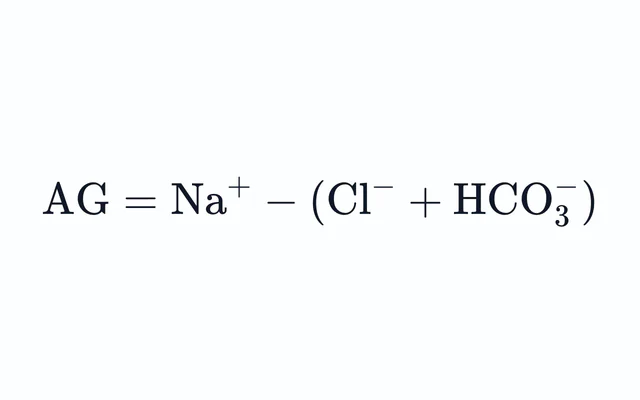
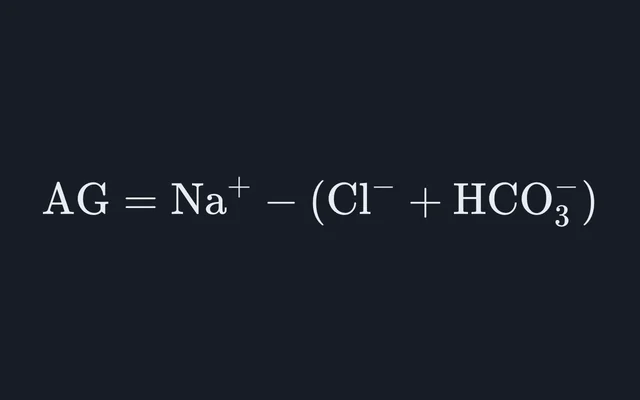
- Appropriate compensation. The lungs have lowered CO2 by the amount this acidosis alone accounts for. That is evidence against a second, respiratory disorder. It does not mean the acidosis has a single cause; the anion gap and the delta ratio address that.
- Concurrent respiratory acidosis. Ventilation is falling short of what the acid load demands. Exhaustion, sedating drugs, neuromuscular weakness and lung disease all limit it. A pCO2 that looks normal can carry this finding: with a bicarbonate of 16 mmol/L or less the whole band sits below 35 mmHg, so a value inside the usual 35 to 45 interval is already too high.
- Concurrent respiratory alkalosis. Something is driving breathing beyond the acid load. Salicylate poisoning, which stimulates the brainstem’s respiratory center while it adds acid, is the textbook example, and early sepsis is another.
Why the answer is a band
Compensation is a physiological response that varies between patients, so the rule predicts a range. Albert, Dell and Winters fitted the line in 1967 to blood gases from patients with metabolic acidosis, and the 2 mmHg either side is the allowance for that scatter. A pCO2 1 mmHg from the centre tells you nothing, so the calculator shows how far the measured value sits from the centre beside the verdict. A value a little past an edge is weaker evidence of a second disorder than one well beyond it.
When Winters’ formula does not apply
- A bicarbonate of 22 mmol/L or more. That is not a metabolic acidosis, so the calculator gives no expected pCO2. A metabolic alkalosis has its own, less reliable rule, which the Acid Base Interpreter applies.
- The first hours of an acidosis. Ventilation starts to rise within the first hour, but the full respiratory response takes many hours to develop. A gas drawn that early can sit above the band while the lungs catch up, with no second disorder behind it.
- A venous gas. The formula predicts an arterial pCO2. Venous pCO2 runs higher by an amount that varies between patients, so a venous value against this band can suggest a respiratory acidosis that is not there.
- Controlled mechanical ventilation. The ventilator sets the minute ventilation, so the pCO2, and any value outside the band, reflects the settings and not the patient’s own response.
Bicarbonate, total CO2 and kPa
US reports give bicarbonate in mEq/L and SI reports in mmol/L, which for bicarbonate is the same number, so either goes in unchanged. Total CO2 on a chemistry panel includes the carbon dioxide dissolved in plasma, 0.03 mmol/L for every mmHg of pCO2, on top of the bicarbonate. At a pCO2 of 30 mmHg the dissolved part is 0.9 mmol/L, and entering total CO2 in place of bicarbonate then raises the expected pCO2 by 1.35 mmHg, which matters only near an edge of the band.
UK and most European analysers report pCO2 in kPa. Choose kPa on either
pCO2 field and the calculator converts at 1 mmHg = 0.1333 kPa; the rule itself is
written in mmHg. In kPa the same line reads
expected pCO2 = 0.2 × HCO3 + 1.07 ± 0.27 kPa.
Common mistakes
- Entering a kPa value as mmHg. A UK report’s 3.2 kPa typed into a field set to mmHg reads as a pCO2 of 3.2 mmHg, a profound respiratory alkalosis. Check the unit on the report before the number.
- Ignoring the band. Calling a pCO2 of 27 mmHg abnormal with a bicarbonate of 12, because the centre of the band is 26, treats a range as a point.
- Using it on a respiratory primary. If the pCO2 is the primary problem, bicarbonate is the compensating value, with separate acute and chronic rules. Winters’ formula answers only how the lungs respond to a metabolic acidosis.
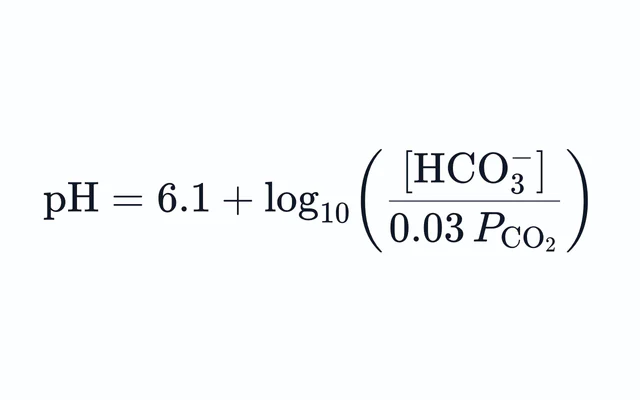
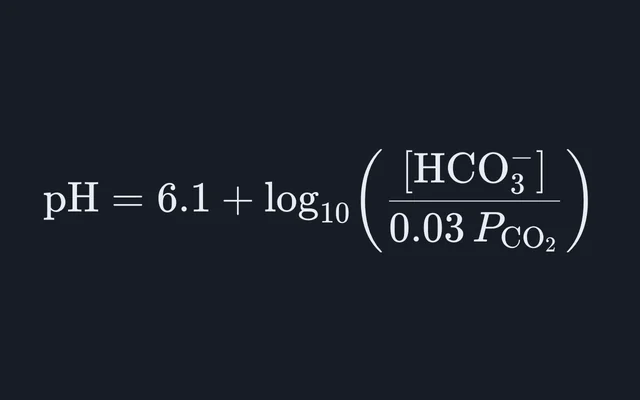
- Stopping at the pCO2. This checks one step of a blood gas. The pH comes first, and the anion gap and the delta ratio come after; the Acid Base Interpreter works through the whole sequence with this rule built in.
Converting units first? Use the pressure conversion table.
How to calculate expected pCO2 with Winters’ formula
- Write down the formula:
pCO2 exp = 1.5 · HCO3 + 8, ± 2 -
Gather the values it needs. The calculator above starts with these:
- Bicarbonate: HCO3 = 12 mmol/L
-
Substitute them and work through the arithmetic:
- pCO2 exp = 1.5 x HCO3 + 8, plus or minus 2
- = 1.5 x 12 + 8
- = 18 + 8
- = 26 mmHg, so 24 to 28 mmHg
- To find the bicarbonate instead, rearrange the formula:
HCO3 = (pCO2 exp - 8) ÷ 1.5
Worked examples
Each one runs through the calculator above, so the arithmetic here is the arithmetic it does.
Is a pCO2 of 19 mmHg too low for a bicarbonate of 8?
- pCO2 exp = 1.5 x HCO3 + 8, plus or minus 2
- = 1.5 x 8 + 8
- = 12 + 8
- = 20 mmHg, so 18 to 22 mmHg
No. A pCO2 far below the normal range is what a severe metabolic acidosis should produce, and 19 mmHg sits inside the band, so this is appropriate compensation rather than a second, respiratory alkalosis. A low pCO2 means nothing on its own; only its place against the band does.
Is a normal pCO2 of 40 mmHg reassuring with a bicarbonate of 10?
- pCO2 exp = 1.5 x HCO3 + 8, plus or minus 2
- = 1.5 x 10 + 8
- = 15 + 8
- = 23 mmHg, so 21 to 25 mmHg
No. The lungs should have brought the pCO2 down into the low twenties, so a value inside the usual 35 to 45 interval means a respiratory acidosis is also present, from exhaustion, sedation or lung disease, for example. A normal pCO2 is only normal when the bicarbonate is too.
Practise this with Lab and Clinical Calculation Practice Problems, questions generated from this calculator and 20 other calculators in Biology.
Common questions
What is the expected pCO2 in metabolic acidosis?
It depends on the bicarbonate, which is why there is no single normal value. Winters’ formula multiplies the bicarbonate by 1.5, adds 8 and allows 2 mmHg either side: for a bicarbonate of 16 mEq/L that is 1.5 × 16 + 8 = 32 mmHg, so any measured pCO2 from 30 to 34 mmHg is appropriate compensation. Bicarbonate in mEq/L and in mmol/L is the same number, so US and SI reports go in unchanged.
What does it mean if the pCO2 is higher than Winters’ formula predicts?
It means the lungs are not clearing as much CO2 as the acidosis should drive them to, so a respiratory acidosis is present alongside the metabolic one. Exhaustion, sedating drugs, neuromuscular weakness and lung disease all do this. It is easy to miss because the pCO2 can look normal: with a bicarbonate of 10, a pCO2 of 40 mmHg is well above the expected 21 to 25. The exception is a gas drawn in the first hours of an acidosis, before the respiratory response has fully developed.
What does it mean if the pCO2 is lower than Winters’ formula predicts?
It means ventilation is lowering CO2 further than the acidosis explains, so a respiratory alkalosis is present as well. Salicylate poisoning is the textbook example, because it adds acid and drives the brainstem’s control of breathing at the same time, and early sepsis can do the same. With a bicarbonate of 14 the band is 27 to 31 mmHg, so a measured pCO2 of 20 mmHg points at a second disorder rather than at unusually good compensation.
Can Winters’ formula be used in metabolic alkalosis?
No. It describes the respiratory response to a low bicarbonate and nothing else, so the calculator refuses a bicarbonate of 22 mmol/L or more. In a metabolic alkalosis the pCO2 rises by about 0.7 mmHg for each mmol/L of bicarbonate above 24, and that response is less reliable, because breathing less is limited by the need to keep oxygenating. The Acid Base Interpreter applies that rule, along with the acute and chronic rules for the respiratory disorders.
How do I use Winters’ formula with pCO2 in kPa?
Choose kPa on either pCO2 field and the calculator converts it. The rule is written in mmHg, and 1 kPa is 7.5 mmHg, so in kPa it becomes approximately expected pCO2 = 0.2 × HCO3 + 1.07 ± 0.27. For a bicarbonate of 12 mmol/L that is a band of 3.2 to 3.73 kPa. Check the unit on the report before typing: 3.2 entered into a field set to mmHg reads as a profound respiratory alkalosis.
Who derived Winters’ formula?
Albert, Dell and Winters, in a 1967 paper in the Annals of Internal Medicine, Quantitative displacement of acid-base equilibrium in metabolic acidosis. They related arterial pCO2 to bicarbonate in patients with metabolic acidosis, and 1.5 × HCO3 + 8 ± 2 is the form of their line in bedside use. It is usually called Winters’ formula, although Winters was the last of the three authors.