Air Conditioner BTU Calculator
Find the air conditioner size a room needs from its length and width in ft or m, with ENERGY STAR’s BTU chart and adjustments, plus tons and kW.
Calculator
Inches as a fraction of a foot: 12 ft 6 in is 12.5 ft.
Applied to the chart figure, before people and a kitchen are added.
The chart allows for two. Each one beyond them adds 600 BTU/h.
- Cooling capacity needed ENERGY STAR’s figure for 150 up to 250 sq ft.
- 6,000 BTU/h
- Tons of refrigeration The capacity over 12,000 BTU/h, one ton of refrigeration.
- 0.5 tons
- Cooling capacity Heat removed from the room, at 0.29307 W per BTU/h. Not the electricity the unit uses.
- 1.758 kW
- Floor area 16.72 m².
- 180 sq ft
Working, with your numbers
- A = L x W
- = 15 ft x 12 ft (4.572 m x 3.658 m)
- = 180 sq ft (16.72 m²)
- ENERGY STAR chart, 150 up to 250 sq ft: 6,000 BTU/h
- Q = 6,000 BTU/h
Lengths are converted to feet, the unit of the ENERGY STAR chart, before the area is looked up.
Citing this tool
Last updated . Add the date you accessed it as well, which a citation of a page that can change asks for. If a specific result matters, cite the permalink from the tool’s share row instead of this page: it reproduces the exact parameters.
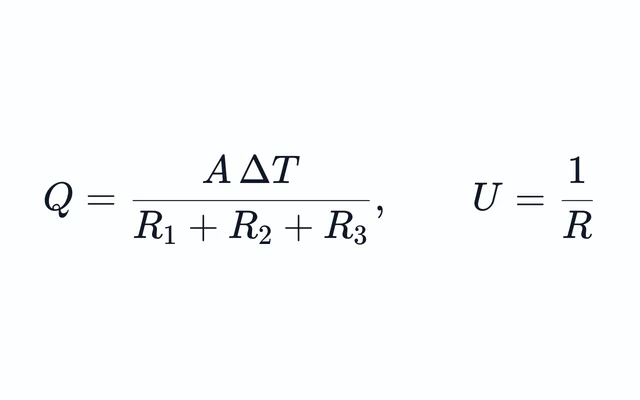
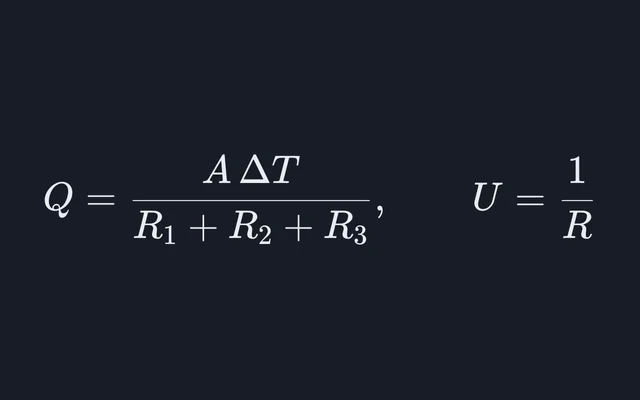
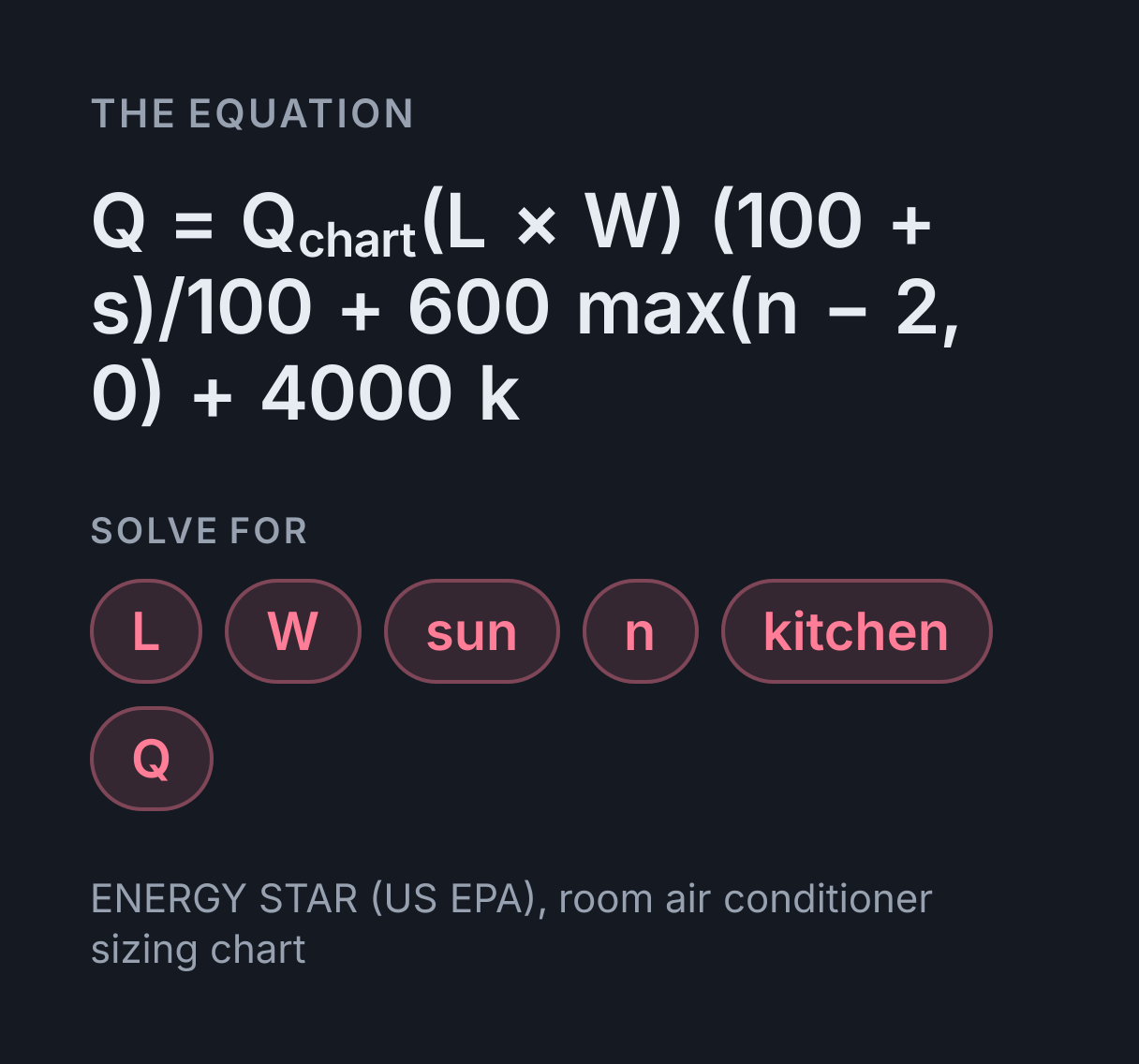
The equation
ENERGY STAR (US EPA), room air conditioner sizing chart
What size air conditioner do I need?
Multiply the room’s length and width in feet and find the area on ENERGY STAR’s chart, from 5,000 BTU per hour at 100 square feet to 34,000 at 2,500. Take 10 percent off for a heavily shaded room, add 10 percent for a very sunny one, then 600 BTU per person beyond two and 4,000 for a kitchen.
The ENERGY STAR room air conditioner sizing chart
| Area to be cooled (sq ft) | Area (m²) | Capacity needed (BTU/h) | Capacity (kW) |
|---|---|---|---|
| 100 up to 150 | 9.3 up to 13.9 | 5,000 | 1.47 |
| 150 up to 250 | 13.9 up to 23.2 | 6,000 | 1.76 |
| 250 up to 300 | 23.2 up to 27.9 | 7,000 | 2.05 |
| 300 up to 350 | 27.9 up to 32.5 | 8,000 | 2.34 |
| 350 up to 400 | 32.5 up to 37.2 | 9,000 | 2.64 |
| 400 up to 450 | 37.2 up to 41.8 | 10,000 | 2.93 |
| 450 up to 550 | 41.8 up to 51.1 | 12,000 | 3.52 |
| 550 up to 700 | 51.1 up to 65.0 | 14,000 | 4.10 |
| 700 up to 1,000 | 65.0 up to 92.9 | 18,000 | 5.28 |
| 1,000 up to 1,200 | 92.9 up to 111.5 | 21,000 | 6.15 |
| 1,200 up to 1,400 | 111.5 up to 130.1 | 23,000 | 6.74 |
| 1,400 up to 1,500 | 130.1 up to 139.4 | 24,000 | 7.03 |
| 1,500 up to 2,000 | 139.4 up to 185.8 | 30,000 | 8.79 |
| 2,000 up to 2,500 | 185.8 up to 232.3 | 34,000 | 9.96 |
ENERGY STAR, run by the US Environmental Protection Agency, publishes the chart in square feet and BTU per hour; the m² and kW columns are conversions added here. Its rows share their edges, so a room exactly on one, such as 15 by 20 ft at 300 sq ft, is read into the row that starts there: 8,000 BTU/h rather than 7,000. The calculator says whenever a room lands on an edge.
The capacity per square foot is not constant. It falls from 50 BTU/h per sq ft at 100 sq ft to 13.6 at 2,500 sq ft, so no single BTU-per-square-foot figure reproduces the chart. ENERGY STAR calculates the capacities for an 8-foot ceiling and gives no rule for a taller room; a 10-foot ceiling encloses a quarter more air over the same floor, and nothing is added for it here.
How the sun, shade, people and kitchen adjustments work
ENERGY STAR’s adjustments come in two kinds. Shade and sun scale the chart figure, and a room takes one or neither. People and a kitchen add fixed amounts that do not grow with the room: the kitchen allowance is the same for a small galley as for a large kitchen, and only people beyond the two the chart already allows for count, as long as they use the room regularly.
ENERGY STAR does not say in which order to apply them, and the order matters once a percentage meets a fixed amount. A very sunny 6,000 BTU/h kitchen needs 10,600 BTU/h with the 10 percent taken on the chart figure, as this calculator takes it, and 11,000 with it taken on the total. The working prints every term, so another reading can be checked against it.
Why a bigger air conditioner is not better
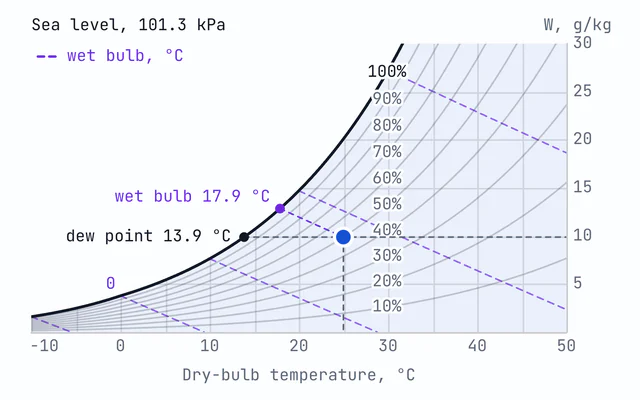
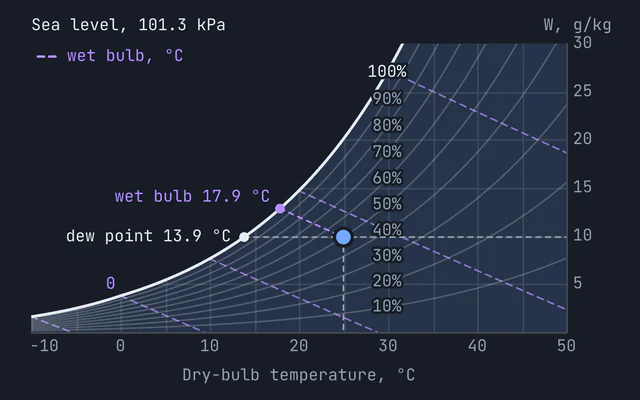
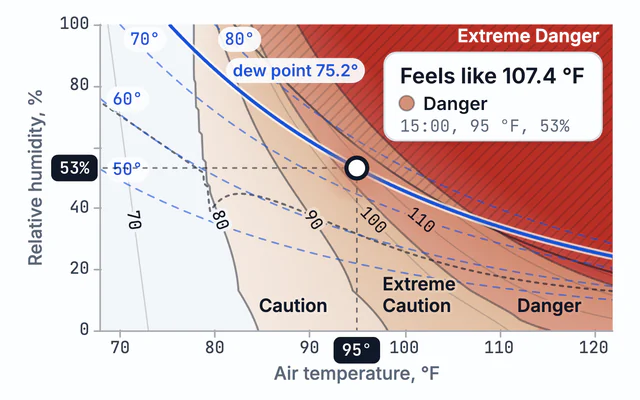
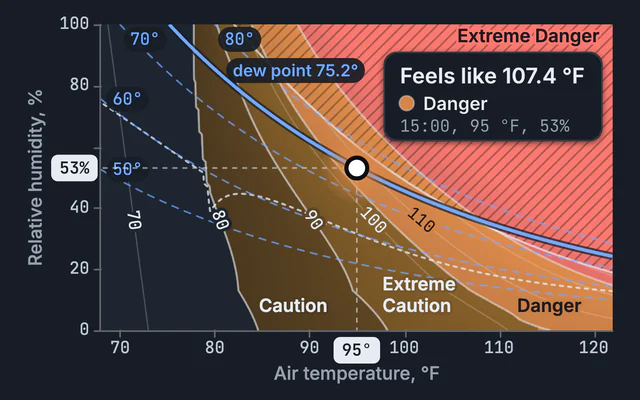
ENERGY STAR warns that a unit too large for the room is less effective: it cools the room before it has had the chance to remove the humidity, and the cool, moist air feels damp and clammy. An air conditioner dries air by cooling it below its dew point on the coil, where the water condenses and drains away, and the psychrometric chart explorer follows that path across the chart. Humid air also feels hotter at the same temperature, which the heat index calculator puts a number on.
BTU, tons and kilowatts
A BTU per hour is a rate of heat removal. A ton of refrigeration is defined as 12,000 BTU/h, the rate that melts a short ton of ice, 2,000 lb, in 24 hours, taking 144 BTU to melt each pound, so a 6,000 BTU/h unit is half a ton. One BTU/h is 0.29307 W, from the International Table BTU of 1055.05585262 J, which makes a ton 3.517 kW.
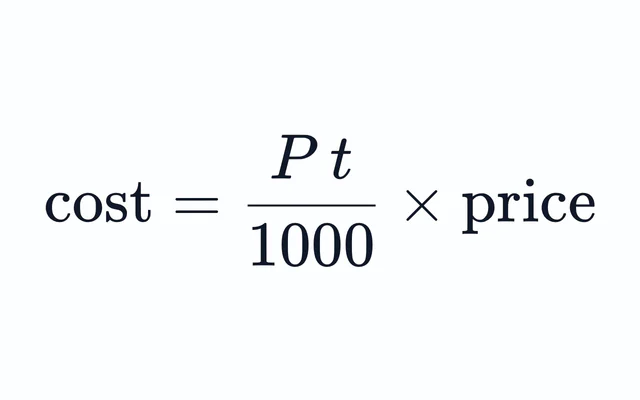
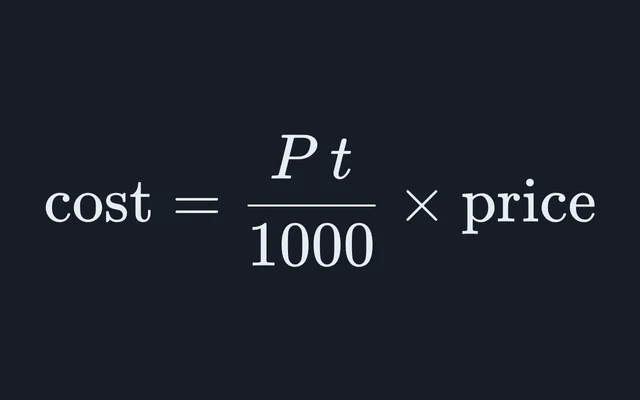
Those kilowatts are the heat the unit takes out of the room, not the power it draws from the outlet, which is smaller and printed on its rating label. To price the running cost, put that label wattage into the electricity cost calculator.
Measuring the room
ENERGY STAR measures the floor in feet, with inches turned into a fraction of a foot. For an L-shaped or irregular room it suggests dividing the floor into rectangles and triangles, a triangle being half its length times its width, and adding the pieces. To enter a total worked out that way, type it as the length and set the width to 1, in ft for an area in square feet or in m for one in m².
Common mistakes
- Adding 600 BTU/h for every person. The chart already allows for two, so four people add 1,200 BTU/h, not 2,400.
- Typing inches as decimals. 12 ft 6 in is 12.5 ft, not 12.6, because a foot has 12 inches.
- Reading m² as square feet. A 20 m² room is 215.3 sq ft, a 6,000 BTU/h room on the chart. Taken as 20 sq ft it would fall below the chart altogether.
- Sizing a central system with it. The chart is for room air conditioners, each cooling one room. A whole-house system is sized from a load calculation, such as ACCA Manual J, that counts the building’s walls, windows and insulation.
Converting units first? Use the length conversion table.
Worked examples
Each one runs through the calculator above, so the arithmetic here is the arithmetic it does.
What size air conditioner does a 4 m by 5 m room need?
- A = L x W
- = 13.12 ft x 16.4 ft (4 m x 5 m)
- = 215.3 sq ft (20 m²)
- ENERGY STAR chart, 150 up to 250 sq ft: 6,000 BTU/h
- Q = 6,000 BTU/h
ENERGY STAR’s chart is in square feet, so a room measured in metric units is converted first, at 0.09290304 m² to the square foot: 20 m² is 215.3 sq ft. The 6,000 BTU/h it needs is 1.758 kW, the figure to compare with a cooling capacity given in kilowatts.
How many BTU does a 14 by 12 ft kitchen need with four people in it?
- A = L x W
- = 14 ft x 12 ft (4.267 m x 3.658 m)
- = 168 sq ft (15.61 m²)
- ENERGY STAR chart, 150 up to 250 sq ft: 6,000 BTU/h
- Q = 6,000 + 600 x (4 - 2) + 4,000
- = 6,000 + 1,200 + 4,000
- = 11,200 BTU/h
The chart already allows for two people, so of the four only two add 600 BTU/h each. The kitchen allowance is a flat 4,000 BTU/h whatever the kitchen’s size, so in a room this small it adds two thirds of the chart figure.
What size air conditioner does a very sunny 25 by 20 ft living room need?
- A = L x W
- = 25 ft x 20 ft (7.62 m x 6.096 m)
- = 500 sq ft (46.45 m²)
- ENERGY STAR chart, 450 up to 550 sq ft: 12,000 BTU/h
- Q = 12,000 x 1.10
- = 13,200 BTU/h
The 10 percent is taken on the chart figure, 12,000 BTU/h for 450 up to 550 sq ft, before anything is added. 13,200 BTU/h is 1.1 tons of refrigeration, or 3.869 kW.
Practise this with Thermodynamics Practice Problems, questions generated from this calculator and 13 other calculators in Thermodynamics.
Common questions
How many square feet does a 12,000 BTU air conditioner cool?
On ENERGY STAR’s chart, 12,000 BTU/h, one ton, is the capacity for 450 up to 550 square feet. The row below, 10,000 BTU/h, covers 400 up to 450 square feet, and the row above, 14,000 BTU/h, covers 550 up to 700. A very sunny room needs 10 percent more and a kitchen 4,000 BTU/h more, so in either a 12,000 BTU/h unit covers less floor.
How many BTU per square foot does an air conditioner need?
ENERGY STAR’s chart has no single figure. Small rooms need more per square foot than large ones: 5,000 BTU/h for 100 square feet is 50 BTU/h per square foot, while 34,000 BTU/h for 2,500 square feet is 13.6. So look the room up in the chart rather than multiplying its area by a fixed rate.
Is a bigger air conditioner better?
No. ENERGY STAR says a unit that is too big will be less effective and less efficient: it cools the room before it has a chance to remove the humidity, and the cool, moist air feels damp and clammy. It recommends sizing the unit to the square footage of the space, which is what its chart does.
How do you convert BTU to tons and kW?
Divide BTU per hour by 12,000 for tons of refrigeration, and multiply by 0.29307 for watts, since one BTU/h is 0.29307107 W. So 12,000 BTU/h is 1 ton or 3.517 kW, and 6,000 BTU/h is half a ton or 1.758 kW. These are cooling capacities, the heat removed from the room, not the electricity the unit uses, which is on its rating label.
Do I add 600 BTU for every person in the room?
No, only for each person beyond two who regularly uses the room, because the chart already allows for two. A bedroom shared by two needs nothing extra, four people add 1,200 BTU/h and five add 1,800 BTU/h.
What if my ceiling is higher than 8 feet?
ENERGY STAR calculates its chart for an 8-foot ceiling and gives no rule for a taller room. A 10-foot ceiling encloses a quarter more air over the same floor area, which the chart does not count, and this calculator, which follows the chart, adds nothing for it.
Can I size central air conditioning with this chart?
No. The chart is ENERGY STAR’s for room air conditioners, each cooling one room. A central system for a whole house is sized from a load calculation, such as ACCA Manual J, which counts the building’s walls, windows, insulation and climate rather than its floor area alone.