Electricity Cost Calculator
Find what an appliance costs to run from its watts and hours of use: kWh per day, then the cost per day, month and year at your own price per kWh.
Calculator
The wattage on the rating label or in the manual. It is the most the appliance draws, so one that cycles on and off, like a refrigerator, uses less on average.
Hours the appliance actually draws power each day, up to 24. For one with a thermostat, count the time it spends heating or cooling, not the time it is plugged in.
From your bill, in any currency: 0.15 for 15 cents. The 0.20 shown is only an example. Add every per-kWh charge, supply and delivery together.
In the currency of the price. An average month of 30.44 days.
Working, with your numbers
- E = P x t / 1000
- = 1500 W x 4 h / 1000
- = 6 kWh per day
- C = E x price x 30.4375 days
- = 6 x 0.2 x 30.4375
- = 36.53 per month
Values are converted into the units the equation is worked in before the arithmetic.
- Cost per year A year of 365.25 days, the leap day averaged in.
- 438.30 per year
- Cost per day
- 1.20 per day
- Cost per hour of use What each hour the appliance is drawing its rated power costs.
- 0.30 per hour
- Energy per day
- 6 kWh
- Energy per month Comparable with the kWh used on a monthly bill.
- 182.6 kWh
- Energy per year Comparable with the yearly kWh printed on many appliance energy labels.
- 2192 kWh
Citing this tool
Last updated . Add the date you accessed it as well, which a citation of a page that can change asks for. If a specific result matters, cite the permalink from the tool’s share row instead of this page: it reproduces the exact parameters.
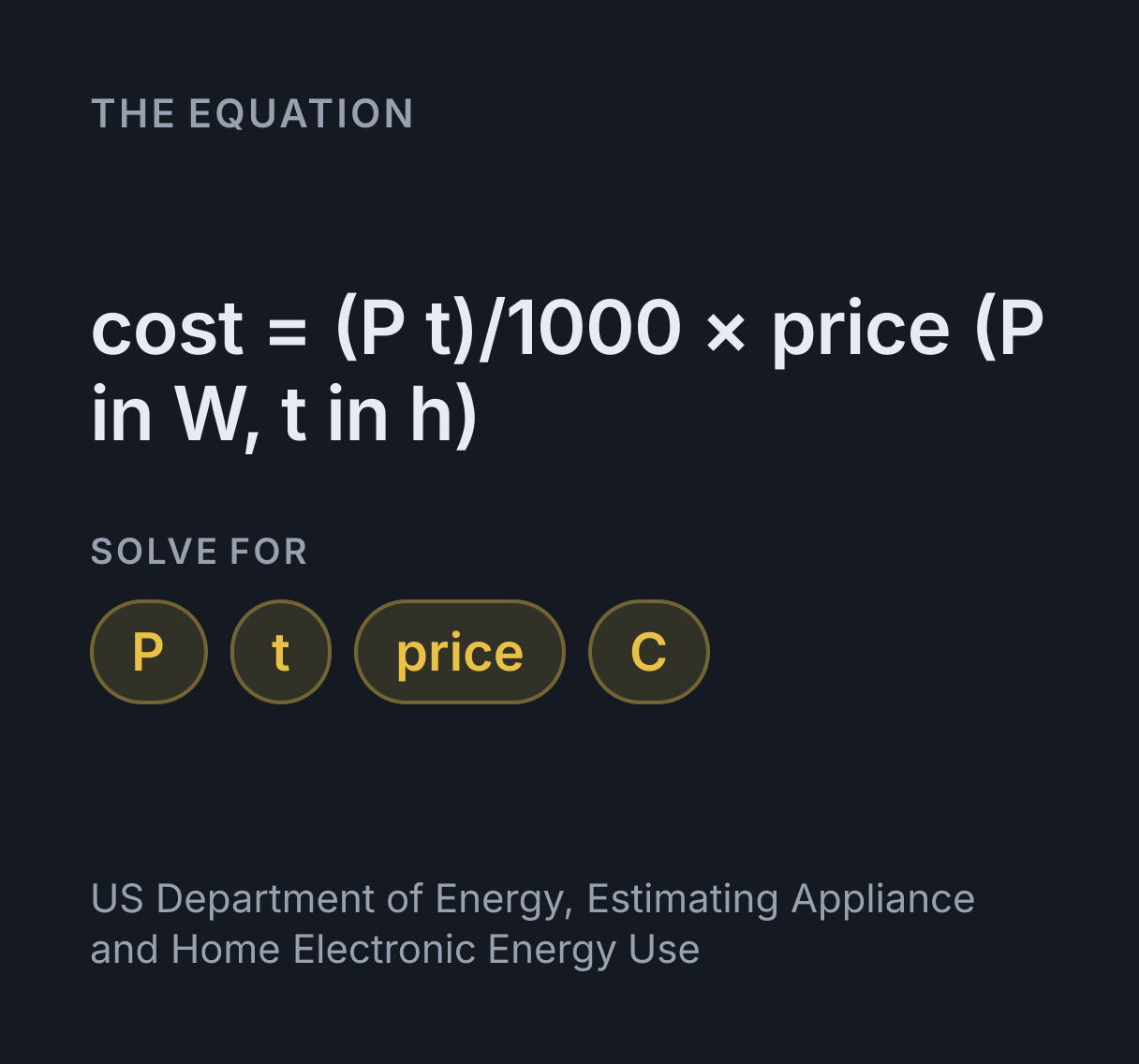
The equation
US Department of Energy, Estimating Appliance and Home Electronic Energy Use
How do you calculate electricity cost?
Multiply the appliance’s power in watts by the hours it runs each day, then divide by 1,000 to get kilowatt-hours (kWh) per day. Multiply the kWh by your price per kWh for the daily cost. An average month is 30.44 days and a year 365.25, so multiply the daily cost by those for monthly and yearly figures.
Finding the wattage, and the hours that count
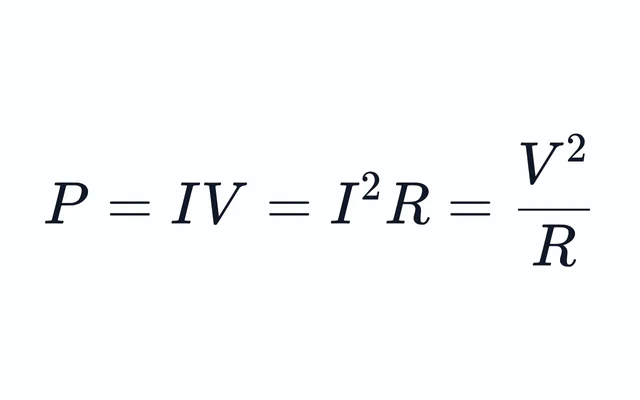
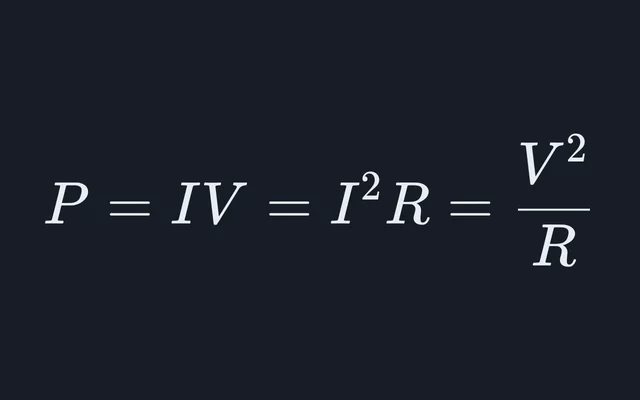
The wattage is on the rating label, usually on the back or base of the appliance, or in its manual. If the label lists only volts and amps, multiply them, or let the electrical power calculator do that step. For a rating in kilowatts, choose kW in the unit menu; the working converts it to watts before the division by 1,000.
The label gives the most the appliance draws. Anything run by a thermostat or a compressor switches itself on and off: a refrigerator, a freezer, an air conditioner, a water heater, a space heater once the room is warm. For those, count the hours it draws power, which are fewer than the hours it is plugged in; the label wattage over the plugged-in hours overstates the cost. A plug-in energy monitor between the outlet and the appliance measures the real kWh. To price a measured figure here, enter the kWh per day as the power in kW and set the hours to 1.
Which price per kWh to use
Many US bills split the per-kWh price in two, a supply or generation charge and a delivery or distribution charge, and both scale with use. Add every charge quoted per kWh to get the price to enter here. Leave out charges that do not depend on use, such as a monthly customer charge in the US or the daily standing charge on a UK bill, because running one more appliance does not change them.
Tiered rates change the price per kWh once monthly use passes a threshold, and time-of-use rates change it with the hour of the day. For either, enter the price for the tier or the hours in which the appliance does most of its running. The calculator works in any currency: type 0.15 for 15 cents and the costs come out in dollars, or type 15 and they come out in cents. The 0.20 it opens with is an example, not an average for any country.
Why a month is 30.44 days here
Calendar months run from 28 to 31 days, so the calculator uses the average month, a twelfth of a 365.25-day year, which keeps twelve monthly costs equal to one yearly cost. A 31-day month costs a little more than the monthly figure and February a little less. A bill covers the days between two meter readings, which need not line up with a calendar month, so check how many days it covers before comparing it with the monthly figure.
Common mistakes
- Leaving out the 1,000. Watts times hours gives watt-hours, and utilities price electricity per kilowatt-hour. Skipping the division makes every cost a thousand times too high.
- Treating kW and kWh as the same thing. A kilowatt is a rate, how fast energy is used; a kilowatt-hour is an amount, the energy used at that rate over an hour. A 2 kW heater uses 2 kWh in one hour and 6 kWh in three.
- Pricing a cycling appliance at its full rating around the clock. A refrigerator entered at its label wattage for 24 hours a day is priced as though its compressor never stops.
- Using only the supply rate. Where delivery is billed per kWh as well, entering the supply price alone understates every figure the calculator gives.
- Forgetting standby power. A television, game console or charger that is switched off but still plugged in can keep drawing a small standby power. Price it as that standby wattage for 24 hours a day.
Converting units first? Use the power conversion table.
Worked examples
Each one runs through the calculator above, so the arithmetic here is the arithmetic it does.
What does it cost a month to charge an EV at 7.2 kW for 3 hours a day at 15 cents a kWh?
- E = P x t / 1000
- = 7200 W x 3 h / 1000
- = 21.6 kWh per day
- C = E x price x 30.4375 days
- = 21.6 x 0.15 x 30.4375
- = 98.62 per month
Charger power is quoted in kilowatts, and the working converts it to watts before dividing by 1,000, so the kWh line is the one to check. The meter counts more energy than the battery stores, because some is lost as heat while charging, so the real cost runs above this figure.
How many hours a day can a 1500 W heater run on 30 a month at 15 cents per kWh?
- t = 1000 x C / (P x price x 30.4375)
- = 1000 x 30 / (1500 x 0.15 x 30.4375)
- = 30,000 / 6848.4
- = 4.381 h per day
Solving for the hours turns a monthly budget into a daily limit. A heater on a thermostat switches its element off once the room is warm, so this counts the hours the element is on, not the hours the heater is switched on.
Practise this with Electricity Practice Problems, questions generated from this calculator and 11 other calculators in Electricity.
Common questions
How do I find how many watts an appliance uses?
Check the rating label, usually on the back or base, or the manual. If it lists only volts and amps, multiply them: 120 V at 10 A is 1,200 W. The label gives the most the appliance draws, so one that cycles on and off, such as a refrigerator, uses less on average, and a plug-in energy monitor measures its real kWh.
Why is my electric bill higher than this estimate?
Bills add charges that do not depend on use, such as a monthly customer charge, and many split the per-kWh price into a supply charge and a delivery charge. Enter the sum of every per-kWh charge as the price. Taxes, tiered rates and time-of-use rates can also make the price you pay differ from the headline rate.
How many days are in a month in this calculator?
30.44, the average month: a 365.25-day year divided by 12, so twelve monthly costs add up to exactly one yearly cost. A 31-day month costs about 2 percent more than the monthly figure, and a 28-day February about 8 percent less.
Does the calculator work in any currency?
Yes. The price is taken in whatever unit you type and every cost comes out in that unit, so 0.15 gives dollars and 15 gives cents, and a price in pence such as 24.5p entered as 0.245 gives pounds. The 0.20 it opens with is an example, not a national average.