Corrected Sodium and Free Water Deficit Calculator
Correct sodium for high glucose by Katz (1.6) and Hillier (2.4), with glucose in mg/dL or mmol/L, plus the free water deficit and the working shown.
Calculator
As the laboratory reports it. mEq/L and mmol/L are the same number for sodium, since it carries a single charge.
mg/dL on American reports, mmol/L on British, Canadian and Australian ones. Choose the unit your report uses. 100 mg/dL is 5.55 mmol/L.
Only used for the free water deficit. The current weight, since the formula estimates the water present now. Choose lb for a weight in pounds.
Only used for the free water deficit. 0.6 for adult men, 0.5 for adult women and older men, 0.45 for older women (Adrogué and Madias, 2000). A fraction, so 0.6 rather than 60.
Working, with your numbers
- Na corr = Na + 1.6 x (glucose - 100) / 100
- glucose = 900 mg/dL = 49.96 mmol/L
- = 135 + 1.6 x (900 - 100) / 100
- = 135 + 1.6 x 8
- = 135 + 12.8
- = 147.8 mmol/L
Values are converted into the units the equation is worked in before the arithmetic.
Above 400 mg/dL, Hillier and colleagues found a factor of 4.0 per 100 mg/dL fitted better than 1.6, so at this glucose the Katz figure may understate the corrected sodium. Their overall factor of 2.4 is shown with the results.
- Corrected sodium, Hillier 2.4 mmol/L per 100 mg/dL above 100, the average fall Hillier and colleagues measured in 1999. Above 100 mg/dL it always corrects further than Katz’s 1.6, and the gap between them widens as glucose rises.
- 154.2 mmol/L
- Correction added, Katz 1.6 for every 100 mg/dL of glucose above 100, and nothing at or below 100, where there is no excess glucose to draw water out of cells.
- +12.8 mmol/L
- Corrected sodium reads as Hyponatremia is below 135 mmol/L in the 2014 European clinical practice guideline, and hypernatremia above 145 mmol/L as Adrogué and Madias define it. When the two corrections land in different bands, the classification depends on the factor chosen.
- Above 145 by both
- Glucose in both units mmol/L times 18.016 gives mg/dL, from glucose’s molar mass of 180.16 g/mol. Both factors are written per 100 mg/dL, so a glucose in mmol/L is converted before the arithmetic.
- 900 mg/dL, 49.96 mmol/L
- Total body water Weight in kg times the water fraction. An estimate, since the fraction stands in for a body composition that age, sex and fat mass all shift.
- 42 L
- Free water deficit, measured sodium TBW × (Na ÷ 140 − 1) with the sodium as measured, which only gives a deficit above 140 mmol/L. It is the water missing now: losses still under way add to it, and it does not say how fast to replace it.
- None
- Free water deficit, corrected sodium The same formula with the Katz corrected sodium, the sodium expected once glucose is back to 100 mg/dL and the water it drew out of cells has moved back. The same as the line above unless glucose is over 100 mg/dL.
- 2.34 L
Citing this tool
Last updated . Add the date you accessed it as well, which a citation of a page that can change asks for. If a specific result matters, cite the permalink from the tool’s share row instead of this page: it reproduces the exact parameters.
The equation
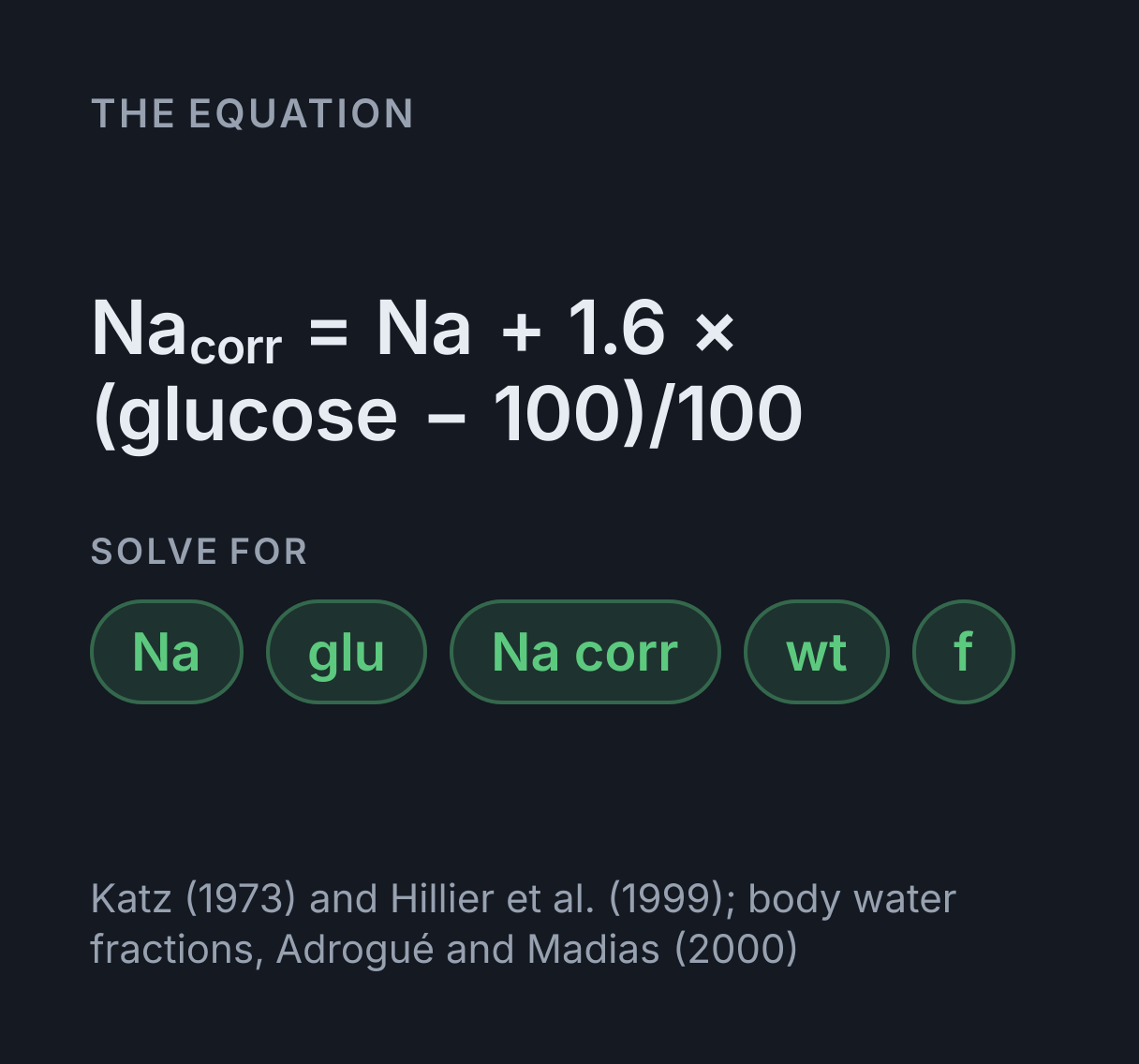
Katz (1973) and Hillier et al. (1999); body water fractions, Adrogué and Madias (2000)
How do you calculate corrected sodium?
Corrected sodium = measured sodium + 1.6 × (glucose − 100) / 100, with sodium in mmol/L (the same number as mEq/L) and glucose in mg/dL. This is the Katz correction, the factor in the 2024 consensus report on hyperglycemic crises. Hillier’s alternative uses 2.4. At or below a glucose of 100 mg/dL, nothing is added.
Why a high glucose lowers the measured sodium
Glucose that cannot get into cells stays in the extracellular fluid, and there it behaves as sodium does: it is an effective osmole, so it draws water out of cells. That water dilutes the extracellular sodium although none has been lost, which makes this a hypertonic hyponatremia: the sodium is genuinely low while the osmolality is raised. As the glucose comes down, the water moves back into cells and the sodium climbs toward the corrected figure.
The correction is therefore a prediction: the sodium this patient would have at a glucose of 100 mg/dL if nothing else about their salt and water changed. Read at face value, the measured sodium misleads in both directions. A low reading can be entirely the glucose’s doing. A normal reading beside a very high glucose deserves more attention, because corrected it can be a hypernatremia, and the water loss behind it stays hidden until the glucose falls.
Katz or Hillier: 1.6 or 2.4
Katz’s 1973 factor was a calculation of the expected fall, not a measurement in patients, and no controlled experiment tested it until Hillier, Abbott and Barrett in 1999. In 6 healthy volunteers, somatostatin blocked insulin secretion while a dextrose infusion took the glucose above 600 mg/dL, and the sodium fell by an average of 2.4 mmol/L per 100 mg/dL. The fall was not a straight line. Up to 400 mg/dL the standard 1.6 worked well, and above 400 mg/dL a factor of 4.0 fitted better, which is why the calculator flags a glucose over 400.
Neither figure settles the question, since healthy volunteers given dextrose are not a patient in ketoacidosis with vomiting and an osmotic diuresis. Both are shown, and where they land on different sides of 135 or 145 the readout says so, because the classification then depends on the factor chosen rather than on the patient.
Glucose in mmol/L
Both factors are written per 100 mg/dL of glucose. American reports use mg/dL, while British, Canadian and Australian ones use mmol/L. Glucose’s molar mass is 180.16 g/mol, so 1 mmol/L is 18.016 mg/dL and the baseline of 100 mg/dL is 5.55 mmol/L. Worked per mmol/L, each mmol/L above 5.55 adds 0.288 mmol/L of sodium by Katz and 0.432 by Hillier.
Choose mmol/L in the glucose field and the calculator converts before the arithmetic, and the working prints the glucose in both units. The slip to avoid is a mmol/L figure typed into a field set to mg/dL: every value up to 100 then reads as a normal glucose, and nothing is corrected.
How do you calculate the free water deficit?
Free water deficit = total body water × (sodium / 140 − 1), where total body water is current weight in kg times a fraction: 0.6 for adult men, 0.5 for adult women and older men, and 0.45 for older women (Adrogué and Madias). The result is in litres, and a sodium of 140 mmol/L or below gives none.
The formula rests on one assumption, that the body’s sodium content does not change while the water is put back. Sodium times body water now must then equal 140 times the body water needed, and the water needed minus the water present is the deficit. Its limits follow from that:
- It counts the water missing now. Water still being lost in urine, stool and breath adds to it.
- It assumes pure water was lost. When sodium and potassium went with it, as they do in an osmotic diuresis, the fluid needed is larger than the free water figure.
- It says nothing about the rate. How fast to give the water depends on how quickly the hypernatremia developed and on the protocol in use.
- The fraction is an estimate. It stands for an average body composition, and fat holds little water, so in obesity weight times the fraction overstates body water and the deficit with it.
Measured or corrected sodium in the deficit
At a normal glucose the two give the same deficit. At a high glucose they do not, and the calculator shows both rather than choosing. The measured sodium describes the body now, with glucose still holding water outside cells. The corrected sodium is the one expected after the glucose has fallen and that water has moved back, so the deficit from it is the water needed to bring the sodium to 140 once that shift has happened.
However high the glucose, then, a measured sodium that is not raised hides the deficit entirely. That is how a reassuring sodium can sit beside the profound water loss of a hyperosmolar state, and it is the case the calculator opens on.
Common mistakes
- Reading the sodium without the glucose. A low sodium beside a high glucose may be no sodium disorder once corrected, and a normal one may be a hypernatremia.
- Entering glucose in the wrong unit. A glucose in mmol/L typed as mg/dL sits below 100, and the correction silently disappears.
- Running the formula below 100 mg/dL. Applied linearly, it would subtract sodium at a glucose of 80 for a glucose excess that does not exist, so this calculator adds nothing at or below 100.
- Entering pounds as kilograms. A weight in pounds with the field left on kg makes the body water, and the deficit, about 2.2 times too large. Choose lb instead.
- Typing the water fraction as a percentage. The field takes 0.6 for a man and refuses 60.
- Treating the deficit as the whole prescription. It is the free water missing now. Ongoing losses, and any salt lost with the water, come on top of it.
Worked examples
Each one runs through the calculator above, so the arithmetic here is the arithmetic it does.
What is the corrected sodium for a sodium of 130 and a glucose of 600 mg/dL?
- Na corr = Na + 1.6 x (glucose - 100) / 100
- glucose = 600 mg/dL = 33.3 mmol/L
- = 130 + 1.6 x (600 - 100) / 100
- = 130 + 1.6 x 5
- = 130 + 8
- = 138 mmol/L
Low as measured and inside 135 to 145 once corrected, so the glucose explains the whole of this low reading. Hillier’s 2.4 gives 142 from the same figures, still inside the range.
What is the corrected sodium for a sodium of 138 and a glucose of 40 mmol/L?
- Na corr = Na + 1.6 x (glucose - 100) / 100
- glucose = 720.6 mg/dL = 40 mmol/L
- = 138 + 1.6 x (720.6 - 100) / 100
- = 138 + 1.6 x 6.206
- = 138 + 9.93
- = 147.9 mmol/L
A glucose in mmol/L is converted first: 40 mmol/L is 720.6 mg/dL. The normal looking 138 corrects to above 145 by both factors, a hypernatremia the measured value hides. Typed into a field set to mg/dL, the same 40 sits below 100 and nothing is added.
What glucose would lower a sodium of 140 to 126 on its own?
- glucose = 100 + 100 x (Na corr - Na) / 1.6
- = 100 + 100 x (140 - 126) / 1.6
- = 100 + 100 x 14 / 1.6
- = 100 + 875
- = 975 mg/dL = 54.12 mmol/L
Working backwards gives the glucose that would explain the whole fall from 140 by itself. It would take 975 mg/dL, so beside an ordinary glucose a sodium of 126 is a hyponatremia with a cause of its own.
Practise this with Lab and Clinical Calculation Practice Problems, questions generated from this calculator and 20 other calculators in Biology.
Common questions
Should I use the 1.6 or the 2.4 correction factor?
Use the one your course or protocol names, and know why they differ. Katz’s 1.6 from 1973 was calculated rather than measured, and it is the factor in the 2009 and 2024 consensus reports on hyperglycemic crises. Hillier and colleagues measured the fall in 6 healthy volunteers in 1999 and found 2.4 per 100 mg/dL on average, with 1.6 working well up to 400 mg/dL and 4.0 fitting better above it. For a sodium of 130 at a glucose of 600 mg/dL, Katz gives 138 and Hillier 142.
How do I correct sodium when glucose is in mmol/L?
Convert the glucose to mg/dL first by multiplying by 18.016, or use the factor per mmol/L. Glucose’s molar mass is 180.16 g/mol, so the 100 mg/dL baseline is 5.55 mmol/L, and each mmol/L above it adds 0.288 mmol/L of sodium by Katz or 0.432 by Hillier. A glucose of 33.3 mmol/L is about 600 mg/dL and adds 8.0 by Katz. The common slip is entering 33.3 into an mg/dL formula, where it sits below the baseline and adds nothing.
What is the free water deficit for a 70 kg man with a sodium of 160?
About 6.0 L. His total body water is 0.6 × 70 = 42 L, and 42 × (160 / 140 − 1) = 6.0 L. For a 70 kg adult woman, at a fraction of 0.5, it is 5.0 L, and for an older woman of the same weight at 0.45 it is 4.5 L. The figure is the water missing at that moment: losses still under way add to it, and how fast to replace it is a separate decision that depends on how quickly the sodium rose.
Why does the sodium rise as glucose falls in HHS?
Because the water the glucose drew out of cells moves back in as the glucose comes down, so the measured sodium climbs toward the corrected value. The 2024 consensus report on hyperglycemic crises puts the rise at 1.6 mmol/L for every 100 mg/dL fall in glucose, and says the initial rise is not in itself a reason to give hypotonic fluids. A measured 132 beside a glucose of 900 mg/dL corrects to 144.8 by Katz: the sodium to expect at a glucose of 100 mg/dL if nothing else about salt and water had changed.
Is a low sodium with a high glucose pseudohyponatremia?
No. Pseudohyponatremia is a measurement error: very high lipids or proteins take up part of the plasma volume, an indirect ion-selective electrode then reads the sodium falsely low, and the osmolality is normal. A high glucose causes a real fall, because water leaves cells and genuinely dilutes the sodium, and the osmolality is raised. That is why the sodium is corrected for glucose with a factor rather than remeasured on a direct electrode.