Dew Point Calculator
Calculate the dew point from air temperature and relative humidity in °F or °C, or humidity from a dew point, with the frost point below freezing.
Calculator
From 32 to 122 °F (0 to 50 °C).
Working, with your numbers
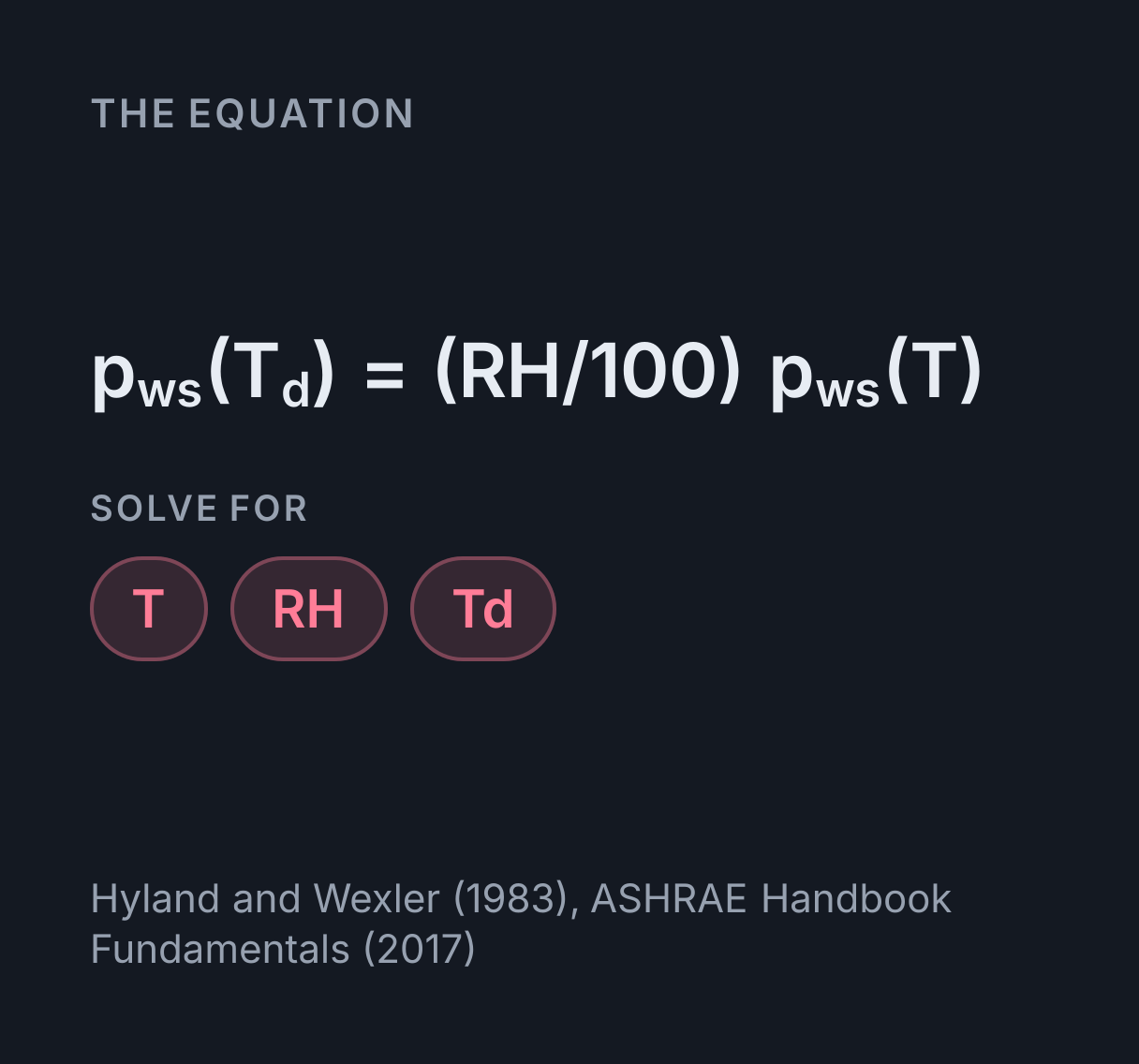
- pw = RH / 100 x pws(T)
- T = 30 °C (86 °F), pws(T) = 4.246 kPa
- = 60 / 100 x 4.246
- = 2.5476 kPa
- Td = the temperature at which pws = 2.5476 kPa
- = 21.39 °C (70.5 °F)
Values are converted into the units the equation is worked in before the arithmetic.
- Dew point, over water The temperature this air must cool to, with its moisture and pressure unchanged, before dew forms.
- 70.5 °F (21.4 °C)
- Magnus approximation, over water Alduchov and Eskridge’s (1996) Magnus formula, td = 243.04 γ / (17.625 − γ) with γ = ln(RH/100) + 17.625 t / (243.04 + t). Above freezing it agrees with the answer within 0.06 °C (0.1 °F).
- 70.5 °F (21.4 °C)
- Vapour pressure 25.48 hPa (millibars). pw = RH × pws(T), from Hyland and Wexler’s saturation pressure.
- 2.548 kPa
- Air minus dew point The dew point depression. The smaller it is, the nearer the air is to saturation; at 100 percent it is zero.
- 15.5 °F (8.6 °C)
Use this answer in
Citing this tool
Last updated . Add the date you accessed it as well, which a citation of a page that can change asks for. If a specific result matters, cite the permalink from the tool’s share row instead of this page: it reproduces the exact parameters.
The equation
Hyland and Wexler (1983), ASHRAE Handbook Fundamentals (2017)
How do you calculate dew point?
Multiply the saturation vapour pressure at the air temperature by the relative humidity to get the air’s actual vapour pressure, then find the temperature at which that pressure would saturate the air: that is the dew point. The Magnus formula is a close shortcut: Td = 243.04γ / (17.625 − γ), where γ = ln(RH/100) + 17.625T / (243.04 + T), with T in °C.
What the dew point tells you
The dew point is a measure of how much water vapour is in the air, fixed by the vapour pressure alone. Cool the air without adding or removing water and it reaches saturation at the dew point, where dew, fog or condensation on a cold glass begins. Relative humidity is a different kind of number: it compares the vapour pressure with the saturation vapour pressure at the air’s current temperature, so it changes whenever the temperature does.
That makes the dew point the steadier measure of how humid a day is. The calculator’s default, 86 °F at 60 percent, has a dew point of 70.5 °F. The same air cooled to 75 °F in the evening is at 85.9 percent, and warmed to 95 °F it is at 45.3 percent, with the dew point unchanged throughout. The gap between the air temperature and the dew point, shown in the readouts, shrinks to zero as the air nears saturation.
How the calculator finds it
The saturation vapour pressure comes from Hyland and Wexler’s (1983) equations, as ASHRAE Handbook Fundamentals (2017) gives them, and the dew point is found by searching for the temperature at which that pressure equals the vapour pressure in the air. The psychrometric chart explorer and the heat index calculator run the same two functions, so all three pages give one dew point for the same air. No barometric pressure is needed, because the dew point depends only on the vapour pressure.
The Magnus formula is shown beside the answer, with Alduchov and Eskridge’s (1996) coefficients. Wherever the dew point is above freezing it agrees with Hyland and Wexler within 0.06 °C (0.1 °F), across air from 32 to 122 °F (0 to 50 °C) and humidities from 1 to 100 percent. Choose relative humidity or air temperature as the unknown and the same saturation pressure runs in reverse.
Dew point or frost point
Dry air can have its saturation point below freezing even when the air itself is warmer. There the vapour saturates over ice before it would over supercooled water, so the temperature the calculator reports is the frost point, and the readouts label it as one. The Magnus readout keeps to water, so below freezing it gives a lower figure, the dew point over supercooled water.
For the same reason the calculator takes air only from 32 °F (0 °C) upward. Weather observations quote relative humidity over water even in frost, while other references, ASHRAE among them, measure it over ice below freezing, and the two saturation pressures differ by about 10 percent at 14 °F (−10 °C). A dew point given below 32 °F could be either kind, so it is refused as an input too.
Using the dew point elsewhere
The humidex calculator takes a dew point directly, and once this calculator has found one it offers to carry the value over. The heat index calculator accepts a relative humidity or a dew point. For the rest of the moist air properties of the same state, wet bulb, humidity ratio and enthalpy among them, the psychrometric chart explorer plots it.
Common mistakes
- Pairing an indoor humidity with an outdoor temperature. Relative humidity belongs to the air it was measured in. Air brought indoors and heated keeps its dew point but loses relative humidity, so the two readings have to come from the same place.
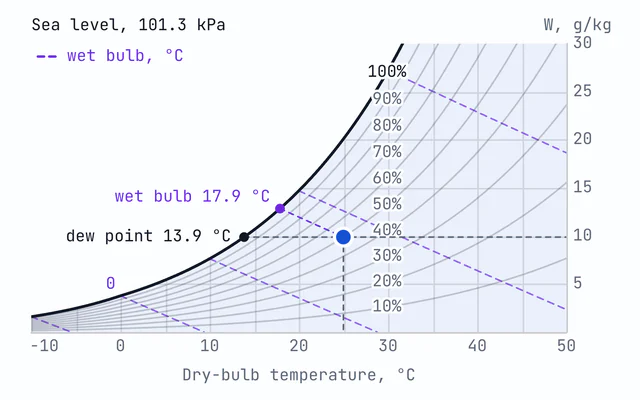
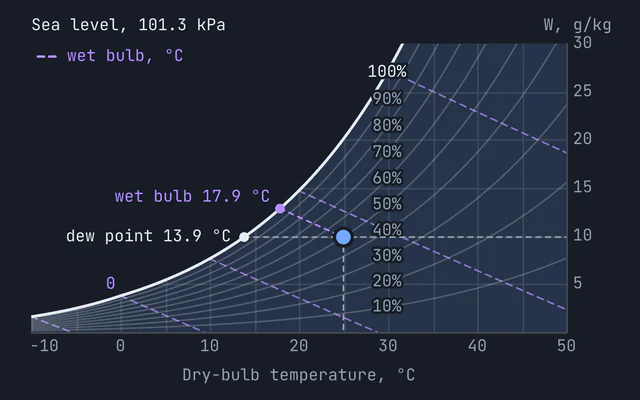
- Entering a wet-bulb reading as the dew point. The wet bulb lies between the dew point and the air temperature, so the humidity comes out too high. Air at 25 °C and 50 percent has a wet bulb of 17.9 °C at sea level, and 17.9 °C entered as a dew point gives 64.7 percent. The psychrometric chart explorer turns a wet bulb into a dew point properly.
- Expecting altitude to move the dew point. The same temperature and relative humidity give the same dew point at any altitude. Pressure changes the humidity ratio and the wet bulb instead.
Converting units first? Use the temperature conversion table.
Worked examples
Each one runs through the calculator above, so the arithmetic here is the arithmetic it does.
What is the relative humidity at 30 °C with a dew point of 20 °C?
- RH = 100 x pws(Td) / pws(T)
- Td = 20 °C (68 °F), T = 30 °C (86 °F)
- = 100 x 2.3388 kPa / 4.246 kPa
- = 55.08 %
Run backwards, from a dew point to a relative humidity: the ratio of the saturation pressure at the dew point to the one at the air temperature. Weather reports often give the dew point, and this is the humidity it implies.
How warm is air at 40 percent humidity with a 60 °F dew point?
- pws(T) = 100 x pws(Td) / RH
- Td = 15.56 °C (60 °F), pws(Td) = 1.7674 kPa
- = 100 x 1.7674 / 40
- = 4.4186 kPa
- T = the temperature at which pws = 4.4186 kPa
- = 30.7 °C (87.25 °F)
Solved for the air temperature: warming air leaves its dew point alone and lowers its relative humidity, so the moisture that is 40 percent at 87.3 °F saturates at 60 °F. A glass of iced water in it collects condensation.
What is the dew point of 50 °F air at 30 percent relative humidity?
- pw = RH / 100 x pws(T)
- T = 10 °C (50 °F), pws(T) = 1.228 kPa
- = 30 / 100 x 1.228
- = 0.3684 kPa
- Tf = the temperature at which pws over ice = 0.3684 kPa, the frost point
- = -6.01 °C (21.18 °F)
Below 32 °F the answer is a frost point: this air saturates over ice at 21.2 °F (−6.0 °C) before it would over water. The Magnus formula works over water and gives 19.8 °F, so check which of the two a weather report or another calculator means.
Practise this with Thermodynamics Practice Problems, questions generated from this calculator and 13 other calculators in Thermodynamics.
Common questions
What is the difference between dew point and relative humidity?
The dew point measures how much water vapour the air holds, and relative humidity measures how close the air is to saturation at its present temperature. Warm the air without adding water and the dew point stays put while the relative humidity falls: air with a dew point of 50 °F is at 69.5 percent relative humidity at 60 °F and at 35.1 percent at 80 °F.
How do you find relative humidity from the dew point?
Divide the saturation vapour pressure at the dew point by the saturation vapour pressure at the air temperature and multiply by 100. For 90 °F air with a dew point of 75 °F the two are 2.965 and 4.819 kPa, so the relative humidity is 61.5 percent. Choose relative humidity as the unknown and the calculator does this, with the working shown.
Can the dew point be higher than the air temperature?
No. The dew point equals the air temperature when the air is saturated, at 100 percent relative humidity, and is below it otherwise, so the calculator refuses a dew point above the air temperature. The gap between the two, the dew point depression, shrinks as the air nears saturation.
Does altitude change the dew point?
Not for a given amount of water vapour. The dew point depends only on the vapour pressure, so the calculator needs no barometric pressure, and the same temperature and relative humidity give the same dew point at sea level and at altitude. Pressure does change other properties of the same air, such as the humidity ratio and the wet bulb, which the psychrometric chart explorer works out.
What is the frost point?
The temperature at which air saturates over ice. When the saturation point is below 32 °F (0 °C), the air reaches saturation over ice before it would over supercooled water, so its frost point is a little warmer than its dew point over water. Air at 41 °F (5 °C) and 50 percent relative humidity has a frost point of 24.7 °F (−4.0 °C), against a dew point over water of 23.8 °F (−4.6 °C) by the Magnus formula.
How accurate is the Magnus formula for dew point?
With Alduchov and Eskridge’s (1996) coefficients, 17.625 and 243.04 °C, it agrees with the Hyland and Wexler saturation pressure this calculator uses within 0.06 °C (0.1 °F) wherever the dew point is above freezing, for air from 32 to 122 °F (0 to 50 °C) and humidities from 1 to 100 percent. Below freezing it gives the dew point over supercooled water rather than the frost point.