Humidex Calculator
Calculate the humidex from air temperature and dew point with Environment Canada’s formula, in °C or °F, with its comfort scale and the relative humidity.
Calculator
At or below the air temperature. The dew point calculator finds it from the relative humidity.
A number on Environment Canada’s scale, not a temperature in °C or °F.
Working, with your numbers
- T = 30 °C (86 °F), Td = 22 °C (71.6 °F) = 295.15 K
- e = 6.11 x exp[5417.7530 x (1/273.15 - 1/Td)]
- = 6.11 x exp[5417.7530 x (1/273.15 - 1/295.15)]
- = 6.11 x exp(1.478)
- = 26.8 hPa
- H = T + 0.5555 x (e - 10)
- = 30 + 0.5555 x (26.8 - 10)
- = 30 + 9.332
- = 39.33
Values are converted into the units the equation is worked in before the arithmetic.
- Degree of comfort (Environment Canada) By the humidex as a whole number: 20 to 29 little discomfort, 30 to 39 some discomfort, 40 to 45 great discomfort, 46 and over dangerous.
- Some discomfort
- Feels like, in °F Environment Canada reads a humidex of 40 as feeling like 40 °C in dry air, which is 104 °F. The NWS heat index is a different model and gives a different number.
- 102.8 °F
- Vapour pressure e = 6.11 exp[5417.7530 (1/273.15 − 1/Td)], with the dew point in kelvin. 1 hPa is 1 millibar.
- 26.8 hPa
- Relative humidity From the dew point, by the same saturation pressure as the dew point calculator.
- 62.3 %
Citing this tool
Last updated . Add the date you accessed it as well, which a citation of a page that can change asks for. If a specific result matters, cite the permalink from the tool’s share row instead of this page: it reproduces the exact parameters.
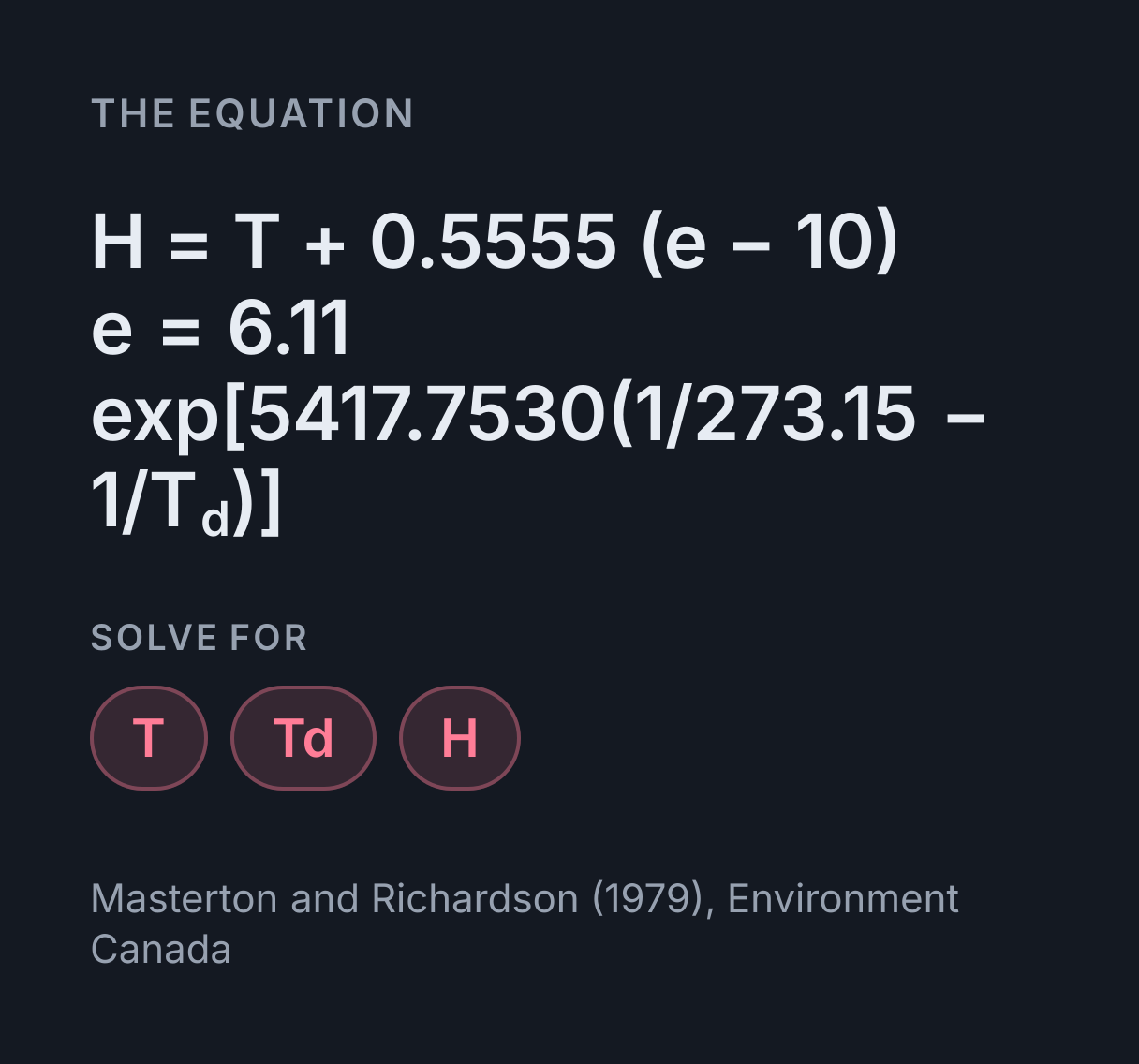
The equation
Masterton and Richardson (1979), Environment Canada
What is the humidex formula?
Environment Canada’s humidex formula is H = T + 0.5555(e − 10), where T is the air temperature in °C and e the vapour pressure in hPa, found from the dew point Td in kelvin: e = 6.11 exp[5417.7530(1/273.15 − 1/Td)]. A humidex of 40 feels about as hot as dry air at 40 °C (104 °F).
Where the formula comes from
The index is Masterton and Richardson’s, published by Environment Canada in 1979, and the constants are the ones its climate glossary prints. The vapour pressure line is a Clausius-Clapeyron form for water: 6.11 hPa is the vapour pressure at a dew point of 0 °C, and the glossary describes 5417.7530 as a rounded constant based on the molecular weight of water, its latent heat of evaporation and the universal gas constant.
The 10 hPa taken from e sets where the humidex equals the air temperature. That vapour
pressure belongs to a dew point of 7.0 °C (44.5 °F); moister air adds 0.5555 for every hPa above
it, and drier air comes out below the air temperature. Environment Canada shows an hourly humidex
only when the air is 20 °C or warmer and the humidex is at least 1 above the air temperature, and
the calculator warns when either condition fails.
Why it takes a dew point
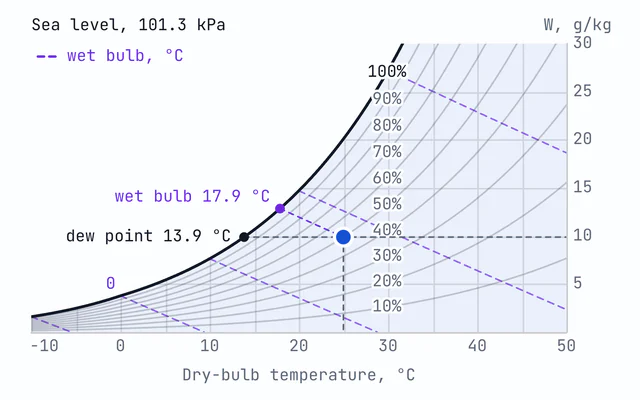
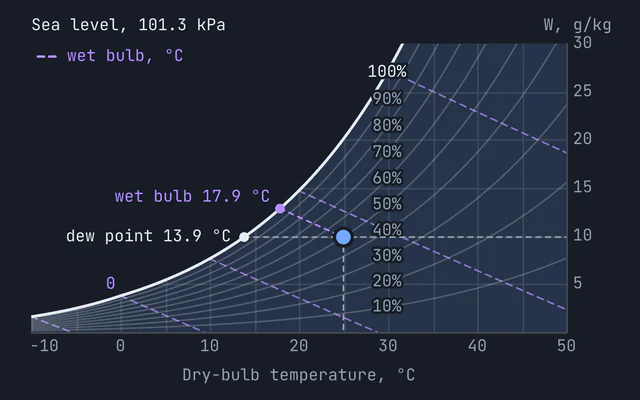
The formula needs the amount of water vapour in the air, and the dew point fixes it on its own, whatever the air temperature. A relative humidity has to be turned into a dew point first, which the dew point calculator does and can then pass straight to this one. With wet-bulb and dry-bulb readings instead, the psychrometric chart explorer gives the dew point. The relative humidity readout here uses the same saturation pressure as both of those pages, so the three agree.
Environment Canada’s printed humidex table is set in relative humidity rather than dew point. Turning each of its 291 cells into a dew point with that saturation pressure and putting it through this formula reproduces 276 of them exactly and comes within 0.6 of every one. The other 15 lie within 0.07 of a half, where a second saturation formula can tip the rounding.
Reading the humidex scale
| Humidex | Degree of comfort |
|---|---|
| 20 to 29 | Little discomfort |
| 30 to 39 | Some discomfort |
| 40 to 45 | Great discomfort; avoid exertion |
| 46 and over | Dangerous; possible heat stroke |
Environment Canada calls any humidex over 40 extremely high and advises reducing all unnecessary physical activity at that point. The scale is a guide to comfort, not a medical assessment, so follow local heat warnings where they are issued.
Humidex and heat index are different numbers
The US National Weather Service uses the heat index, Rothfusz’s regression on Steadman’s model of a person, worked out from the relative humidity. It is a separate model with its own scale, and the two disagree for the same air: at 30 °C (86 °F) with a 22 °C dew point, the default above, the humidex is 39.3 while the heat index calculator gives 33.3 °C (91.9 °F). Read each against its own categories. In cold weather the counterpart of both is the wind chill calculator.
Common mistakes
- Putting the relative humidity in the dew point field. With the dew point in °F, a humidity of 60 percent typed there reads as a dew point of 60 °F, which is valid, so nothing catches it: at 30 °C it gives a humidex of 34.3 instead of 38.8. Find the dew point first; at 30 °C and 60 percent it is 21.4 °C (70.5 °F).
- Reading the humidex as a temperature in °F. Its scale compares with °C, so a humidex of 35 does not mean 35 °F: it feels like 95 °F, the figure the readouts give beside it.
- Holding it to the NWS heat index bands. Caution, Danger and the rest belong to the heat index. The humidex has the four degrees of comfort in the table above.
Converting units first? Use the temperature conversion table.
How to calculate humidex
- Write down the formula:
H = T + 0.5555 · (e - 10), e = 6.11 · exp[5417.7530 · (1/273.15 - 1/Td)] -
Gather the values it needs. The calculator above starts with these:
- Air temperature: T = 30 °C
- Dew point: Td = 22 °C
-
Substitute them and work through the arithmetic:
- T = 30 °C (86 °F), Td = 22 °C (71.6 °F) = 295.15 K
- e = 6.11 x exp[5417.7530 x (1/273.15 - 1/Td)]
- = 6.11 x exp[5417.7530 x (1/273.15 - 1/295.15)]
- = 6.11 x exp(1.478)
- = 26.8 hPa
- H = T + 0.5555 x (e - 10)
- = 30 + 0.5555 x (26.8 - 10)
- = 30 + 9.332
- = 39.33
-
To find one of the other values instead, rearrange the formula for it:
- Air temperature:
T = H - 0.5555 · (e - 10) - Dew point:
Td = 1 ÷ [1/273.15 - ln(e ÷ 6.11) ÷ 5417.7530], e = (H - T) ÷ 0.5555 + 10
- Air temperature:
Worked examples
Each one runs through the calculator above, so the arithmetic here is the arithmetic it does.
What is the humidex at 21 °C and 100 percent humidity?
- T = 21 °C (69.8 °F), Td = 21 °C (69.8 °F) = 294.15 K
- e = 6.11 x exp[5417.7530 x (1/273.15 - 1/Td)]
- = 6.11 x exp[5417.7530 x (1/273.15 - 1/294.15)]
- = 6.11 x exp(1.416)
- = 25.18 hPa
- H = T + 0.5555 x (e - 10)
- = 21 + 0.5555 x (25.18 - 10)
- = 21 + 8.431
- = 29.43
Environment Canada’s own example: saturated air at 21 °C feels like 29. At 100 percent relative humidity the dew point equals the air temperature, so the same 21 °C goes into both fields.
What air temperature gives a humidex of 46 with a 75 °F dew point?
- Td = 23.89 °C (75 °F) = 297.04 K
- e = 6.11 x exp[5417.7530 x (1/273.15 - 1/Td)]
- = 6.11 x exp[5417.7530 x (1/273.15 - 1/297.04)]
- = 6.11 x exp(1.595)
- = 30.12 hPa
- T = H - 0.5555 x (e - 10)
- = 46 - 0.5555 x (30.12 - 10)
- = 46 - 11.17
- = 34.83 °C (94.69 °F)
46 is where Environment Canada’s scale turns dangerous, with heat stroke possible. With the dew point held, each degree of air temperature adds exactly one to the humidex, so the vapour pressure term is the whole gap between them.
What dew point makes the humidex 40 at 30 °C?
- T = 30 °C (86 °F)
- e = (H - T) / 0.5555 + 10
- = (40 - 30) / 0.5555 + 10
- = 28 hPa
- Td = 1 / [1/273.15 - ln(e / 6.11) / 5417.7530]
- = 1 / [1/273.15 - ln(28 / 6.11) / 5417.7530]
- = 295.86 K = 22.71 °C (72.87 °F)
Rearranged for the dew point. Environment Canada describes a humidex of 40 as humid air at 30 degrees feeling like dry air at 40, and this is the moisture that takes: a dew point of 22.7 °C (72.9 °F), where its great discomfort band begins.
Practise this with Thermodynamics Practice Problems, questions generated from this calculator and 13 other calculators in Thermodynamics.
Common questions
What humidex is dangerous?
Environment Canada’s scale reads 20 to 29 as little discomfort, 30 to 39 as some discomfort, 40 to 45 as great discomfort, when exertion should be avoided, and 46 and over as dangerous, with heat stroke possible. It calls any humidex over 40 extremely high and advises reducing all unnecessary physical activity at that point. Local heat warnings are the guide to follow.
Is the humidex the same as the heat index?
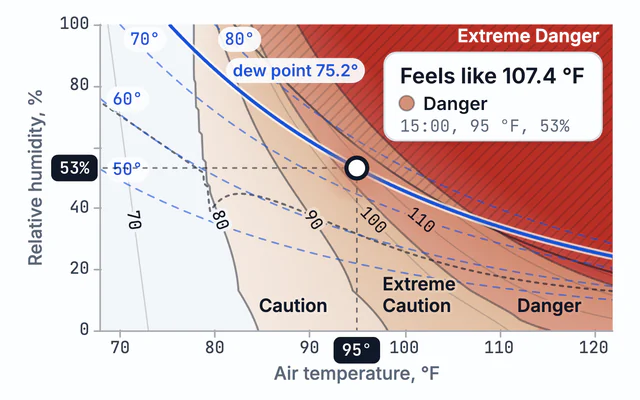
No. The humidex is Environment Canada’s index, from Masterton and Richardson (1979), worked out from the dew point. The heat index is the US National Weather Service’s, from Rothfusz’s regression on Steadman’s model, worked out from the relative humidity. They give different numbers for the same air: at 35 °C (95 °F) with a dew point of 24 °C (75.2 °F), the humidex is 46.3 and the heat index 41.9 °C (107.4 °F).
Can the humidex be worked out from relative humidity?
Yes, by turning the relative humidity into a dew point first, since Environment Canada’s formula needs the vapour pressure that the dew point fixes. At 32 °C and 50 percent the dew point is 20.3 °C (68.5 °F), which gives a humidex of 39.8. The dew point calculator does the first step and offers to pass its answer to this one.
What does a humidex of 40 mean?
Environment Canada explains that a humidex of 40 means humid air at 30 degrees feels more or less the same as dry air at 40 degrees, which is 104 °F. It is also where Environment Canada’s scale moves from some discomfort to great discomfort, the band in which it advises avoiding exertion.
Why can the humidex be lower than the air temperature?
Because the formula adds 0.5555 for every hPa of vapour pressure above 10 hPa and takes it away below, and 10 hPa is the vapour pressure at a dew point of 7.0 °C (44.5 °F). In drier air the humidex comes out below the air temperature. Environment Canada shows an hourly humidex only when the air is 20 °C or warmer and the humidex is at least 1 above the air temperature, and the calculator warns outside those conditions.
Is the humidex in °C or °F?
It is a number on Environment Canada’s scale rather than a measured temperature, and the scale is built to compare with °C: a humidex of 45 feels like dry air at 45 °C, which is 113 °F. The calculator shows that °F figure beside the humidex. Do not hold a humidex to the NWS heat index categories, which belong to a different model.