Newman Projection and Conformation Explorer
Turn the C−C bond of ethane, propane or butane in 3D while the Newman and sawhorse projections and the energy diagram follow, with anti and gauche shares.
Visualiser
Drag the Newman circle or any back group to turn the bond, or empty 3D space to turn the view. Arrow keys turn it 1°, or 15° with Shift. Space plays and pauses.
Energy as the bond turns
Newman projection of butane along C2−C3, C2 in front. Front carbon: CH₃ at 12 o’clock, H at 4 o’clock, H at 8 o’clock. Back carbon: CH₃ at 2 o’clock, H at 6 o’clock, H at 10 o’clock. 60°, gauche (synclinal), with 3.8 kJ/mol of strain, mostly CH₃↔CH₃ gauche.
- Strain energy The sum of every interaction being paid at 60°, measured from a molecule with none. The lowest point of this molecule’s curve is 0.0 kJ/mol.
- 3.8 kJ/mol
- Dihedral angle φ is the angle between the CH₃ on C2 and the CH₃ on C3, seen down the bond: positive when the front bond would turn clockwise to eclipse the back one. On each carbon it is measured from the group that differs from the other two, as IUPAC chooses it. Klyne and Prelog’s symbol for it is +sc.
- 60° gauche
- Main interaction CH₃↔CH₃ gauche 3.8: 3.8 kJ/mol in all. Full costs from Table 3.5: H↔H eclipsed 4.0, H↔CH₃ eclipsed 6.0, CH₃↔CH₃ eclipsed 11 and CH₃↔CH₃ gauche 3.8 kJ/mol.
- CH₃↔CH₃ gauche 3.8 kJ/mol
- Barrier from here Still to climb from 60°: 12.2 kJ/mol clockwise and 15.2 anticlockwise. From the bottom of the gauche (60°) well the barriers are 12.2 kJ/mol clockwise, over eclipsed (120°) to anti (180°), and 15.2 anticlockwise, over syn (0°) to gauche (−60°).
- 12.2 kJ/mol
- Anti at 25 °C The share of molecules in the anti conformation, φ = 180°, from the Boltzmann factor e^(−E/RT) of each staggered conformation. N(gauche)/N(anti) = 2e^(−ΔE/RT) with ΔE = 3.8 kJ/mol and RT = 2.479 kJ/mol: 0.4318. The rest are gauche, 30.16% in all: 15.08% at +60° and 15.08% at −60°. They are mirror images with the same energy, which is why the ratio carries a factor of 2.
- 69.84 %
- Rotation rate How often a molecule in the gauche (60°) conformation turns out of it at 25 °C: 4.53 × 10¹⁰ s⁻¹ clockwise and 1.35 × 10¹⁰ s⁻¹ anticlockwise, from the Eyring equation, k = (k_B T/h) e^(−ΔG‡/RT), with each barrier as ΔG‡. It lasts about 17 ps on average. Play turns the back carbon at a steady 30° a second, so the curve can be read as it goes; at room temperature a real molecule hops between its staggered conformations billions of times a second.
- 5.88 × 10¹⁰ /s
Staggered conformations at 25 °C RT = 2.479 kJ/mol
anti 69.84% gauche 30.16%, 15.08% each side
Citing this tool
Last updated . Add the date you accessed it as well, which a citation of a page that can change asks for. If a specific result matters, cite the permalink from the tool’s share row instead of this page: it reproduces the exact parameters.
On the syllabus: MCAT, 5B: Nature of molecules and intermolecular interactions.
The equation
Interaction energies from McMurry, Organic Chemistry (OpenStax, 2023), Table 3.5
Reading a Newman projection
A Newman projection is a molecule seen straight down one carbon-carbon single bond. The carbon nearer you is drawn as a point, where its three bonds meet in the middle. The carbon behind it is hidden, so it is drawn as a circle, and its three bonds start at the edge of the circle. Each carbon’s three bonds are 120° apart, and the only thing that changes as the bond turns is how the back three sit against the front three.
That is measured by the dihedral angle φ, the angle round the circle from a group on the front carbon to a group on the back one: for butane, from one methyl group to the other. It is positive when the front bond would have to turn clockwise to cover the back one. The explorer opens on butane turning about its C2−C3 bond, drawn three ways at once: as a 3D model, a Newman projection and a sawhorse. The back carbon and its bonds are the same colour in all three, and the arc marked φ in the Newman projection is the same angle as the marker on the energy diagram.
Using the explorer
Drag the back carbon round the Newman circle to turn the bond, or take hold of any of its groups in the 3D model or the sawhorse; the other two views follow, and so does the marker on the energy diagram. Drag empty space in the 3D model to turn the view. The slider under the stage moves φ a degree at a time, as do the arrow keys on the focused stage, or 15° with Shift, and the buttons jump to the named conformations. A press anywhere on the energy diagram turns the bond to that angle.
The strain is drawn where it is paid. Each eclipsed pair of bonds gets a red wedge in the Newman projection and a glow in the other two views, and two methyls gauche to each other get a violet arc. Each mark is as strong as the share of its Table 3.5 cost being paid at that angle, so a wedge fills as its pair comes into eclipse and is gone 60° later, and pointing at one names it.
Staggered and eclipsed ethane
In staggered ethane each C−H bond on the front carbon sits halfway between two on the back carbon, 60° from each. Turn the back carbon 60° and the bonds line up, one behind another: that is eclipsed ethane, and it is 12 kJ/mol (2.9 kcal/mol) higher in energy. The cost comes from the three pairs of bonds lined up, so each H↔H eclipsing interaction is worth 4.0 kJ/mol. The strain of bonds held eclipsed is called torsional strain, to tell it from the steric strain of groups too big to sit close together.
Every staggered conformation of ethane is the same one, because the three hydrogens on each carbon are alike, so the energy diagram is three identical humps of 12 kJ/mol in a full turn. The same is true of any molecule with one carbon that carries three identical groups, which is why the explorer offers only Staggered and Eclipsed for ethane, propane, 2-methylpropane and 2,2-dimethylpropane.
The energy diagram of butane
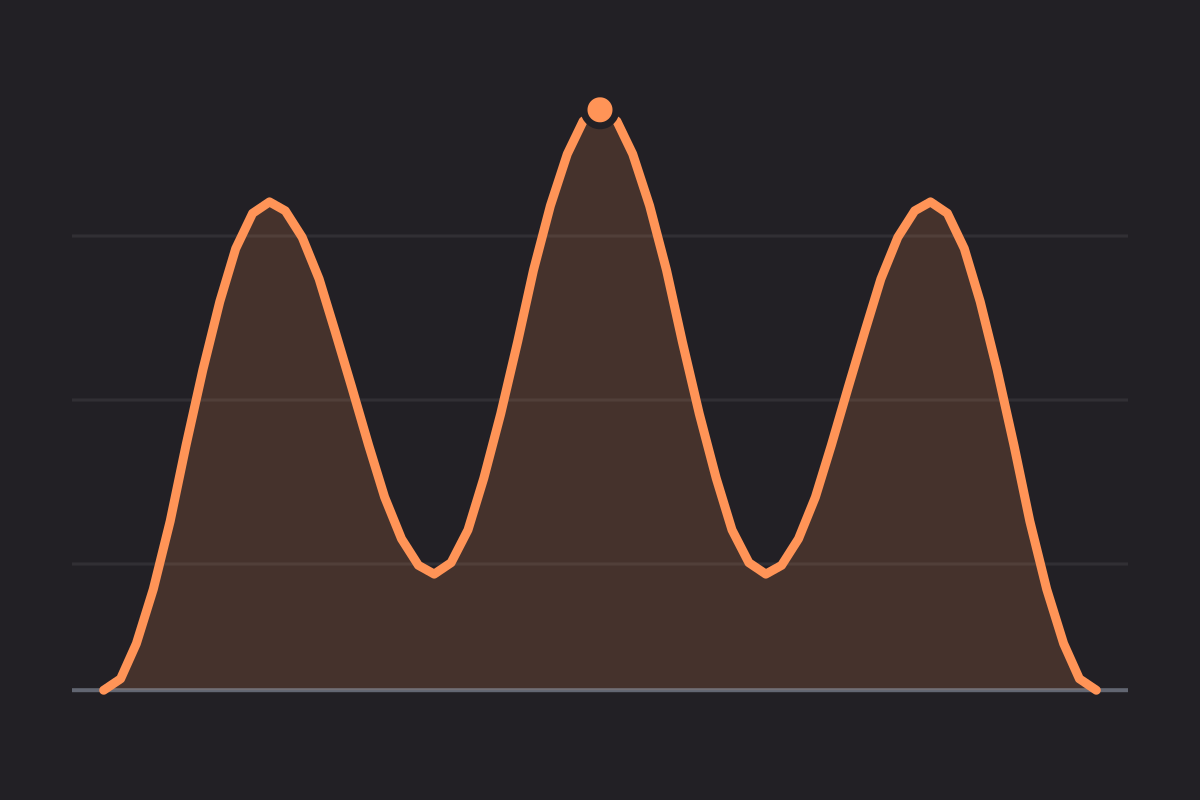
Butane, CH₃CH₂CH₂CH₃, seen along its middle bond, has a methyl group on each of the two carbons, and the diagram stops being three equal humps. The costs that build it are four figures from Table 3.5 of McMurry’s Organic Chemistry (OpenStax, 2023): 4.0 kJ/mol for two hydrogens eclipsed, 6.0 for a hydrogen and a methyl eclipsed, 11 for two methyls eclipsed and 3.8 for two methyls gauche. The explorer adds them up over the nine front and back pairs, and each conformation in the diagram is a sum you can check:
- Anti, φ = 180°: nothing eclipsed and the methyls as far apart as they can be:
0 kJ/mol. - Gauche, φ = ±60°: one methyl-methyl contact at 60°:
3.8 kJ/mol. - Eclipsed, φ = ±120°: each methyl eclipses a hydrogen, and two hydrogens eclipse each other:
6.0 + 6.0 + 4.0 = 16 kJ/mol. - Syn, or fully eclipsed, φ = 0°: the methyls eclipse each other, and so do two pairs of hydrogens:
11 + 4.0 + 4.0 = 19 kJ/mol.
So the lowest barrier out of anti is 16 kJ/mol, the way out of gauche to anti is over 16 − 3.8 = 12.2 kJ/mol, and from one gauche to the other the bond has to climb 19 − 3.8 = 15.2 kJ/mol through syn. The dashed line on the diagram is RT, 2.48 kJ/mol at 25 °C, the yardstick for thermal energy per mole. Every barrier here is several times RT: low enough to be crossed billions of times a second, high enough that at any moment most molecules sit near the bottom of a well.
Choose another molecule and the same four costs build its curve. Propane’s barrier is
6.0 + 4.0 + 4.0 = 14 kJ/mol, 2-methylpropane’s 6.0 + 6.0 + 4.0 = 16 and
2,2-dimethylpropane’s 3 × 6.0 = 18. Along C2−C3, 2-methylbutane runs from 3.8 to 21 kJ/mol and
2,3-dimethylbutane from 7.6 to 26 kJ/mol, and Build your own puts a hydrogen or a methyl at each of the
six places.
How much of butane is anti?
At any moment almost every molecule is near one of the three staggered conformations, anti or one of
the two gauche, which are mirror images of each other with the same energy. The share in each follows
the Boltzmann distribution, so the ratio of gauche to anti is
N(gauche)/N(anti) = 2e^(−ΔE/RT), where ΔE is the gauche conformation’s energy above anti
and the 2 counts the two gauche forms. Here is the explorer’s working at 25 °C; each step should match
a readout.
RT = 8.314 × 298.15 = 2479 J/mol, which is 2.479 kJ/mol.e^(−3.8/2.479) = e^(−1.533) = 0.2159for each gauche conformation against anti.N(gauche)/N(anti) = 2 × 0.2159 = 0.4318.- So the anti share is
1/(1 + 0.4318) = 69.84%, and the gauche share 30.16%, 15.08% each side.
About 70 percent of butane is anti at room temperature, and 30 percent gauche. Cooling favours the lower conformation: at 0 °C the anti share is 72.7 percent, and at −150 °C, the bottom of the range, 95.3 percent. Warming spreads the molecules out: 63.0 percent at 100 °C and 59.6 percent at 150 °C, still well short of the third each that the three conformations would get if they were equal. The same ΔG° = −RT ln K connects any energy difference to an equilibrium constant in the Gibbs free energy calculator.
Beyond butane: crowded molecules
2-Methylbutane, seen along C2−C3, has two methyls on the front carbon and one on the back. With the back methyl between
the two front methyls it is gauche to both, 2 × 3.8 = 7.6 kJ/mol; in the other two it is
gauche to one methyl and anti to the other, 3.8 kJ/mol. The explorer calls the 7.6 kJ/mol conformation
anti, because its reference groups are the hydrogen on C2 and the methyl on C3, and those are 180° apart
there. At 25 °C, 90.3 percent of 2-methylbutane is in the two 3.8 kJ/mol conformations, 45.1 percent
each, and 9.7 percent in the third.
2,3-Dimethylbutane has two methyls on each carbon. With its hydrogens anti, each methyl is gauche to one
methyl across the bond, two contacts in all, 7.6 kJ/mol; with the hydrogens gauche there are three, 11.4
kJ/mol, so in this count the anti conformation holds 69.8 percent at 25 °C, by the same 3.8 kJ/mol
difference as butane. Its eclipsed conformations cost 11 + 6.0 + 6.0 = 23 kJ/mol with one
pair of methyls eclipsed and 11 + 11 + 4.0 = 26 kJ/mol with both. Adding up pairs is least
safe in crowded molecules like these, and the explorer puts a note beside them. For 2,3-dimethylbutane
the count is far off: at −180 °C, ¹³C NMR finds two gauche molecules to every anti one, as if all three
conformations had the same energy (Lunazzi and colleagues, 1977).
How fast does the bond turn?
The Eyring equation turns a barrier into a rate,
k = (k_B T/h) e^(−ΔG‡/RT), and the explorer uses each barrier as ΔG‡ with a transmission
coefficient of 1. At 25 °C the prefactor k_B T/h is 6.21 × 10¹² s⁻¹, and for ethane’s 12 kJ/mol the
exponential is 0.00790, so a staggered ethane molecule turns over the barrier on one side about
4.9 × 10¹⁰ times a second. It can leave either way, so it leaves at twice that,
9.8 × 10¹⁰ s⁻¹, and each staggered conformation lasts about 10 picoseconds on average.
Butane turns more slowly. Gauche turns to anti over 12.2 kJ/mol at about 4.5 × 10¹⁰ s⁻¹ and to the other gauche over 15.2 kJ/mol at 1.4 × 10¹⁰ s⁻¹, while anti leaves over 16 kJ/mol at 9.8 × 10⁹ s⁻¹ each way. Rates like these are why the conformations of ethane and butane cannot be separated and kept in a bottle, as butane and its constitutional isomer 2-methylpropane can. Temperature acts on the rate far more steeply than on the shares: at −150 °C, ethane makes about 2.1 × 10⁷ hops a second each way. The same exponential dependence on a barrier is what the Arrhenius equation calculator works with for reaction rates. Play turns the bond at a steady 30° a second so the curve can be read, which is a picture of the diagram and not of a real molecule’s motion.
From Newman to sawhorse and back
A sawhorse projection shows the same bond from above and to one side. The C−C bond is drawn as a long line running up to the right, with the front carbon at its lower left, and each carbon’s three bonds come off its end of that line. To turn a Newman projection into a sawhorse, draw the long bond, then copy the three front groups onto the lower carbon and the three back groups onto the upper carbon, each keeping its place round the bond: a group at twelve o’clock in the Newman projection points up in the sawhorse. To go back, look along the long bond from the lower left.
The explorer draws both from the same 3D model, so a group’s angle round the bond is the same in each, and the sawhorse’s long bond is drawn about twice its true length, so that the two ends stand apart. Every bond angle in the model is the tetrahedral 109.5°, the angle four electron domains take round a carbon in the VSEPR molecular geometry visualiser. For how the atoms are joined in the first place, the Lewis structure generator draws the bonds a Newman projection is turning.
Naming conformations: Klyne and Prelog
Anti, gauche, eclipsed and syn are names for particular angles. The general names, from William Klyne and Vladimir Prelog in 1960 and used by IUPAC, divide the circle into ranges by the angle between the two reference groups:
- Synperiplanar, within 30° of 0°: butane’s syn conformation.
- Synclinal, from 30° to 90° either way: gauche, which IUPAC also calls skew.
- Anticlinal, from 90° to 150° either way: butane’s eclipsed conformation at 120°.
- Antiperiplanar, within 30° of 180°: anti.
The clinal ranges carry the sign of the angle, so gauche butane is +sc or −sc, and the Dihedral angle readout’s hint gives the symbol. The names depend on which groups are measured between. IUPAC takes on each carbon the group that differs from the other two, as the φ arc does: the methyls in butane, and on a carbon carrying two methyls the hydrogen, so that anti in 2,3-dimethylbutane means the two hydrogens are 180° apart. Where all three are alike, IUPAC measures to the nearest group, so staggered ethane is synclinal and eclipsed ethane synperiplanar, whichever hydrogens the arc joins.
What this model leaves out
- The shape of the curve between the published points. The stationary values are sums of Table 3.5’s costs. Between them each cost is switched on smoothly with the angle, cos²(3θ/2) for an eclipsing pair and sin²(3θ/2) for a gauche one, which is a choice made here to join the points and not a measurement. For ethane it is the textbook 6(1 + cos 3φ) kJ/mol.
- Additivity. Each pair is counted as if the others were not there. In crowded molecules the groups push each other apart and the bonds bend, so the real energies can differ from the sums. That is why 2,2,3,3-tetramethylbutane, with a methyl at all six places, is not in the molecule menu, and why the explorer warns when you build a crowded one.
- Entropy. Each conformation is counted at the bottom of its well, by its energy alone, and the factor of 2 for the two gauche forms is the only entropy in the populations.
- Solvent and other groups. The costs are for alkanes, with only hydrogen and methyl, and butane’s ethyl group seen along C1−C2 is costed as a methyl. Polar groups such as fluorine or hydroxyl bring dipoles and the gauche effect, and a solvent can shift the balance; none of that is in the table.
- A fixed geometry. The bond angles stay tetrahedral and the bond lengths fixed at every angle, where a real molecule relaxes a little as it turns.
Common mistakes
- Drawing the back carbon’s bonds from the centre. Only the front carbon’s bonds meet in the middle. The back ones start at the edge of the circle.
- Calling 120° gauche. Gauche is 60°. At 120° every group is eclipsed by one on the other carbon, and in butane that conformation is 16 kJ/mol up, not 3.8.
- Forgetting there are two gauche conformations. They are mirror images at +60° and −60°,
and leaving out the 2 in
2e^(−ΔE/RT)puts butane at 82 percent anti instead of 70. - Mixing units in e^(−ΔE/RT). With R = 8.314 J/(mol K), ΔE must be in J/mol: 3800, not 3.8. With ΔE in kcal/mol, R is 0.001987 kcal/(mol K); 1 kcal is 4.184 kJ exactly.
- Treating conformations as separate compounds. At room temperature a butane molecule changes conformation billions of times a second, so anti and gauche butane are one compound, and their shares an equilibrium.
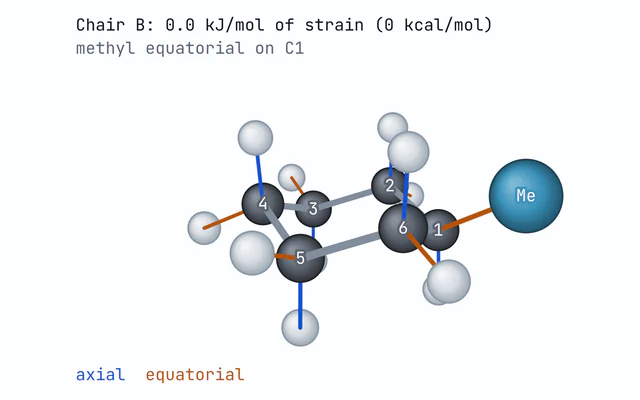
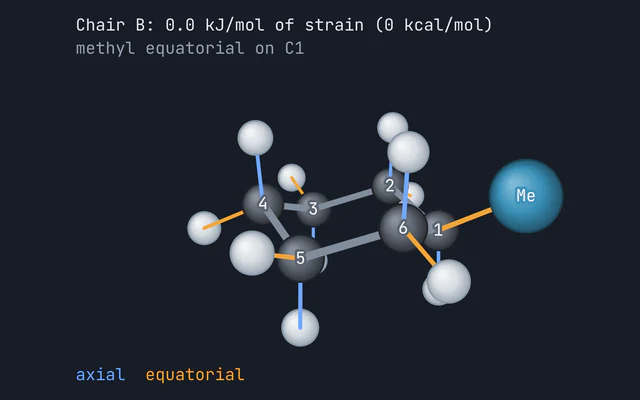
- Reading the 3.8 kJ/mol as new. It is the same contact as an axial methyl group’s 1,3-diaxial interaction in a cyclohexane ring, which is gauche to the ring carbon across the next bond, and the chair conformation explorer counts it there, twice for each axial methyl. For the other kind of stereochemistry, which needs bonds broken to change, the R and S configuration explorer names a stereocentre.
Constants used: Planck constant (h), Boltzmann constant (k) and Molar gas constant (R).
Common questions
What is a Newman projection?
A drawing of a molecule seen straight down one C−C bond. The front carbon is the point where its three bonds meet, and the back carbon is a circle, with its three bonds drawn from the edge. The angle round the circle between a group on the front carbon and a group on the back carbon is the dihedral angle φ, and it names the conformation: 60° is gauche and 180° is anti.
What is the most stable conformation of butane?
Anti, with the two methyl groups 180° apart. Gauche, at 60°, is 3.8 kJ/mol higher; the eclipsed conformation at 120° is 16 kJ/mol higher, and the fully eclipsed one at 0° is 19 kJ/mol higher. At 25 °C about 70 percent of butane molecules are anti and 30 percent gauche.
What is the difference between staggered and eclipsed ethane?
In staggered ethane each C−H bond on the front carbon sits halfway between two on the back carbon; in eclipsed ethane they line up. Eclipsed ethane is 12 kJ/mol higher in energy: three H↔H eclipsing interactions of 4.0 kJ/mol each, the strain called torsional strain.
Why is gauche butane less stable than anti?
At 60° the two methyl groups are close enough to crowd each other, which costs 3.8 kJ/mol of steric strain. It is the same 3.8 kJ/mol as each 1,3-diaxial interaction of an axial methyl group in a cyclohexane chair, because an axial methyl on C1 is gauche to C3 of the ring across the C1−C2 bond, just as one methyl of gauche butane is to the other.
How fast does the bond in ethane rotate?
Very fast. Over its 12 kJ/mol barrier, the Eyring equation gives about 4.9 × 10¹⁰ turns a second at 25 °C in each direction, and a staggered conformation can leave either way, so it lasts about 10 picoseconds on average. That is why the conformations of ethane or butane cannot be separated and kept in a bottle.
How do you turn a Newman projection into a sawhorse projection?
Draw the C−C bond as a line running up to the right, with the front carbon at its lower left, then copy the three front groups onto the lower carbon and the three back groups onto the upper carbon, each keeping its place round the bond. The explorer draws both from the same 3D model, so a group’s angle round the bond is the same in each.
What do anti, gauche, eclipsed and syn mean?
They name the dihedral angle between the two reference groups, for butane the two methyls: anti is 180°, gauche 60°, eclipsed 120° and syn, or fully eclipsed, 0°. The IUPAC names, from Klyne and Prelog, cover ranges: antiperiplanar within 30° of 180°, synclinal from 30° to 90°, anticlinal from 90° to 150° and synperiplanar within 30° of 0°.