One Rep Max Calculator
Estimate your one rep max from one set by the Epley, Brzycki and Lombardi formulas, in lb or kg, with a 50 to 100 percent training chart.
Calculator
The whole load for the set, the bar included.
Whole reps in one set taken to failure. 10 or fewer gives the most reliable estimate.
- Epley estimate 119.1 kg. 1RM = w × (1 + r ÷ 30), from Epley (1985).
- 262.5 lb
- Brzycki estimate 114.8 kg. 1RM = w ÷ (1.0278 − 0.0278 × r), from Brzycki (1993).
- 253.2 lb
- Lombardi estimate 119.9 kg. 1RM = w × r^0.10, from Lombardi (1989).
- 264.3 lb
- Spread of the three How far the highest estimate sits above the lowest. From 1 to 10 reps it stays under 6 percent, and past 10 it grows fast.
- 4.4 %
Training percentage chart
| % of 1RM | Load, lb | Epley reps | Brzycki reps | Lombardi reps |
|---|---|---|---|---|
| 100% | 262.5 | 1.0 | 1.0 | 1.0 |
| 95% | 249.4 | 1.6 | 2.8 | 1.7 |
| 90% | 236.3 | 3.3 | 4.6 | 2.9 |
| 85% | 223.1 | 5.3 | 6.4 | 5.1 |
| 80% | 210.0 | 7.5 | 8.2 | 9.3 |
| 75% | 196.9 | 10.0 | 10.0 | over 15 |
| 70% | 183.8 | 12.9 | 11.8 | over 15 |
| 65% | 170.6 | over 15 | 13.6 | over 15 |
| 60% | 157.5 | over 15 | over 15 | over 15 |
| 55% | 144.4 | over 15 | over 15 | over 15 |
| 50% | 131.3 | over 15 | over 15 | over 15 |
Each reps column is that formula solved for the reps at that share of your max. 100 percent is one rep by definition, where Epley’s formula, read literally, would give 0. Figures above 10 reps are shown faint because they are less reliable, and above 15 the formulas are not used.
Working, with your numbers
- Epley: 1RM = w x (1 + r / 30) = 225 x (1 + 5 / 30) = 225 x 1.1667 = 262.5 lb
- Brzycki: 1RM = w / (1.0278 - 0.0278 x r) = 225 / (1.0278 - 0.0278 x 5) = 225 / 0.8888 = 253.2 lb
- Lombardi: 1RM = w x r^0.10 = 225 x 5^0.10 = 225 x 1.1746 = 264.3 lb
The formulas are ratios, so a weight in kg gives a 1RM in kg and one in lb a 1RM in lb.
Citing this tool
Last updated . Add the date you accessed it as well, which a citation of a page that can change asks for. If a specific result matters, cite the permalink from the tool’s share row instead of this page: it reproduces the exact parameters.
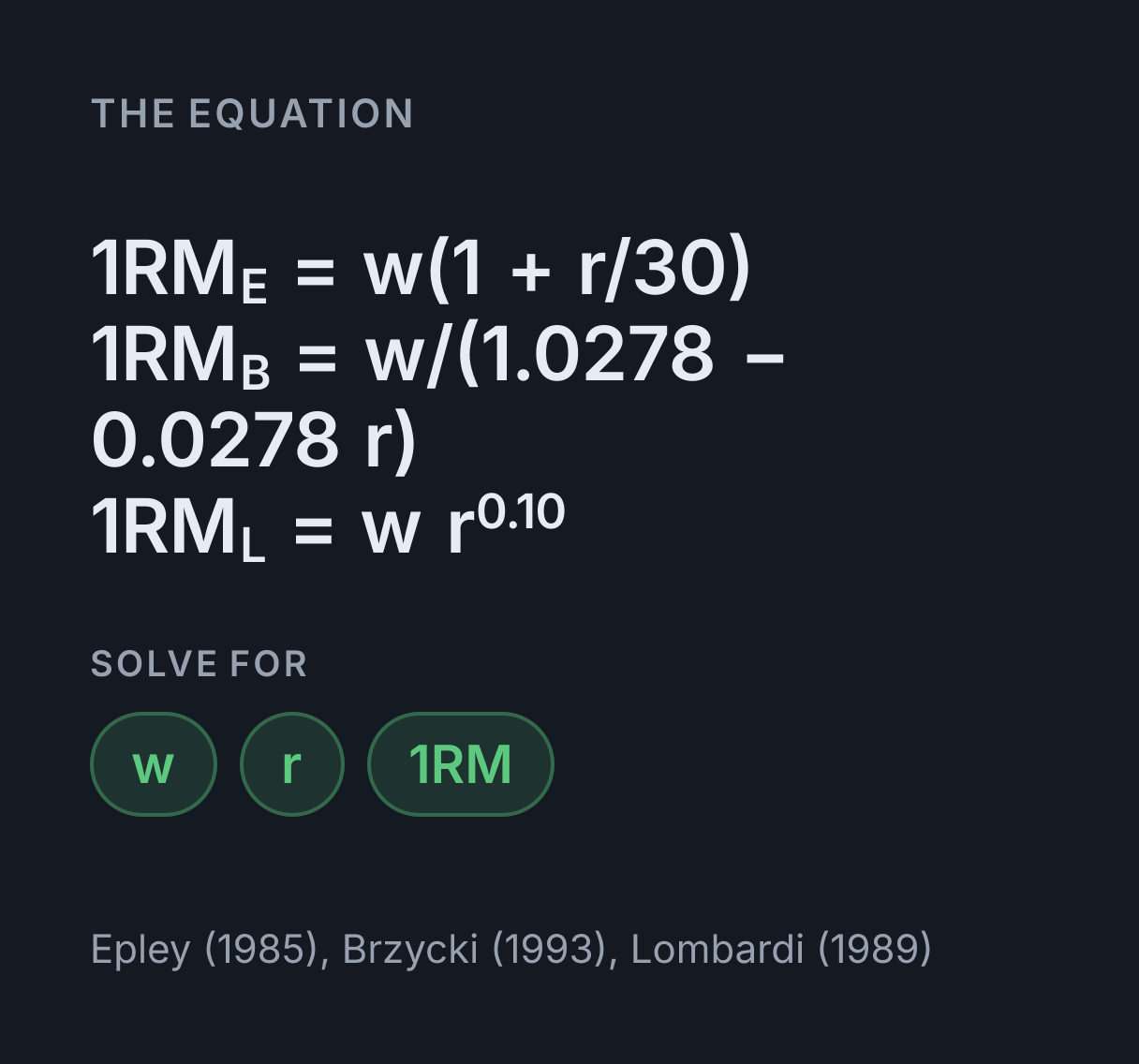
The equation
Epley (1985), Brzycki (1993), Lombardi (1989)
How do you calculate your one rep max?
Lift a weight for as many reps as you can, 10 at most, then put the weight and the reps into a formula. Epley: 1RM = weight × (1 + reps ÷ 30). Brzycki: 1RM = weight ÷ (1.0278 − 0.0278 × reps). Lombardi: 1RM = weight × reps0.10. For 225 lb lifted 5 times they give 262.5, 253.2 and 264.3 lb.
Why the three formulas give three answers
Each formula is one fixed curve relating the reps a lifter can do to the share of their max the weight represents, and the three curves were drawn differently. Epley’s adds a thirtieth of the weight for every rep, so its estimate climbs in a straight line. Brzycki’s takes 2.78 percent of the max off the weight for each extra rep, a straight line in percent that bends the estimate upward as the reps rise. Lombardi’s raises the reps to the power 0.10, a curve that flattens, so each added rep counts for less than the one before it.
At low reps the curves stay close: from 1 to 10 reps the three estimates are never more than 6 percent apart. Past 10 they separate quickly, to about 12 percent at 12 reps and 25 percent at 15. That is why the calculator answers up to 15 reps, with a caution above 10, and above 15 refuses and says why.
Why a set of 10 reps or fewer works best
Brzycki gave 10 reps as the limit for a reliable prediction, and the arithmetic shows the reason. A set of a few reps is close to a single, so the formula has little to extrapolate: from a set of 3 the highest of the three estimates adds 12 percent to the weight lifted, and from a set of 10 it adds 33 percent. The further a set is from one rep, the larger the share of the answer that comes from the formula rather than from the lift.
All three also assume the set went to failure, with the last rep the last one possible. A set stopped with reps still in hand is entered as fewer reps than the lifter had, and the estimate comes out low by an amount no formula can see.
Reading the training percentage chart
The chart turns the estimate into loads from 100 percent of 1RM down to 50 percent, and beside each load gives the reps each formula implies a lifter could manage there. Those columns are the formulas run backwards, and they show how differently the curves behave away from a single. At 80 percent of 1RM, Epley implies 7.5 reps, Brzycki 8.2 and Lombardi 9.3. At 75 percent Lombardi’s curve already implies 17.8, against 10.0 for Epley, because a curve that flattens needs many more reps to account for each step down in weight.
The 100 percent row is one rep for all three, by definition. Read literally, Epley’s formula puts 0 reps there, since it adds a thirtieth of the weight even to a single: one rep at 225 lb gives an Epley estimate of 232.5 lb. So when the reps entered are 1, the calculator treats the weight lifted as a tested max and builds the chart from it. Otherwise, choose which estimate the chart starts from with the buttons above it.
The muscles a one rep max tests
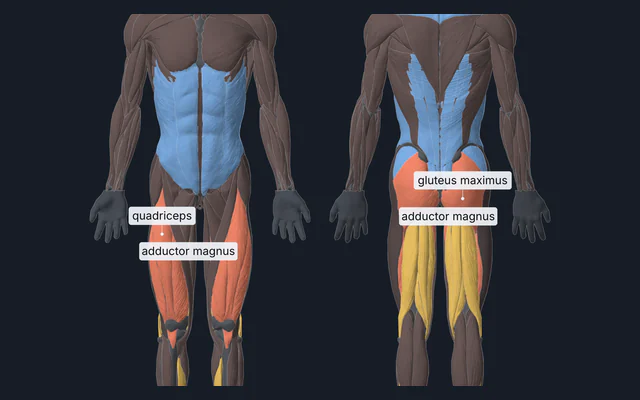
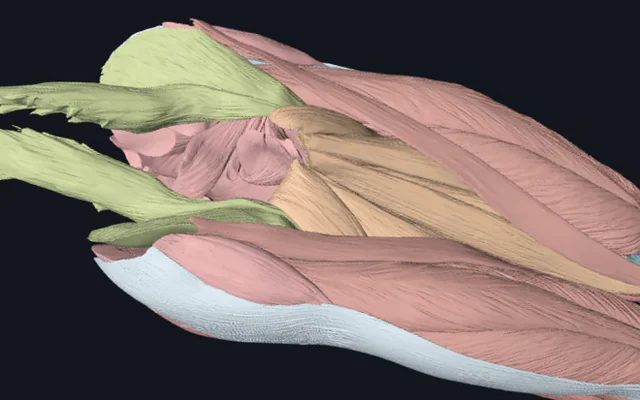
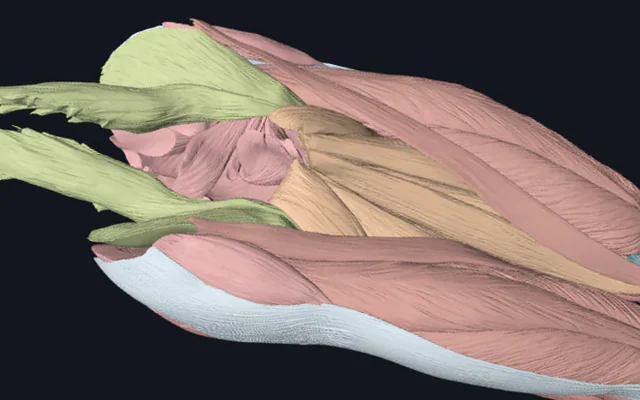
A one rep max belongs to a lift rather than to a lifter, since the same person has a different max on every exercise, and the formulas see only the weight and the reps, not which lift it was. Which muscles a heavy set works depends on the lift. For the loaded lifts on this site, the prime movers are below. A prime mover produces the lift’s main joint action against the load.
- Back squat: the quadriceps, gluteus maximus and adductor magnus.
- Front squat: the quadriceps, gluteus maximus and adductor magnus.
- Leg press: the quadriceps, gluteus maximus and adductor magnus.
- Conventional deadlift: gluteus maximus, the hamstrings, adductor magnus, the quadriceps and the erector spinae.
- Sumo deadlift: gluteus maximus, adductor magnus, the hamstrings, the quadriceps and the erector spinae.
- Romanian deadlift: the hamstrings, gluteus maximus, adductor magnus and the erector spinae.
- Barbell hip thrust: gluteus maximus.
- Flat bench press: both parts of pectoralis major, the anterior deltoid and triceps brachii.
- Incline bench press: the clavicular part of pectoralis major, the anterior deltoid and triceps brachii.
- Standing overhead press: the anterior deltoid, the clavicular part of pectoralis major and triceps brachii.
- Bent-over barbell row: latissimus dorsi, the posterior deltoid, the rhomboids, the middle trapezius, brachialis and biceps brachii.
The muscles worked explorer shows each of these on a 3D body, with its synergists and stabilizers, and the muscles worked index covers all 25 lifts.
Common mistakes
- Counting a set that stopped short of failure. Two reps left in hand on a set of 5 make it a 7-rep effort entered as 5, and every estimate comes out low.
- Estimating from a long set. Past 10 reps the three formulas part company, and past 15 the calculator gives no answer. A heavier set of 10 or fewer keeps them within 6 percent of each other.
- Mixing pounds and kilograms. 100 entered as lb when the bar held 100 kg makes the estimate and every load in the chart 2.2 times too small. Pick the unit first: switching it converts the weight already in the box.
- Leaving out the bar. The weight lifted is the whole load, so 90 lb a side on a 45 lb bar is 225 lb, not 180.
- Treating the estimate as a weight to attempt. It is a prediction from one set, and for any one lifter it can miss in either direction.
Worked examples
Each one runs through the calculator above, so the arithmetic here is the arithmetic it does.
What is my one rep max if I bench 225 lb for 5 reps?
- 1RM = w x (1 + r / 30)
- w = 225 lb (102.1 kg), r = 5
- = 225 x (1 + 5 / 30)
- = 225 x 1.1667
- = 262.5 lb (119.1 kg)
That is Epley’s figure. Brzycki’s formula puts the same set at 253.2 lb and Lombardi’s at 264.3 lb. Up to 10 reps the three stay within 6 percent of each other, so any of them is a fair estimate from a set this short.
What is my one rep max if I squat 100 kg for 8 reps?
- 1RM = w x (1 + r / 30)
- w = 100 kg (220.5 lb), r = 8
- = 100 x (1 + 8 / 30)
- = 100 x 1.2667
- = 126.7 kg (279.3 lb)
The formulas are ratios, so a set in kilograms gives a max in kilograms with no conversion: 126.7 kg, which is 279.3 lb. Brzycki’s formula gives 124.2 kg and Lombardi’s 123.1 kg, so at 8 reps Epley’s straight line already sits highest of the three.
What weight should I use for 8 reps if my max is 300 lb?
- w = 1RM / (1 + r / 30)
- 1RM = 300 lb (136.1 kg), r = 8
- = 300 / (1 + 8 / 30)
- = 300 / 1.2667
- = 236.8 lb (107.4 kg)
The formula run backwards, from a max to a working weight. Brzycki’s line gives 241.6 lb and Lombardi’s 243.7 lb for the same 8 reps, so a load of about 235 to 245 lb covers all three before the bar is rounded to the plates you have.
How many reps can I do at 80 percent of my one rep max?
- r = 30 x (1RM / w - 1)
- 1RM = 250 lb (113.4 kg), w = 200 lb (90.72 kg)
- = 30 x (250 / 200 - 1)
- = 30 x 0.25
- = 7.5 reps
Any max gives the same answer at 80 percent, because only the ratio enters: 200 lb against a 250 lb max is one case. Brzycki’s formula implies 8.2 reps there and Lombardi’s 9.3, and a fraction means the load sits between two whole-rep maxima.
Common questions
Which one rep max formula is the most accurate?
None is best for every lifter, because each formula is one fixed curve and lifters differ. From 1 to 10 reps the Epley, Brzycki and Lombardi estimates stay within 6 percent of each other, so the choice matters little there. Past 10 reps they separate quickly, to a quarter apart at 15. If you later test a true single, compare it with the three estimates and keep using the formula that came closest for that lift.
What is the difference between the Epley and Brzycki formulas?
Epley’s formula adds a thirtieth of the weight for every rep, a straight line, while Brzycki’s takes 2.78 percent of the max off the weight for each rep, which makes the estimate curve upward as the reps rise. Below 10 reps Epley’s gives the higher estimate, at 10 reps the two agree within 0.03 percent, and above 10 Brzycki’s climbs faster, to 9 percent above Epley’s at 15 reps.
Why does Epley’s formula give more than the weight for a single rep?
Because it adds a thirtieth of the weight for every rep, the first one included, so one rep at 225 lb gives an Epley estimate of 232.5 lb. Brzycki’s and Lombardi’s formulas both return the weight itself at one rep. A single taken to failure is already a tested max, so when the reps entered are 1 this calculator uses the weight lifted as the 1RM and builds the chart from it.
Why does the calculator stop at 15 reps?
Because past 15 reps the three formulas no longer agree closely enough for any of them to be an estimate worth having. From 1 to 10 reps they stay within 6 percent of each other, at 15 they are a quarter apart, and at 16 they are 30 percent apart and still separating. Brzycki’s equation would also divide by zero at about 37 reps. A heavier set of 10 reps or fewer gives a better estimate.
Does a one rep max calculator work for any exercise?
The arithmetic is the same for every exercise, since the formulas see only the weight and the reps, never the lift. That makes them a fit for lifts loaded with a known weight and taken to failure in a set of 10 or fewer, such as the squat, bench press and deadlift. Your max differs from lift to lift, so estimate each one from a set of its own.