Target Heart Rate Calculator
Find your target heart rate by the Karvonen method, with maximum heart rate from Tanaka’s equation for your age, ACSM training zones and the working shown.
Calculator
In whole years. Tanaka’s equation was fitted to healthy adults, so the calculator takes 18 to 100.
Count it sitting or lying quietly, ideally on waking, for a full minute. The usual adult range is 60 to 100 bpm, and trained endurance athletes often sit below it.
The share of heart rate reserve to aim for. ACSM’s moderate band is 40 to 59 percent of reserve and its vigorous band 60 to 89 percent.
The heart rate to aim for during exercise. Enter one and solve for intensity to see how hard a heart rate is.
Working, with your numbers
- HRmax = 208 - 0.7 x age
- = 208 - 0.7 x 50
- = 208 - 35
- = 173 bpm
- THR = HRrest + intensity x (HRmax - HRrest)
- = 70 + 0.5 x (173 - 70)
- = 70 + 0.5 x 10³
- = 70 + 51.5
- = 121.5 bpm
Values are converted into the units the equation is worked in before the arithmetic.
- Maximum heart rate Tanaka, Monahan and Seals (2001), 208 − 0.7 × age, from 351 studies of 18,712 healthy adults. An average for the age, so a measured maximum can sit above or below it.
- 173 bpm
- 220 − age, for comparison 3 bpm below Tanaka’s estimate. Above 40 the older rule gives the lower figure, and Tanaka’s study found it underestimates the maximum in older adults.
- 170 bpm
- Heart rate reserve Maximum minus resting heart rate. The Karvonen method takes its percentage of this span and adds the resting rate back.
- 103 bpm
- ACSM intensity band 50 percent of heart rate reserve is in the moderate band, 40 to 59 percent, of the ACSM classification (Garber et al. 2011).
- Moderate
- As a percentage of maximum The same heart rate as a share of maximum. A percentage of reserve is never a lower heart rate than the same percentage of maximum, which is why the two scales have different bands.
- 70.2 %
- Light, 30 to 39% HRR ACSM’s light band by heart rate reserve, in whole beats rounded inwards so every rate listed is inside it.
- 101 to 110 bpm
- Moderate, 40 to 59% HRR ACSM’s moderate band by heart rate reserve, in whole beats rounded inwards so every rate listed is inside it. ACSM advises most adults to do at least 150 minutes a week of moderate exercise, 75 of vigorous, or a mix of the two.
- 112 to 130 bpm
- Vigorous, 60 to 89% HRR ACSM’s vigorous band by heart rate reserve, in whole beats rounded inwards so every rate listed is inside it. At least 75 minutes a week of vigorous exercise meets the same ACSM advice as 150 of moderate.
- 132 to 161 bpm
- Light, 57 to 63% of max The same band as a percentage of maximum, which ignores the resting rate, so two people of the same age get the same zone whatever their resting rates.
- 99 to 108 bpm
- Moderate, 64 to 76% of max The same band as a percentage of maximum, which ignores the resting rate, so two people of the same age get the same zone whatever their resting rates.
- 111 to 131 bpm
- Vigorous, 77 to 95% of max The same band as a percentage of maximum, which ignores the resting rate, so two people of the same age get the same zone whatever their resting rates.
- 134 to 164 bpm
Citing this tool
Last updated . Add the date you accessed it as well, which a citation of a page that can change asks for. If a specific result matters, cite the permalink from the tool’s share row instead of this page: it reproduces the exact parameters.
The equation
Karvonen (1957), Tanaka, Monahan and Seals (2001), ACSM bands (Garber 2011)
What is the target heart rate formula?
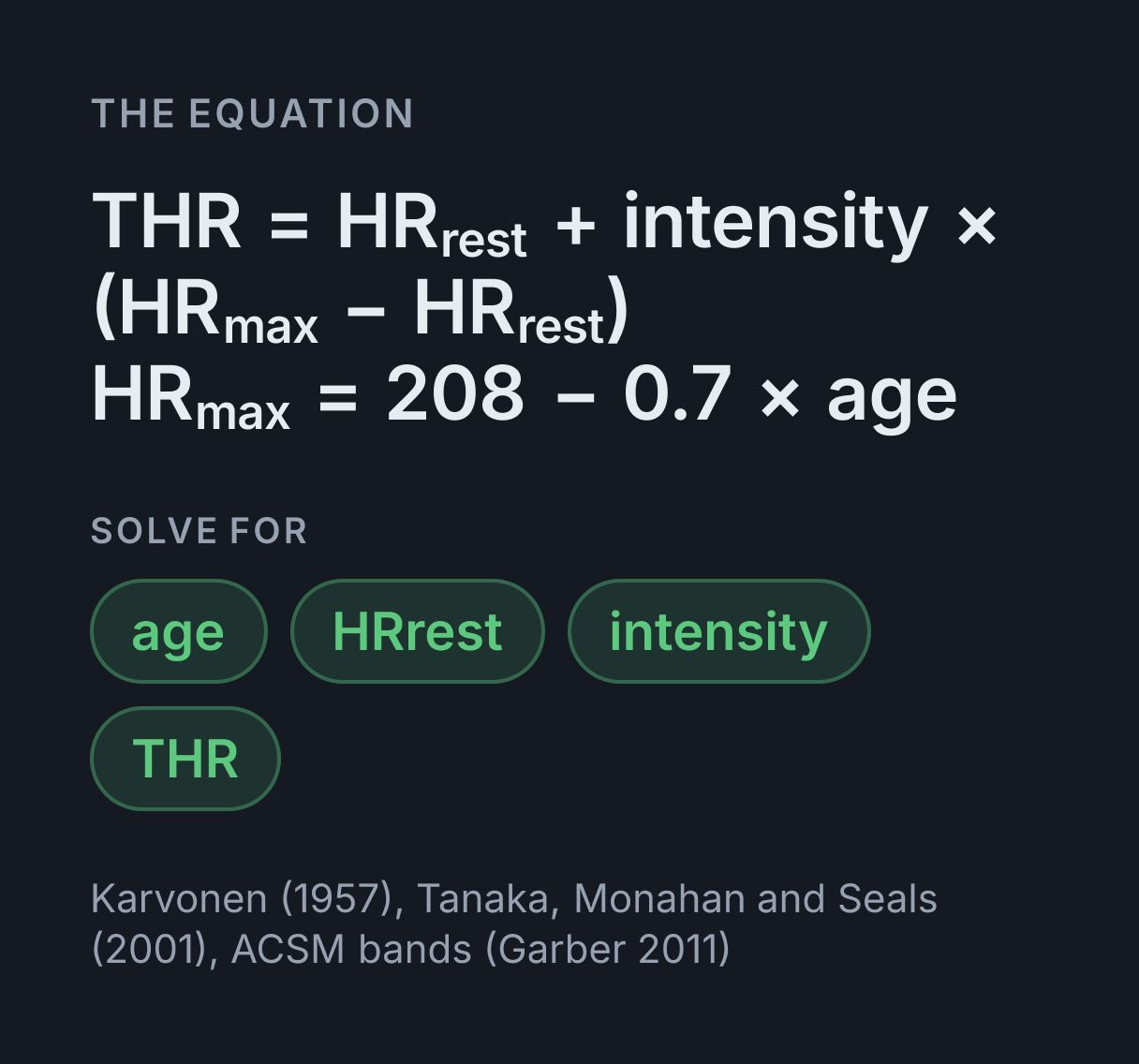
The target heart rate formula is the Karvonen, or heart rate reserve, method: THR = HRrest + intensity × (HRmax − HRrest), where intensity is the share of heart rate reserve a session aims for. Maximum heart rate is estimated from age as HRmax = 208 − 0.7 × age, the equation of Tanaka, Monahan and Seals (2001).
Why 208 − 0.7 × age replaced 220 − age
The older rule is usually traced to a 1971 review by Fox, Naughton and Haskell, and by 2001 its validity had still never been established in a sample with enough older adults in it. Tanaka’s group tested it. They pooled the mean maximum heart rates of 492 groups from 351 studies, 18,712 people in all, then measured the maximum directly in 514 healthy adults in their own laboratory. The pooled data gave 208 − 0.7 × age and the laboratory 209 − 0.7 × age, the same slope one beat apart. The line did not differ between men and women, and wide differences in habitual physical activity did not move it.
The two rules differ by 12 − 0.3 × age beats per minute, so they agree at 40, where both give 180, and part by 3 beats a decade on either side. At 20 the older rule gives 200 against 194, and at 70 it gives 150 against 159. That second gap is the one Tanaka’s paper names: 220 − age underestimates the maximum in older adults, and with it the intensity an exercise program should reach.
Both are estimates of an average. The correlation of −0.90 Tanaka reported was between age and the mean maximum of each group, not any one person’s maximum, and people of the same age spread around the line. Where a graded exercise test has measured a maximum, that figure replaces either estimate.
Heart rate reserve or percent of maximum
The reserve method comes from Karvonen, Kentala and Mustala’s 1957 study of training and heart rate. The percentage is taken of the span between resting and maximum heart rate, and the resting rate is added back, which rearranges to THR = intensity × HRmax + (1 − intensity) × HRrest. That second term is why the same percentage gives a higher heart rate on the reserve scale than on the maximum scale. The calculator’s opening case shows it: 50 percent of reserve for a 50 year old resting at 70 bpm is 121.5 bpm, which is 70.2 percent of maximum. It is also why two people of the same age get different reserve zones when their resting rates differ, and the same zone on the maximum scale.
So ACSM gives every band on both scales. Its position stand on exercise prescription advises most adults to do at least 150 minutes a week of moderate exercise, or 75 minutes of vigorous exercise, or a mix of the two.
| Intensity | % of heart rate reserve | % of maximum heart rate |
|---|---|---|
| Very light | below 30 | below 57 |
| Light | 30 to 39 | 57 to 63 |
| Moderate | 40 to 59 | 64 to 76 |
| Vigorous | 60 to 89 | 77 to 95 |
| Near maximal to maximal | 90 and above | 96 and above |
The bands are printed in whole percents, so the calculator lists each zone in whole beats rounded inwards, and no beat appears in two zones. An intensity between two whole percents is placed by the band edges of 30, 40, 60 and 90 percent of reserve.
When heart rate is the wrong guide
Every zone here assumes heart rate rises with effort the way it does in a healthy adult taking nothing that changes it. Beta blockers break that assumption. They lower the resting rate, the maximum and the rise with exercise, so a zone worked out from an age-predicted maximum can sit above anything the heart will reach on the drug, and chasing it means working far harder than the band intends. Rate-slowing calcium channel blockers such as verapamil and diltiazem do the same.
The usual alternatives are a target taken from the heart rate measured during an exercise test done on the same medication, or perceived exertion on the Borg 6 to 20 scale, where ACSM’s moderate band is 12 to 13 and its vigorous band 14 to 17. A pacemaker, an irregular rhythm such as atrial fibrillation, or a transplanted heart each make heart rate an unreliable guide too, and a zone in those cases belongs to the cardiology or cardiac rehabilitation team.
Common mistakes
- Reading a percent of maximum band as a reserve percentage. 64 to 76 percent is moderate on the maximum scale, but every whole percent from 64 to 76 of reserve is in the vigorous band. Entering 70 percent of reserve because 70 percent of maximum is moderate gives a vigorous target.
- Counting the resting rate after moving about. A reading taken after walking or climbing stairs runs high. It narrows the reserve, but because the resting rate is added back it raises every reserve zone: each extra resting beat adds 0.5 beats to a 50 percent target.
- Treating the predicted maximum as a limit, or as a goal. It is the average for the age. Some people exceed it in a maximal test and others never reach it.
- Mixing charts built on different equations. A zone chart drawn from 220 − age and one drawn from Tanaka’s equation differ by 6 bpm at the maximum for a 60 year old, and the gap carries into every zone.
How to calculate target heart rate with the Karvonen formula
- Write down the formula:
THR = HRrest + intensity × (HRmax - HRrest), with HRmax = 208 - 0.7 × age -
Gather the values it needs. The calculator above starts with these:
- Age: 50 years
- Resting heart rate: HRrest = 70 bpm
- Intensity: 50 %
-
Substitute them and work through the arithmetic:
- HRmax = 208 - 0.7 x age
- = 208 - 0.7 x 50
- = 208 - 35
- = 173 bpm
- THR = HRrest + intensity x (HRmax - HRrest)
- = 70 + 0.5 x (173 - 70)
- = 70 + 0.5 x 10³
- = 70 + 51.5
- = 121.5 bpm
- To find the intensity instead, rearrange the formula:
intensity = (THR - HRrest) ÷ (HRmax - HRrest), with HRmax = 208 - 0.7 × age
Worked examples
Each one runs through the calculator above, so the arithmetic here is the arithmetic it does.
What is a 40 year old’s target heart rate at 70 percent, resting at 60 bpm?
- HRmax = 208 - 0.7 x age
- = 208 - 0.7 x 40
- = 208 - 28
- = 180 bpm
- THR = HRrest + intensity x (HRmax - HRrest)
- = 60 + 0.7 x (180 - 60)
- = 60 + 0.7 x 120
- = 60 + 84
- = 144 bpm
At 40 both maximum heart rate equations give 180, so this is the one age where the choice between them does not matter. 70 percent of reserve is in the ACSM vigorous band, and 144 bpm is 80 percent of maximum, inside the vigorous band on that scale too.
What intensity is a heart rate of 120 for a 60 year old resting at 75 bpm?
- HRmax = 208 - 0.7 x age
- = 208 - 0.7 x 60
- = 208 - 42
- = 166 bpm
- intensity = (THR - HRrest) / (HRmax - HRrest)
- = (120 - 75) / (166 - 75)
- = 45 / 91
- = 0.4945, so 49.45 %
Moderate, near the middle of the ACSM band of 40 to 59 percent of reserve. Solving for the intensity is the form to use when a watch shows a heart rate and the question is how hard that is.
What is a 70 year old’s target heart rate at 50 percent, resting at 65 bpm?
- HRmax = 208 - 0.7 x age
- = 208 - 0.7 x 70
- = 208 - 49
- = 159 bpm
- THR = HRrest + intensity x (HRmax - HRrest)
- = 65 + 0.5 x (159 - 65)
- = 65 + 0.5 x 94
- = 65 + 47
- = 112 bpm
220 − age would put this maximum at 150, 9 bpm lower, and the target at 107.5 bpm. That shortfall in older adults is the error Tanaka, Monahan and Seals found in the older rule.
Practise this with Lab and Clinical Calculation Practice Problems, questions generated from this calculator and 20 other calculators in Biology.
Common questions
What is the maximum heart rate formula?
Tanaka’s equation, maximum heart rate = 208 − 0.7 × age in beats per minute, is the one this calculator uses. Tanaka, Monahan and Seals fitted it in 2001 to the pooled results of 351 studies and 18,712 healthy adults, and confirmed it in 514 adults tested in their own laboratory. For a 50 year old it gives 173 bpm, against 170 from the older 220 − age.
Why is 220 minus age less accurate?
Because its validity had never been established in a sample with enough older adults, and when Tanaka’s group tested it in 2001 they found it underestimates the maximum in older people. The gap is 12 − 0.3 × age beats per minute, zero at 40 and growing every year after: at 80, 220 − age gives 140 bpm where Tanaka’s equation gives 152, and a 60 percent target is 7.2 bpm lower with it.
What is the Karvonen formula?
It sets a target heart rate as the resting rate plus a chosen share of heart rate reserve, the span between resting and maximum: THR = HRrest + intensity × (HRmax − HRrest). It comes from Karvonen, Kentala and Mustala’s 1957 study of training and heart rate. For a 30 year old resting at 65 bpm, 60 percent of reserve is 65 + 0.6 × (187 − 65) = 138.2 bpm.
What heart rate is moderate intensity?
In the ACSM classification, moderate intensity is 40 to 59 percent of heart rate reserve, or 64 to 76 percent of maximum heart rate, and vigorous is 60 to 89 percent of reserve, or 77 to 95 percent of maximum. For a 50 year old resting at 70 bpm, the moderate band by reserve is 112 to 130 bpm. ACSM advises most adults to do at least 150 minutes a week at moderate intensity, or 75 at vigorous, or a mix.
Should I use heart rate reserve or percent of maximum?
Either works if the band matches the scale. The same percentage is a higher heart rate on the reserve scale, which is why ACSM’s moderate band is 40 to 59 percent of reserve but 64 to 76 percent of maximum. The reserve method uses the resting rate, so two people of the same age can get different zones, while percent of maximum needs only age. Mixing them, such as treating 70 percent of maximum as a reserve figure, lands in the wrong band.
Do beta blockers change target heart rate?
Yes. Beta blockers lower the resting heart rate, the maximum and the rise with exercise, so a zone from an age-predicted maximum can sit above anything the heart will reach on the drug. The usual alternatives are a target set from the heart rate in an exercise test taken on the same medication, or perceived exertion, where ACSM’s moderate band is 12 to 13 on the Borg 6 to 20 scale. Verapamil and diltiazem slow the heart rate in a similar way.
How should I measure my resting heart rate?
Sit or lie quietly for a few minutes, ideally soon after waking and before any exercise, then count the pulse for a full 60 seconds, or for 30 seconds and double it. A reading taken just after moving about runs high, and because the resting rate is added back in the Karvonen formula, a high reading raises every target rather than lowering it.