Blood Type and X-Linked Punnett Square Calculator
Work out a child’s possible ABO and Rh blood types from the parents’, with the Punnett square drawn, plus X-linked crosses split into sons and daughters.
Calculator
Parent 1
A+
- ABO
- AO 83%, AA 17%
- Rh
- Dd 56%, DD 44%
I know the genotype
A parent of a type O person must carry O, and an Rh positive person with an Rh negative parent must be Dd.
Parent 2
B+
- ABO
- BO 95%, BB 5%
- Rh
- Dd 56%, DD 44%
I know the genotype
A parent of a type O person must carry O, and an Rh positive person with an Rh negative parent must be Dd.
Grandparents’ blood types optional
Each grandparent narrows down what that parent carries, worked out exactly over the grandparents’ own genotypes. A type A parent with a type O parent must be AO.
AB+ has 3 boxes, adding up to 0.2829. Tap any box for its product.
| Parent 2’s gamete | A D, 0.420 | A d, 0.163 | O D, 0.300 | O d, 0.116 |
|---|---|---|---|---|
| B D, 0.379 | AB+, AB DD, 0.1594 | AB+, AB Dd, 0.0617 | B+, BO DD, 0.1139 | B+, BO Dd, 0.0441 |
| B d, 0.147 | AB+, AB Dd, 0.0617 | AB−, AB dd, 0.0239 | B+, BO Dd, 0.0441 | B−, BO dd, 0.0171 |
| O D, 0.342 | A+, AO DD, 0.1437 | A+, AO Dd, 0.0556 | O+, OO DD, 0.1026 | O+, OO Dd, 0.0397 |
| O d, 0.132 | A+, AO Dd, 0.0556 | A−, AO dd, 0.0216 | O+, OO Dd, 0.0397 | O−, OO dd, 0.0154 |
Any of the eight blood types is possible
- A+
- A−
- B+
- B−
- AB+
- AB−
- O+
- O−
No type is ruled out.
A demonstration of how blood types are inherited, not a diagnosis or a parentage test. A type these rules call impossible does not prove that someone is not a parent.
Why “impossible” is not proof
- The Bombay phenotype (hh): types as O, yet can pass on A or B.
- cis-AB: A and B on one chromosome, passed on together.
- Weak A or B subgroups, which can type as O.
- Chimerism: a second cell line in one body, such as cells from a twin.
- A bone marrow transplant, which changes a person’s blood type but not what they pass on.
- Weak or partial D, which can type differently from one test to another.
- Laboratory or record errors.
100 children
If 100 couples with these blood types each had a child, about this many would have each type.
Solid drops are Rh positive and pale ones Rh negative. AB is half blue, half orange: it carries both antigens.
- Most likely The likeliest type for one child of these parents, with each parent’s genotype weighted by how common it is in the population chosen.
- AB+, 28.3%
- Possible types Worked out from the genotypes each parent could have, whatever the population. The chips list the rest as ruled out.
- 8 of 8
- Chance of Rh negative An Rh negative child needs d from both parents. In pregnancy, Rh is a matter for antenatal care, which tests rather than predicts.
- 7.79%
- Parent 1 The likelier genotype at each gene and its chance, from the population or from what you set.
- AO 83%, Dd 56%
- Parent 2 The likelier genotype at each gene and its chance, from the population or from what you set.
- BO 95%, Dd 56%
Working for AB+
- Shares from Stanford Blood Center’s estimates for the US population: A 42%, B 10%, AB 4%, O 44%, Rh negative 15%.
- r = √O = √0.44 = 0.66332, p = 1 − √(O + B) = 0.26515, q = 1 − √(O + A) = 0.072638
- D = 1 − p − q − r = −0.0011162, so p = 0.26501, q = 0.072598 and r = 1 − p − q = 0.6624
- d = √(Rh negative) = √0.15 = 0.3873
- Parent 1 is type A: P(AO | A) = 2pr / (p² + 2pr) = 0.35108 / 0.42131 = 0.83331, so it passes on A with 0.58335 and O with 0.41665.
- Parent 2 is type B: P(BO | B) = 2qr / (q² + 2qr) = 0.096177 / 0.10145 = 0.94805, so it passes on B with 0.52598 and O with 0.47402.
- Parent 1 is Rh positive: P(Dd | Rh+) = 2d(1 − d) / ((1 − d)² + 2d(1 − d)) = 0.4746 / 0.85 = 0.55835, so it passes on d with 0.27917.
- Parent 2 is Rh positive: P(Dd | Rh+) = 2d(1 − d) / ((1 − d)² + 2d(1 − d)) = 0.4746 / 0.85 = 0.55835, so it passes on d with 0.27917.
- P(x, y) is the chance that parent 1 passes on x and parent 2 passes on y: the two chances multiplied.
- P(AB) = P(A, B) = 0.58335 × 0.52598 = 0.30683
- P(Rh+) = 1 − P(d from parent 1) × P(d from parent 2) = 1 − 0.27917 × 0.27917 = 0.92206
- P(AB+) = P(AB) × P(Rh+) = 0.30683 × 0.92206 = 0.28291
- Check: the square’s 3 AB+ boxes add up to 0.28291.
Each parent’s genotype odds come from the population’s allele frequencies by Hardy-Weinberg proportions. The square’s boxes for a type add up to the same chance, which is the check.
Citing this tool
Last updated . Add the date you accessed it as well, which a citation of a page that can change asks for. If a specific result matters, cite the permalink from the tool’s share row instead of this page: it reproduces the exact parameters.
On the syllabus: AP Biology, Unit 5: Heredity; MCAT, 1C: Transmission of heritable information from generation to generation and the processes that increase genetic diversity.
The equation
Bernstein (1924), ABO blood groups as three alleles at one locus
How is ABO and Rh blood type inherited?
Human ABO blood type inheritance is governed by a single gene locus with three alleles: IA and IB are codominant, while i is recessive, yielding four blood groups (A, B, AB and O). The Rhesus (Rh) factor is inherited separately, with D dominant to d: Rh positive (Rh+) red cells carry the D antigen and Rh negative (Rh−) cells lack it.
The three alleles, A, B and O, are often written Iᴬ, Iᴮ and i. Everyone carries two of them, one from each parent. A and B are codominant, so a person with one of each is type AB and has both antigens on their red cells, and both are dominant to O, so AO is type A and BO is type B. Six genotypes make four types: A is AA or AO, B is BB or BO, AB is AB, and O is OO. Felix Bernstein showed in 1924 that this one gene with three alleles fits family and population data, where the older idea of two separate genes for A and B did not.
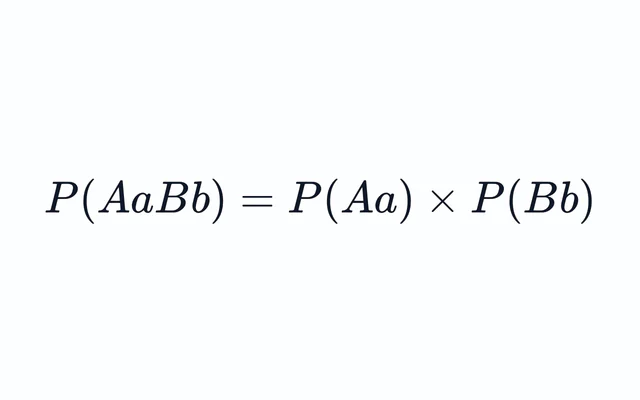
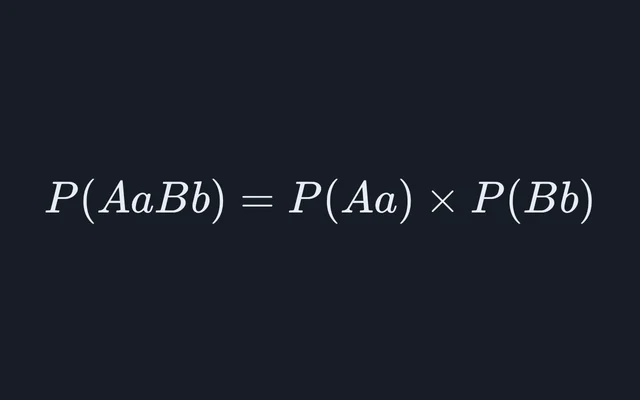
Rh is taught the same way, as one gene with D dominant to d: Rh positive is DD or Dd and Rh negative is dd. In fact the D antigen depends on whether a working RHD gene is there at all, and most Rh negative people of European descent have no RHD gene, so d stands for its absence. The D and d model is the standard teaching version and gives the same ratios. ABO sits on chromosome 9 and RHD on chromosome 1, so the two are inherited independently, and a child’s chance of being AB+ is its chance of AB times its chance of Rh positive.
Pick each parent’s type above. The calculator works out how likely each parent is to carry O and d, draws the square, lists the child types that can and cannot happen, and shows the chance of each, with a hundred children drawn to scale. If you know a genotype, set it under “I know the genotype”, or enter the grandparents’ types and let the calculator narrow it down. Known genotypes gives the classic coursework square with exact fractions, and X-linked handles traits carried on the X chromosome, with sons and daughters apart.
Reading the weighted Punnett square
In a textbook Punnett square every box is equally likely,
because each parent’s genotype is known and each of its two alleles is passed on half the time. Knowing only
that a parent is type A leaves two possibilities, AA and AO, so here the sides are drawn to scale: each column
is as wide as parent 1’s chance of passing that gamete on, and each row as tall as parent 2’s. A box’s area is
then its chance, and the boxes of one type add up to that type’s chance. Tap a box to see its product. In the
ABO only square for an A+ parent and a B+ parent, the box where parent 1 passes on A and parent 2 passes on O is
0.5833 × 0.4740 = 0.2765, and it is the only route to a type A child.
With ABO and Rh together the square is up to 4 by 4, with gametes such as A D and O d. The narrow columns and rows for d show at a glance that an Rh positive parent passes on d much less often than D, which is why an Rh negative child of two Rh positive parents is possible but uncommon. The boxes for one type are outlined together, and the bars beside the square pick a type from the keyboard.
Worked example: an A+ parent and a B+ parent
Take an A+ parent and a B+ parent under the US preset, the case the calculator opens on. Stanford Blood Center’s figures give 44 percent O, 42 percent A, 10 percent B, 4 percent AB and 15 percent Rh negative. Bernstein’s method turns those into allele frequencies of p = 0.2650 for A, q = 0.0726 for B and r = 0.6624 for O, and d = 0.3873 for d.
-
A type A person is AO with probability
2pr / (p² + 2pr) = 0.833, so the A+ parent passes on O with probability 0.4167 and A with 0.5833. -
A type B person is BO with probability
2qr / (q² + 2qr) = 0.948, so the B+ parent passes on O with probability 0.4740 and B with 0.5260. - Each Rh positive parent is Dd with probability 0.558, and so passes on d with probability 0.2792.
-
The child is AB with
0.5833 × 0.5260 = 0.3068, A with0.5833 × 0.4740 = 0.2765, B with0.4167 × 0.5260 = 0.2192and O with0.4167 × 0.4740 = 0.1975, and Rh negative with0.2792 × 0.2792 = 0.078.
So every one of the eight types is possible: AB+ 28.3 percent, A+ 25.5, B+ 20.2 and O+ 18.2, and the four Rh negative types between 1.5 and 2.4 percent each. AB+ is the likeliest single type, yet a type O child, which many people expect to be impossible from these parents, has about a 1 in 5 chance.
Why the percentages depend on the population
A blood type does not say which genotype is behind it, so the chances above depend on how common each genotype
is, and that depends on the population. Under Hardy-Weinberg proportions, which G. H. Hardy and Wilhelm Weinberg
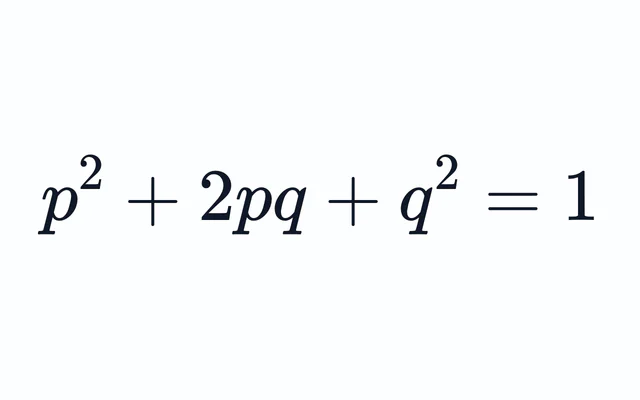
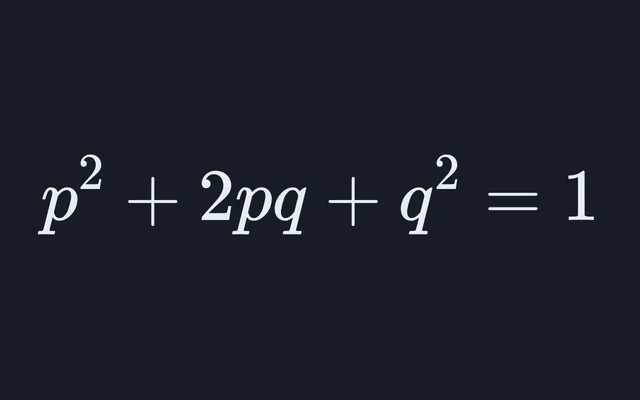
published separately in 1908, a population mating at random with allele frequencies p, q and r has AA in
proportion p², AO 2pr, BB q², BO 2qr, AB 2pq and OO r². The share of type A people who are AO is therefore
2pr / (p² + 2pr), the equation on this page. The
Hardy-Weinberg calculator works through the same proportions for
a gene with two alleles.
Blood services publish the share of each type rather than allele frequencies, so the calculator recovers them
by Bernstein’s method. Type O is r², and O and B together are (q + r)², which is (1 − p)², so
r = √O, p = 1 − √(O + B) and q = 1 − √(O + A). The three estimates rarely
add to exactly 1, and Bernstein’s adjustment spreads the shortfall D = 1 − p − q − r back over
them: p and q are each multiplied by 1 + D/2, and the calculator takes r as what is left, so that
the three add to exactly 1. For the US shares D is −0.0011, and the adjusted frequencies reproduce all four
published ABO shares of both presets to within 0.2 percentage points. Rh has two alleles, so d is simply the
square root of the Rh negative share. Both steps are approximations: a real population mixes groups with
different frequencies and does not mate at random, so treat the chances as estimates, not exact figures.
The two presets show how much this matters. NHS Blood and Transplant’s figures for donors in England give 50 percent O, 36 percent A, 11 percent B, 3 percent AB and 26 percent Rh negative. Under them a type A parent is AO with probability 0.866 rather than 0.833, and an Rh positive parent is Dd with probability 0.675 rather than 0.558, so the same A+ and B+ couple has an 11.4 percent chance of an Rh negative child instead of 7.8. Both presets are national figures, and blood group frequencies differ a good deal by ancestry; donor shares need not match a whole population either, since who gives blood is not a random sample. Choose Custom to enter the shares for another population.
Grandparents’ types narrow a parent down further. A type A parent whose mother or father is type O must have received O from that parent, so is AO for certain and passes on O half the time, whatever the population. The calculator works this out exactly for any combination, over every genotype the grandparents could have, and says so when the types entered cannot all be right.
Which blood types are impossible, and the exceptions
| Parents | Possible children | Not possible |
|---|---|---|
| A and A | A, O | B, AB |
| A and B | A, B, AB, O | none |
| A and AB | A, B, AB | O |
| A and O | A, O | B, AB |
| B and B | B, O | A, AB |
| B and AB | A, B, AB | O |
| B and O | B, O | A, AB |
| AB and AB | A, B, AB | O |
| AB and O | A, B | AB, O |
| O and O | O | A, B, AB |
Each pair has its own page in the blood type inheritance chart, with every Punnett square and the odds on US and England figures.
For Rh, two Rh negative parents have only Rh negative children, while a couple with an Rh positive parent can have either, since an Rh positive parent may carry d. These are the rules of ordinary inheritance, and a few rare cases break them.
- The Bombay phenotype. People with two non-working copies of the H gene, hh, cannot make the H antigen that A and B are built on, so they type as O whatever ABO alleles they carry, and can pass on A or B. It was first described in Bombay, now Mumbai, in 1952.
- cis-AB. A rare allele that makes both A and B at once, so an AB parent can pass on A and B together, and an O and an AB parent can have an AB or an O child.
- Weak subgroups of A or B. They make so little antigen that a routine test can read them as O.
- Chimerism and bone marrow transplants. Two cell lines in one body, such as cells from a twin, or a donor’s marrow, can give a blood type that is not the one a person passes on.
- Weak or partial D. Variants of the D antigen can type differently from one test to another.
- Laboratory and record errors. A mislabelled sample or a wrong record gives the same surprise.
An unexpected type is a reason to recheck, not proof that someone is not a parent.
X-linked inheritance: why sons and daughters differ
Genes on the X chromosome follow other rules, because a female has two X chromosomes and a male has one X and a Y. A son gets his X from his mother and his Y from his father, and a daughter gets one X from each. So a father passes his X to every daughter and to no son, and a son’s chance of an X-linked trait depends on his mother alone.
For a recessive allele, written Xʰ beside the typical Xᴴ, a son with one copy is affected, while a daughter needs two. A carrier mother, XᴴXʰ, and an unaffected father, XᴴY, have sons who are each affected with probability 1/2, and daughters who are never affected but are carriers with probability 1/2. That is why red-green colour blindness and hemophilia A are far commoner in men. An affected father, XʰY, with a mother who is not a carrier passes Xʰ to every daughter, so every daughter is a carrier and no son is affected.
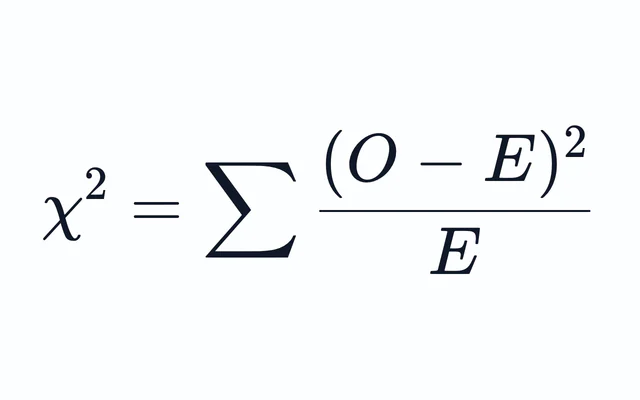
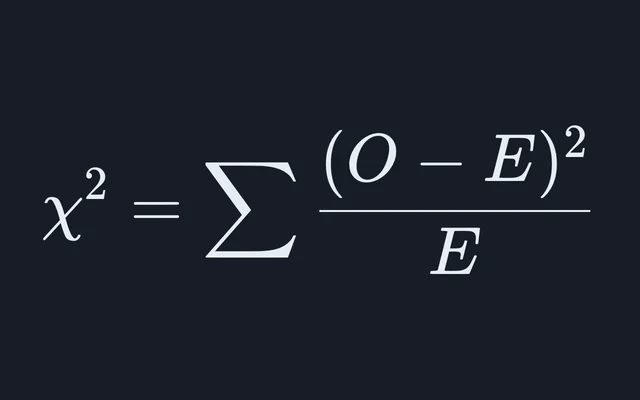
Thomas Hunt Morgan found the pattern in 1910 with a white-eyed male fruit fly. Bred to his red-eyed sisters, it gave 1,237 red-eyed offspring, and three white-eyed males that he set aside. Those red-eyed offspring, bred together, gave 2,459 red-eyed females, 1,011 red-eyed males and 782 white-eyed males, with no white-eyed females. White eyes had reached the grandsons only. The Morgan’s white-eyed flies preset is that second cross, XᵂXʷ × XᵂY, which predicts red-eyed females, red-eyed males and white-eyed males in the ratio 2:1:1. Tested against 2:1:1 in the chi-square calculator, his counts give χ² = 129 on 2 degrees of freedom: there were far too few white-eyed males for chance alone, a reminder that real counts can depart from a square.
X-linked dominant inheritance
When the allele is dominant, one copy is enough in either sex. An affected father, XᴴY, passes it to every daughter, who are all affected, and to none of his sons. An affected mother with one copy, XᴴXʰ, passes it to half of her children, so with an unaffected father half of her sons and half of her daughters are affected. X-linked hypophosphatemia, in the PHEX gene, is inherited this way. In a family tree the sign is an affected father whose daughters are all affected and who never passes it to a son.
What this calculator cannot tell you
It cannot say who a child’s parents are. A blood type can sometimes rule a person out, but the exceptions above mean it cannot settle the question on its own, and parentage is established by DNA testing. It is not medical advice either, and gives no guidance on transfusion. Rh in pregnancy is handled by antenatal care, which tests rather than predicts.
The X-linked presets show inheritance patterns, not clinical facts about the conditions they name. Real families can differ from the square: some carriers have symptoms, a condition can arise from a new mutation in a family with no history of it, and the chance for a particular family is a question for a genetics service.
The population mode assumes random mating and Hardy-Weinberg proportions, and every mode assumes Mendelian segregation, full penetrance and no new mutation. For what the letters stand for, the DNA to protein translator reads a gene’s codons, and the DNA double helix explorer shows the molecule they are written in.
Common mistakes
- Treating a type as a genotype. Type A can be AA or AO, so two type A parents can have a type O child: about 17 percent of the time under the US figures.
- Expecting an AB parent to have a type O child. An AB parent passes on A or B, never O, so by ordinary inheritance its child is never type O, whoever the other parent is.
- Reading possible as likely. From an A+ and a B+ parent an O− child is possible, at about 1.5 percent under the US figures.
- Assuming two Rh positive parents cannot have an Rh negative child. Two Dd parents have a 1 in 4 chance each time.
- Adding the ABO and Rh chances. The genes are on different chromosomes, so the chances
multiply: AO Dd × BO Dd gives AB+ with
1/4 × 3/4 = 3/16. - Giving a son his father’s X. A son’s X always comes from his mother, so an X-linked trait never passes from father to son.
Common questions
What blood type will my baby be?
It depends on which alleles each parent carries, not only on their types. An O parent and an AB parent can only have an A or a B child, while an A parent and a B parent can have a child of any of the four types. When the parents’ genotypes are unknown, the calculator weighs each possibility by how common it is in a population: for an A+ parent and a B+ parent under US figures, AB+ is the likeliest type at 28.3 percent, and a type O child has about a 1 in 5 chance.
Can two O parents have an A or B child?
Not by ordinary ABO inheritance, because both can pass on only O. Rare exceptions exist: a parent with the Bombay phenotype or a weak A or B subgroup can test as O yet pass on A or B, and laboratory errors happen. An unexpected blood type is a reason to recheck, and it does not prove that someone is not a parent.
Can two Rh positive parents have an Rh negative baby?
Yes, if both carry the d allele. Two Dd parents have a 1 in 4 chance of an Rh negative child each time. When only the types are known, the calculator estimates how likely each parent is to be Dd from how common Rh negative blood is in the chosen population: with 15 percent Rh negative, as in the US figures, each Rh positive parent is Dd with probability 0.558, and the chance of an Rh negative child is 7.8 percent.
Why are the percentages different from a textbook Punnett square?
A textbook square starts from known genotypes: AO × BO gives A, B, AB and O a quarter each. Knowing only that a parent is type A leaves AA or AO, so the calculator weighs them by Hardy-Weinberg proportions from the population’s allele frequencies, and draws each parent’s side of the square in proportion. Under US figures a type A person is AO with probability 0.833, which is 2pr / (p² + 2pr) with p = 0.265 for A and r = 0.662 for O.
Why are X-linked recessive conditions more common in males?
A son gets his only X chromosome from his mother, so one copy of the allele is enough, while a daughter needs one on each X. From a carrier mother and an unaffected father, each son has a 1 in 2 chance of being affected and each daughter a 1 in 2 chance of being a carrier, and no daughter is affected. For an allele on 1 X chromosome in 20, about 1 man in 20 would show the trait but only 1 woman in 400.
How is X-linked dominant inheritance different?
One copy is enough in either sex. An affected father passes the allele to every daughter and to none of his sons; an affected mother with one copy passes it to half of her children, sons and daughters alike. X-linked hypophosphatemia is inherited this way, and the tell-tale sign in a family tree is an affected father whose daughters are all affected and who never passes it to a son.
Can a blood type test prove who a child’s father is?
No. A blood type can sometimes rule a man out, but it cannot settle the question on its own, because the Bombay phenotype, cis-AB, chimerism and laboratory error can all produce a type the usual rules call impossible. Parentage is established by DNA testing.