Rf Value Calculator
Calculate an Rf value from the distances moved by a spot and the solvent front, or find either distance from Rf, for paper and thin layer chromatography.
Calculator
From the baseline to the centre of the spot, not to its top edge.
From the baseline to the line the solvent reached. Mark it as soon as the paper or plate comes out, before the solvent evaporates.
Between 0 and 1, with no unit.
Working, with your numbers
- Rf = distance moved by spot / distance moved by solvent front
- = 3 cm / 7.5 cm
- = 0.4
Values are converted into the units the equation is worked in before the arithmetic.
- Rf to two decimal places A ruler read to the nearest millimetre over a run of a few centimetres fixes Rf to about the second decimal place, so figures beyond it are not measured.
- 0.40
- Spot height as a share of the run How far up the run the spot sits: the Rf times 100.
- 40%
Citing this tool
Last updated . Add the date you accessed it as well, which a citation of a page that can change asks for. If a specific result matters, cite the permalink from the tool’s share row instead of this page: it reproduces the exact parameters.
On the syllabus: AQA GCSE Required Practicals, Chromatography.
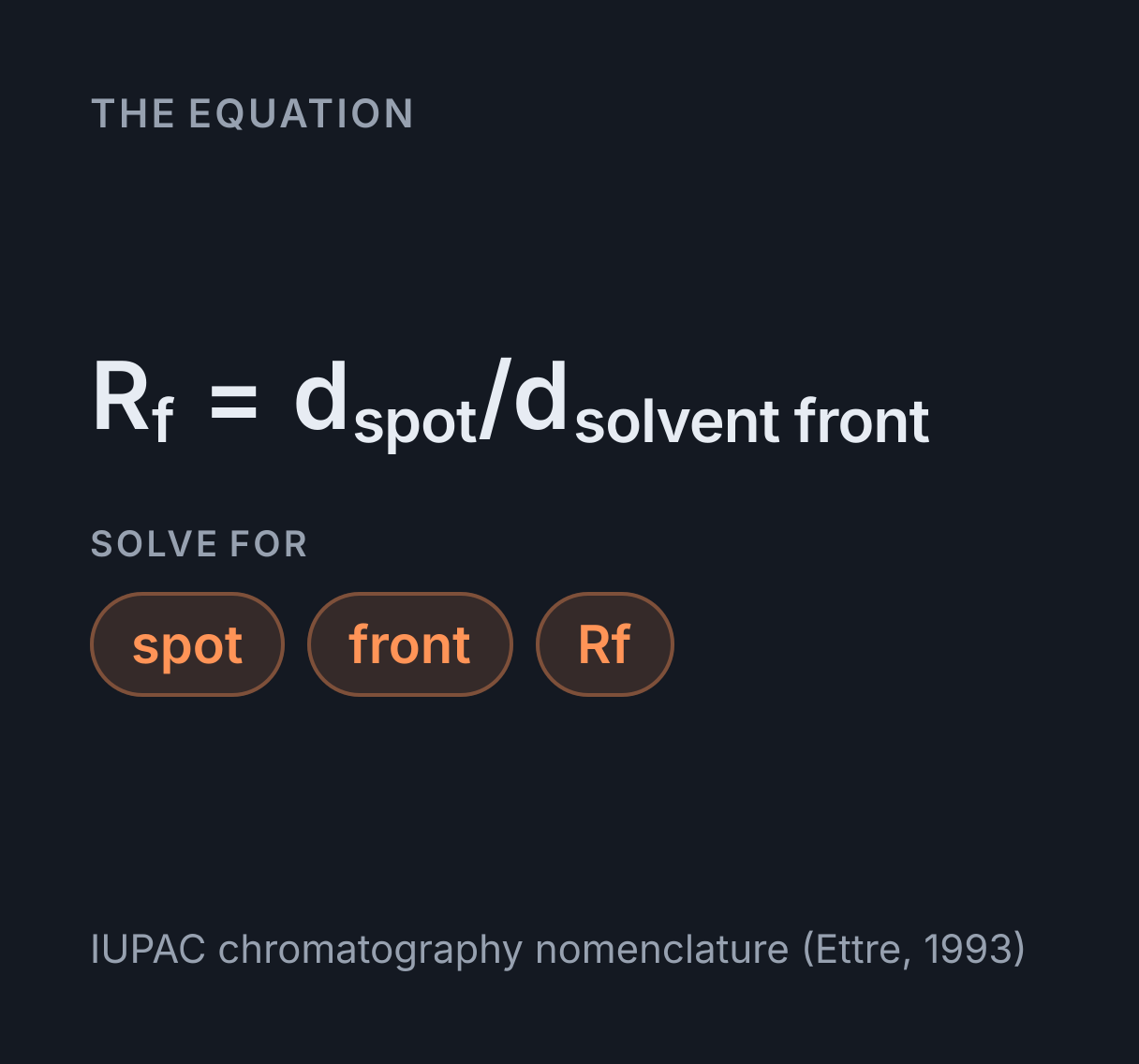
The equation
IUPAC chromatography nomenclature (Ettre, 1993)
What is the Rf value formula?
The Rf value (retention factor) is Rf = distance moved by the spot ÷ distance moved by the solvent front, both measured from the baseline where the sample was spotted. Because a spot can never travel further than the solvent carrying it, Rf always lies between 0 and 1 and has no units.
Measuring the two distances
Draw the baseline in pencil, because ink is itself a mixture of dyes and would run with the sample, and keep it above the level of the solvent in the tank so the spots do not dissolve into the pool below. When the solvent has climbed most of the way up, take the paper or plate out and mark the solvent front at once: the solvent evaporates, and the line it reached soon cannot be seen.
Measure to the centre of each spot, not to its top edge. A spot spreads as it travels, and its centre is where most of the substance sits, which is the point the IUPAC definition measures to. A ruler read to the nearest millimetre over a run of a few centimetres fixes Rf to about the second decimal place, which is why the first readout rounds to two: more figures than that claim a precision the measurement does not have.
What an Rf value tells you
Each substance divides its time between the moving solvent, the mobile phase, and the paper or the coating on the plate, the stationary phase. The more strongly the stationary phase holds it, the less of the run it keeps up with and the lower its Rf. On a silica plate, which is polar, polar compounds are held more strongly and run lower than nonpolar ones in the same solvent.
That makes an Rf a property of a substance under one set of conditions, not of the substance alone. A different solvent, a different paper or plate, or a different temperature gives a different value, so an unknown is identified by running it beside known references on the same sheet and comparing them, not by looking its Rf up in a table. Two substances can share an Rf in one solvent, so a match in one solvent is evidence rather than proof, and a second run in a different solvent that still matches is far stronger.
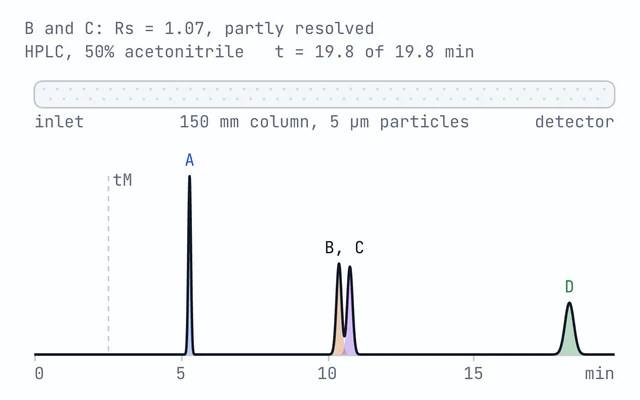
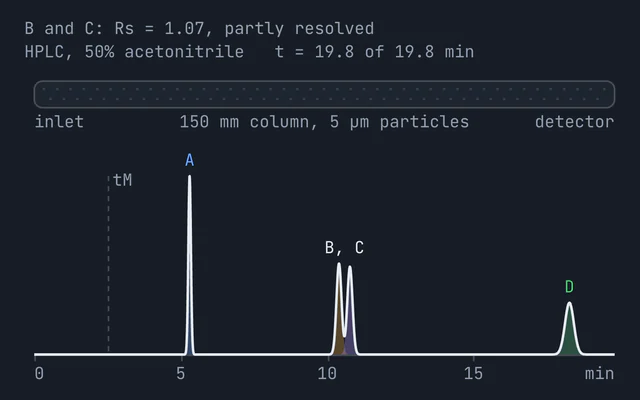
Column chromatography and HPLC use a retention factor too, but a different one: k, the time an analyte spends in the stationary phase relative to the mobile phase, which the chromatography simulator works with. The Rf on this page is the planar chromatography quantity IUPAC calls the retardation factor.
Spots that stay on the baseline or run with the front
An Rf of 0 means the substance did not move from where it was spotted, and an Rf of 1 means it travelled with the solvent front. Neither identifies anything, because every substance the solvent leaves behind shares the first value and every substance it carries freely shares the second. The calculator accepts both and warns about them. The cure is a different solvent: one that carries the substance more readily for a spot stuck at the baseline, and less readily for one at the front.
Common mistakes
- Measuring from the edge of the paper. Both distances start at the baseline. With the baseline 1.0 cm up, a spot whose centre is 5.1 cm from the edge and a front 8.0 cm from it give 4.1 ÷ 7.0 = 0.59, not 5.1 ÷ 8.0 = 0.64.
- Swapping the two distances. Solvent front over spot gives a number above 1, which no spot can have, so the calculator refuses it rather than reporting it.
- Mixing millimetres and centimetres. A spot at 18 mm with a front at 6.0 cm is 1.8 ÷ 6.0 = 0.30, not 18 ÷ 6.0 = 3. Choose the unit for each field and the calculator converts before dividing.
- Comparing Rf values from different runs. A change of solvent, paper, plate or temperature moves every Rf, so compare spots that ran side by side on the same sheet.
Converting units first? Use the length conversion table.
How to calculate an Rf value
- Write down the formula:
Rf = spot ÷ front -
Gather the values it needs. The calculator above starts with these:
- Distance moved by the spot: 3 cm
- Distance moved by the solvent front: 7.5 cm
-
Substitute them and work through the arithmetic:
- Rf = distance moved by spot / distance moved by solvent front
- = 3 cm / 7.5 cm
- = 0.4
-
To find one of the other values instead, rearrange the formula for it:
- Distance moved by the spot:
spot = Rf × front - Distance moved by the solvent front:
front = spot ÷ Rf
- Distance moved by the spot:
Worked examples
Each one runs through the calculator above, so the arithmetic here is the arithmetic it does.
What is the Rf value if the spot moved 18 mm and the solvent front 6.0 cm?
- Rf = distance moved by spot / distance moved by solvent front
- = 1.8 cm / 6 cm
- = 0.3
0.30, once both distances are in the same unit: 1.8 cm over 6.0 cm. Dividing 18 by 6.0 as they stand gives 3, which no spot can have, since it would put the spot far beyond the solvent that carried it.
How far will a dye with an Rf of 0.65 travel if the solvent front moves 9 cm?
- spot = Rf x front
- = 0.65 x 9 cm
- = 5.85 cm
5.85 cm from the baseline. Rearranged like this, Rf predicts where to look for a spot, but only for the same solvent and the same kind of paper or plate the 0.65 was measured on.
How far must the solvent front run to move a spot with an Rf of 0.25 by 2 cm?
- front = spot / Rf
- = 2 cm / 0.25
- = 8 cm
8 cm. Rf fixes the ratio, not the distances, so a longer run spreads spots further apart: spots at Rf 0.25 and 0.30 end up 4 mm apart after an 8 cm run but only 2 mm apart after 4 cm.
Practise this with Chemistry Practice Problems, questions generated from this calculator and 9 other calculators in Chemistry.
Common questions
Can an Rf value be greater than 1?
No. The spot is carried by the solvent, so it cannot get ahead of the solvent front, and its distance from the baseline is at most the front’s. An Rf above 1 means a slip in the measurement, most often the two distances swapped, so the calculator refuses it rather than reporting it.
Why do Rf values change from one experiment to the next?
Because an Rf depends on the conditions as well as the substance: the solvent, the type of paper or plate, whether the tank was saturated with solvent beforehand, and the temperature all move it. That is why an unknown is compared with references spotted on the same sheet and run at the same time, rather than with a value from a table or another day’s run.
What does an Rf value of 0.5 mean?
That the spot travelled half as far as the solvent front: with the front 8 cm from the baseline, the centre of the spot is 4 cm from it. On its own the number only locates the spot. It identifies a substance when a known compound run on the same sheet, in the same solvent, gives the same value.
Is the Rf value the same as the retention factor?
In paper and thin layer chromatography, yes: the Rf value and the retention factor both mean the distance moved by the spot divided by the distance moved by the solvent front, and IUPAC calls it the retardation factor. In column chromatography and HPLC, retention factor means something else, k, the time an analyte spends in the stationary phase relative to the mobile phase.