Pendulum period: the small-angle formula vs the exact period, by amplitude
The small-angle formula 2π√(L/g) falls short of a pendulum’s exact period by 0.428% at 15°, 1.71% at 30° and 15.3% at 90°, at any length. For a 1 m pendulum at 90° that is 2.006 s against 2.368 s. The shortfall passes 1% at 22.9° and 10% at 72.7°, and reaches 59.0% at 170°.
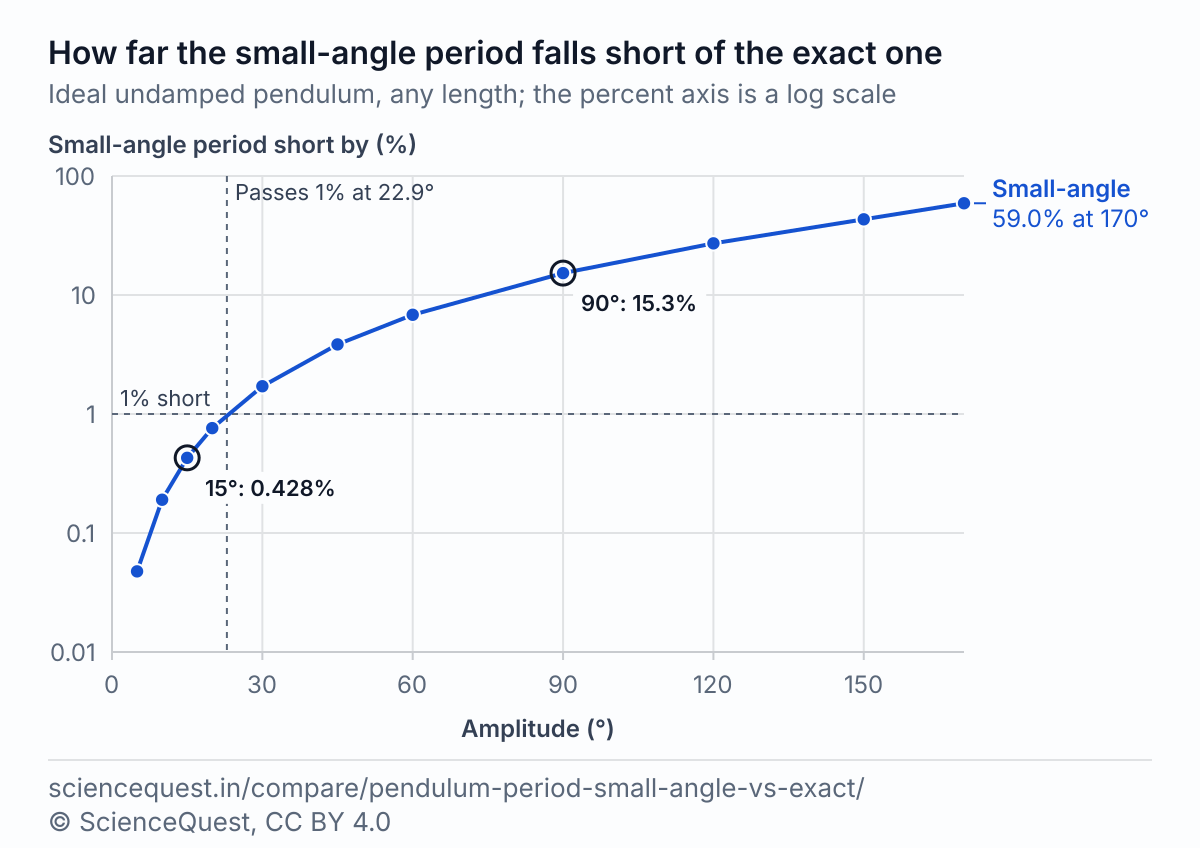
Small-angle against exact, by amplitude
| Amplitude (°) | Exact against small-angle | 1 m pendulum | |
|---|---|---|---|
| Ratio | Short by % | Exact s | |
| 5 | 1.0005 | 0.0476 | 2.007 |
| 10 | 1.0019 | 0.190 | 2.010 |
| 15 | 1.0043 | 0.428 | 2.015 |
| 20 | 1.0077 | 0.761 | 2.022 |
| 30 | 1.0174 | 1.71 | 2.041 |
| 45 | 1.0400 | 3.84 | 2.087 |
| 60 | 1.0732 | 6.82 | 2.153 |
| 90 | 1.1803 | 15.3 | 2.368 |
| 120 | 1.3729 | 27.2 | 2.755 |
| 150 | 1.7622 | 43.3 | 3.536 |
| 170 | 2.4394 | 59.0 | 4.894 |
Short by is (T − T₀) ÷ T, a share of the exact period, as the simulator’s Approximation error readout gives it. For a 1 m pendulum T₀ = 2.006 s at every amplitude. The ratio and the shortfall come out the same at every length and every g.
Period by length at 30° and 90°
| Length (m) | Small-angle | Exact | |
|---|---|---|---|
| Any angle | 30° | 90° | |
| 0.25 | 1.003 | 1.021 | 1.184 |
| 0.5 | 1.419 | 1.443 | 1.675 |
| 1 | 2.006 | 2.041 | 2.368 |
| 2 | 2.837 | 2.887 | 3.349 |
| 10 | 6.345 | 6.455 | 7.489 |
Every period goes as the square root of the length: a pendulum four times as long has twice the period, at the same ratio to its small-angle figure.
Where the shortfall passes 0.1%, 1%, 5% and 10%
| Short by (%) | Amplitude ° | Exact, 1 m s | Exact longer by % |
|---|---|---|---|
| 0.1 | 7.2 | 2.008 | 0.100 |
| 1 | 22.9 | 2.027 | 1.01 |
| 5 | 51.3 | 2.112 | 5.26 |
| 10 | 72.7 | 2.229 | 11.1 |
Counted against the small-angle period, the gap reads larger: 10% short of the exact period is 11.1% longer than the small-angle one.
Why the small-angle period runs short
The small-angle formula comes from setting sin θ equal to θ in the equation of motion, which makes the swing simple harmonic, with one period at every amplitude, 2π√(L/g) [1]. The true restoring torque grows as sin θ and falls behind θ as the swing widens, so the bob takes longer to come back. Beléndez and colleagues integrate the full equation to an exact period with the complete elliptic integral K in it [1] [2]. The simulator computes K by Gauss’s arithmetic-geometric mean, which converges quadratically [3].
Both periods carry the same √(L/g), so their ratio depends on the amplitude alone: at 90° a 0.25 m pendulum and a 10 m one both run 1.1803 times their small-angle period. Below 20° the shortfall grows about fourfold at each doubling of the amplitude. It reaches 27.2% at 120° and 59.0% at 170°. At 180° the bob would balance upright and never come back, so the exact period has no bound.
The simulator and the first table take the shortfall as a share of the exact period, (T − T₀) ÷ T, which stays under 100%. As a share of the small-angle period, T ÷ T₀ − 1, the 170° gap is 144%, since the exact period there is 2.4394 times the small-angle one. Release a lab pendulum from under 7.2° and the formula stays within 0.1% either way.
The formulas
- Small-angle period [1]
-
- Exact period of the ideal pendulum [1]
-
- Complete elliptic integral of the first kind [2]
-
- K by the arithmetic-geometric mean [3]
-
T is the exact period and T₀ the small-angle period, in seconds. L is the length from the pivot to the bob, g the acceleration due to gravity, here the standard 9.80665 m/s² [4], and θ₀ the amplitude. K is the complete elliptic integral of the first kind [2], k = sin(θ₀/2) its modulus and k′ = √(1 − k²). M(1, k′) is the common limit of a and b when you repeat a ← (a + b) ÷ 2 and b ← √(ab) from 1 and k′ [3]. Beléndez et al. [1] define K by the parameter m, the square of the modulus (eq. 24), and write k for sin²(θ₀/2) (eq. 10), so their K(k) is the K(sin(θ₀/2)) above and gives the same period.
Where each period holds
| Formula | Derived from | Holds for | Not for |
|---|---|---|---|
| Small-angle period, 2π√(L/g) | The equation of motion with sin θ taken as θ, which makes the swing simple harmonic, “harmonic only for small angle oscillations” [1] | An ideal pendulum at small amplitude: within 0.1% of the exact period up to 7.2°, within 1% up to 22.9° | Wide swings: 6.82% short at 60° and 15.3% at 90°. A swing that dies away, since the formula has no damping in it |
| Exact period, 4√(L/g) K(sin θ₀/2) | The full equation, θ″ = −(g/L) sin θ, integrated by conservation of energy for a release from rest at θ₀ [1]; K by the arithmetic-geometric mean [3] | A point mass on “a light inextensible rod” [1], swinging in a vertical plane with no damping, at any amplitude below 180° | 180° itself, where the period has no bound; air drag or pivot friction, which the model leaves out; a bob on a string released past 90°, where the string goes slack, since it can pull the bob but not push it |
| Standard gravity, 9.80665 m/s² | A conventional value, 980.665 cm/s², set by the 3rd CGPM in 1901 [4] | The periods the tables print. The ratio and the shortfall do not depend on g | A measured local g. Both periods go as 1 ÷ √g, so set your own g in the simulator |
Calculators and simulators
Sources
- Beléndez A, Pascual C, Méndez DI, Beléndez T, Neipp C. Exact solution for the nonlinear pendulum. Revista Brasileira de Ensino de Física 2007;29(4):645 to 648. doi:10.1590/S1806-11172007000400024
- NIST Digital Library of Mathematical Functions, §19.2 Definitions, equations 19.2.4 and 19.2.8. Release 1.2.8, . https://dlmf.nist.gov/19.2
- NIST Digital Library of Mathematical Functions, §19.8(i) Gauss’s Arithmetic-Geometric Mean, equations 19.8.1 and 19.8.5. Release 1.2.8, . https://dlmf.nist.gov/19.8
- 3rd General Conference on Weights and Measures (CGPM), 1901. Declaration on the unit of mass and on the definition of weight; conventional value of gₙ. Proceedings of the 3rd CGPM, p. 70. BIPM. https://www.bipm.org/en/committees/cg/cgpm/3-1901/resolution-2
The values are facts and free to use; this table’s selection and presentation are © 2026 ScienceQuest.