pH of strong vs weak acids by concentration, from 1 M to 10⁻⁸ M
At 0.01 M a strong acid is pH 2.00, formic acid 2.90, acetic acid 3.39, carbonic acid 4.18 and ammonium 5.62. Dilute them and the values close up. At 10⁻⁶ M acetic acid, 94.8% dissociated, is pH 6.02 beside the strong acid’s 6.00, and at 10⁻⁸ M the strong acid is pH 6.98, still below 7.
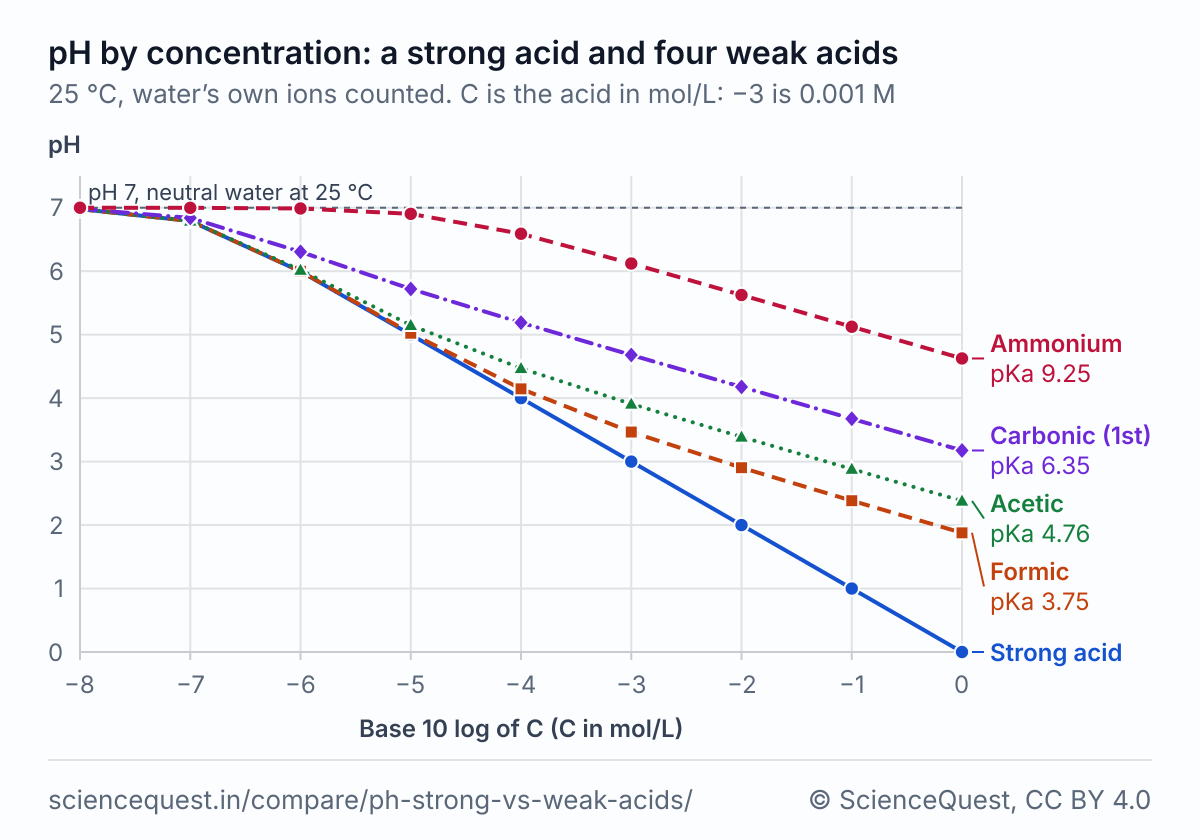
pH from 1 M to 10⁻⁸ M
| Acid (M) | Strong | Weak acids, by pKa | ||||
|---|---|---|---|---|---|---|
| Strong acid | Citric (1st) pKa 3.13 | Formic pKa 3.75 | Acetic pKa 4.76 | Carbonic (1st) pKa 6.35 | Ammonium pKa 9.25 | |
| 1 | 0.00 | 1.57 | 1.88 | 2.38 | 3.18 | 4.63 |
| 10⁻¹ | 1.00 | 2.08 | 2.38 | 2.88 | 3.68 | 5.12 |
| 10⁻² | 2.00 | 2.62 | 2.90 | 3.39 | 4.18 | 5.62 |
| 10⁻³ | 3.00 | 3.25 | 3.47 | 3.91 | 4.68 | 6.12 |
| 10⁻⁴ | 4.00 | 4.05 | 4.15 | 4.47 | 5.19 | 6.59 |
| 10⁻⁵ | 5.00 | 5.01 | 5.02 | 5.15 | 5.72 | 6.90 |
| 10⁻⁶ | 6.00 | 6.00 | 6.00 | 6.02 | 6.31 | 6.99 |
| 10⁻⁷ | 6.79 | 6.79 | 6.79 | 6.79 | 6.84 | 7.00 |
| 10⁻⁸ | 6.98 | 6.98 | 6.98 | 6.98 | 6.98 | 7.00 |
Every cell solves the full charge balance with Kw = 1.0 × 10⁻¹⁴ at 25 °C. The citric and carbonic columns count each acid’s first step only. Ammonium’s 7.00 at 10⁻⁸ M rounds 6.9999, just on the acid side of 7.
Percent dissociated: dilution ionizes more of each acid
| Acid (M) | Citric (1st) pKa 3.13 | Formic pKa 3.75 | Acetic pKa 4.76 | Carbonic (1st) pKa 6.35 | Ammonium pKa 9.25 |
|---|---|---|---|---|---|
| 1 | 2.69 | 1.32 | 0.416 | 0.0668 | 0.00237 |
| 10⁻¹ | 8.25 | 4.13 | 1.31 | 0.211 | 0.00750 |
| 10⁻² | 23.8 | 12.5 | 4.08 | 0.666 | 0.0237 |
| 10⁻³ | 56.7 | 34.2 | 12.3 | 2.09 | 0.0743 |
| 10⁻⁴ | 89.3 | 71.4 | 33.9 | 6.46 | 0.218 |
| 10⁻⁵ | 98.7 | 94.9 | 71.0 | 19.0 | 0.448 |
| 10⁻⁶ | 99.9 | 99.4 | 94.8 | 47.4 | 0.544 |
| 10⁻⁷ | > 99.9 | 99.9 | 99.1 | 75.5 | 0.558 |
| 10⁻⁸ | > 99.9 | 99.9 | 99.4 | 81.1 | 0.559 |
Lower’s five percent rule lets the √(Ka·C) shortcut stand while the [H⁺] it gives is under 5% of C: citric acid at 1 M only, formic acid down to 10⁻¹ M, acetic acid down to 10⁻² M, carbonic acid down to 10⁻³ M and ammonium down to 10⁻⁶ M.
A very dilute strong acid: the H⁺ that water adds
| Acid (M) | pH water counted | [H⁺] M | From water M | Water’s share % |
|---|---|---|---|---|
| 10⁻⁶ | 6.00 | 1.01 × 10⁻⁶ | 9.90 × 10⁻⁹ | 1.0 |
| 10⁻⁷ | 6.79 | 1.62 × 10⁻⁷ | 6.18 × 10⁻⁸ | 38.2 |
| 10⁻⁸ | 6.98 | 1.05 × 10⁻⁷ | 9.51 × 10⁻⁸ | 90.5 |
Water ionizes into equal amounts of H⁺ and OH⁻, so the H⁺ it supplies equals the OH⁻ in the solution, and [H⁺] is the acid’s concentration plus that.
These are ideal solutions in pure, carbon dioxide-free water at 25 °C. A pH meter reads hydrogen ion activity, so measured values drift from these, most at 0.1 M and above.
Why strong and weak acids differ
A strong acid gives up every proton, so down to about 10⁻⁶ M its pH is −log C, pH 2.00 at 0.01 M. A weak acid gives up only some. At 0.01 M acetic acid is 4.08% dissociated, at pH 3.39. Ammonium’s pKa of 9.25 is higher, so at the same concentration it is 0.0237% dissociated, at pH 5.62.
Dilute a weak acid and more of it ionizes, the Ostwald dilution law in Lower’s section 13.3. Acetic acid goes from 0.416% at 1 M to 94.8% at 10⁻⁶ M and is half dissociated at 3.5 × 10⁻⁵ M, where its pH equals its pKa of 4.76. At 10⁻⁵ M ammonium passes the five percent rule, with the shortcut’s [H⁺], √(Ka·C), at 0.75% of C, yet water supplies 64% of its H⁺. The shortcut leaves water out, so at 10⁻⁵ M it puts ammonium above pH 7.
Below about 10⁻⁶ M you have to count water’s own ions. Taking [H⁺] = C gives pH 6, 7 and 8 for 10⁻⁶, 10⁻⁷ and 10⁻⁸ M, and pH 8 would make an acid basic. With water counted, the strong acid is at pH 6.00, 6.79 and 6.98, and at 10⁻⁸ M water supplies 90.5% of the H⁺. Lower’s section 13.2 says no amount of dilution can make the solution alkaline.
The formulas
- Strong acid, water counted [1]
-
- Weak acid, charge balance [2]
-
- Degree of dissociation [3]
-
- pH [4]
-
- Ion product of water at 25 °C [5]
-
C is the acid’s concentration in mol/L, Ka = 10^−pKa its dissociation constant (pKa from the CRC Handbook, tables E1 and E2), Kw the ion product of water and α the fraction dissociated, which the second table gives as a percent. The weak acid balance has one positive root, which the pH calculator finds by bisection.
Where each figure holds
| Figure | Based on | Holds for | Not for |
|---|---|---|---|
| Strong acid pH | Every molecule dissociated, and [H⁺] = C + Kw ÷ [H⁺] solved as the quadratic it is (Lower 13.2) | A strong monoprotic acid at 25 °C at any dilution: [H⁺] never falls below 10⁻⁷ M, so the pH stays under 7 | The rows from 1 M to 10⁻³ M, whose ions reach the 0.001 M below which Lower 13.7 lets concentration stand for activity. A diprotic acid such as sulfuric, whose second proton the quadratic does not count |
| Weak acid pH and percent dissociated | The charge balance [H⁺] = [A⁻] + [OH⁻], solved exactly (Lower 13.7), with Lower 13.3’s fraction dissociated, [A⁻] ÷ C = Ka ÷ (Ka + [H⁺]) | A monoprotic weak acid at 25 °C, at any dilution, with ions below about 0.001 M, where concentrations stand in for activities with negligible error (Lower 13.7) | Rows whose ions reach 0.001 M: citric acid from 1 M to 10⁻² M, formic acid from 1 M to 10⁻² M, acetic acid at 1 M and 10⁻¹ M and ammonium from 1 M to 10⁻³ M. Ammonium comes as a salt such as ammonium chloride (Lower 13.3), whose chloride alone is at C. Citric and carbonic acid’s later steps, pKa 4.76 and 6.40 for citric and 10.33 for carbonic (CRC), which add H⁺ these columns leave out |
| Kw = 1.0 × 10⁻¹⁴ | IAPWS R11-24, table 3: pKw 13.99 at 25 °C, a revision of Bandura and Lvov’s equation | 25 °C, where neutral water is pH 7.00 | Other temperatures: IAPWS gives pKw 14.95 at 0 °C and 12.25 at 100 °C, so neutral water there is not pH 7 |
| The pKa values | The CRC Handbook, 84th edition, in LibreTexts tables E1 and E2. Acetic acid’s 4.76 rounds the CRC’s 4.756; ammonium’s 9.25 is 14.00 less ammonia’s pKb of 4.75 | Dilute solutions at 25 °C, each Ka to ±5 percent at best, as Lower 13.3 advises | Other temperatures, or salty solutions: Lower 13.3 finds Ka less certain still once total ions pass 0.1 M |
| pH itself | IUPAC defines pH by the activity of H⁺, −lg a(H⁺) (Gold Book); this page takes activity as concentration | Ions below about 0.001 M, where Lower 13.7 finds the difference negligible | Ions at 0.001 M or more. Lower 13.7 puts the H⁺ activity of 0.10 M hydrochloric acid at 81% of its concentration, so a meter there reads above the table’s 1.00 |
Calculators and simulators
Sources
- Lower S. Chem1 General Chemistry, section 13.2, Strong Monoprotic Acids and Bases. Chemistry LibreTexts, CC BY 3.0. https://chem.libretexts.org/Bookshelves/General_Chemistry/Chem1_(Lower)/13%3A_Acid-Base_Equilibria/13.02%3A_Strong_Monoprotic_Acids_and_Bases
- Lower S. Chem1 General Chemistry, section 13.7, Exact Calculations and Approximations. Chemistry LibreTexts, CC BY 3.0. https://chem.libretexts.org/Bookshelves/General_Chemistry/Chem1_(Lower)/13%3A_Acid-Base_Equilibria/13.07%3A_Exact_Calculations_and_Approximations
- Lower S. Chem1 General Chemistry, section 13.3, Finding the pH of Weak Acids, Bases, and Salts. Chemistry LibreTexts, CC BY 3.0. https://chem.libretexts.org/Bookshelves/General_Chemistry/Chem1_(Lower)/13%3A_Acid-Base_Equilibria/13.03%3A_Finding_the_pH_of_weak_Acids_Bases_and_Salts
- IUPAC. Compendium of Chemical Terminology (the Gold Book), entry pH, online version 3.0.1; 2019. doi:10.1351/goldbook.P04524
- International Association for the Properties of Water and Steam. IAPWS R11-24, Revised Release on the Ionization Constant of H2O, table 3; 2024. Revises the equation of Bandura AV, Lvov SN, J Phys Chem Ref Data 2006;35:15. https://iapws.org/technical-guidance/release/Ionization
- LibreTexts. Table E1, Acid Dissociation Constants at 25 °C, from the CRC Handbook of Chemistry and Physics, 84th edition (2004). https://chem.libretexts.org/Ancillary_Materials/Reference/Reference_Tables/Equilibrium_Constants/E1%3A_Acid_Dissociation_Constants_at_25C
- LibreTexts. Table E2, Base Dissociation Constants at 25 °C, from the CRC Handbook of Chemistry and Physics, 84th edition (2004). https://chem.libretexts.org/Ancillary_Materials/Reference/Reference_Tables/Equilibrium_Constants/E2._Base_Dissociation_Constants_at_25C
The values are facts and free to use; this table’s selection and presentation are © 2026 ScienceQuest.