Primer melting temperature: Wallace rule vs basic GC formula vs nearest-neighbor (SantaLucia)
For the T7 promoter primer, TAATACGACTCACTATAGGG, at Primer3’s defaults the nearest-neighbor method gives 50.3 °C, the Wallace rule 56 °C and the basic GC formula 47.7 °C. Take out the magnesium and the nearest-neighbor Tm falls to 44.6 °C while the other two stay put. Reordering the same 20 bases puts it anywhere from 50.2 to 52.8 °C.
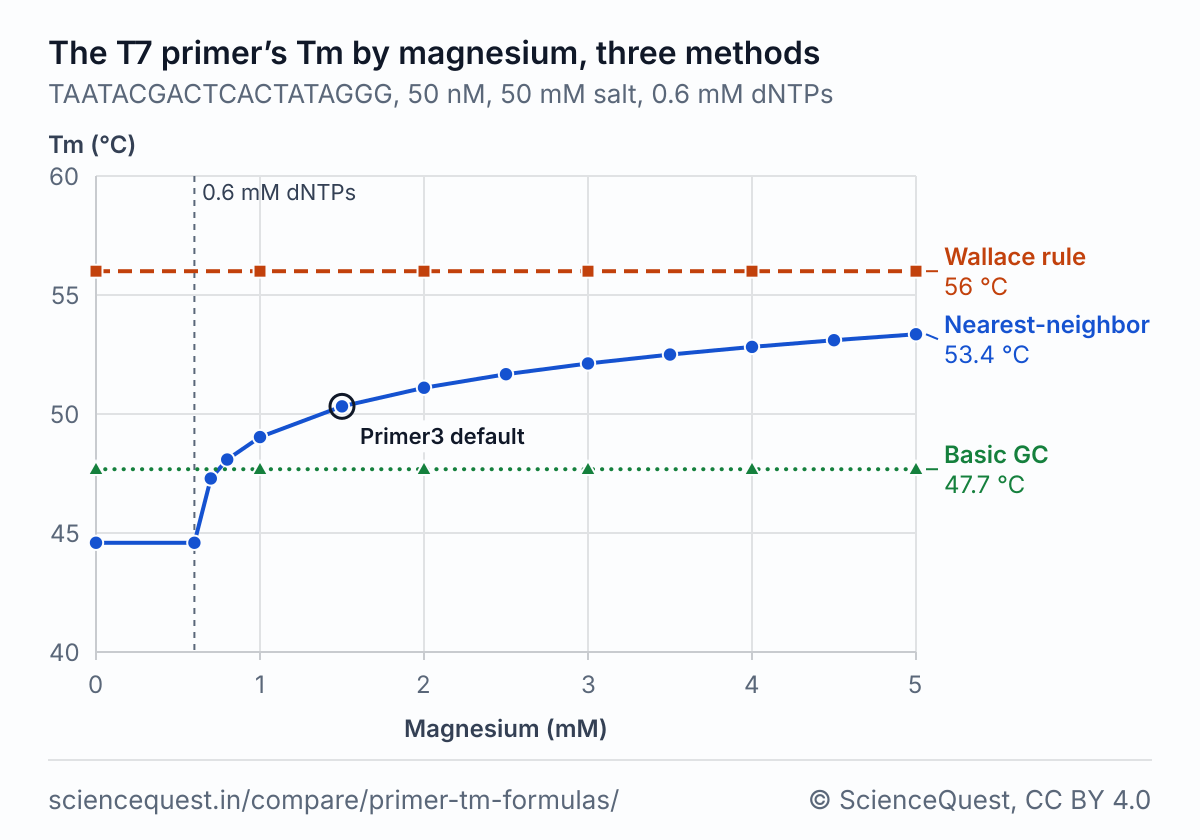
The T7 primer’s Tm by magnesium
| Mg²⁺ (mM) | Nearest-neighbor, by salt | Counting rules | ||
|---|---|---|---|---|
| 50 mM | 100 mM | Wallace | Basic GC | |
| 0 | 44.6 | 47.9 | 56 | 47.7 |
| 0.6 | 44.6 | 47.9 | 56 | 47.7 |
| 0.7 | 47.3 | 49.5 | 56 | 47.7 |
| 0.8 | 48.1 | 50.0 | 56 | 47.7 |
| 1 | 49.0 | 50.7 | 56 | 47.7 |
| 1.5 | 50.3 | 51.6 | 56 | 47.7 |
| 2 | 51.1 | 52.3 | 56 | 47.7 |
| 2.5 | 51.7 | 52.7 | 56 | 47.7 |
| 3 | 52.1 | 53.1 | 56 | 47.7 |
| 3.5 | 52.5 | 53.4 | 56 | 47.7 |
| 4 | 52.8 | 53.7 | 56 | 47.7 |
| 4.5 | 53.1 | 53.9 | 56 | 47.7 |
| 5 | 53.4 | 54.1 | 56 | 47.7 |
Monovalent salt is Na⁺ and K⁺ together. Up to 0.6 mM the formula counts no magnesium, since the dNTPs bind it [2][7]. The sodium equivalent passes 300 mM, the top of the range SantaLucia fitted the salt correction over [1], from the 3.5 mM row on at 100 mM salt and only in the 5 mM row at 50 mM.
Five sequencing primers at Primer3’s defaults
| Primer | Length bases | GC % | Nearest-neighbor °C | Wallace °C | NN minus Wallace °C | Basic GC °C |
|---|---|---|---|---|---|---|
| T7 | 20 | 40.0 | 50.3 | 56 | −5.7 | 47.7 |
| SP6 | 18 | 33.3 | 44.5 | 48 | −3.5 | 41.2 |
| T3 | 21 | 42.9 | 54.5 | 60 | −5.5 | 50.5 |
| M13 forward (−21) | 18 | 50.0 | 56.8 | 54 | +2.8 | 48.0 |
| M13 reverse | 17 | 47.1 | 49.1 | 50 | −0.9 | 44.6 |
Sequences, 5′ to 3′: T7 TAATACGACTCACTATAGGG; SP6 ATTTAGGTGACACTATAG; T3 GCAATTAACCCTCACTAAAGG; M13 forward (−21) TGTAAAACGACGGCCAGT; M13 reverse CAGGAAACAGCTATGAC.
The same 20 bases in another order
| G and C bases | Nearest-neighbor °C | Change °C | Sequence | Wallace °C | Basic GC °C |
|---|---|---|---|---|---|
| As written | 50.3 | 0.0 | TAATACGACTCACTATAGGG | 56 | 47.7 |
| At both ends | 50.2 | −0.1 | CGCCTAATAATATATACGGG | 56 | 47.7 |
| At the 3′ end | 51.5 | +1.2 | TAATAATATATACGCCCGGG | 56 | 47.7 |
| In the middle | 52.8 | +2.5 | TAATAACGCCCGGGTATATA | 56 | 47.7 |
| Spread out | 50.8 | +0.5 | TACAGTACACTACTGATGAG | 56 | 47.7 |
Change: the nearest-neighbor Tm minus the T7 primer’s as written. We kept each run of G and C bases, and of A and T bases, in the order the T7 primer has them.
Why the formulas disagree
The Wallace rule counts bases: 2 °C for each A or T and 4 °C for each G or C [5]. The basic GC formula adds the length, as 64.9 + 41 × (G + C − 16.4) ÷ N [4]. Neither has a term for salt, magnesium, strand concentration or the order of the bases, so each gives one number per composition. The nearest-neighbor method sums an enthalpy and an entropy for each of the 19 overlapping pairs of neighbors in a 20-mer, plus one term for each end, from SantaLucia’s table measured in 1 M NaCl [1], then corrects the entropy by 0.368 × (N − 1) × ln[Na⁺] for the salt in your buffer. Primer3, whose defaults the tables use, computes its Tm this way unless told otherwise [7][8].
Magnesium enters through von Ahsen’s sodium equivalent, the monovalent salt plus 120 × √([Mg²⁺] − [dNTP]) in mM [2]. At Primer3’s 1.5 mM Mg²⁺ and 0.6 mM dNTPs the magnesium counts as 113.8 mM of extra sodium, more than the 50 mM of salt itself. The square root makes the first tenths of a millimolar above the dNTPs count most: the T7 primer gains 5.7 °C from 0.6 to 1.5 mM and 3.0 °C more from there to 5 mM. Once the magnesium is in, doubling the salt to 100 mM adds 1.3 °C, against 3.3 °C without it.
SantaLucia’s table weighs each pair of neighbors differently: at 37 °C a GC/CG stack is worth −2.2 kcal/mol and a TA/AT stack −0.6 [1]. Rearranging a primer changes which pairs sit side by side. Put the T7 primer’s 8 G and C bases in the middle and its Tm is 52.8 °C; at both ends it is 50.2 °C, and the Wallace rule says 56 °C for all five orders. Across the five presets the nearest-neighbor Tm runs from 5.7 °C below the Wallace rule for T7 to 2.8 °C above it for M13 forward (−21), so no fixed offset turns one into the other. Against 217 matched duplexes measured under PCR conditions, von Ahsen and colleagues found the corrected nearest-neighbor Tm had a standard error of 1.76 °C [2], so a gap of a few tenths between two cells sits inside the method’s own error.
The formulas
- Wallace rule [5]
-
- Basic GC formula [4]
-
- Nearest-neighbor (SantaLucia 1998) [1]
-
- Sodium equivalent of Mg²⁺ (von Ahsen 2001) [2]
-
A, T, G and C count each base and N is the length. ΔH° and ΔS° sum SantaLucia’s values over the N − 1 neighbor pairs and the two ends, in cal/mol and cal/(mol·K); R is 1.987 cal/(mol·K) and CT the total strand concentration in mol/L. [Na⁺]eq enters the Tm in mol/L, though von Ahsen’s formula gives it in mM, and its square root counts as zero once the dNTPs match the Mg²⁺.
Where each formula holds
| Formula | Based on | Holds for | Not for |
|---|---|---|---|
| Nearest-neighbor (SantaLucia, with von Ahsen’s Mg²⁺) | A single parameter set derived from 108 oligonucleotide duplexes in 1 M NaCl, with the salt correction from 26 duplexes shorter than 17 base pairs in 0.01 to 0.3 M NaCl, whose Tm it predicted with an average deviation of 2.2 °C [1], and the Mg²⁺ term from 475 matched and mismatched duplexes on one real-time PCR platform [2] | Perfectly matched DNA of 8 to 40 bases, the range where Kibbe calls it the preferred method, with the best accuracy at 14 to 20 bases [3]; a sodium equivalent inside the 10 to 300 mM its salt correction was fitted over [1], though every primer in the tables, at 17 to 21 bases, is longer than the duplexes behind that correction | Mismatches, modified bases, RNA and duplexes past 40 bases; Primer3 designs no primer over 35 bases, the length its manual says its Tm is valid to [7]; DMSO or other additives, since von Ahsen’s 1.76 °C came with a 0.75 °C per percent DMSO term that the calculator leaves out [2] |
| Wallace rule | No sample reported in a source read for this page: a rule of thumb that Biopython credits to Thein and Wallace (1986) [5], and that OligoCalc prints below 14 bases with a citation to Marmur and Doty (1962) [4] | Primers of about 14 to 20 bases [5], under the conditions OligoCalc says it assumes for both its basic formulas: 50 nM primer, 50 mM Na⁺ and pH 7.0 [4] | Any change of buffer, since it has no salt, Mg²⁺ or strand term; longer primers, where it keeps adding 2 or 4 °C a base, so a 40-mer at 50 percent GC gets 120 °C; T3, at 21 bases, is already past its range |
| Basic GC formula | No sample reported in a source read for this page: OligoCalc prints it from 14 bases and cites Wallace and colleagues (1979) [6] and Sambrook and Russell (2001) [4] | Sequences of 14 bases or more under the conditions OligoCalc says it assumes: 50 nM primer, 50 mM Na⁺ and pH 7.0 [4] | Sequences under 14 bases, where neither OligoCalc nor the calculator applies it; any other salt or any Mg²⁺. Kibbe ranks the basic formulas as the least preferred method [3] |
Calculators and simulators
Sources
- SantaLucia J Jr. A unified view of polymer, dumbbell, and oligonucleotide DNA nearest-neighbor thermodynamics. Proc Natl Acad Sci USA 1998;95(4):1460-1465. The unified stack parameters in 1 M NaCl, Eq. 3 for the Tm and Eq. 8 for the salt correction. doi:10.1073/pnas.95.4.1460
- von Ahsen N, Wittwer CT, Schütz E. Oligonucleotide melting temperatures under PCR conditions: nearest-neighbor corrections for Mg²⁺, deoxynucleotide triphosphate, and dimethyl sulfoxide concentrations with comparison to alternative empirical formulas. Clin Chem 2001;47(11):1956-1961. doi:10.1093/clinchem/47.11.1956
- Kibbe WA. OligoCalc: an online oligonucleotide properties calculator. Nucleic Acids Res 2007;35(Web Server issue):W43-W46. The 8 to 40 nt range for the nearest-neighbor method, and the basic formulas as the least preferred. doi:10.1093/nar/gkm234
- OligoCalc: Oligonucleotide Properties Calculator, Northwestern University, as archived on . Its basic Tm formulas as printed, Tm= (wA+xT) * 2 + (yG+zC) * 4 below 14 nucleotides and Tm= 64.9 +41*(yG+zC-16.4)/(wA+xT+yG+zC) above 13, with their citations and assumptions. https://web.archive.org/web/20241231172418/http://biotools.nubic.northwestern.edu/OligoCalc.html
- Thein SL, Wallace RB. In: Davies KE, editor. Human Genetic Diseases: A Practical Approach. Oxford: IRL Press; 1986: 33-50. The book is not online. The rule, Tm = 4 °C × (G + C) + 2 °C × (A + T), a rule of thumb “for primers of 14 to 20 nt length”, from the Tm_Wallace documentation of Biopython’s Bio.SeqUtils.MeltingTemp, in its version of . https://github.com/biopython/biopython/blob/de0bb21fb3a1ec4a1a9fb1da69468a7c45fd7a30/Bio/SeqUtils/MeltingTemp.py#L648
- Wallace RB, Shaffer J, Murphy RF, Bonner J, Hirose T, Itakura K. Hybridization of synthetic oligodeoxyribonucleotides to φX174 DNA: the effect of single base pair mismatch. Nucleic Acids Res 1979;6(11):3543-3557. The paper OligoCalc cites for its 64.9 formula. We could read only its abstract, on probes of 11, 14 and 17 bases, which states neither formula. doi:10.1093/nar/6.11.3543
- Primer3 manual. The defaults PRIMER_DNA_CONC 50 nM, PRIMER_SALT_MONOVALENT 50 mM, PRIMER_SALT_DIVALENT 1.5 mM and PRIMER_DNTP_CONC 0.6 mM, PRIMER_TM_FORMULA and PRIMER_SALT_CORRECTIONS 1 (SantaLucia 1998), and the von Ahsen conversion of Mg²⁺ to monovalent cations. https://primer3.org/manual.html
- Untergasser A, Cutcutache I, Koressaar T, Ye J, Faircloth BC, Remm M, Rozen SG. Primer3: new capabilities and interfaces. Nucleic Acids Res 2012;40(15):e115. Primer3’s melting temperature models, which use up-to-date nearest-neighbor parameters and salt correction formulae and count the buffer’s salt and dNTPs. doi:10.1093/nar/gks596
The values are facts and free to use; this table’s selection and presentation are © 2026 ScienceQuest.