Projectile range with and without air resistance, by launch angle
Launched at 30 m/s from the ground at 45°, a sphere the size and mass of a baseball flies 58.9 m, against 91.8 m in a vacuum. It flies farthest, 59.3 m, at 41.6°. A 50 mm steel ball falls 7.2% short of the vacuum, best at 44.4°; a table tennis ball falls 85.4% short, best at 31.8°.
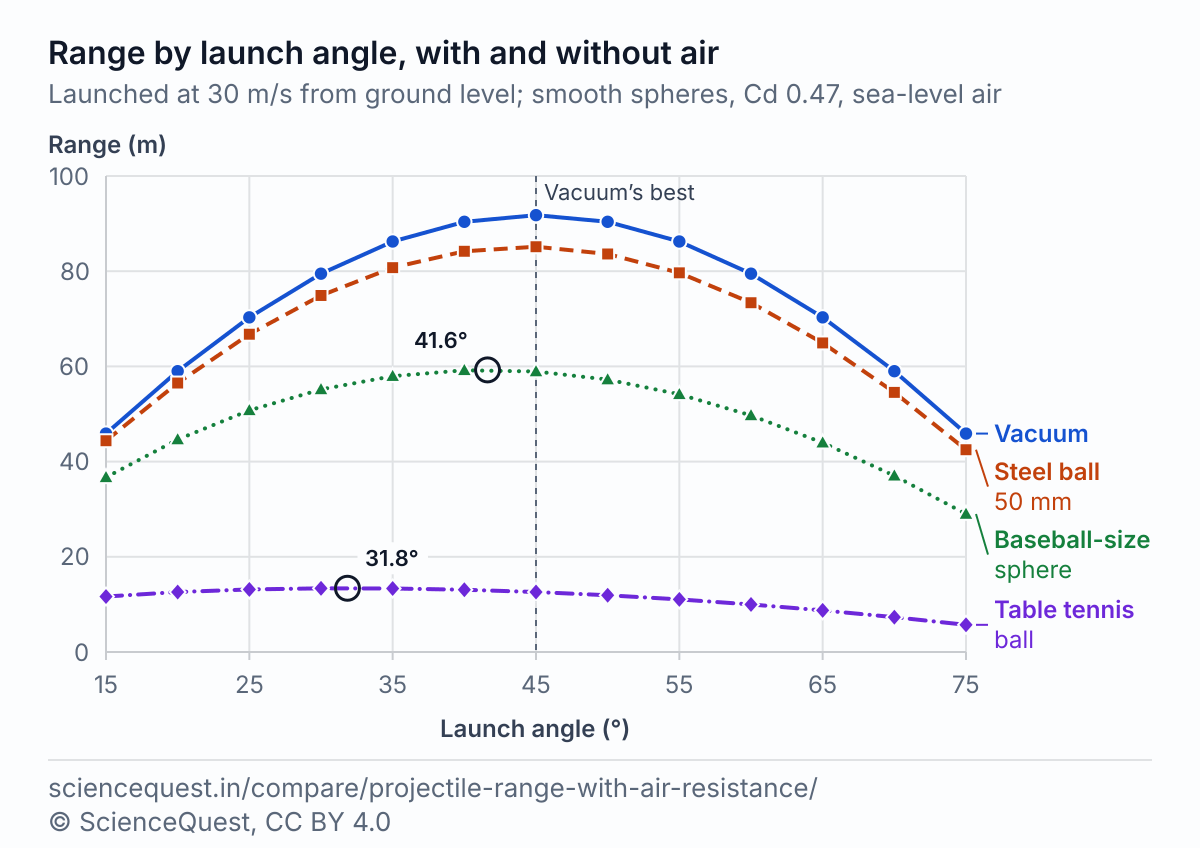
Range by launch angle at 30 m/s
| Launch angle (°) | Vacuum | Steel ball, 50 mm | Baseball-size sphere | Tennis-ball-size sphere | Table tennis ball |
|---|---|---|---|---|---|
| 15 | 45.9 | 44.4 | 36.7 | 30.7 | 11.7 |
| 20 | 59.0 | 56.5 | 44.6 | 36.2 | 12.6 |
| 25 | 70.3 | 66.8 | 50.8 | 40.2 | 13.1 |
| 30 | 79.5 | 74.9 | 55.2 | 42.9 | 13.4 |
| 35 | 86.2 | 80.7 | 58.0 | 44.4 | 13.3 |
| 40 | 90.4 | 84.2 | 59.2 | 44.8 | 13.1 |
| 45 | 91.8 | 85.1 | 58.9 | 44.2 | 12.6 |
| 50 | 90.4 | 83.6 | 57.2 | 42.6 | 11.9 |
| 55 | 86.2 | 79.7 | 54.1 | 40.1 | 11.0 |
| 60 | 79.5 | 73.4 | 49.7 | 36.7 | 10.0 |
| 65 | 70.3 | 64.9 | 44.0 | 32.4 | 8.7 |
| 70 | 59.0 | 54.5 | 37.0 | 27.3 | 7.3 |
| 75 | 45.9 | 42.5 | 29.0 | 21.4 | 5.7 |
In feet, divide by 0.3048: the vacuum’s 91.8 m at 45° is 301 ft, and the baseball-size sphere’s 58.9 m is 193 ft. The vacuum column is the same for any ball.
Best angle and longest throw for each sphere
| Sphere | Mass g | Terminal speed m/s | Best angle ° | Longest range m | Range at 45° m | Short of vacuum % |
|---|---|---|---|---|---|---|
| Steel ball, 50 mm | 513.8 | 94.4 | 44.4 | 85.2 | 85.1 | 7.2 |
| Baseball-size sphere | 145.0 | 33.9 | 41.6 | 59.3 | 58.9 | 35.4 |
| Tennis-ball-size sphere | 57.7 | 23.6 | 39.5 | 44.8 | 44.2 | 51.2 |
| Table tennis ball | 2.7 | 8.6 | 31.8 | 13.4 | 12.6 | 85.4 |
The best angle comes from a search over the simulator’s own function, to a hundredth of a degree; in a vacuum the same search lands on 45.0°. The spheres are 50, 74, 67 and 40 mm across, in the table’s order.
The baseball-size sphere at 45°, by launch speed
| Launch speed (m/s) | In a vacuum | With drag | ||||
|---|---|---|---|---|---|---|
| Range m | Apex m | Flight s | Range m | Apex m | Flight s | |
| 10 | 10.2 | 2.5 | 1.44 | 9.6 | 2.5 | 1.42 |
| 20 | 40.8 | 10.2 | 2.88 | 32.4 | 9.0 | 2.70 |
| 30 | 91.8 | 22.9 | 4.33 | 58.9 | 17.7 | 3.79 |
| 40 | 163.2 | 40.8 | 5.77 | 84.0 | 27.3 | 4.69 |
| 50 | 254.9 | 63.7 | 7.21 | 106.0 | 36.9 | 5.44 |
At 40 and 50 m/s the sphere launches at Re 2.03 × 10⁵ and 2.53 × 10⁵, past the 2 × 10⁵ where the flat part of the smooth sphere’s drag curve ends, so those drag rows rest on a Cd that may no longer hold. The projectile simulator starts at this sphere’s mass and diameter, 0.145 kg and 0.074 m; set its gravity to 9.81, the nearest it takes, and every range here moves by 0.09 m or less.
Why drag lowers the best angle
Drag on a sphere grows with the square of its speed, ½ ρ Cd A v², and pulls against the way it flies, while its weight, mg, pulls down. The terminal speed, √(2mg/(ρ Cd A)), weighs one against the other: it is the speed at which drag would match the weight. The steel ball’s is 94.4 m/s, more than three times the launch speed, and it falls 7.2% short of the vacuum. The table tennis ball’s is 8.6 m/s, and its best throw covers 13.4 m.
Drag is strongest at launch, when the ball moves fastest, and a high throw gives it longer to act: in a vacuum a launch at 60° stays up 5.30 s, one at 30° 3.06 s. Aim lower and you swap height for a shorter, faster flight. The more drag a sphere carries for its weight, the more that swap pays, so the best angle drops from 44.4° for the steel ball to 41.6° for the baseball-size sphere, 39.5° for the tennis-ball-size one and 31.8° for the table tennis ball. Near each peak the curve runs flat: at 45° the baseball-size sphere still reaches 58.9 m. It comes down steeper than it went up, at 55.5° and 20.4 m/s.
Every sphere here is smooth. A real baseball has raised seams and a tennis ball a felt cover, and NASA Glenn’s sphere drag page shows a rough ball’s drag dropping at a lower Reynolds number than a smooth one’s, the reason a golf ball carries dimples. The model also leaves out spin, and with it the lift a spinning ball gets. Read each sphere’s figures as the drag a ball of that size and mass would meet if it were smooth.
The formulas
- Range in a vacuum [1]
-
- Drag on a sphere [3]
-
- Flight with drag [4]
-
- Terminal speed [2]
-
- Reynolds number [5]
-
v is the speed and θ the launch angle; g = 9.80665 m/s², standard gravity; ρ = 1.225 kg/m³ and μ = 1.7894 × 10⁻⁵ Pa·s, sea-level air in the 1976 US Standard Atmosphere; Cd = 0.47; m is the sphere’s mass and d its diameter. The vacuum range and flight time follow from NASA Glenn’s x = U₀t and y = V₀t − gt²/2, with U₀ = v cos θ, V₀ = v sin θ and y = 0 at landing. The flight with drag adds the drag force, pointed against the velocity as NASA Glenn’s What is Drag? page puts it, to the weight; NASA’s Flight Equations with Drag page takes the vertical and horizontal motions one at a time. The drag flights are integrated in steps of 1 ms or less, as the projectile simulator integrates them.
Where each figure holds
| Part of the model | Based on | Holds for | Not for |
|---|---|---|---|
| Vacuum range | No air and constant gravity: NASA Glenn’s ballistic flight equations. NASA gives g as 9.8 m/s²; the tables take standard gravity, 9.80665 m/s², the value the 3rd CGPM adopted in 1901 | A launch whose drag is small next to its weight: a dense ball, thrown slowly | Any of these spheres in air at 30 m/s: even the steel ball falls 7.2% short |
| Drag coefficient 0.47 | Hoerner, page 3-7: a smooth sphere’s Cd is about 0.47 from Re 10⁴ to 10⁵ and falls fast near 4 × 10⁵. NASA Glenn’s sphere drag curve stays flat from about 3 × 10³ to 2 × 10⁵ | Smooth spheres that do not spin: every flight in the first two tables stays between Re 5.6 × 10³ and 1.5 × 10⁵, on NASA’s flat stretch but past both ends of Hoerner’s band | The 40 and 50 m/s rows of the last table, which launch past Re 2 × 10⁵; the baseball-size sphere gets there at 39.5 m/s. Real balls with seams, felt or dimples; spin, which adds lift the model leaves out |
| Air density 1.225 kg/m³ | Sea level in the 1976 US Standard Atmosphere, 15 °C and 1,013.25 hPa | Still air at sea level | Thinner air at altitude or on a hot day, which drags less, so every sphere flies farther; any wind |
| Sphere sizes and masses | MLB rule 3.01, ITF Rules of Tennis Appendix I and ITTF law 2.3, beside the free fall calculator’s 50 mm steel ball, which the calculator sets at 7,850 kg/m³ | A sphere of that size and mass: the baseball-size one’s 145 g and 74 mm sit inside rule 3.01’s 141.7 to 148.8 g and 72.8 to 74.8 mm across | The balls in play, which differ from a smooth sphere in surface and spin |
Calculators and simulators
Sources
- NASA Glenn Research Center. Ballistic Flight Equations. Beginner’s Guide to Aeronautics; updated . https://www1.grc.nasa.gov/beginners-guide-to-aeronautics/ballistic-flight-equations/
- NASA Glenn Research Center. Flight Equations with Drag. Beginner’s Guide to Aeronautics; updated . The terminal velocity, and the vertical and horizontal motions with drag, each taken on its own. https://www1.grc.nasa.gov/beginners-guide-to-aeronautics/flight-equations-with-drag/
- NASA Glenn Research Center. Drag Equation. Beginner’s Guide to Aeronautics; updated . https://www1.grc.nasa.gov/beginners-guide-to-aeronautics/drag-equation/
- NASA Glenn Research Center. What is Drag? Beginner’s Guide to Aeronautics; updated . Drag is a vector that acts in the direction opposite to the motion. https://www1.grc.nasa.gov/beginners-guide-to-aeronautics/what-is-drag/
- NASA Glenn Research Center. Drag of a Sphere. Beginner’s Guide to Aeronautics; updated . The drag coefficient of a smooth and a rough sphere against the Reynolds number, and why a golf ball has dimples. https://www1.grc.nasa.gov/beginners-guide-to-aeronautics/drag-of-a-sphere/
- Hoerner SF. Fluid-Dynamic Drag: Practical Information on Aerodynamic Drag and Hydrodynamic Resistance. Midland Park, NJ: the author; 1965. Page 3-7: a sphere’s drag coefficient is fairly constant, in the order of 0.47, between Reynolds numbers 10⁴ and 10⁵, and near 4 × 10⁵ it falls fast to about 0.1. The 0.47 is the one the projectile simulator and the free fall calculator use. https://archive.org/details/fluiddynamicdrag0000hoer
- 3rd General Conference on Weights and Measures (CGPM), 1901. Declaration 2, on the unit of mass and on the definition of weight; conventional value of gₙ: 980.665 cm/s². Proceedings of the 3rd CGPM, p. 70. BIPM. https://www.bipm.org/en/committees/cg/cgpm/3-1901/resolution-2
- NOAA, NASA and U.S. Air Force (1976). U.S. Standard Atmosphere, 1976. NASA TM-X-74335. Table I, page 53: density 1.2250 kg/m³ at 0 m; Table III, page 101: dynamic viscosity 1.7894 × 10⁻⁵ N·s/m² at 0 m. https://ntrs.nasa.gov/citations/19770009539
- Major League Baseball. Official Baseball Rules, 2026 edition. Rule 3.01, The Ball: 5 to 5¼ ounces avoirdupois, 9 to 9¼ inches in circumference. https://mktg.mlbstatic.com/mlb/official-information/2026-official-baseball-rules.pdf
- International Tennis Federation. ITF Rules of Tennis 2026. Appendix I, The Ball: mass 56.0 to 59.4 g and size 6.54 to 6.86 cm for type 1, type 2 and high altitude balls. https://www.itftennis.com/media/7221/2026-rules-of-tennis-english.pdf
- International Table Tennis Federation. ITTF Statutes 2025, chapter 2, The Laws of Table Tennis, law 2.3, The Ball: a sphere of 40 mm that weighs 2.7 g. https://documents.ittf.sport/sites/default/files/public/2025-02/2025_ITTF_Statutes_clean_version.pdf
The values are facts and free to use; this table’s selection and presentation are © 2026 ScienceQuest.