Postcentral gyrus
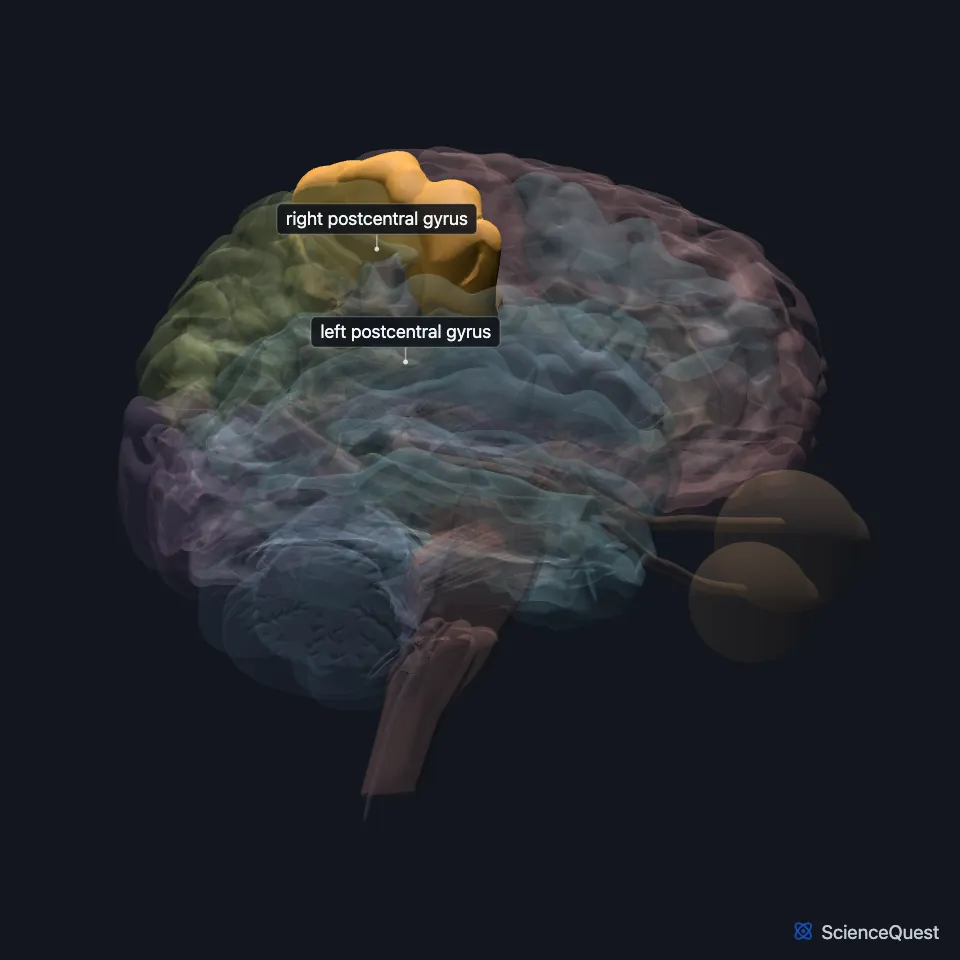
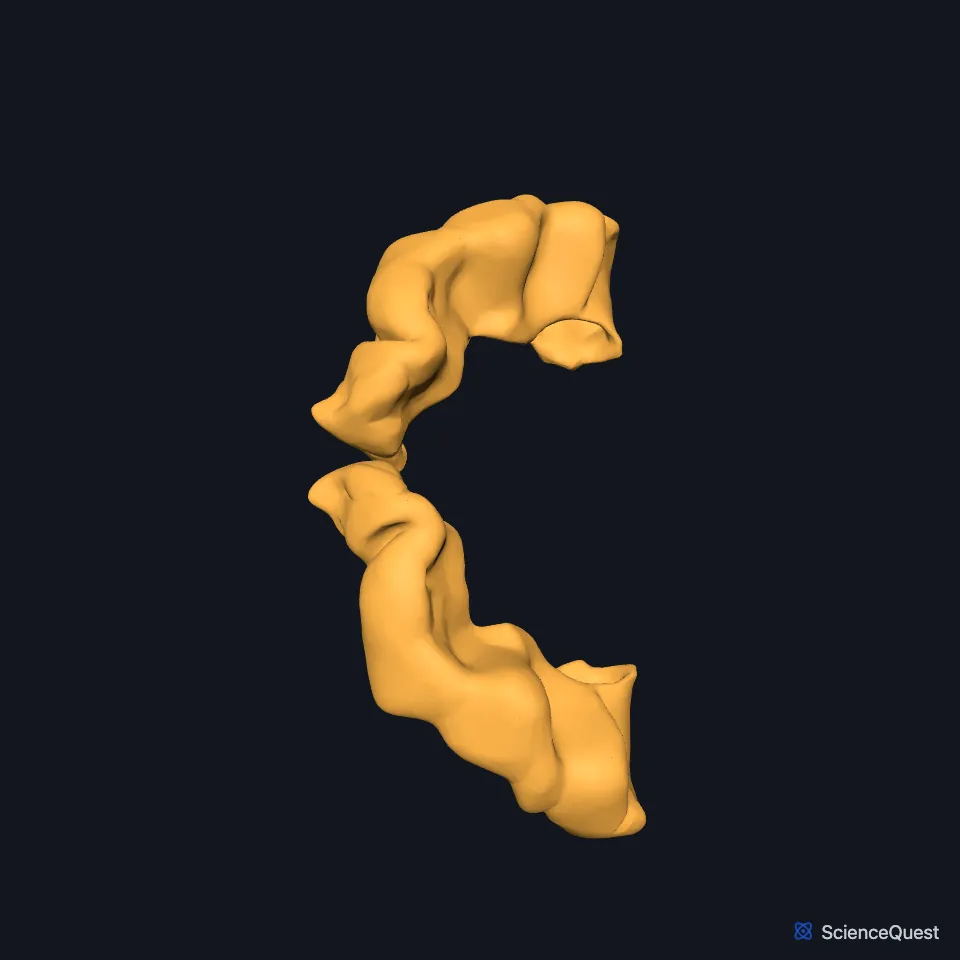
The postcentral gyrus is the gyrus just behind the central sulcus. It holds the primary somatosensory cortex, Brodmann’s areas 3, 1 and 2, which follow one another from the depth of the central sulcus back to the postcentral sulcus. (OpenStax A&P 2e, 13.2; StatPearls, Postcentral Gyrus; Geyer et al. 1999, NeuroImage; Grefkes et al. 2001, NeuroImage)
Where is the postcentral gyrus?
It runs along the side of the parietal lobe between the central sulcus in front and the postcentral sulcus behind. Behind it lie the superior and inferior parietal lobules, which the intraparietal sulcus separates. (StatPearls, Postcentral Gyrus; Neuroscience Online, Overview of the Nervous System; FMA, Superior parietal lobule and Inferior parietal lobule)
The precentral gyrus faces it across the central sulcus. (OpenStax Behavioral Neuroscience, 10.3; Neuroscience Online, Overview of the Nervous System and Motor Cortex)
What does the postcentral gyrus do?
It perceives touch, pressure, temperature and pain from the body. It also handles proprioception, your sense of where your body parts are. (OpenStax A&P 2e, 13.2; StatPearls, Postcentral Gyrus)
Body sensations reach awareness here. Electrical stimulation of this cortex makes a patient feel sensations, and damage to it on one side impairs touch and position sense on the opposite side of the body. (OpenStax A&P 2e, 14.2; Neuroscience Online, Somatosensory Processes; StatPearls, Postcentral Gyrus)
Pain does not rest on this gyrus alone. Painful stimuli also activate the rostral cingulate gyrus and the insula, so damage here does not remove all pain sensation. (Neuroscience Online, Somatosensory Processes)
How is the body mapped on the postcentral gyrus?
The map shows the opposite side of the body. The foot and leg lie on the medial surface, in the posterior paracentral lobule; the trunk, arm and hand take the upper half of the gyrus, and the face the lower half, toward the lateral sulcus. (OpenStax A&P 2e, 14.2; Neuroscience Online, Somatosensory Processes)
The map is distorted: the hand and face take up more cortex than their size suggests, because their small receptive fields need more neurons. (OpenStax A&P 2e, 14.2; Neuroscience Online, Somatosensory Processes)
Which pathways reach the postcentral gyrus, and where do they go next?
Discriminative touch and proprioception travel up the dorsal columns and medial lemniscus, and pain and temperature up the spinothalamic tract. Each pathway crosses the midline once on its way to the thalamus, which relays the signals to this gyrus. (OpenStax A&P 2e, 14.2; Neuroscience Online, Somatosensory Processes)
From here, information goes on to the secondary somatosensory cortex, the primary and supplementary motor cortex, and the posterior parietal cortex. (Neuroscience Online, Somatosensory Processes)
The somatosensory cortex also supplies about 30% of the fibers in the corticospinal tract. (Neuroscience Online, Motor Cortex)
| Feature | Detail and source |
|---|---|
| Lobe | Parietal (Neuroscience Online, Overview of the Nervous System) |
| Cortex | Primary somatosensory cortex (OpenStax A&P 2e, 13.2; StatPearls, Postcentral Gyrus) |
| Brodmann areas | 1, 2 and 3 (OpenStax A&P 2e, 13.2; Geyer et al. 1999, NeuroImage; Grefkes et al. 2001, NeuroImage) |
| Relay before it | Thalamus, for the dorsal column and spinothalamic pathways (OpenStax A&P 2e, 14.2; Neuroscience Online, Somatosensory Processes) |
Touches in this model
Measured on the BodyParts3D meshes: surfaces within 2 mm of the postcentral gyrus, nearest first, 12 of 18.
- Anterior part of left superior temporal gyrus in contact
- Anterior part of right superior temporal gyrus in contact
- Left angular gyrus in contact
- Left insula in contact
- Left precentral gyrus in contact
- Left superior parietal lobule and precuneus in contact
- Left supramarginal gyrus in contact
- Posterior part of left superior temporal gyrus in contact
- Posterior part of right superior temporal gyrus in contact
- Right angular gyrus in contact
- Right insula in contact
- Right precentral gyrus in contact
Sources
- OpenStax Anatomy and Physiology 2e, section 13.2, The Central Nervous System. CC BY-NC-SA 4.0. Read 2026-10-25.
- StatPearls, Neuroanatomy, Postcentral Gyrus. Joseph DiGuiseppi; Prasanna Tadi. Last update July 24, 2023. CC BY-NC-ND 4.0. Read 2026-10-25.
- NeuroImage, Areas 3a, 3b, and 1 of human primary somatosensory cortex, NeuroImage 10, pages 63 to 83 (abstract, PMID 10385582). Geyer S, Schleicher A, Zilles K. Abstract read on Europe PMC; no reuse licence stated. Read 2026-10-25.
- NeuroImage, Human somatosensory area 2: observer-independent cytoarchitectonic mapping, interindividual variability, and population map, NeuroImage 14, pages 617 to 631 (abstract, PMID 11506535). Grefkes C, Geyer S, Schormann T, Roland P, Zilles K. Abstract read on Europe PMC; no reuse licence stated. Read 2026-10-25.
- Neuroscience Online, McGovern Medical School, Section 2, Chapter 1, Overview of the Nervous System. Nachum Dafny, Ph.D.. Last update Reviewed and revised 07 Oct 2020. Open access; no reuse licence stated. Read 2026-10-25.
- Foundational Model of Anatomy, FMA61899, Superior parietal lobule (read on EBI OLS). FMA release terms, University of Washington. Read 2026-10-25.
- Foundational Model of Anatomy, FMA77536, Inferior parietal lobule (read on EBI OLS). FMA release terms, University of Washington. Read 2026-10-25.
- OpenStax Introduction to Behavioral Neuroscience, section 10.3, Our Brain Gets Involved: Responsibilities of Upper Motor Systems. CC BY-NC-SA 4.0. Read 2026-10-25.
- Neuroscience Online, McGovern Medical School, Section 3, Chapter 3, Motor Cortex. James Knierim, Ph.D.. Last update Last Review 07 July 2026. Open access; no reuse licence stated. Read 2026-10-25.
- OpenStax Anatomy and Physiology 2e, section 14.2, Central Processing. CC BY-NC-SA 4.0. Read 2026-10-25.
- Neuroscience Online, McGovern Medical School, Section 2, Chapter 5, Somatosensory Processes. Patrick Dougherty, Ph.D. (content provided by Chieyeko Tsuchitani, Ph.D.). Last update Reviewed and revised 17 August 2026. Open access; no reuse licence stated. Read 2026-10-25.
The values are facts and free to use; this page’s selection and presentation are © 2026 ScienceQuest.