Insula
The insula is a lobe of cortex deep inside the lateral fissure. You see it only when you separate the temporal and frontal lobes. (Neuroscience Online, Overview of the Nervous System)
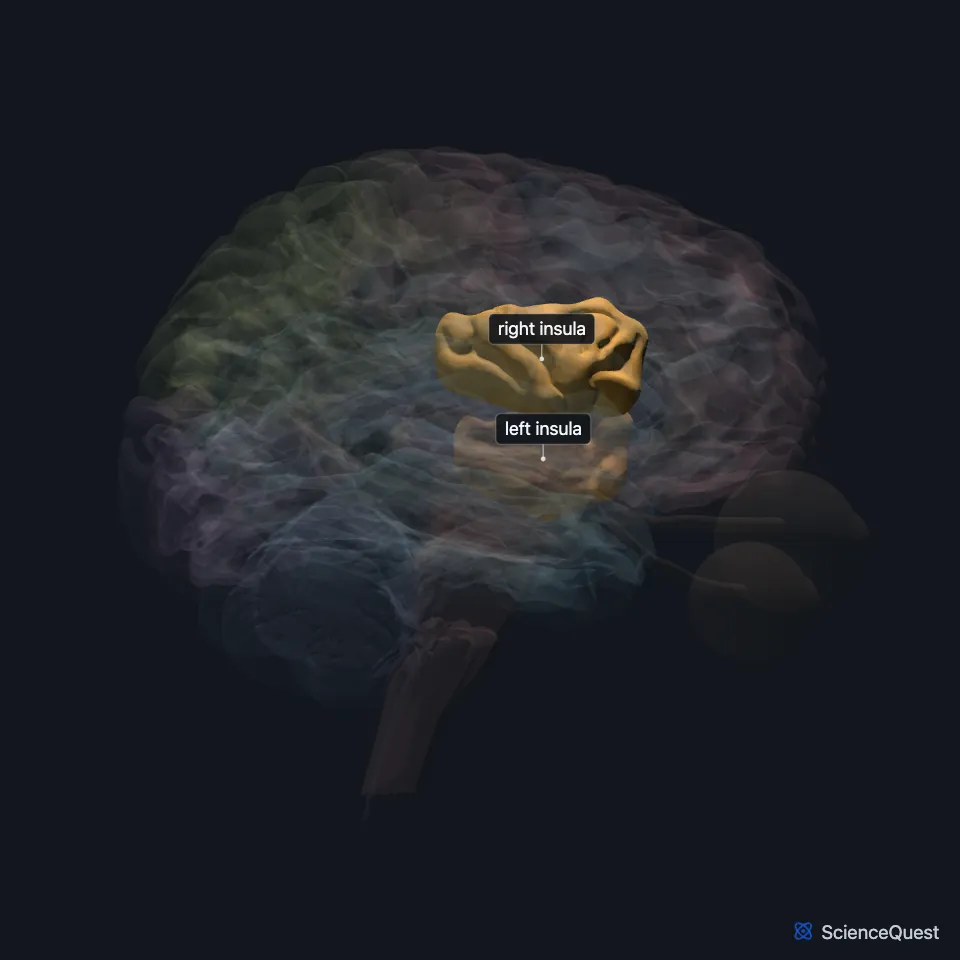
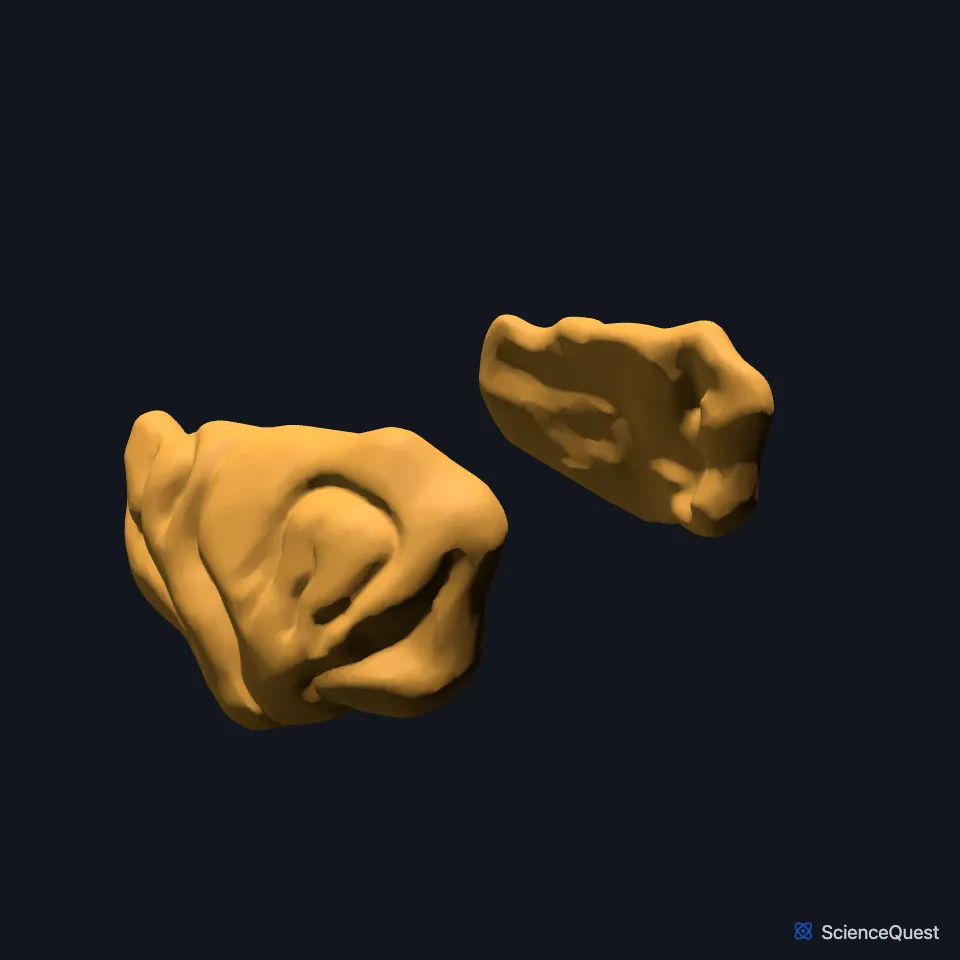
Where is the insula?
Parts of the frontal, parietal and temporal lobes next to the lateral sulcus cover it. Together they are the operculum. (Neuroscience Online, Overview of the Nervous System)
In a coronal section at the junction of the midbrain and diencephalon, the insula lies lateral to the putamen. Higher and nearer the midline, the corpus callosum overlies the lateral ventricles. (Neuroscience Online, Overview of the Nervous System)
What does the insula look like?
The insular central sulcus divides it into an anterior part with three short gyri, the gyri breves, and a posterior part with two long gyri, the gyri longi. The peri-insular, or circular, sulcus runs around its edge. (StatPearls, Insular Cortex; NCI Thesaurus, Gyri Breves Insulae and Gyrus Longus Insulae; Neuroscience Online, Overview of the Nervous System)
What does the insula do?
Taste reaches awareness in the insula, though sources place the taste area differently: OpenStax Behavioral Neuroscience puts it in the anterior insula and frontal operculum, a 2010 review argues it sits farther back in humans than in monkeys, and stimulation evokes taste from the central insula. Hunger and thirst are among the signals that can activate the insula. (OpenStax Behavioral Neuroscience, 8.2 and 16.4; Small 2010, Brain Struct Funct; Stephani et al. 2011, Brain Struct Funct; Laketić et al. 2025, Brain Sci)
Its front part is central to interoception, your sense of the body’s internal state, and to emotional awareness. Its back part deals more with touch and other body sensations. (OpenStax Behavioral Neuroscience, 13.3; Laketić et al. 2025, Brain Sci)
During monitoring before epilepsy surgery, the insula can be stimulated through implanted electrodes. In one series of 222 patients, most evoked responses were body sensations such as pain, visceral feelings came next, and taste and smell responses were rare. (OpenStax Behavioral Neuroscience, 13.3; Mazzola et al. 2017, J Clin Neurophysiol; Stephani et al. 2011, Brain Struct Funct)
Pain pathways from the thalamus reach the insular cortex and the cingulate gyrus, and the insula is thought to take part in the emotional side of pain. (Neuroscience Online, Somatosensory Processes and Pain Tracts and Sources)
What does the insula connect with?
Its front part connects with the anterior cingulate, frontal and orbitofrontal cortex and the front of the temporal lobe, and its back part mainly with parietal, sensorimotor and posterior temporal areas. It also links with the amygdala and hypothalamus. (OpenStax Behavioral Neuroscience, 13.3; Laketić et al. 2025, Brain Sci)
The secondary somatosensory cortex projects to the insula, and through it influences the amygdala and hippocampus, which matter for learning and remembering by touch. (Neuroscience Online, Somatosensory Processes)
Where the sources differ
Sources disagree on the number of lobes. OpenStax A&P 2e divides the cortex into four lobes. Neuroscience Online divides each hemisphere into six, counting the insular and limbic lobes, and adds that neither is a true lobe. (OpenStax A&P 2e, 13.2; Neuroscience Online, Overview of the Nervous System)
Touches in this model
Measured on the BodyParts3D meshes: surfaces within 2 mm of the insula, nearest first, 12 of 14.
- Anterior part of left superior temporal gyrus in contact
- Anterior part of right superior temporal gyrus in contact
- Left accessory short gyrus in contact
- Left postcentral gyrus in contact
- Left precentral gyrus in contact
- Left putamen in contact
- Left supramarginal gyrus in contact
- Right accessory short gyrus in contact
- Right postcentral gyrus in contact
- Right precentral gyrus in contact
- Right putamen in contact
- Right supramarginal gyrus in contact
Sources
- Neuroscience Online, McGovern Medical School, Section 2, Chapter 1, Overview of the Nervous System. Nachum Dafny, Ph.D.. Last update Reviewed and revised 07 Oct 2020. Open access; no reuse licence stated. Read 2026-10-25.
- StatPearls, Insular Cortex. Michael W. Kortz; Kevin O. Lillehei. Last update May 1, 2023. CC BY-NC-ND 4.0. Read 2026-10-25.
- NCI Thesaurus, C32703, Gyri Breves Insulae (read on EBI OLS). CC BY 4.0. Read 2026-10-25.
- NCI Thesaurus, C32704, Gyrus Longus Insulae (read on EBI OLS). CC BY 4.0. Read 2026-10-25.
- OpenStax Introduction to Behavioral Neuroscience, section 8.2, The Gustatory System. CC BY-NC-SA 4.0. Read 2026-10-25.
- OpenStax Introduction to Behavioral Neuroscience, section 16.4, Neural Control of Feeding Behavior. CC BY-NC-SA 4.0. Read 2026-10-25.
- Brain Structure and Function, Taste representation in the human insula, Brain Struct Funct 214, pages 551 to 561 (abstract, PMID 20512366). Small DM. Abstract read on Europe PMC; no reuse licence stated. Read 2026-10-25.
- Brain Structure and Function, Functional neuroanatomy of the insular lobe, Brain Struct Funct 216, pages 137 to 149 (abstract, PMID 21153903). Stephani C, Fernandez-Baca Vaca G, Maciunas R, Koubeissi M, Lüders HO. Abstract read on Europe PMC; no reuse licence stated. Read 2026-10-25.
- Brain Sciences, Insular Cortex-Biology and Its Role in Psychiatric Disorders: A Narrative Review, Brain Sci 15, article 793 (full text, PMC12384716). Laketić D, Stojanović NM, Laketić I, Pavlović M, Milosević B, Starčević A, Kapor S. CC BY. Read 2026-10-25.
- OpenStax Introduction to Behavioral Neuroscience, section 13.3, What Is the Contribution of Brain Structures in Emotional States?. CC BY-NC-SA 4.0. Read 2026-10-25.
- Journal of Clinical Neurophysiology, Electrical Stimulations of the Human Insula: Their Contribution to the Ictal Semiology of Insular Seizures, J Clin Neurophysiol 34, pages 307 to 314 (abstract, PMID 28644200). Mazzola L, Mauguière F, Isnard J. Abstract read on Europe PMC; no reuse licence stated. Read 2026-10-25.
- Neuroscience Online, McGovern Medical School, Section 2, Chapter 5, Somatosensory Processes. Patrick Dougherty, Ph.D. (content provided by Chieyeko Tsuchitani, Ph.D.). Last update Reviewed and revised 17 August 2026. Open access; no reuse licence stated. Read 2026-10-25.
- Neuroscience Online, McGovern Medical School, Section 2, Chapter 7, Pain Tracts and Sources. Nachum Dafny, Ph.D.. Last update Reviewed 20 July 2026. Open access; no reuse licence stated. Read 2026-10-25.
- OpenStax Anatomy and Physiology 2e, section 13.2, The Central Nervous System. CC BY-NC-SA 4.0. Read 2026-10-25.
The values are facts and free to use; this page’s selection and presentation are © 2026 ScienceQuest.