Amygdala
The amygdala is a group of subnuclei that Neuroscience Online calls the integrative center for emotions, emotional behavior and motivation. (OpenStax Psychology 2e, 10.4; Neuroscience Online, Limbic System: Amygdala)
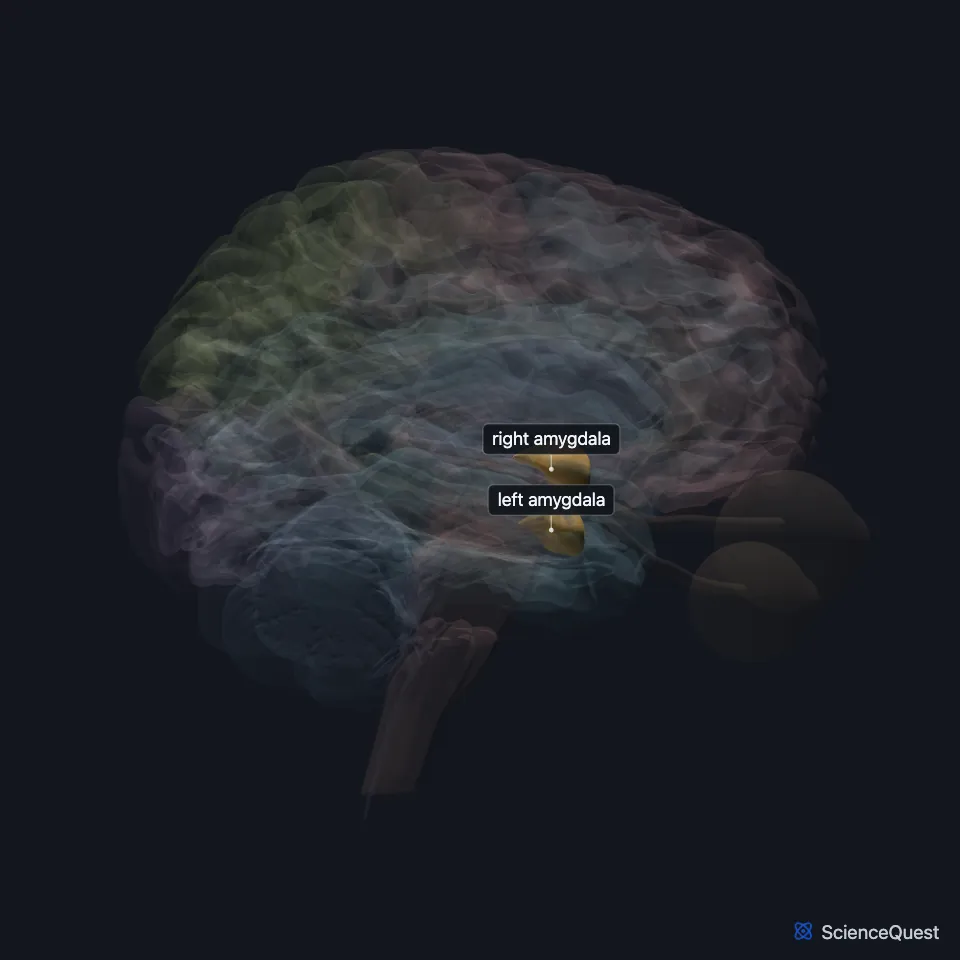
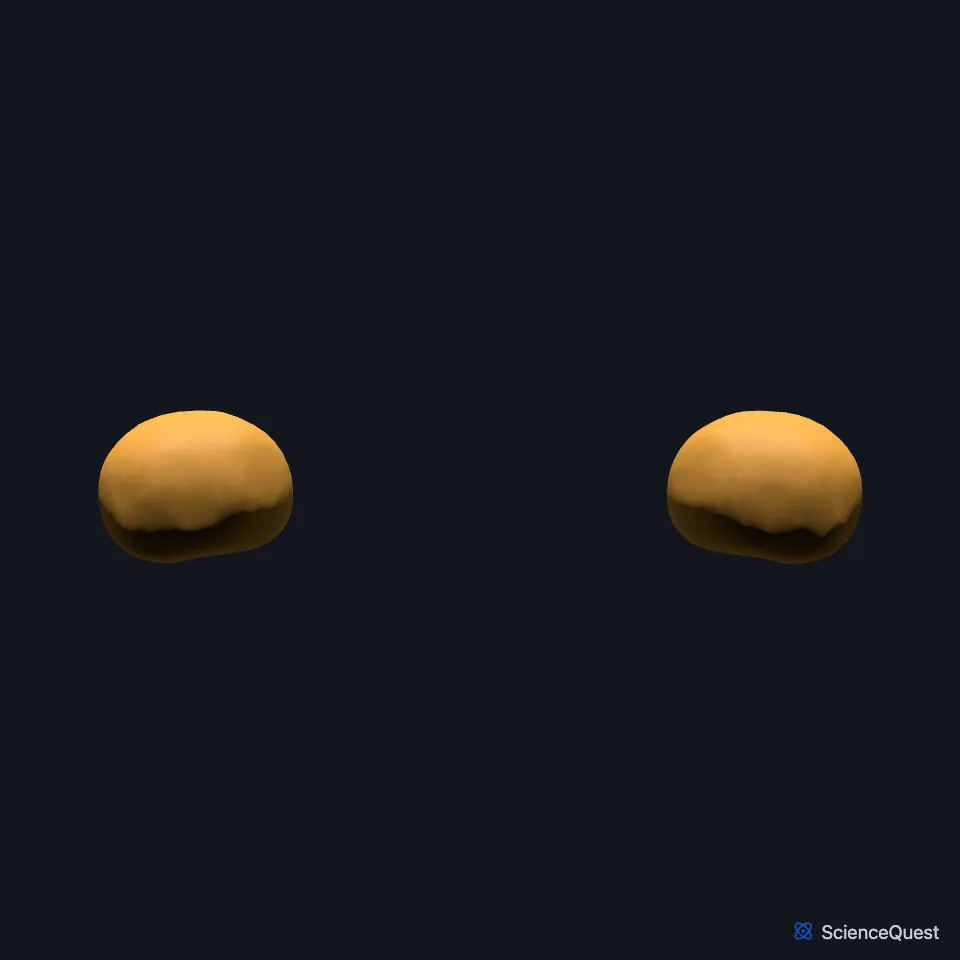
Where is the amygdala?
Turn the brain upside down and the end of the structure continuous with the hippocampus is the uncus. Peel the uncus away and you expose the amygdala, against the front of the hippocampus. (Neuroscience Online, Limbic System: Amygdala)
It is one of the subcortical parts of the telencephalon, listed as the amygdaloid nucleus complex. (Neuroscience Online, Overview of the Nervous System)
What are the parts of the amygdala?
Its nuclei fall into groups that include the basolateral and central nuclei. The central nucleus drives the body’s side of an emotion, such as changes in heart rate, blood pressure and breathing, through the lateral hypothalamus and brainstem. (OpenStax Psychology 2e, 10.4; StatPearls, Amygdala; Neuroscience Online, Limbic System: Amygdala)
What does the amygdala do?
It is central to fear and to learning what to fear, and stimulating it can provoke intense fear or aggression. (OpenStax Behavioral Neuroscience, 1.4; OpenStax Psychology 2e, 8.2; Neuroscience Online, Limbic System: Amygdala; Davis and Whalen 2001, Mol Psychiatry)
In mice, lateral amygdala neurons with raised levels of CREB, a transcription factor, are preferentially active when a learned fear is recalled. Killing those neurons after learning erased that fear memory, while killing a similar share of random lateral amygdala neurons did not. (Han et al. 2009, Science; Josselyn 2010, J Psychiatry Neurosci)
Its central nucleus produces the bodily side of emotion, such as changes in heart rate, blood pressure and breathing, through outputs to the lateral hypothalamus and brainstem. (Neuroscience Online, Limbic System: Amygdala)
People with bilateral amygdala lesions from Urbach-Wiethe disease early in life cannot read emotion in facial expressions, but they can still identify faces. (Neuroscience Online, Limbic System: Amygdala)
What does the amygdala connect to?
It receives input from every sense and from the viscera. Smell comes from the olfactory bulb; hearing, vision and touch come through the temporal and anterior cingulate cortices. (Neuroscience Online, Limbic System: Amygdala)
Its main outputs are the ventral amygdalofugal pathway, the stria terminalis, and direct connections to the hippocampus, the entorhinal cortex and the dorsomedial nucleus of the thalamus. (Neuroscience Online, Limbic System: Amygdala)
The stria terminalis is to the amygdala what the fornix is to the hippocampus. The two amygdalae communicate through the anterior commissure. (Neuroscience Online, Limbic System: Amygdala)
Where the sources differ
OpenStax Psychology 2e 8.2, citing Josselyn’s 2010 review, describes this work as a study in rats in which killing lateral amygdala neurons made a fear memory fade. Josselyn’s group reported the experiment in Science in 2009: it used mice, and the memory was lost only when the CREB-rich neurons were killed, not random ones. (OpenStax Psychology 2e, 8.2; Han et al. 2009, Science; Josselyn 2010, J Psychiatry Neurosci)
Touches in this model
Measured on the BodyParts3D meshes: surfaces within 2 mm of the amygdala, nearest first, 12 of 22.
- Choroid plexus of left cerebral hemisphere in contact
- Choroid plexus of right cerebral hemisphere in contact
- Left caudate nucleus in contact
- Left fornix of forebrain in contact
- Left fusiform gyrus in contact
- Left hippocampus in contact
- Left inferior temporal gyrus in contact
- Left lateral ventricle in contact
- Left optic tract in contact
- Left stria terminalis in contact
- Orbital gyri and straight gyri, both sides in contact
- Right caudate nucleus in contact
Sources
- OpenStax Psychology 2e, section 10.4, Emotion. CC BY-NC-SA 4.0. Read 2026-10-25.
- Neuroscience Online, McGovern Medical School, Section 4, Chapter 6, Limbic System: Amygdala. Anthony Wright, Ph.D.. Last update Revised 20 July 2026. Open access; no reuse licence stated. Read 2026-10-25.
- Neuroscience Online, McGovern Medical School, Section 2, Chapter 1, Overview of the Nervous System. Nachum Dafny, Ph.D.. Last update Reviewed and revised 07 Oct 2020. Open access; no reuse licence stated. Read 2026-10-25.
- StatPearls, Neuroanatomy, Amygdala (introduction, read as the abstract on Europe PMC, PMID 30725787). AbuHasan Q, Reddy V, Siddiqui W. Abstract read on Europe PMC; no reuse licence stated. Read 2026-10-25.
- OpenStax Introduction to Behavioral Neuroscience, section 1.4, The Brain: Structure and Function. CC BY-NC-SA 4.0. Read 2026-10-25.
- OpenStax Psychology 2e, section 8.2, Parts of the Brain Involved with Memory. CC BY-NC-SA 4.0. Read 2026-10-25.
- Molecular Psychiatry, The amygdala: vigilance and emotion, Mol Psychiatry 6, pages 13 to 34 (abstract, PMID 11244481). Davis M, Whalen PJ. Abstract read on Europe PMC; no reuse licence stated. Read 2026-10-25.
- Science, Selective erasure of a fear memory, Science 323, pages 1492 to 1496 (abstract, PMID 19286560). Han JH, Kushner SA, Yiu AP, Hsiang HL, Buch T, Waisman A, Bontempi B, Neve RL, Frankland PW, Josselyn SA. Abstract read on Europe PMC; no reuse licence stated. Read 2026-10-25.
- Journal of Psychiatry and Neuroscience, Continuing the search for the engram: examining the mechanism of fear memories, J Psychiatry Neurosci 35, pages 221 to 228 (abstract, PMID 20569648). Josselyn SA. Abstract read on Europe PMC; no reuse licence stated. Read 2026-10-25.
The values are facts and free to use; this page’s selection and presentation are © 2026 ScienceQuest.