Parahippocampal gyrus
The parahippocampal gyrus is a gyrus on the inferomedial surface of the temporal lobe. It takes part in learning and memory. (Neuroscience Online, Overview of the Nervous System)
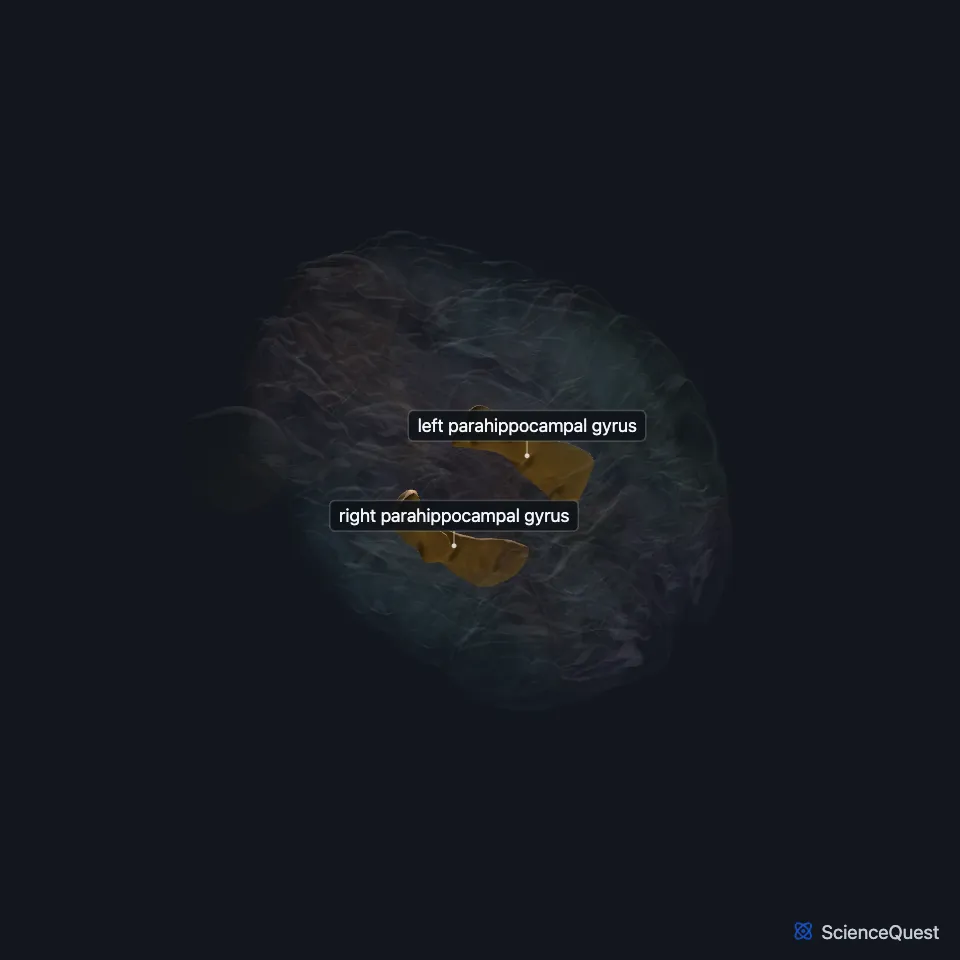
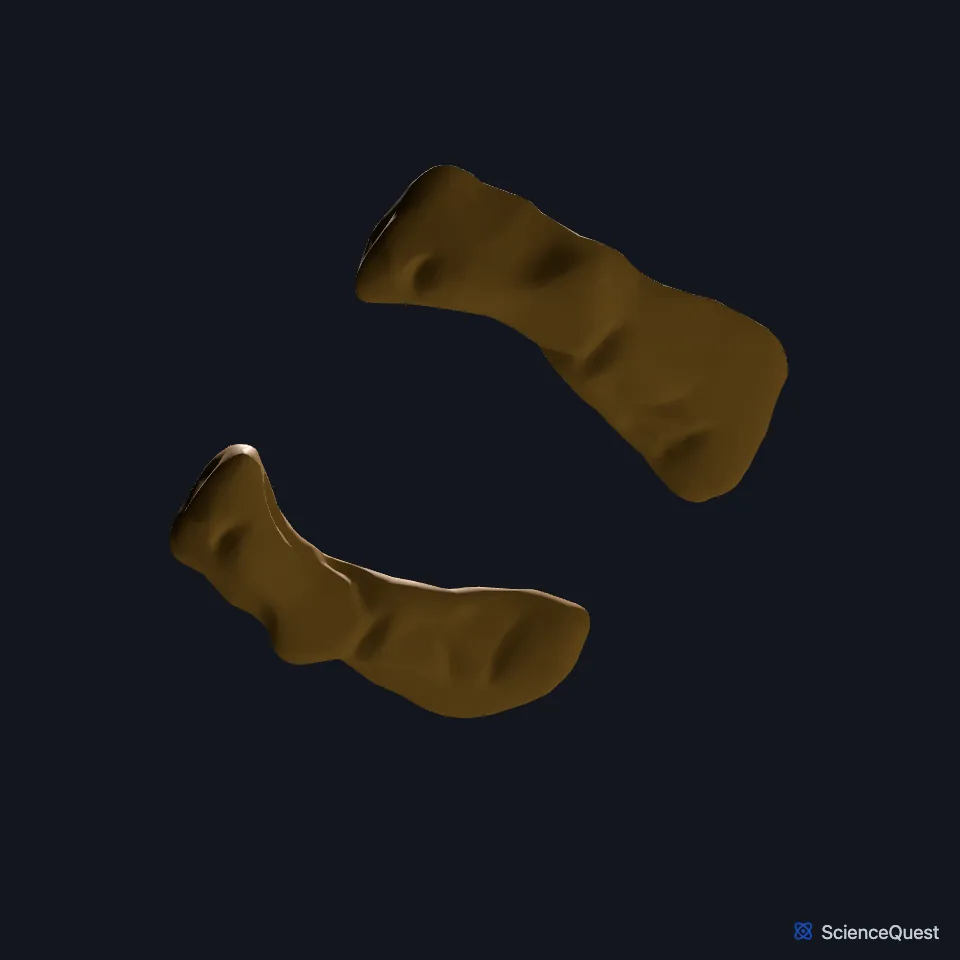
Where is the parahippocampal gyrus?
It lies inferomedial to the inferior temporal gyrus. The collateral sulcus separates it from the occipitotemporal gyrus beside it. (Neuroscience Online, Overview of the Nervous System)
The subiculum marks the change from the hippocampus to the parahippocampal gyrus, going from three cortical layers to six. (Neuroscience Online, Limbic System: Hippocampus)
With the cingulate gyrus, it is one of the cortical parts of the limbic lobe. (Neuroscience Online, Overview of the Nervous System)
What does the parahippocampal gyrus do?
Its entorhinal cortex provides the main cortical input to the hippocampus. (Neuroscience Online, Limbic System: Hippocampus; OpenStax Behavioral Neuroscience, 18.3)
In rats, grid cells in the medial entorhinal cortex fire each time the animal crosses one of many points that form a regular triangular grid across its enclosure. (OpenStax Behavioral Neuroscience, 18.3; Hafting et al. 2005, Nature)
What does the parahippocampal gyrus connect to?
In the Papez circuit, the cingulate cortex projects back to the entorhinal cortex of this gyrus, completing the loop. (Neuroscience Online, Limbic System: Hippocampus)
The cingulate, temporal and orbital cortices and the amygdala all reach the hippocampus through the entorhinal cortex. (Neuroscience Online, Limbic System: Hippocampus)
The amygdala also projects straight to the entorhinal cortex. (Neuroscience Online, Limbic System: Amygdala)
Touches in this model
Measured on the BodyParts3D meshes: surfaces within 2 mm of the parahippocampal gyrus, nearest first, 12 of 20.
- Left cingulate gyrus in contact
- Left fusiform gyrus in contact
- Left hippocampus in contact
- Peduncle of midbrain in contact
- Pons in contact
- Right cingulate gyrus in contact
- Right fusiform gyrus in contact
- Right hippocampus in contact
- White matter structure of cerebral hemisphere in contact
- Left amygdala 0.6 mm away
- Left occipital lobe 0.7 mm away
- Right amygdala 0.7 mm away
Sources
- Neuroscience Online, McGovern Medical School, Section 2, Chapter 1, Overview of the Nervous System. Nachum Dafny, Ph.D.. Last update Reviewed and revised 07 Oct 2020. Open access; no reuse licence stated. Read 2026-10-25.
- Neuroscience Online, McGovern Medical School, Section 4, Chapter 5, Limbic System: Hippocampus. Anthony Wright, Ph.D.. Last update Revised 07 July 2026. Open access; no reuse licence stated. Read 2026-10-25.
- OpenStax Introduction to Behavioral Neuroscience, section 18.3, Explicit Memories: Episodic and Semantic Memories. CC BY-NC-SA 4.0. Read 2026-10-25.
- Nature, Microstructure of a spatial map in the entorhinal cortex, Nature 436, pages 801 to 806 (abstract, PMID 15965463). Hafting T, Fyhn M, Molden S, Moser MB, Moser EI. Abstract read on Europe PMC; no reuse licence stated. Read 2026-10-25.
- Neuroscience Online, McGovern Medical School, Section 4, Chapter 6, Limbic System: Amygdala. Anthony Wright, Ph.D.. Last update Revised 20 July 2026. Open access; no reuse licence stated. Read 2026-10-25.
The values are facts and free to use; this page’s selection and presentation are © 2026 ScienceQuest.