Pons
The pons, Latin for bridge, is the part of the brain stem between the midbrain above and the medulla oblongata below. (OpenStax A&P 2e, 13.2; StatPearls, Pons; Lewis and Short, pons)
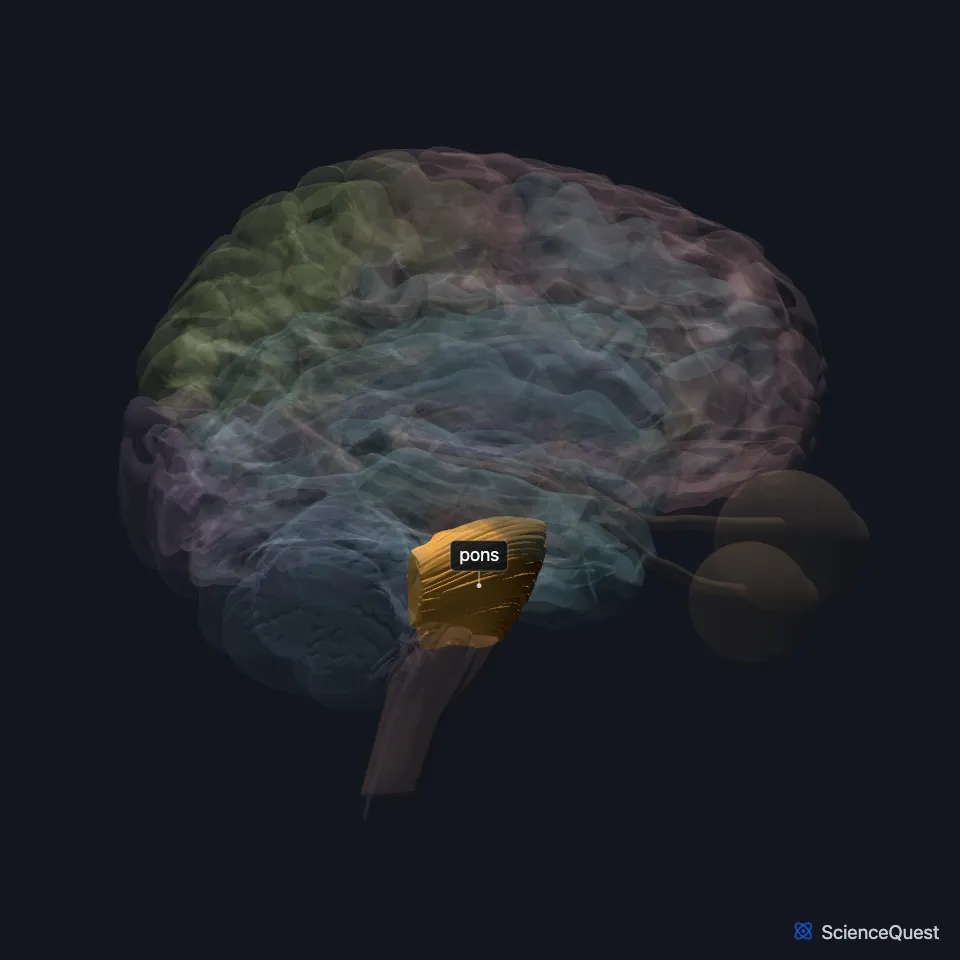
Where is the pons?
Its front surface rests on the clivus, and the basilar artery runs in a groove down its midline. (StatPearls, Pons)
Its back surface forms the upper part of the floor of the fourth ventricle, and the cerebellum covers it from behind. (OpenStax A&P 2e, 13.3; StatPearls, Pons)
It is about 27 mm high, 38 mm wide and 25 mm deep. (StatPearls, Pons)
How is the pons built?
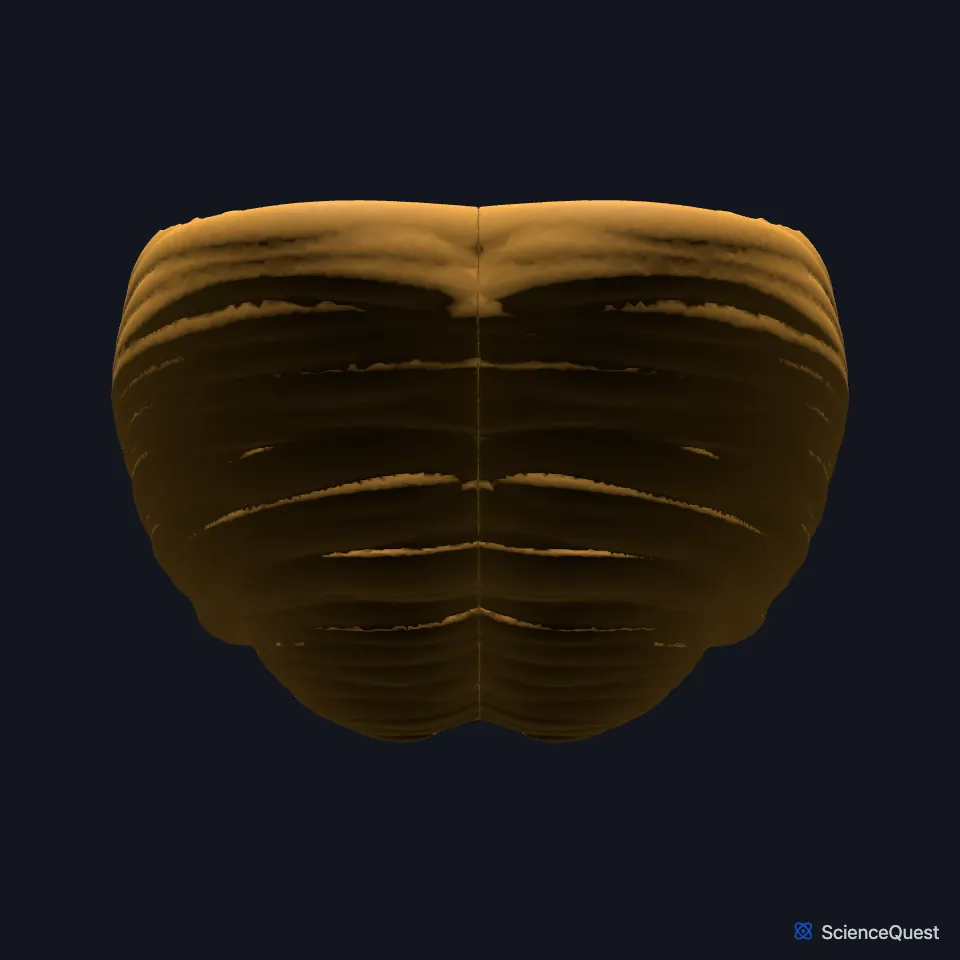
Its bulging front part holds the pontine nuclei, lengthwise corticospinal and corticopontine fibers, and crosswise fibers bound for the cerebellum. The back part, the tegmentum, holds mainly the reticular formation. (OpenStax A&P 2e, 13.2; StatPearls, Pons)
The front, basilar part holds the pontine nuclei, the corticospinal and corticopontine tracts running down, and fibers crossing to the opposite cerebellum through the middle cerebellar peduncle. (StatPearls, Pons)
What does the pons do?
It relays motor commands to the cerebellum. Fibers from the cerebral cortex end on the pontine nuclei, and those nuclei send axons across to the opposite half of the cerebellum. (OpenStax A&P 2e, 13.2; StatPearls, Pons and Cerebellar Dysfunction)
Its pontine respiratory group modifies the breathing rhythm that the medulla oblongata generates. It has two parts: the pneumotaxic center, which limits inspiration, and the apneustic center, which prolongs it. (OpenStax A&P 2e, 22.3; StatPearls, Physiology, Respiratory Drive)
With the medulla it helps regulate breathing, heart rate and blood pressure. (OpenStax A&P 2e, 13.2; StatPearls, Brainstem and Pons)
The trigeminal nerve, which carries sensation from the face, enters at the level of the pons. Its principal, or chief, sensory nucleus in the pontine tegmentum passes fine touch and pressure on to the thalamus. (OpenStax A&P 2e, 16.3; StatPearls, Pons and Cranial Nerve 5 (Trigeminal))
What connects to the pons?
The middle cerebellar peduncle, the largest of the three, carries axons from the pontine nuclei across to the opposite side of the cerebellum. (OpenStax A&P 2e, 16.5; StatPearls, Brainstem and Pons)
The corticospinal tract passes through it from the cerebral peduncles of the midbrain to the pyramids of the medulla. (OpenStax A&P 2e, 14.3; StatPearls, Pyramidal Tract)
Where the sources differ
The sources put the abducens nucleus, which controls the lateral rectus, in different places. OpenStax A&P 2e places it in the superior medulla; StatPearls places it in the pons, where facial nerve axons loop around it to raise the facial colliculus. (OpenStax A&P 2e, 16.3; StatPearls, Pons)
Touches in this model
Measured on the BodyParts3D meshes: surfaces within 2 mm of the pons, nearest first, 12 of 13.
- Cerebellum in contact
- Cerebral aqueduct in contact
- Fourth ventricle in contact
- Left parahippocampal gyrus in contact
- Medulla oblongata in contact
- Midbrain in contact
- Peduncle of midbrain in contact
- Right parahippocampal gyrus in contact
- Occipital bone in contact
- Skin in contact
- Sphenoid bone in contact
- Left inferior colliculus 0.2 mm away
Sources
- OpenStax Anatomy and Physiology 2e, section 13.2, The Central Nervous System. CC BY-NC-SA 4.0. Read 2026-10-25.
- StatPearls, Neuroanatomy, Pons. Masum Rahman; Prasanna Tadi. Last update January 30, 2023. CC BY-NC-ND 4.0. Read 2026-10-25.
- A Latin Dictionary (Lewis and Short, 1879), entry pons, read in the Lewis and Short text served by Logeion, University of Chicago. Charlton T. Lewis; Charles Short. Public domain. Read 2026-10-25.
- OpenStax Anatomy and Physiology 2e, section 13.3, Circulation and the Central Nervous System. CC BY-NC-SA 4.0. Read 2026-10-25.
- StatPearls, Neuroanatomy, Cerebellar Dysfunction. Mahmut Unverdi; Khalid Alsayouri. Last update July 25, 2023. CC BY-NC-ND 4.0. Read 2026-10-25.
- OpenStax Anatomy and Physiology 2e, section 22.3, The Process of Breathing. CC BY-NC-SA 4.0. Read 2026-10-25.
- StatPearls, Physiology, Respiratory Drive. Joshua E. Brinkman; Fadi Toro; Sandeep Sharma. Last update June 5, 2023. CC BY-NC-ND 4.0. Read 2026-10-25.
- StatPearls, Neuroanatomy, Brainstem. Hayden Basinger; Jeffery P. Hogg. Last update July 4, 2023. CC BY-NC-ND 4.0. Read 2026-10-25.
- OpenStax Anatomy and Physiology 2e, section 16.3, The Cranial Nerve Exam. CC BY-NC-SA 4.0. Read 2026-10-25.
- StatPearls, Neuroanatomy, Cranial Nerve 5 (Trigeminal). Trevor Huff; Luke J. Weisbrod; Daniel T. Daly. Last update April 20, 2024. CC BY-NC-ND 4.0. Read 2026-10-25.
- OpenStax Anatomy and Physiology 2e, section 16.5, The Coordination and Gait Exams. CC BY-NC-SA 4.0. Read 2026-10-25.
- OpenStax Anatomy and Physiology 2e, section 14.3, Motor Responses. CC BY-NC-SA 4.0. Read 2026-10-25.
- StatPearls, Neuroanatomy, Pyramidal Tract. Qais AbuHasan; Sunil Munakomi. Last update July 4, 2023. CC BY-NC-ND 4.0. Read 2026-10-25.
The values are facts and free to use; this page’s selection and presentation are © 2026 ScienceQuest.