Medulla oblongata
The medulla oblongata is the lowest part of the brain stem, at about the level of the foramen magnum, where the brain stem joins the spinal cord. (StatPearls, Medulla Oblongata)
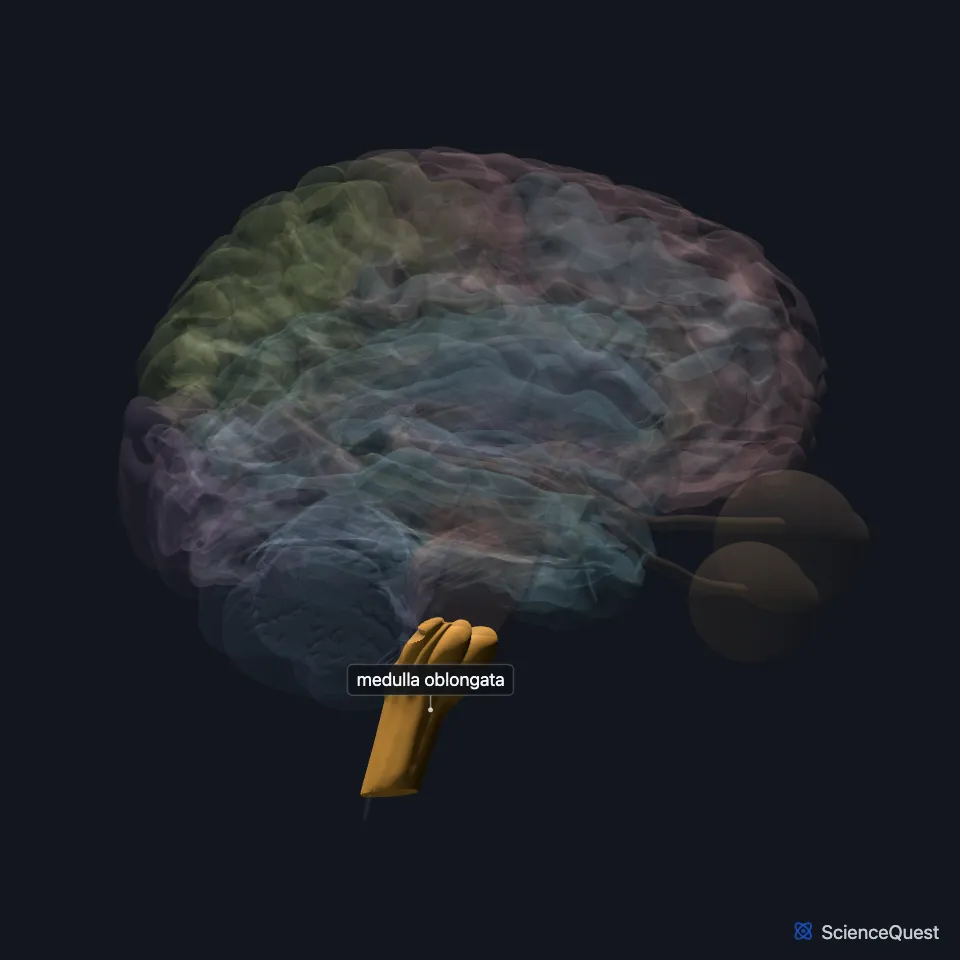
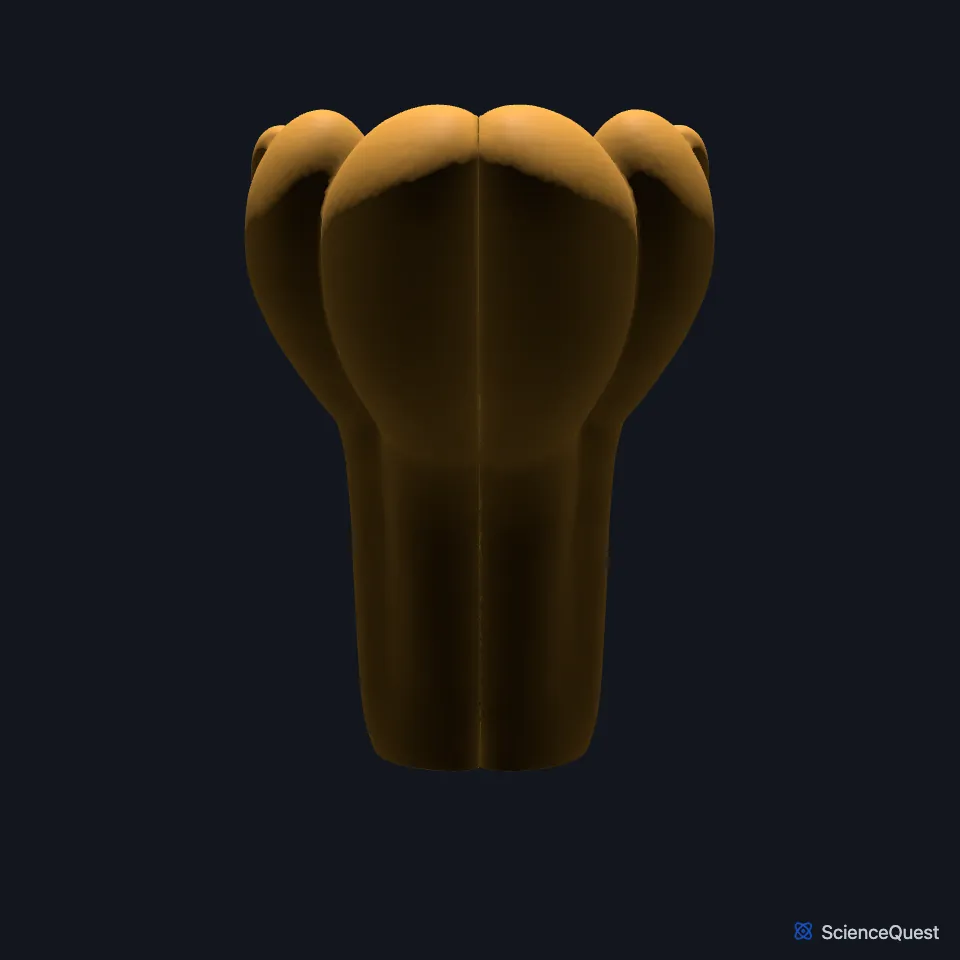
Where is the medulla oblongata?
It lies below the pons and joins the spinal cord. (StatPearls, Pons and Medulla Oblongata; OpenStax A&P 2e, 13.2)
The upper part of its back surface forms the lower floor of the fourth ventricle; the lower part has a median sulcus continuous with the spinal cord’s. (StatPearls, Medulla Oblongata)
How does the medulla oblongata develop?
In the embryo it is the myelencephalon, one of the two parts the hindbrain divides into. (OpenStax A&P 2e, 13.1 and 13.2; StatPearls, Medulla Oblongata)
What does the medulla oblongata do?
It holds cardiovascular centers that work with its breathing centers as one system for the autonomic control of heart rate, blood pressure and breathing. (OpenStax A&P 2e, 19.4; StatPearls, Medulla Oblongata)
Its respiratory center, the dorsal and ventral respiratory groups, generates the breathing rhythm and responds mainly to carbon dioxide, oxygen and pH in the blood. The strongest drive to breathe is the blood’s carbon dioxide, not its oxygen. (OpenStax A&P 2e, 22.3; StatPearls, Physiology, Respiratory Drive)
The area postrema, on the floor of the fourth ventricle beside the solitary nucleus, detects emetic toxins in the blood and the cerebrospinal fluid. It is also called the vomiting center, though a lesion of it does not stop vomiting from every emetic drug, and vomiting from motion sickness is reported not to involve it. (StatPearls, Medulla Oblongata)
The nucleus of the solitary tract coordinates visceral input from chemoreceptors, lung stretch receptors and baroreceptors. Taste also stops there first on its way to the thalamus. (StatPearls, Medulla Oblongata)
Which tracts and nerves pass through the medulla?
The corticospinal tracts form the pyramids on its front. In the lowest part of the medulla, 85 to 90% of their fibers cross to the other side at the pyramidal decussation. (OpenStax A&P 2e, 14.3; StatPearls, Medulla Oblongata and Pyramidal Tract)
Axons of the dorsal column system end in nuclei of the medulla. The second neurons cross the midline there and climb the brain stem as the medial lemniscus to the thalamus. (OpenStax A&P 2e, 14.2; StatPearls, Medulla Oblongata and Medial Lemniscus (Reils Band, Reils Ribbon))
Cranial nerves IX, X and XII arise from it; the accessory nerve (XI) has a part from the medulla, joined by roots from the cervical spinal cord as far down as C5. Its inferior olive sends sensory information to the cerebellum through the inferior cerebellar peduncle. (StatPearls, Medulla Oblongata and Cerebellar Dysfunction; OpenStax A&P 2e, 16.5)
Fibers from the hypothalamus reach the dorsal motor nucleus of its vagus nerve, which sends parasympathetic signals to the heart, stomach and airways. (OpenStax A&P 2e, 15.3; StatPearls, Medulla Oblongata)
Touches in this model
Measured on the BodyParts3D meshes: surfaces within 2 mm of the medulla oblongata, nearest first.
- Central canal of spinal cord in contact
- Fourth ventricle in contact
- Pons in contact
- Occipital bone in contact
- Skin in contact
- Cerebellum 0.7 mm away
- Atlas 0.8 mm away
Sources
- StatPearls, Neuroanatomy, Medulla Oblongata. Radostina Iordanova; Anil Kumar Reddy Reddivari. Last update July 24, 2023. CC BY-NC-ND 4.0. Read 2026-10-25.
- StatPearls, Neuroanatomy, Pons. Masum Rahman; Prasanna Tadi. Last update January 30, 2023. CC BY-NC-ND 4.0. Read 2026-10-25.
- OpenStax Anatomy and Physiology 2e, section 13.2, The Central Nervous System. CC BY-NC-SA 4.0. Read 2026-10-25.
- OpenStax Anatomy and Physiology 2e, section 13.1, The Embryologic Perspective. CC BY-NC-SA 4.0. Read 2026-10-25.
- OpenStax Anatomy and Physiology 2e, section 19.4, Cardiac Physiology. CC BY-NC-SA 4.0. Read 2026-10-25.
- OpenStax Anatomy and Physiology 2e, section 22.3, The Process of Breathing. CC BY-NC-SA 4.0. Read 2026-10-25.
- StatPearls, Physiology, Respiratory Drive. Joshua E. Brinkman; Fadi Toro; Sandeep Sharma. Last update June 5, 2023. CC BY-NC-ND 4.0. Read 2026-10-25.
- OpenStax Anatomy and Physiology 2e, section 14.3, Motor Responses. CC BY-NC-SA 4.0. Read 2026-10-25.
- StatPearls, Neuroanatomy, Pyramidal Tract. Qais AbuHasan; Sunil Munakomi. Last update July 4, 2023. CC BY-NC-ND 4.0. Read 2026-10-25.
- OpenStax Anatomy and Physiology 2e, section 14.2, Central Processing. CC BY-NC-SA 4.0. Read 2026-10-25.
- StatPearls, Neuroanatomy, Medial Lemniscus (Reils Band, Reils Ribbon). Daniel Navarro-Orozco; Rachel Miller; Pradeep C. Bollu. Last update July 6, 2025. CC BY-NC-ND 4.0. Read 2026-10-25.
- OpenStax Anatomy and Physiology 2e, section 16.5, The Coordination and Gait Exams. CC BY-NC-SA 4.0. Read 2026-10-25.
- StatPearls, Neuroanatomy, Cerebellar Dysfunction. Mahmut Unverdi; Khalid Alsayouri. Last update July 25, 2023. CC BY-NC-ND 4.0. Read 2026-10-25.
- OpenStax Anatomy and Physiology 2e, section 15.3, Central Control. CC BY-NC-SA 4.0. Read 2026-10-25.
The values are facts and free to use; this page’s selection and presentation are © 2026 ScienceQuest.