Atlas
The atlas is the first cervical vertebra, C1, and supports the skull at the atlanto-occipital joint. It is the only vertebra with neither a vertebral body nor a spinous process. (StatPearls, Cervical Vertebrae (Head and Neck) and Cervical Vertebrae (Back))
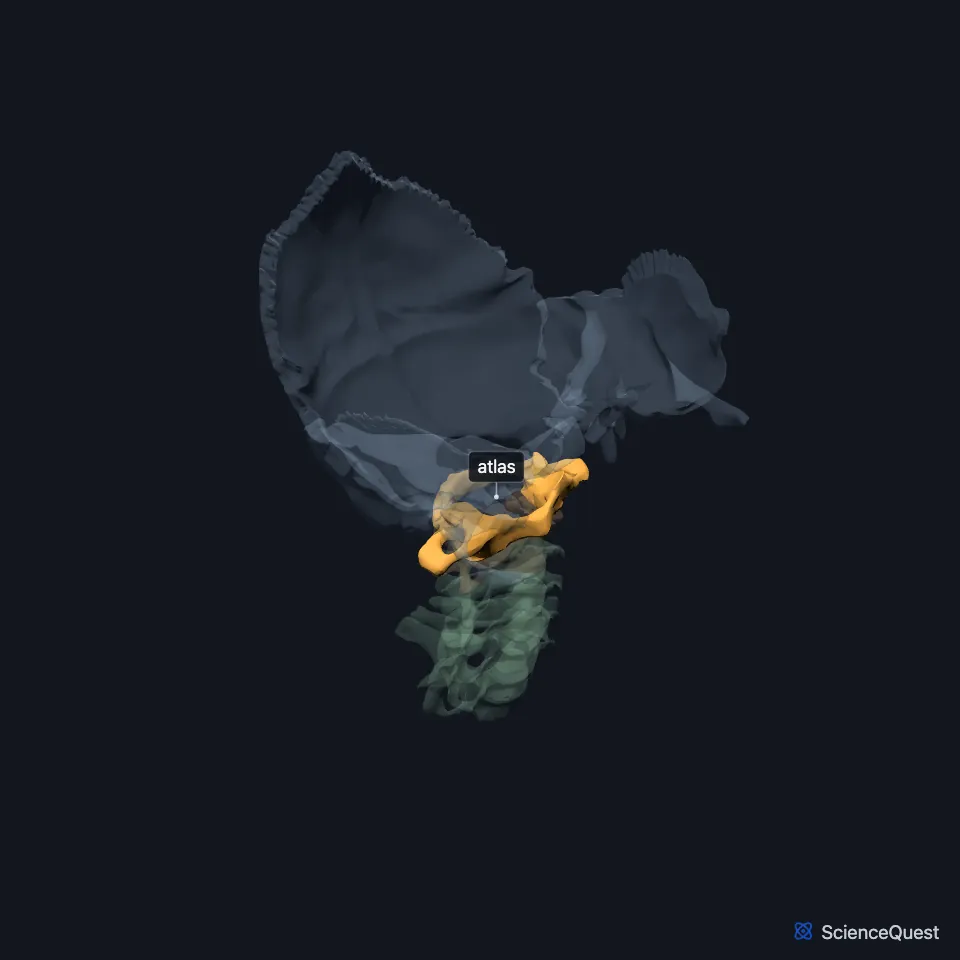
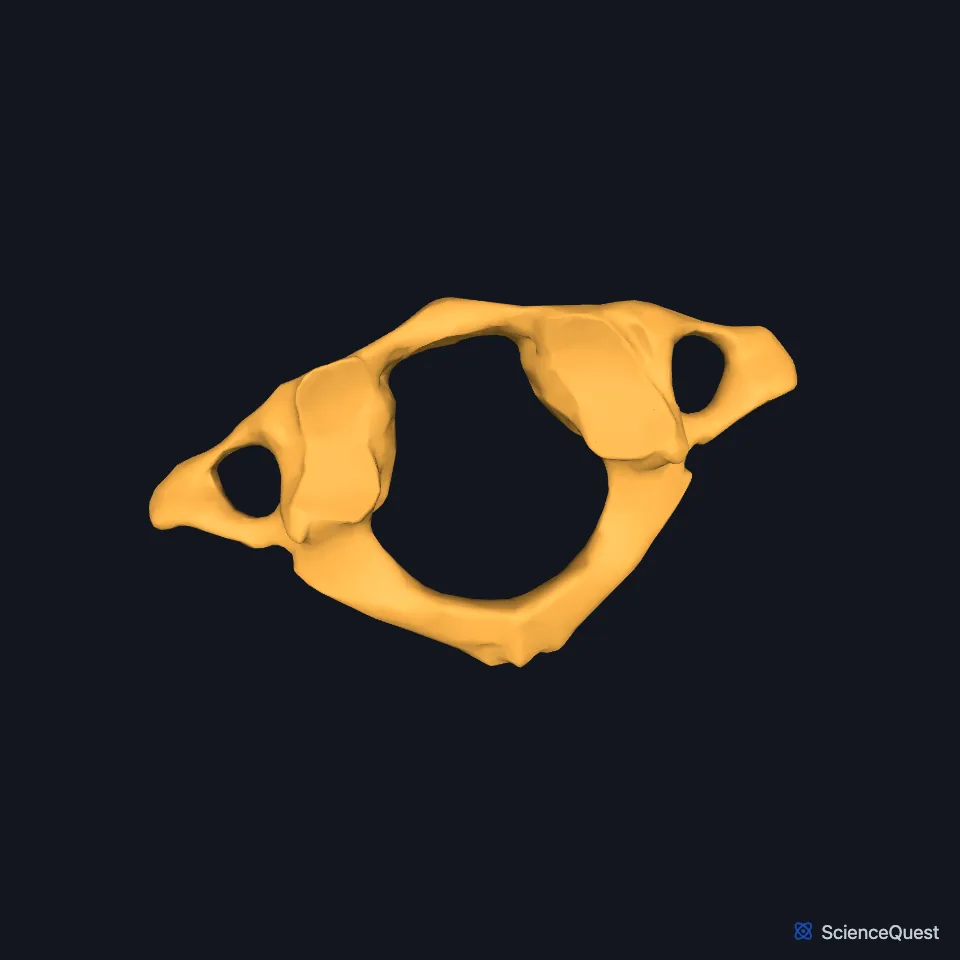
Open it in the Cervical Spine and Skull Base Explorer See it alone in 3D
Where is the atlas?
It is the topmost vertebra, just below the occiput. It links the cranium to the cervical spine through its joints with the occipital bone’s condyles above and the axis below. (StatPearls, C1 Fractures)
The atlas and the axis form the craniocervical junction together with the occiput. (StatPearls, Cervical Vertebrae (Head and Neck))
What does the atlas look like?
It is a ring of an anterior and a posterior arch joined by two lateral masses. The lateral masses bear load in place of a body. (StatPearls, Atlantoaxial Instability and Cervical Vertebrae (Back))
Each lateral mass has a concave superior facet that faces inward and receives an occipital condyle, and an inferior facet that meets the axis. A posterior tubercle sits where other vertebrae have a spinous process. (StatPearls, Cervical Vertebrae (Head and Neck) and Cervical Vertebrae (Back))
The vertebral arteries rise through the transverse foramina of C2 and C1, curve inward over the arch of C1 and enter the skull base. (StatPearls, Cervical Vertebrae (Head and Neck))
What does the atlas do?
The atlanto-occipital joint passes the weight of the head to the spine, gives much of the neck’s flexion and extension, and limits sideways shift of the occiput. (StatPearls, Cervical Vertebrae (Head and Neck))
With no body, the ring of C1 has room for the spinal cord as the cord leaves the foramen magnum. (StatPearls, Cervical Vertebrae (Head and Neck))
C1 rotates around the dens of C2 when the head turns. The atlantoaxial joints provide 50% of the rotation in the cervical spine, and the atlanto-occipital joints 50% of its flexion. (StatPearls, Cervical Vertebrae (Back) and C1 Fractures)
What attaches to the atlas?
The transverse ligament runs between the lateral masses of C1, behind the dens. StatPearls calls it the strongest ligament attachment in the cervical spine. (StatPearls, Atlantoaxial Instability)
Two suboccipital muscles arise from it: the rectus capitis posterior minor from the posterior tubercle and the obliquus capitis superior from the transverse process. The obliquus capitis inferior inserts on that transverse process. (StatPearls, Suboccipital Muscles)
The posterior longitudinal ligament runs from C2 to the sacrum and does not attach to C1, matching the lack of an intervertebral disc at the atlas. (StatPearls, Cervical Vertebrae (Back))
How does the atlas vary?
A bony bridge, the ponticulus posticus, can arch over the groove for the vertebral artery on the atlas. A meta-analysis found it in 16.7% of people, and complete in 9.3%. (StatPearls, Cervical Vertebrae (Back))
| Feature | Detail and source |
|---|---|
| Level | First cervical vertebra, C1 (StatPearls, Cervical Vertebrae (Head and Neck)) |
| Articulates with | Occipital bone (occipital condyles), axis (facets and dens) (StatPearls, Cervical Vertebrae (Back)) |
| Lacks | A vertebral body and a spinous process (StatPearls, Cervical Vertebrae (Back)) |
Touches in this model
Measured on the BodyParts3D meshes: surfaces within 2 mm of the atlas, nearest first, 12 of 35.
- Axis in contact
- Descending part of left trapezius in contact
- Descending part of right trapezius in contact
- Left cervical rotator in contact
- Left levator scapulae in contact
- Left longissimus capitis in contact
- Left obliquus capitis inferior in contact
- Left rectus capitis anterior in contact
- Left rectus capitis posterior minor in contact
- Left splenius cervicis in contact
- Right cervical rotator in contact
- Right levator scapulae in contact
Sources
- StatPearls, Anatomy, Head and Neck: Cervical Vertebrae. Joshua T. Kaiser; Vamsi Reddy; Marjorie V. Launico; Julian G. Lugo-Pico. Last update October 24, 2023. CC BY-NC-ND 4.0. Read 2026-10-25.
- StatPearls, Anatomy, Back, Cervical Vertebrae. Joshua A. Waxenbaum; Vamsi Reddy; Konstantinos Margetis. Last update January 31, 2026. CC BY-NC-ND 4.0. Read 2026-10-25.
- StatPearls, C1 Fractures. Daniel Kim; Vibhu Krishnan Viswanathan; Sunil Munakomi; Richard P. Menger. Last update June 13, 2024. CC BY-NC-ND 4.0. Read 2026-10-25.
- StatPearls, Atlantoaxial Instability. Jordan Lacy; Jitin Bajaj; Christopher C. Gillis. Last update June 12, 2023. CC BY-NC-ND 4.0. Read 2026-10-25.
- StatPearls, Anatomy, Head and Neck, Suboccipital Muscles. Tom George; Prasanna Tadi. Last update January 1, 2023. CC BY-NC-ND 4.0. Read 2026-10-25.
The values are facts and free to use; this page’s selection and presentation are © 2026 ScienceQuest.