Axis
The axis is the second cervical vertebra, C2. Its dens, the odontoid process, projects up from its body and is the pivot around which the atlas rotates. (StatPearls, Cervical Vertebrae (Head and Neck) and Cervical Vertebrae (Back))
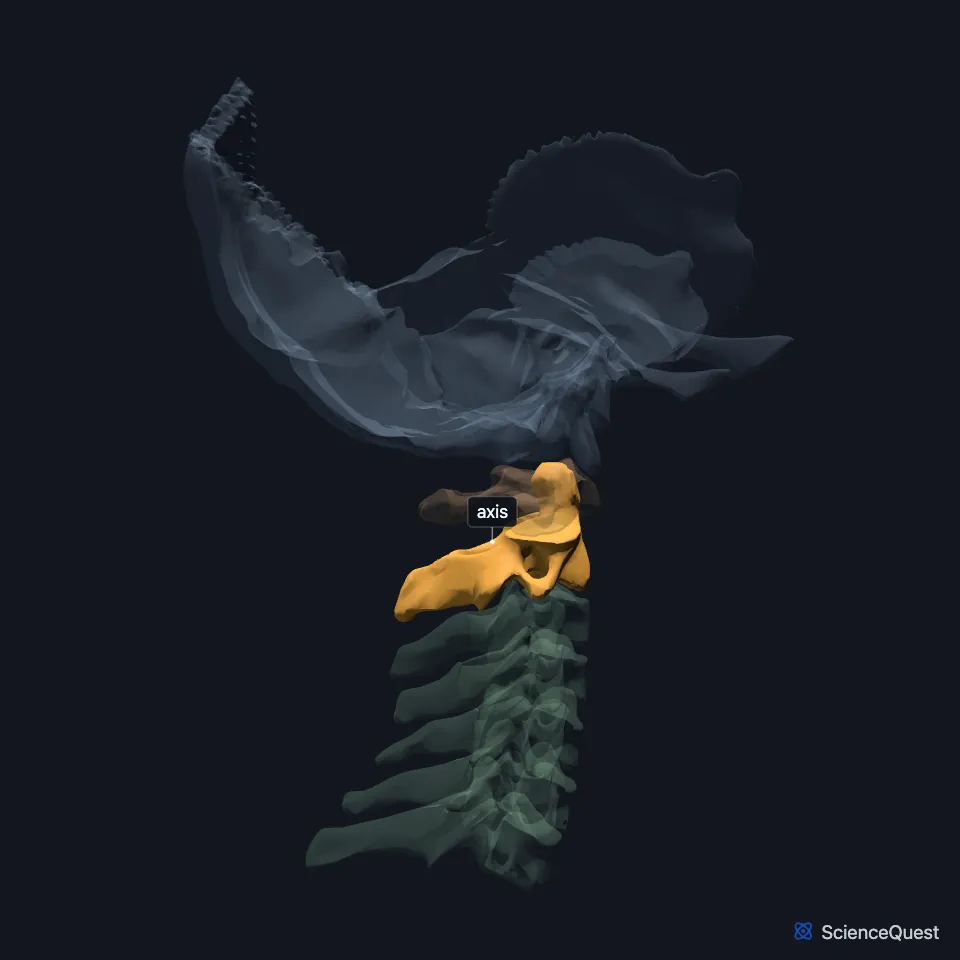
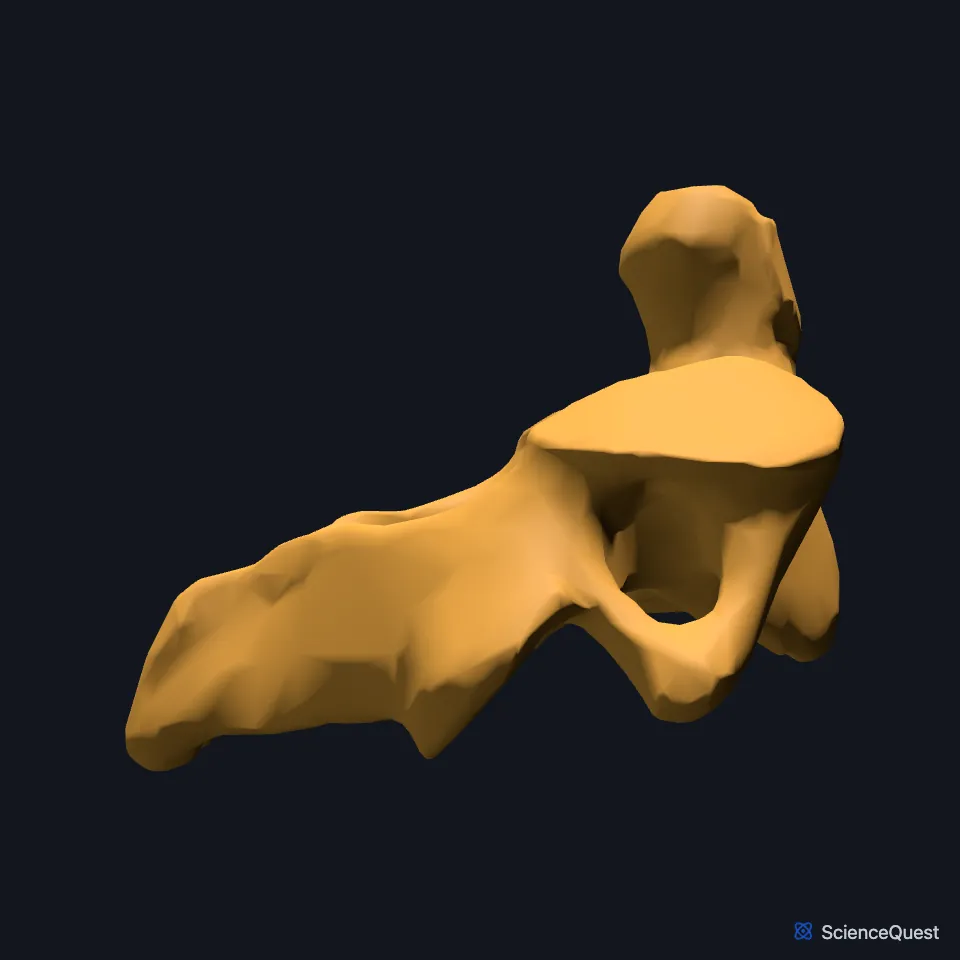
Open it in the Cervical Spine and Skull Base Explorer See it alone in 3D
Where is the axis?
It lies below the atlas and passes weight down through its body to the third cervical vertebra. With the atlas and the occiput it forms the craniocervical junction. (StatPearls, Cervical Vertebrae (Back) and Cervical Vertebrae (Head and Neck))
What are the parts of the axis?
It has two lateral masses that meet the atlas, a vertebral body, and the dens rising from the top of the body. The dens meets the back of the anterior arch of C1. (StatPearls, Cervical Vertebrae (Back))
Unlike the atlas, it has a spinous process. Two suboccipital muscles arise from it, the rectus capitis posterior major and the obliquus capitis inferior. (StatPearls, Suboccipital Muscles and Cervical Vertebrae (Back))
What does the axis do?
StatPearls describes the axis as the primary weight-bearing bone of the upper cervical spine. (StatPearls, Cervical Vertebrae (Head and Neck))
The atlantoaxial junction has three joints. In the midline the anterior arch of the atlas pivots on the dens, and two shallow facet joints lie to the sides. (StatPearls, Cervical Vertebrae (Head and Neck))
This junction gives more of the head’s rotation than flexion or extension. The atlantoaxial joints provide 50% of the rotation in the cervical spine. (StatPearls, Cervical Vertebrae (Head and Neck) and C1 Fractures)
What holds the dens in place?
The transverse ligament of the atlas runs behind the dens. Paired alar ligaments run from the tip of the dens to the margins of the foramen magnum, and the apical ligament joins the tip to the basion. (StatPearls, Atlantoaxial Instability and Cervical Vertebrae (Back))
The tectorial membrane, the upward continuation of the posterior longitudinal ligament, attaches firmly to the axis and to the clivus of the occipital bone. (StatPearls, Cervical Vertebrae (Back) and Occipital Bone, Artery, Vein, and Nerve)
How does the axis develop?
The dens joins the body of C2 at around 6 years of age. Its secondary ossification centers appear around age 3 but do not fuse to its tip until age 12. The ossification centers of the dens are often mistaken for fractures in children. (StatPearls, Cervical Vertebrae (Head and Neck))
StatPearls states that the dens evolved from the body of C1. An os odontoideum, a separate ossicle cut off from the base of C2, appeared in 0.11% of patients in a large series. (StatPearls, Cervical Vertebrae (Head and Neck) and Cervical Vertebrae (Back))
Where the sources differ
The axis has a bifid spinous process in both StatPearls reviews, but they disagree on the vertebrae below it. The head and neck review gives bifid spinous processes to C2 to C6; the back review finds consistent bifidity only from C2 to C4, with C6 single in nearly half of people. (StatPearls, Cervical Vertebrae (Head and Neck) and Cervical Vertebrae (Back))
| Feature | Detail and source |
|---|---|
| Level | Second cervical vertebra, C2 (StatPearls, Cervical Vertebrae (Head and Neck)) |
| Articulates with | Atlas (dens and facets), third cervical vertebra (body) (StatPearls, Cervical Vertebrae (Back)) |
| Hallmark | The dens, or odontoid process (StatPearls, Cervical Vertebrae (Head and Neck)) |
Touches in this model
Measured on the BodyParts3D meshes: surfaces within 2 mm of the axis, nearest first, 12 of 33.
- Atlas in contact
- Descending part of left trapezius in contact
- Descending part of right trapezius in contact
- Intervertebral disk of axis in contact
- Left cervical rotator in contact
- Left levator scapulae in contact
- Left longissimus cervicis in contact
- Left multifidus in contact
- Left rectus capitis posterior major in contact
- Left scalenus medius in contact
- Left spinalis cervicis in contact
- Right cervical rotator in contact
Sources
- StatPearls, Anatomy, Head and Neck: Cervical Vertebrae. Joshua T. Kaiser; Vamsi Reddy; Marjorie V. Launico; Julian G. Lugo-Pico. Last update October 24, 2023. CC BY-NC-ND 4.0. Read 2026-10-25.
- StatPearls, Anatomy, Back, Cervical Vertebrae. Joshua A. Waxenbaum; Vamsi Reddy; Konstantinos Margetis. Last update January 31, 2026. CC BY-NC-ND 4.0. Read 2026-10-25.
- StatPearls, Anatomy, Head and Neck, Suboccipital Muscles. Tom George; Prasanna Tadi. Last update January 1, 2023. CC BY-NC-ND 4.0. Read 2026-10-25.
- StatPearls, C1 Fractures. Daniel Kim; Vibhu Krishnan Viswanathan; Sunil Munakomi; Richard P. Menger. Last update June 13, 2024. CC BY-NC-ND 4.0. Read 2026-10-25.
- StatPearls, Atlantoaxial Instability. Jordan Lacy; Jitin Bajaj; Christopher C. Gillis. Last update June 12, 2023. CC BY-NC-ND 4.0. Read 2026-10-25.
- StatPearls, Anatomy, Head and Neck, Occipital Bone, Artery, Vein, and Nerve. Alex M. Germann; Varun Kashyap. Last update July 24, 2023. CC BY-NC-ND 4.0. Read 2026-10-25.
The values are facts and free to use; this page’s selection and presentation are © 2026 ScienceQuest.