Longissimus
The longissimus is the middle of the three columns of the erector spinae, between the iliocostalis on its outer side and the spinalis on its inner side. StatPearls calls it the most significant part of the group. (OpenStax A&P 2e, 11.3; StatPearls, Back)
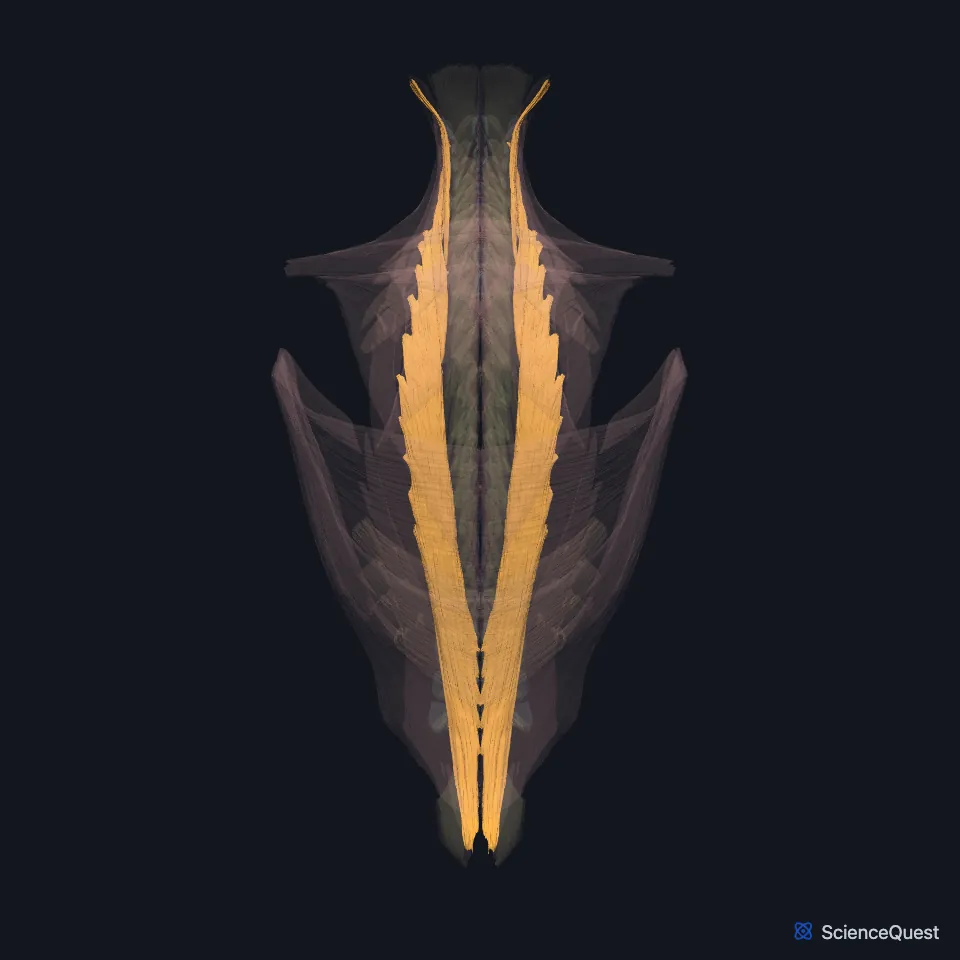
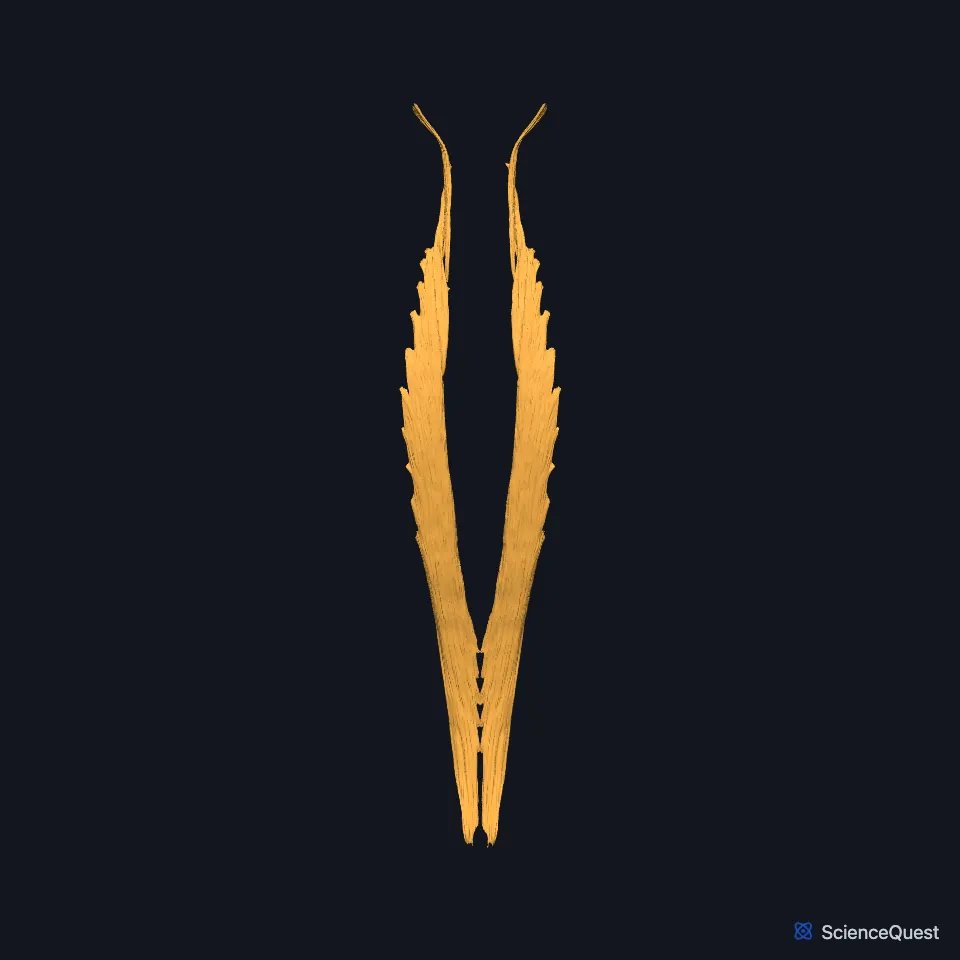
Where is the longissimus?
Its head part, the longissimus capitis, reaches the skull at the mastoid process of the temporal bone. (OpenStax A&P 2e, 11.3; StatPearls, Back, Muscles)
In the neck, the splenius capitis lies over the longissimus capitis, and the trapezius over both. (StatPearls, Back, Muscles)
What are the parts of the longissimus?
It has three parts: the longissimus capitis of the head, the longissimus cervicis of the neck and the longissimus thoracis of the chest. Gray’s 1918 text calls the chest part the longissimus dorsi. (OpenStax A&P 2e, 11.3; StatPearls, Back, Muscles; Gray 1918, 6a. Deep Muscles of the Back)
The capitis arises from the transverse processes of C4 to T4 and inserts on the back edge of the mastoid process. The cervicis runs from the transverse processes of T1 to T4 to the posterior tubercles of the transverse processes of C2 to C6. (StatPearls, Back, Muscles)
StatPearls calls the thoracis the largest muscle of the erector spinae. It has lumbar and thoracic sections and arises from transverse processes low in the spine. (StatPearls, Back, Muscles)
The spinalis thoracis, the innermost column in the chest, blends with the longissimus thoracis on its outer side. (StatPearls, Back, Muscles)
What does the longissimus do?
As part of the erector spinae it extends the back when both sides act, and bends the spine to one side and rotates it when one side acts. The group also maintains posture and the lumbar curve. (StatPearls, Back; OpenStax A&P 2e, 11.3)
The longissimus capitis moves the head. Acting alone it turns the face to its own side and tilts the head toward that shoulder; with its partner it pulls the head back. (OpenStax A&P 2e, 11.3; Gray 1918, 6b. Suboccipital Muscles)
What supplies the longissimus?
Its nerves come from the dorsal rami of the spinal nerves. At the lumbar level, the intermediate branches of the dorsal rami supply the longissimus, while the lateral branches go to the iliocostalis. (StatPearls, Back, Muscles)
The deep cervical, posterior intercostal, subcostal or lumbar arteries supply it, with variation from person to person. (StatPearls, Back, Muscles)
Where the sources differ
OpenStax gives the longissimus capitis a clear action on the head: tilting and turning it to the same side, and extending it when both sides act. StatPearls’ back muscles article calls the actions of the cervical and capitis parts of the erector spinae unknown. (OpenStax A&P 2e, 11.3; StatPearls, Back, Muscles)
| Feature | Detail and source |
|---|---|
| Parts | Longissimus capitis, cervicis and thoracis (OpenStax A&P 2e, 11.3; StatPearls, Back, Muscles; Gray 1918, 6a. Deep Muscles of the Back) |
| Origin | Transverse processes: C4 to T4 (capitis), T1 to T4 (cervicis), lower levels (thoracis) (StatPearls, Back, Muscles) |
| Insertion | Mastoid process of the temporal bone (capitis); transverse processes of C2 to C6 (cervicis); higher transverse processes (thoracis) (StatPearls, Back, Muscles) |
| Action | Extends the spine when both sides act; the capitis also tilts, turns and extends the head (StatPearls, Back; OpenStax A&P 2e, 11.3) |
| Nerve | Intermediate branches of the dorsal rami (StatPearls, Back, Muscles) |
Touches in this model
Measured on the BodyParts3D meshes: surfaces within 2 mm of the longissimus, nearest first, 12 of 111.
- Left iliocostalis cervicis in contact
- Left iliocostalis lumborum in contact
- Left iliocostalis thoracis in contact
- Left latissimus dorsi in contact
- Left levator scapulae in contact
- Left lumbar rotator in contact
- Left multifidus in contact
- Left semispinalis capitis in contact
- Left semispinalis cervicis in contact
- Left semispinalis thoracis in contact
- Left serratus posterior inferior in contact
- Left serratus posterior superior in contact
Sources
- OpenStax Anatomy and Physiology 2e, section 11.3, Axial Muscles of the Head, Neck, and Back. CC BY-NC-SA 4.0. Read 2026-10-25.
- StatPearls, Anatomy, Back. Robert J. Modes; Sevda Lafci Fahrioglu. Last update February 27, 2023. CC BY-NC-ND 4.0. Read 2026-10-25.
- StatPearls, Anatomy, Back, Muscles. Brandi Henson; Bhavana Kadiyala; Mary Ann Edens. Last update August 14, 2023. CC BY-NC-ND 4.0. Read 2026-10-25.
- Gray’s Anatomy of the Human Body, 20th US edition (1918), IV. Myology, 6a. The Deep Muscles of the Back (1918 terms: Sacrospinalis for erector spinae, Iliocostalis dorsi for iliocostalis thoracis, Longissimus dorsi for longissimus thoracis). Henry Gray. Public domain. Read 2026-10-25.
- Gray’s Anatomy of the Human Body, 20th US edition (1918), IV. Myology, 6b. The Suboccipital Muscles, actions of the deep back muscles (1918 terms: Sacrospinalis for erector spinae). Henry Gray. Public domain. Read 2026-10-25.
The values are facts and free to use; this page’s selection and presentation are © 2026 ScienceQuest.