Quadratus lumborum
The quadratus lumborum is a flat, four-sided muscle at the back of the abdomen, beside the lumbar spine. It attaches to the iliac crest, the transverse processes of L1 to L4 and the 12th rib. (StatPearls, Quadratus Lumborum)
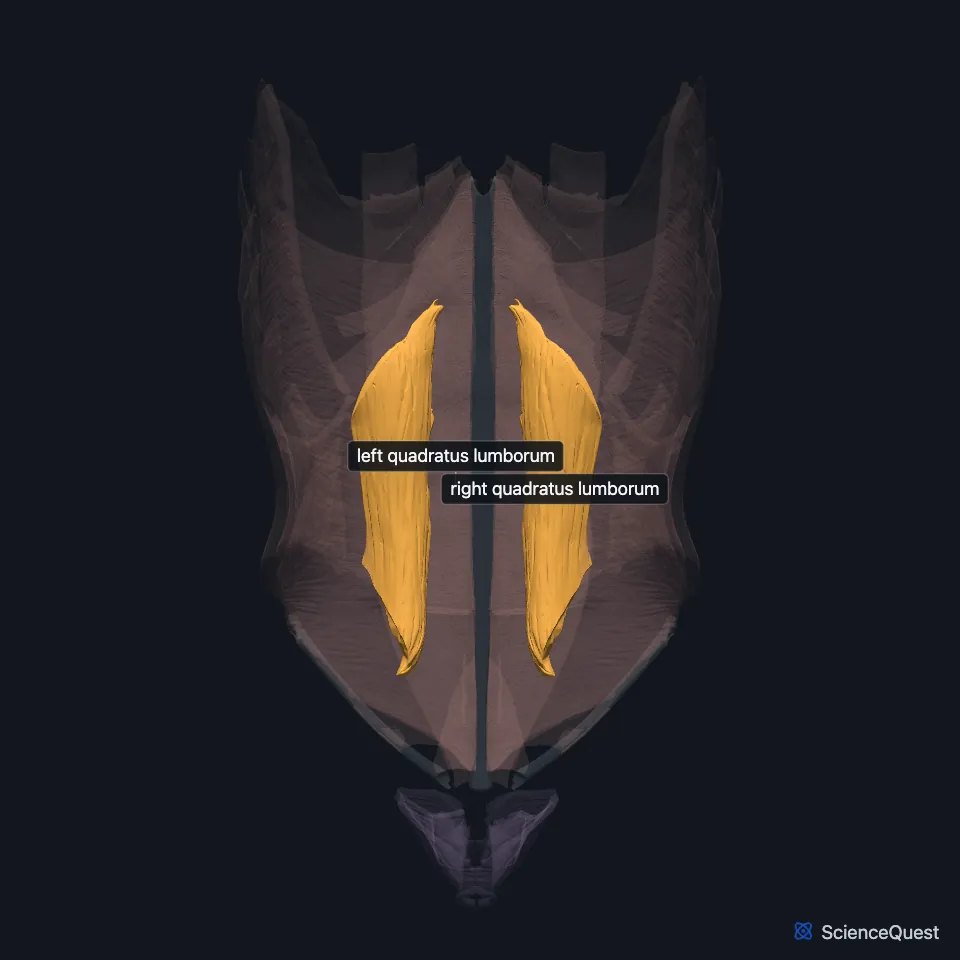
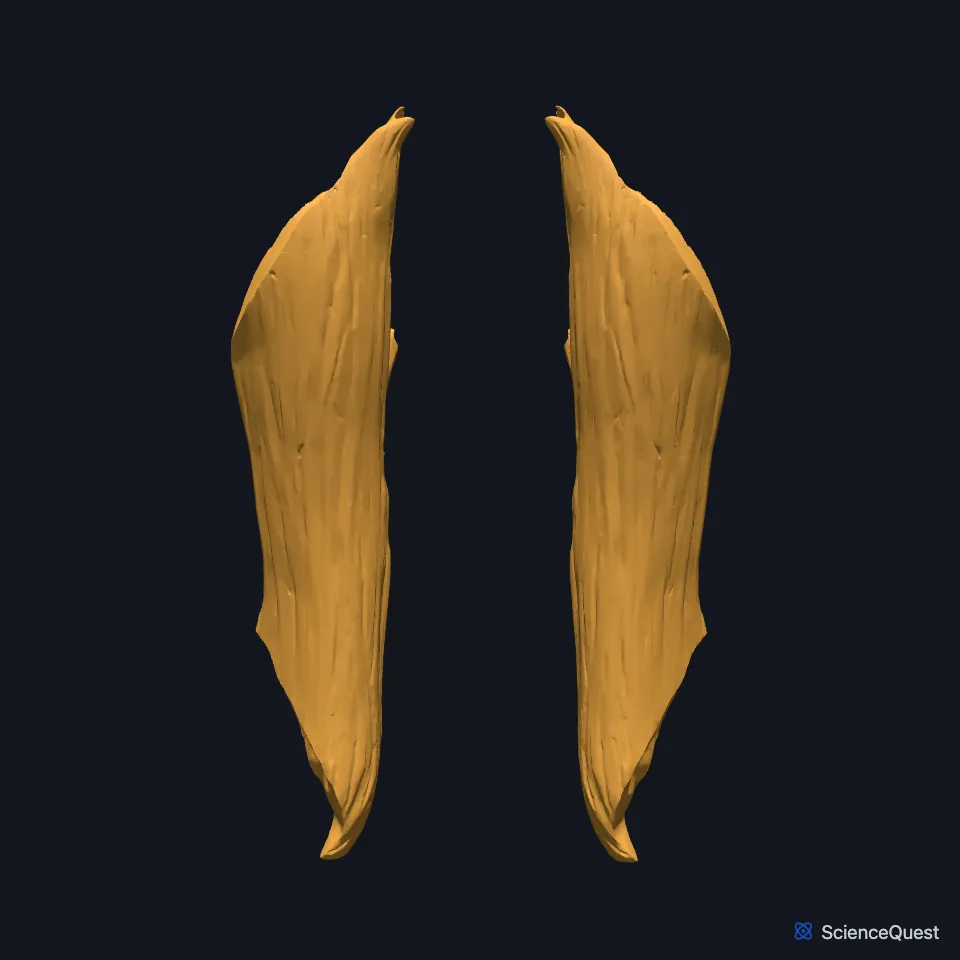
Open it in the Abdominal Muscles Explorer See it alone in 3D
Where is the quadratus lumborum?
It is a muscle of the posterior abdominal wall. Gray’s groups it with the psoas major, the psoas minor and the iliacus as the posterior muscles of the abdomen. (OpenStax A&P 2e, 11.4; StatPearls, Back; Gray 1918, 6d. Muscles of the Abdomen)
It belongs to the thoracolumbar fascia, the sheet that covers the back of the trunk. The anterior layer of that fascia covers the muscle and attaches to the lumbar transverse processes and the iliac crest. (StatPearls, Quadratus Lumborum and Back)
What does the quadratus lumborum attach to?
It arises from the inner lip of the iliac crest and the iliolumbar ligament. It inserts on the inner surface of the 12th rib and the transverse processes of L1 to L4. (StatPearls, Quadratus Lumborum and Abdominal Wall)
Its fibers lie in three layers that pull in different directions. They vary so much in size, direction and thickness that no single fiber pattern describes the muscle. (StatPearls, Quadratus Lumborum)
What does the quadratus lumborum do?
Anatomy texts call it an extensor, stabilizer and side-bender of the lumbar spine and an accessory muscle of inspiration. StatPearls’ abdominal wall article also has it pulling the rib cage down. (StatPearls, Quadratus Lumborum and Abdominal Wall)
A cadaver study has cast doubt on those actions. In extension the quadratus lumborum produced 10 N, against 100 N from the erector spinae and 150 N from multifidus. (StatPearls, Quadratus Lumborum)
On that evidence StatPearls suggests it is a junction for the forces of neighboring muscles. The diaphragm’s lateral arcuate ligament rests on it, so it may act as a pivot in breathing. (StatPearls, Quadratus Lumborum)
What lies around the quadratus lumborum, and what supplies it?
The lateral arcuate ligament (lateral lumbocostal arch) of the diaphragm crosses the fascia over its upper part, from L1 to the 12th rib. StatPearls also describes the muscle as a backward continuation of the transversus abdominis. (StatPearls, Thorax: Diaphragm and Quadratus Lumborum; FMA, Lateral arcuate ligament)
It works with multifidus and the erector spinae, including the iliocostalis and longissimus, as an opponent of the abdominal muscles. (StatPearls, Quadratus Lumborum; OpenStax A&P 2e, 11.3)
The 12th thoracic, iliohypogastric and ilioinguinal nerves supply it, and they pass through it as well. Its blood comes from the lumbar arteries and a lumbar branch of the iliolumbar artery. (StatPearls, Quadratus Lumborum)
Where the sources differ
StatPearls’ abdominal wall article lists side-bending and extension of the spine and lowering of the rib cage as its actions. StatPearls’ quadratus lumborum article reports that it supplies under 10% of the force of a side-bend and doubts that it stabilizes the lumbar spine to any great degree. (StatPearls, Abdominal Wall and Quadratus Lumborum)
OpenStax’s table gives its origin as the ilium and ribs 5 to 10 and its insertion as rib 12 and vertebrae L1 to L4. StatPearls gives it no rib origin: it arises from the inner lip of the iliac crest and the iliolumbar ligament. (OpenStax A&P 2e, 11.4; StatPearls, Quadratus Lumborum)
| Feature | Detail and source |
|---|---|
| Origin | Inner lip of the iliac crest; iliolumbar ligament (StatPearls, Quadratus Lumborum) |
| Insertion | Inner surface of the 12th rib; transverse processes of L1 to L4 (StatPearls, Quadratus Lumborum) |
| Action | Bends the lumbar spine to the side and extends it, as anatomy texts describe it; a cadaver study measured little force (StatPearls, Abdominal Wall and Quadratus Lumborum) |
| Nerve | 12th thoracic, iliohypogastric and ilioinguinal nerves (StatPearls, Quadratus Lumborum) |
Touches in this model
Measured on the BodyParts3D meshes: surfaces within 2 mm of the quadratus lumborum, nearest first, 12 of 36.
- Left transversus abdominis in contact
- Right transversus abdominis in contact
- Diaphragm in contact
- Fifth lumbar vertebra in contact
- First lumbar vertebra in contact
- Left gluteus maximus in contact
- Left iliocostalis lumborum in contact
- Left longissimus thoracis in contact
- Left lumbar rotator in contact
- Left multifidus in contact
- Left twelfth rib in contact
- Right gluteus maximus in contact
Sources
- StatPearls, Anatomy, Abdomen and Pelvis, Quadratus Lumborum. Bruno Bordoni; Reddog E. Sina; Matthew A. Varacallo. Last update July 17, 2024. CC BY-NC-ND 4.0. Read 2026-10-25.
- OpenStax Anatomy and Physiology 2e, section 11.4, Axial Muscles of the Abdominal Wall, and Thorax. CC BY-NC-SA 4.0. Read 2026-10-25.
- StatPearls, Anatomy, Back. Robert J. Modes; Sevda Lafci Fahrioglu. Last update February 27, 2023. CC BY-NC-ND 4.0. Read 2026-10-25.
- Gray’s Anatomy of the Human Body, 20th US edition (1918), IV. Myology, 6d. The Muscles and Fasciae of the Abdomen. Henry Gray. Public domain. Read 2026-10-25.
- StatPearls, Anatomy, Abdomen and Pelvis: Abdominal Wall. William Flynn; Paula Vickerton. Last update July 24, 2023. CC BY-NC-ND 4.0. Read 2026-10-25.
- StatPearls, Anatomy, Thorax: Diaphragm. Kanwal Naveen S. Bains; Sarang Kashyap; Sarah L. Lappin. Last update July 24, 2023. CC BY-NC-ND 4.0. Read 2026-10-25.
- Foundational Model of Anatomy, FMA58283, Lateral arcuate ligament (read on EBI OLS). FMA release terms, University of Washington. Read 2026-10-25.
- OpenStax Anatomy and Physiology 2e, section 11.3, Axial Muscles of the Head, Neck, and Back. CC BY-NC-SA 4.0. Read 2026-10-25.
The values are facts and free to use; this page’s selection and presentation are © 2026 ScienceQuest.