Hip bone
The hip bone, or coxal bone, forms the pelvic girdle and attaches the lower limb to the body. Each hip bone joins the axial skeleton at the sacrum. (OpenStax A&P 2e, 8.3; StatPearls, Pelvis Bones; Gray’s Anatomy (1918), Hip Bone, p. 231)
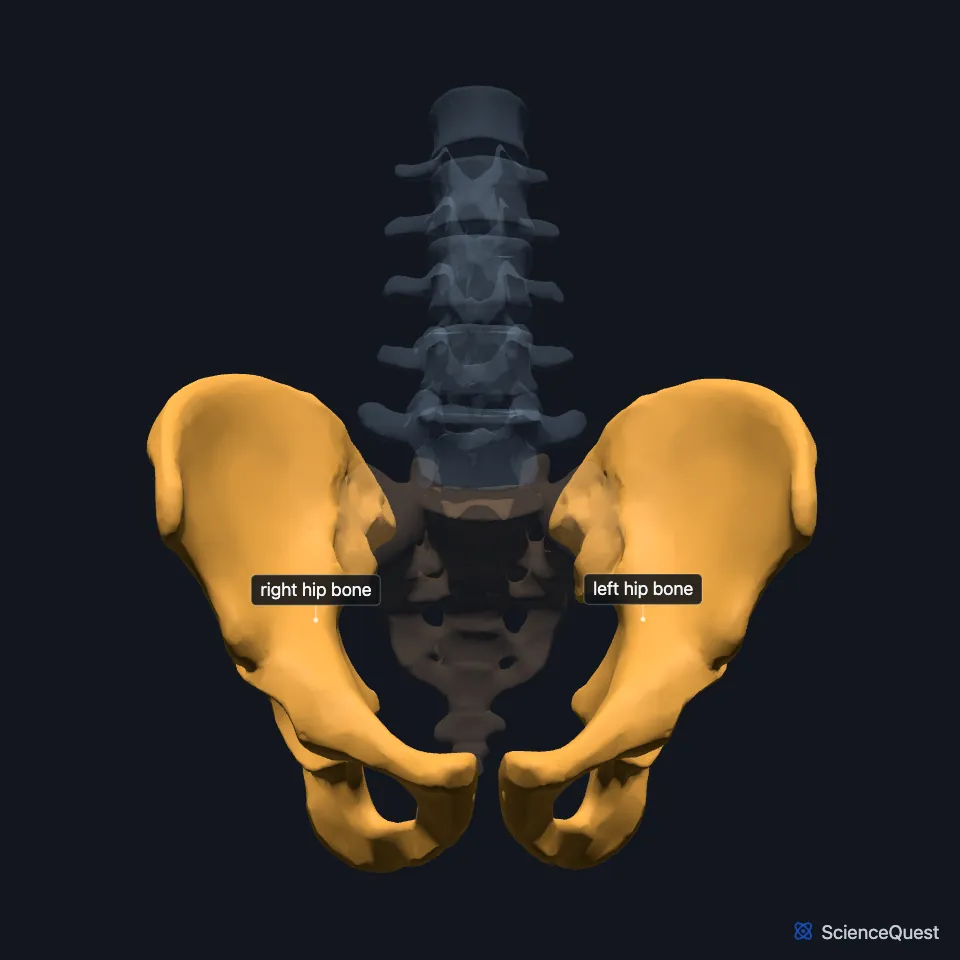
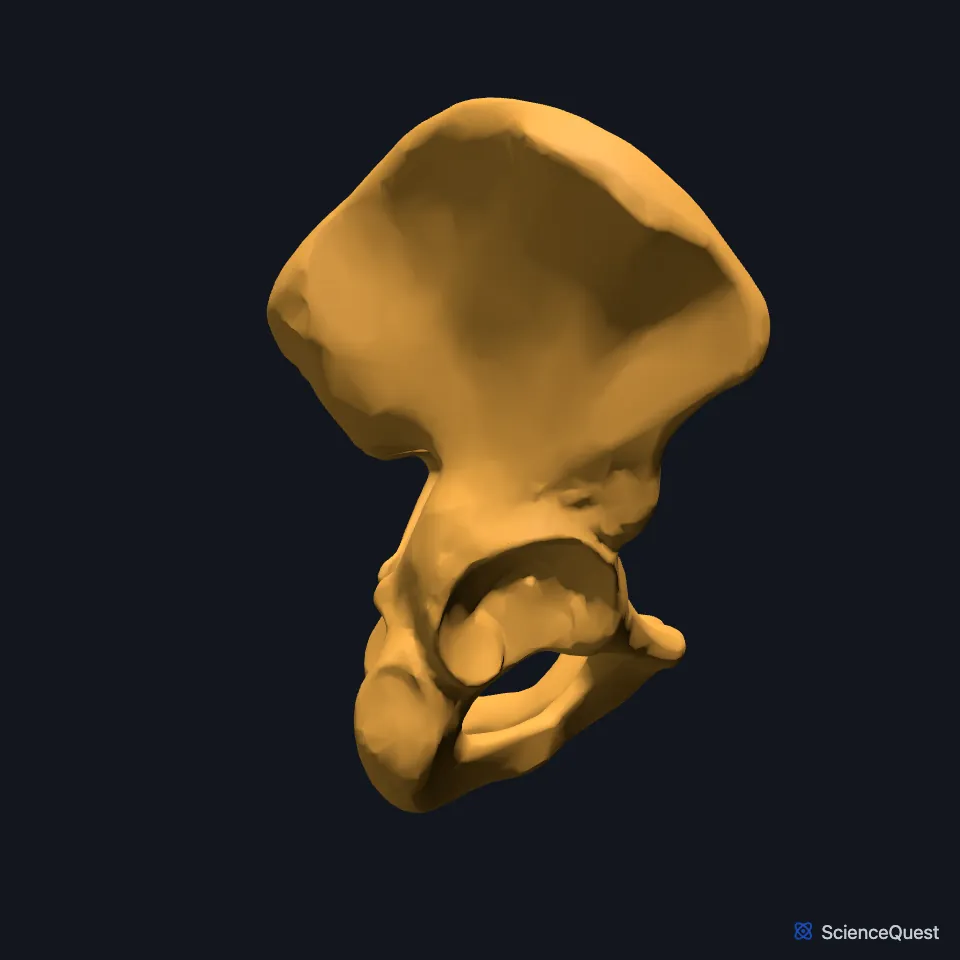
Open it in the Lumbar Spine and Pelvis Explorer See it alone in 3D
Where are the hip bones?
Each side of the pelvis is a large, curved hip bone, formed by the union of the ilium, ischium and pubis. The two hip bones, the sacrum and the coccyx together make up the bony pelvis. (OpenStax A&P 2e, 8.3; StatPearls, Pelvis Bones)
At the front, the pubis of each hip bone curves medially to meet the other at the pubic symphysis. (OpenStax A&P 2e, 8.3; StatPearls, Pelvis Bones)
What are the three parts of the hip bone?
Each adult hip bone forms from three bones, the ilium, ischium and pubis, that join at the acetabulum during the teenage years. Their names live on as the names of its three regions. (OpenStax A&P 2e, 8.3; StatPearls, Pelvis Bones; Gray’s Anatomy (1918), Hip Bone, p. 231)
The ilium is the fan-shaped upper region and the largest. Its curved upper margin, the iliac crest, ends in front at the anterior superior iliac spine. (OpenStax A&P 2e, 8.3; StatPearls, Pelvis Bones)
The ischium forms the back and lower part. Its ischial tuberosity anchors the hamstring muscles, and the pelvis carries the weight of the upper body when you sit. (OpenStax A&P 2e, 8.3; StatPearls, Pelvis Bones)
The three regions meet at the acetabulum, a deep cup on the lateral side of the hip bone that forms part of the hip joint. Low in the front of the hip bone, the large obturator foramen opens between the ischium and pubis. (OpenStax A&P 2e, 8.3; StatPearls, Pelvis Bones)
Which joints does the hip bone form?
Its auricular surface meets the sacrum at the sacroiliac joint, which allows little movement. At the acetabulum it meets the head of the femur at the hip joint, a ball-and-socket joint. (OpenStax A&P 2e, 8.3 and 9.6; StatPearls, Pelvis Bones, Sacroiliac Joint and Hip Joint)
The acetabulum is deep, and the acetabular labrum, a lip of fibrocartilage on its rim, deepens it further, which gives the hip its stability for bearing weight. StatPearls states that the acetabulum covers about 40% of the femoral head. (OpenStax A&P 2e, 9.6; StatPearls, Hip)
Two ligaments bridge from the sacrum to the ischium: the sacrospinous, from the lower sacrum and upper coccyx to the ischial spine, and the sacrotuberous, to the ischial tuberosity. With the sciatic notches they frame the openings through which muscles, nerves and vessels leave the pelvis for the lower limb. (OpenStax A&P 2e, 8.3; StatPearls, Pelvis Bones; Gray’s Anatomy (1918), Hip Bone, p. 231)
What does the hip bone do?
The pectoral girdle is mobile, while the bones of the pelvis are bound together into a weight-bearing structure that allows little movement. Body weight passes through them from the vertebral column, across the hip joints and into the lower limbs. (OpenStax A&P 2e, 8.3; StatPearls, Pelvis Bones, Sacroiliac Joint and Sternoclavicular Joint)
The pelvis also anchors muscles of the trunk and lower limb and protects the pelvic organs. (OpenStax A&P 2e, 8.3; StatPearls, Pelvis Bones)
How do female and male hip bones differ?
The female pelvis is wider, its ischial tuberosities sit farther apart, and its pubic arch is wider and more rounded; in males the arch narrows to an angle. In males the greater sciatic notch is narrower and deeper. (OpenStax A&P 2e, 8.3; Gray’s Anatomy (1918), Hip Bone, p. 231; StatPearls, Pelvis Bones)
These differences make the pelvis the part of the skeleton forensic anthropologists rate the most reliable for estimating sex. (OpenStax A&P 2e, 8.3; Wang et al. 2024, PLOS ONE 19(12): e0311762)
Where the sources differ
OpenStax says the ilium, ischium and pubis fuse during the late teenage years. StatPearls says the triradiate cartilage between them begins to ossify at 15 to 17 years and has fused by 20 to 25. (OpenStax A&P 2e, 8.3; StatPearls, Hip)
| Feature | Detail and source |
|---|---|
| Part of | Pelvic girdle; with the sacrum and coccyx, the bony pelvis (OpenStax A&P 2e, 8.3; StatPearls, Pelvis Bones) |
| Regions | Ilium, ischium and pubis (OpenStax A&P 2e, 8.3; StatPearls, Pelvis Bones) |
| Articulates with | Sacrum (sacroiliac joint); femur (hip joint); the other hip bone (pubic symphysis) (OpenStax A&P 2e, 8.3 and 8.4; StatPearls, Pelvis Bones) |
Touches in this model
Measured on the BodyParts3D meshes: surfaces within 2 mm of the hip bone, nearest first, 12 of 81.
- Sacrum in contact
- Corpus cavernosum of penis in contact
- Left adductor brevis in contact
- Left adductor longus in contact
- Left adductor magnus in contact
- Left adductor minimus in contact
- Left coccygeus in contact
- Left external oblique in contact
- Left femur in contact
- Left gemellus inferior in contact
- Left gemellus superior in contact
- Left gluteus maximus in contact
Sources
- OpenStax Anatomy and Physiology 2e, section 8.3, The Pelvic Girdle and Pelvis. CC BY-NC-SA 4.0. Read 2026-10-25.
- StatPearls, Anatomy, Bony Pelvis and Lower Limb: Pelvis Bones. Christian Figueroa; Felix Jozsa; Patrick H. Le. Last update July 30, 2023. CC BY-NC-ND 4.0. Read 2026-10-25.
- Gray’s Anatomy of the Human Body, 20th US edition (1918), edited by Warren H. Lewis, Osteology, The Hip Bone and The Pelvis (pp. 231 to 242). Henry Gray; Warren H. Lewis (editor). Public domain. Read 2026-10-25.
- OpenStax Anatomy and Physiology 2e, section 9.6, Anatomy of Selected Synovial Joints. CC BY-NC-SA 4.0. Read 2026-10-25.
- StatPearls, Anatomy, Abdomen and Pelvis, Sacroiliac Joint. Michael Wong; Margaret A. Sinkler; John Kiel. Last update August 8, 2023. CC BY-NC-ND 4.0. Read 2026-10-25.
- StatPearls, Anatomy, Bony Pelvis and Lower Limb, Hip Joint. Maks Gold; Akul Munjal; Matthew A. Varacallo. Last update July 25, 2023. CC BY-NC-ND 4.0. Read 2026-10-25.
- StatPearls, Anatomy, Bony Pelvis and Lower Limb, Hip. Roland Glenister; Sandeep Sharma. Last update July 24, 2023. CC BY-NC-ND 4.0. Read 2026-10-25.
- StatPearls, Anatomy, Shoulder and Upper Limb, Sternoclavicular Joint. Thomas N. Epperson; Asa C. Black; Matthew A. Varacallo. Last update November 17, 2023. CC BY-NC-ND 4.0. Read 2026-10-25.
- PLOS ONE (peer-reviewed scoping review), Sex estimation techniques based on skulls in forensic anthropology: A scoping review. Xindi Wang; Guihong Liu; Qiushuo Wu; Yazi Zheng; Feng Song; Yuan Li. CC BY 4.0. Read 2026-10-25.
- OpenStax Anatomy and Physiology 2e, section 8.4, Bones of the Lower Limb. CC BY-NC-SA 4.0. Read 2026-10-25.
The values are facts and free to use; this page’s selection and presentation are © 2026 ScienceQuest.