Biceps femoris
The biceps femoris is the most lateral muscle at the back of the thigh. Its long head arises from the ischial tuberosity and its short head from the linea aspera of the femur. (StatPearls, Thigh Semitendinosus Muscle)
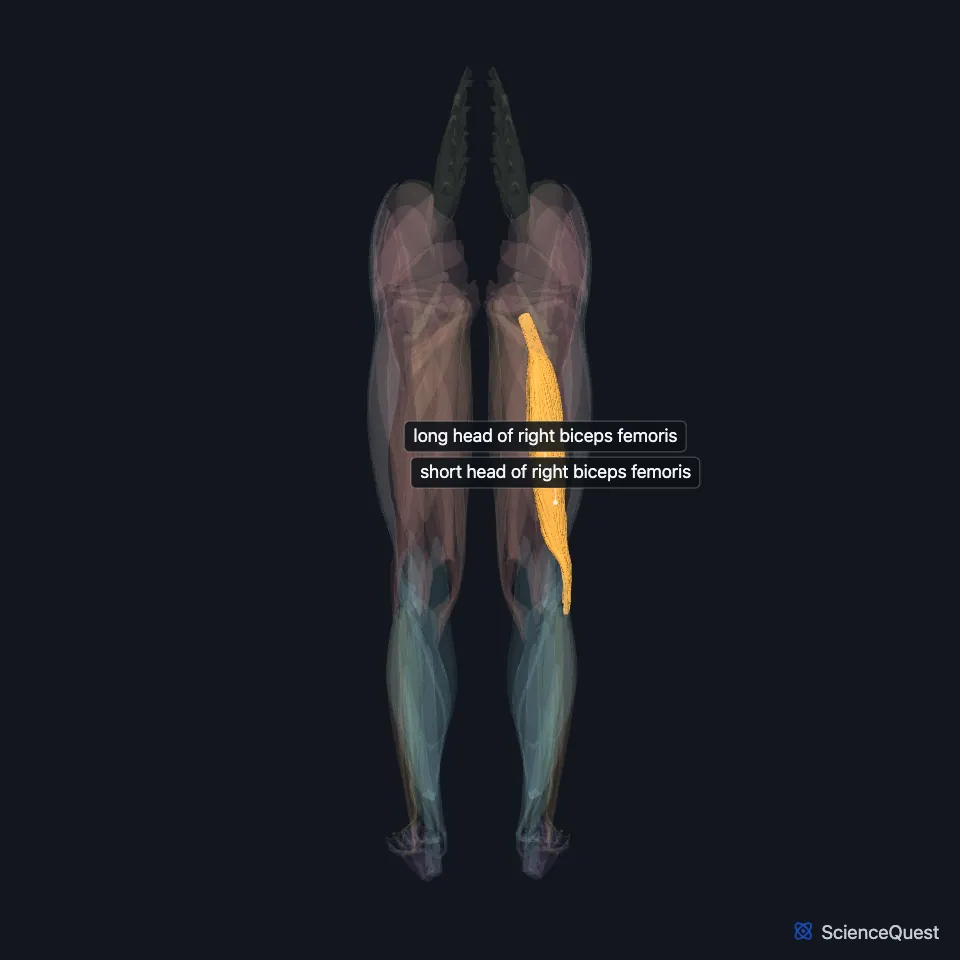
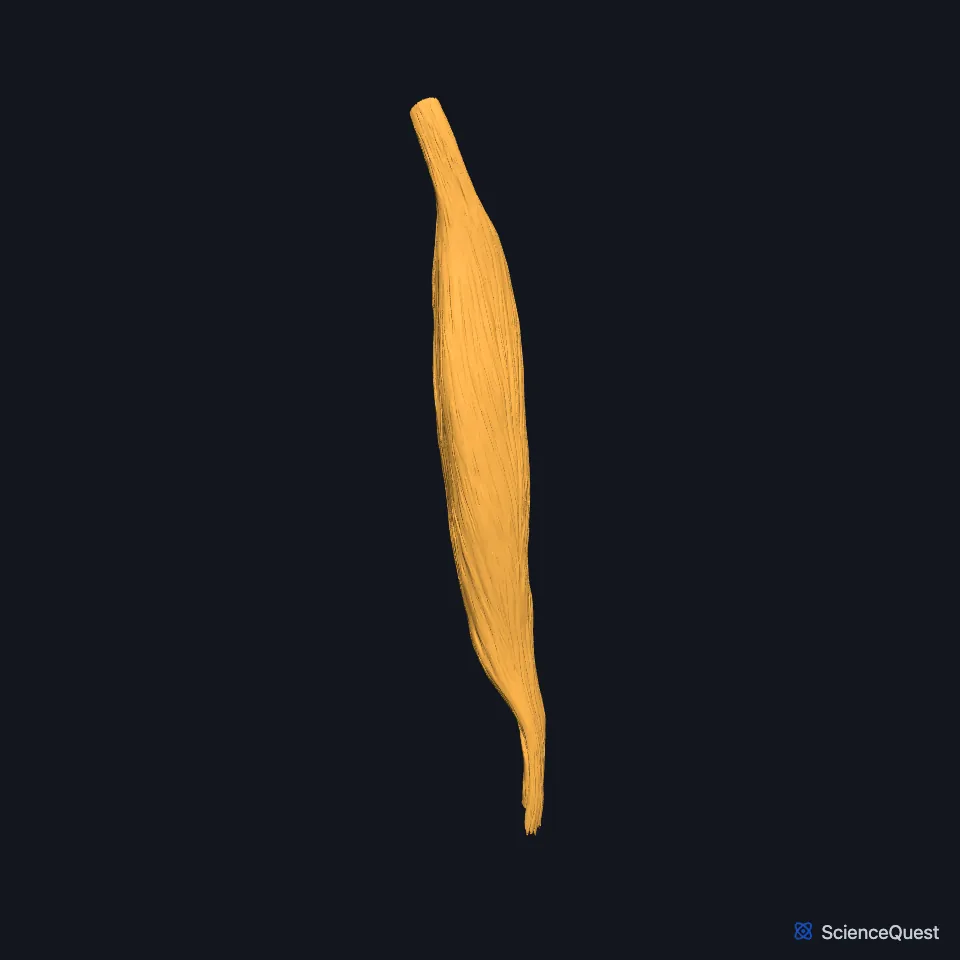
Open it in the Lower Limb Muscles Explorer See it alone in 3D
Where is the biceps femoris?
It is one of the three hamstrings, the long muscles of the back of the thigh, with semitendinosus and semimembranosus. (StatPearls, Posterior Thigh Muscles; OpenStax A&P 2e, 11.6)
Above the knee it forms the upper outer border of the popliteal fossa; semimembranosus and semitendinosus form the upper inner border, and the gastrocnemius the lower one. (StatPearls, Hamstring Muscle)
What are the two heads of the biceps femoris?
The long head arises from the ischial tuberosity by a common tendon with semitendinosus. The short head arises from the lateral lip of the linea aspera, the lateral intermuscular septum and the lateral supracondylar ridge of the femur. (StatPearls, Posterior Thigh Muscles)
Both heads insert mostly on the head of the fibula, with fibers to the lateral collateral ligament of the knee and the lateral condyle of the tibia. (StatPearls, Posterior Thigh Muscles)
The short head is the one part of the hamstrings that does not cross the hip, because it arises on the femur below the hip joint. (StatPearls, Hamstring Muscle)
Biceps is Latin for two-headed, and the muscle arises by two heads, as biceps brachii does in the arm. (OpenStax A&P 2e, 11.2; Lewis and Short, biceps; Gray’s Anatomy (1918), Posterior Femoral Muscles and Biceps Brachii)
What does the biceps femoris do?
Both heads flex the knee and rotate the tibia laterally. The long head also extends the hip. (StatPearls, Posterior Thigh Muscles)
In walking, the hamstrings switch on in the last quarter of the swing phase, extending the hip and braking knee extension. With the anterior cruciate ligament they resist forward slide of the tibia at heel strike. (StatPearls, Hamstring Muscle)
Which nerves and muscles work with the biceps femoris?
Its two heads have different nerves, both parts of the sciatic nerve: the tibial nerve supplies the long head, and the common fibular nerve the short head. (StatPearls, Hamstring Muscle and Posterior Thigh Muscles)
The sciatic nerve runs down the back of the thigh deep to the long head and usually divides into the tibial and common fibular nerves near the top of the popliteal fossa. (StatPearls, Posterior Thigh Muscles and Tibial Nerve)
The hamstrings bend the knee and the quadriceps femoris straightens it, so the two groups pull against each other at that joint. (OpenStax A&P 2e, 11.1; Gray’s Anatomy (1918), Posterior Femoral Muscles and Anterior Femoral Muscles)
Does the biceps femoris vary?
Dissections have found a third head of biceps femoris, and in one body the short and long heads never joined, though both still inserted on the head of the fibula. (StatPearls, Hamstring Muscle and Posterior Thigh Muscles)
Where the sources differ
Sources place the division of the sciatic nerve at different levels. The StatPearls posterior thigh article puts it at the upper border of the popliteal fossa and its hamstring article at the level of the knee joint. Its tibial nerve article puts it a few centimeters above the fossa, and in some people inside the pelvis. (StatPearls, Posterior Thigh Muscles, Hamstring Muscle and Tibial Nerve)
| Feature | Detail and source |
|---|---|
| Origin | Long head: ischial tuberosity, by a tendon shared with semitendinosus. Short head: lateral lip of the linea aspera, lateral intermuscular septum, lateral supracondylar ridge (StatPearls, Posterior Thigh Muscles) |
| Insertion | Head of the fibula; lateral collateral ligament of the knee; lateral condyle of the tibia (StatPearls, Posterior Thigh Muscles) |
| Action | Flexes the knee and rotates the tibia laterally; the long head extends the hip (StatPearls, Posterior Thigh Muscles) |
| Nerve | Long head: tibial nerve. Short head: common fibular nerve (StatPearls, Hamstring Muscle) |
Touches in this model
Measured on the BodyParts3D meshes: surfaces within 2 mm of the biceps femoris, nearest first, 12 of 15.
- Lateral head of right gastrocnemius in contact
- Right adductor magnus in contact
- Right fibularis longus in contact
- Right gluteus maximus in contact
- Right plantaris in contact
- Right popliteus in contact
- Right semimembranosus in contact
- Right semitendinosus in contact
- Right soleus in contact
- Right vastus lateralis in contact
- Right femur in contact
- Right fibula in contact
Sources
- StatPearls, Anatomy, Bony Pelvis and Lower Limb: Thigh Semitendinosus Muscle. Kevin Mathew; Leela Sharath Pillarisetty. Last update May 29, 2023. CC BY-NC-ND 4.0. Read 2026-10-25.
- StatPearls, Anatomy, Bony Pelvis and Lower Limb: Posterior Thigh Muscles. Jacob E. Vaughn; Wayne B. Cohen-Levy. Last update August 21, 2023. CC BY-NC-ND 4.0. Read 2026-10-25.
- OpenStax Anatomy and Physiology 2e, section 11.6, Appendicular Muscles of the Pelvic Girdle and Lower Limbs. CC BY-NC-SA 4.0. Read 2026-10-25.
- StatPearls, Anatomy, Bony Pelvis and Lower Limb, Hamstring Muscle. Young Hu; Avais Raja. Last update January 31, 2026. CC BY-NC-ND 4.0. Read 2026-10-25.
- OpenStax Anatomy and Physiology 2e, section 11.2, Naming Skeletal Muscles. CC BY-NC-SA 4.0. Read 2026-10-25.
- A Latin Dictionary (Lewis and Short, 1879), entry biceps, read in the Lewis and Short text served by Logeion, University of Chicago. Charlton T. Lewis; Charles Short. Public domain. Read 2026-10-25.
- Anatomy of the Human Body (Gray’s Anatomy), 20th US edition, 1918, Myology, The Muscles and Fasciae of the Thigh, 4. The Posterior Femoral Muscles (Hamstring Muscles), pages 478 to 479; Internet Archive scan of the 1918 Lea and Febiger printing, terminology of 1918. Henry Gray; edited by Warren H. Lewis. Public domain. Read 2026-10-25.
- Anatomy of the Human Body (Gray’s Anatomy), 20th US edition, 1918, Myology, The Muscles of the Arm, Biceps brachii, page 443; Internet Archive scan of the 1918 Lea and Febiger printing, terminology of 1918. Henry Gray; edited by Warren H. Lewis. Public domain. Read 2026-10-25.
- StatPearls, Anatomy, Bony Pelvis and Lower Limb: Tibial Nerve. Sohil S. Desai; James La Rose. Last update September 14, 2026. CC BY-NC-ND 4.0. Read 2026-10-25.
- OpenStax Anatomy and Physiology 2e, section 11.1, Interactions of Skeletal Muscles, Their Fascicle Arrangement, and Their Lever Systems. CC BY-NC-SA 4.0. Read 2026-10-25.
- Anatomy of the Human Body (Gray’s Anatomy), 20th US edition, 1918, Myology, The Muscles and Fasciae of the Thigh, 1. The Anterior Femoral Muscles, pages 467 to 471; Internet Archive scan of the 1918 Lea and Febiger printing, terminology of 1918. Henry Gray; edited by Warren H. Lewis. Public domain. Read 2026-10-25.
The values are facts and free to use; this page’s selection and presentation are © 2026 ScienceQuest.