Gluteus maximus
The gluteus maximus is the largest and most superficial of the three gluteal muscles, and it gives the buttock most of its shape. (OpenStax A&P 2e, 11.6; StatPearls, Gluteus Maximus Muscle)
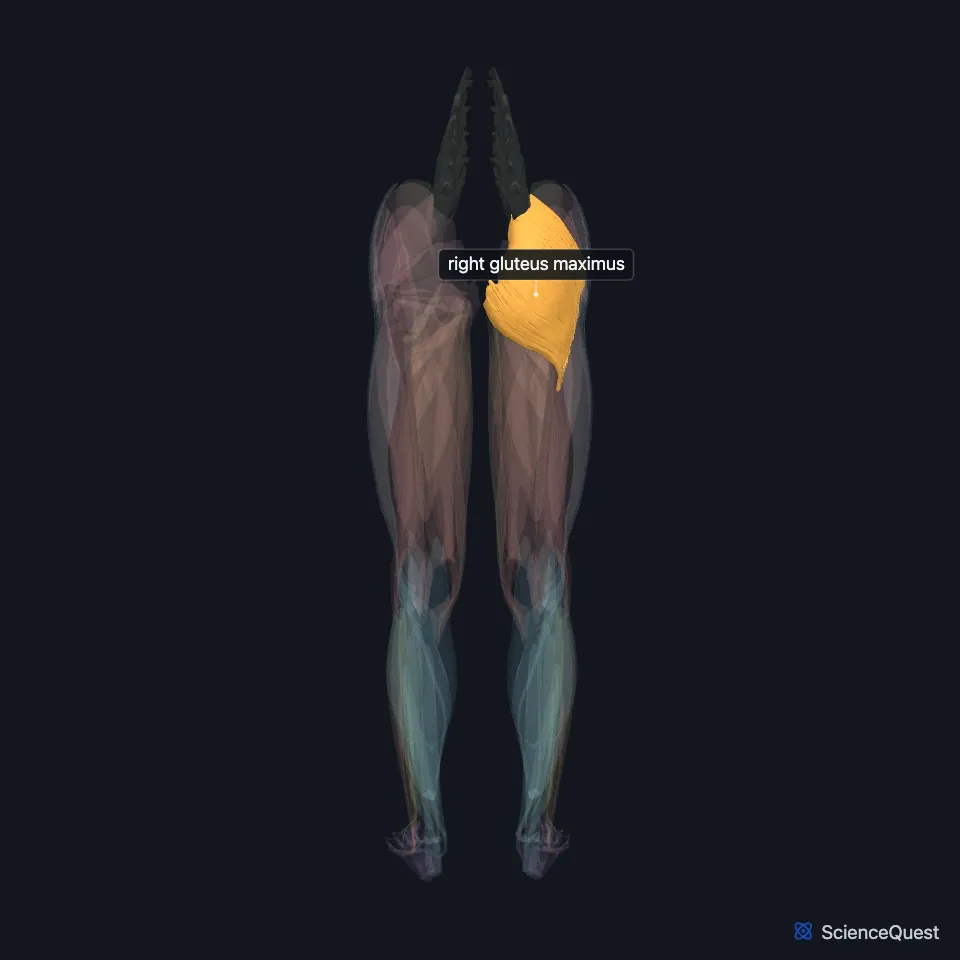
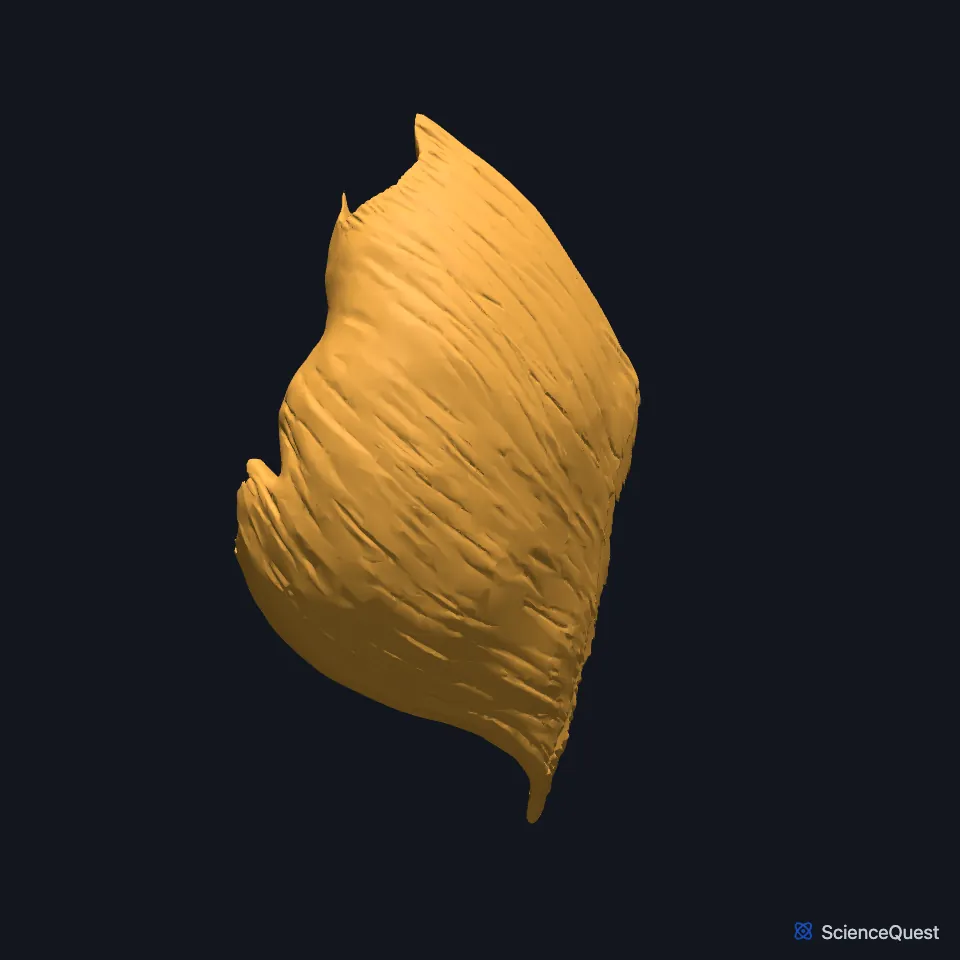
Open it in the Lower Limb Muscles Explorer See it alone in 3D
Where is the gluteus maximus?
It lies at the back of the pelvis, in the gluteal region. It is a thick, fleshy, four-sided muscle that slopes across the buttock at about 45° toward its insertion. (StatPearls, Gluteus Maximus Muscle)
It covers the back part of the gluteus medius, and under the medius lies the gluteus minimus, the smallest of the three. (OpenStax A&P 2e, 11.6; Gray’s Anatomy (1918), Muscles of the Gluteal Region)
The three names come from Latin. Maximus is the superlative of magnus (large), minimus the superlative of parvus (small), and medius means middle. (OpenStax A&P 2e, 11.2; Lewis and Short, magnus, medius and parvus)
What does the gluteus maximus attach to?
It arises from the back of the ilium behind the posterior gluteal line and from the side of the sacrum, with soft-tissue origins on the sacrotuberous ligament and the lumbar fascia (thoracolumbar fascia). (StatPearls, Gluteus Maximus Muscle; FMA, Thoracolumbar fascia)
It has two insertions. Its superficial fibers end in the iliotibial tract, and its deep fibers on the gluteal tuberosity of the femur, between adductor magnus and vastus lateralis. (StatPearls, Gluteus Maximus Muscle)
Three bursae are associated with it: the trochanteric bursa between it and the greater trochanter, the ischial bursa between it and the ischial tuberosity, and the gluteofemoral bursa between the iliotibial tract and vastus lateralis. (StatPearls, Gluteus Maximus Muscle)
What does the gluteus maximus do?
It mainly extends the thigh at the hip and rotates it laterally. It also supports the pelvis and trunk, which matters when you stand on one leg. (StatPearls, Gluteus Maximus Muscle)
It works as an extensor only when the movement needs force: rising from a chair, straightening up from a bend, climbing stairs or a hill, and running. (StatPearls, Gluteus Maximus Muscle)
Paralysis of the muscle does not affect walking on perfectly flat ground. In walking it contracts only in part of the stance phase, from heel strike to foot flat. (StatPearls, Gluteus Maximus Muscle)
Which nerve and muscles work with the gluteus maximus?
The inferior gluteal nerve, from the ventral rami of L5, S1 and S2, supplies it, and no other muscle. That nerve usually leaves the pelvis below the piriformis; in about 0.2% to 4.4% of adults it passes above it. (StatPearls, Gluteus Maximus Muscle and Inferior Gluteal Nerve)
For forceful hip extension it works with semitendinosus and semimembranosus. For lateral rotation it works with the iliopsoas, the piriformis and the obturator muscles. (StatPearls, Gluteus Maximus Muscle)
Both the superior and the inferior gluteal arteries supply it, entering at the center of the muscle. (StatPearls, Gluteus Maximus Muscle)
Where the sources differ
Sources disagree on its origin. The StatPearls gluteus maximus article names the ilium, the sacrum, the sacrotuberous ligament and the lumbar fascia; its inferior gluteal nerve article gives a broad base running from the back of the iliac crest down to the side of the coccyx. (StatPearls, Gluteus Maximus Muscle and Inferior Gluteal Nerve)
| Feature | Detail and source |
|---|---|
| Origin | Back of the ilium behind the posterior gluteal line, side of the sacrum, sacrotuberous ligament, lumbar fascia (thoracolumbar fascia) (StatPearls, Gluteus Maximus Muscle; FMA, Thoracolumbar fascia) |
| Insertion | Iliotibial tract (superficial fibers); gluteal tuberosity of the femur (deep fibers) (StatPearls, Gluteus Maximus Muscle) |
| Action | Extends and laterally rotates the thigh at the hip (StatPearls, Gluteus Maximus Muscle) |
| Nerve | Inferior gluteal nerve (L5, S1, S2) (StatPearls, Gluteus Maximus Muscle) |
Touches in this model
Measured on the BodyParts3D meshes: surfaces within 2 mm of the gluteus maximus, nearest first, 12 of 14.
- Long head of right biceps femoris in contact
- Right gluteus medius in contact
- Right iliotibial tract in contact
- Right vastus lateralis in contact
- Right femur in contact
- Right hip bone in contact
- Right iliococcygeus in contact
- Right iliocostalis lumborum in contact
- Right multifidus in contact
- Right quadratus lumborum in contact
- Sacrum in contact
- Skin in contact
Sources
- OpenStax Anatomy and Physiology 2e, section 11.6, Appendicular Muscles of the Pelvic Girdle and Lower Limbs. CC BY-NC-SA 4.0. Read 2026-10-25.
- StatPearls, Anatomy, Bony Pelvis and Lower Limb, Gluteus Maximus Muscle. Adel Elzanie; Judith Borger. Last update April 1, 2023. CC BY-NC-ND 4.0. Read 2026-10-25.
- Anatomy of the Human Body (Gray’s Anatomy), 20th US edition, 1918, Myology, The Muscles and Fasciae of the Thigh, 3. The Muscles of the Gluteal Region, pages 474 to 478; Internet Archive scan of the 1918 Lea and Febiger printing, terminology of 1918. Henry Gray; edited by Warren H. Lewis. Public domain. Read 2026-10-25.
- OpenStax Anatomy and Physiology 2e, section 11.2, Naming Skeletal Muscles. CC BY-NC-SA 4.0. Read 2026-10-25.
- A Latin Dictionary (Lewis and Short, 1879), entry magnus, read in the Lewis and Short text served by Logeion, University of Chicago. Charlton T. Lewis; Charles Short. Public domain. Read 2026-10-25.
- A Latin Dictionary (Lewis and Short, 1879), entry medius, read in the Lewis and Short text served by Logeion, University of Chicago. Charlton T. Lewis; Charles Short. Public domain. Read 2026-10-25.
- A Latin Dictionary (Lewis and Short, 1879), entry parvus, read in the Lewis and Short text served by Logeion, University of Chicago. Charlton T. Lewis; Charles Short. Public domain. Read 2026-10-25.
- Foundational Model of Anatomy, FMA25072, Thoracolumbar fascia (read on EBI OLS). FMA release terms, University of Washington. Read 2026-10-25.
- StatPearls, Anatomy, Abdomen and Pelvis: Inferior Gluteal Nerve. Justin Merryman; Edinen Asuka; Asa C. Black; Matthew A. Varacallo. Last update July 30, 2023. CC BY-NC-ND 4.0. Read 2026-10-25.
The values are facts and free to use; this page’s selection and presentation are © 2026 ScienceQuest.