Piriformis
The piriformis is a flat, pear-shaped muscle of the gluteal region, one of the short muscles that rotate the thigh laterally. (StatPearls, Piriformis Muscle)
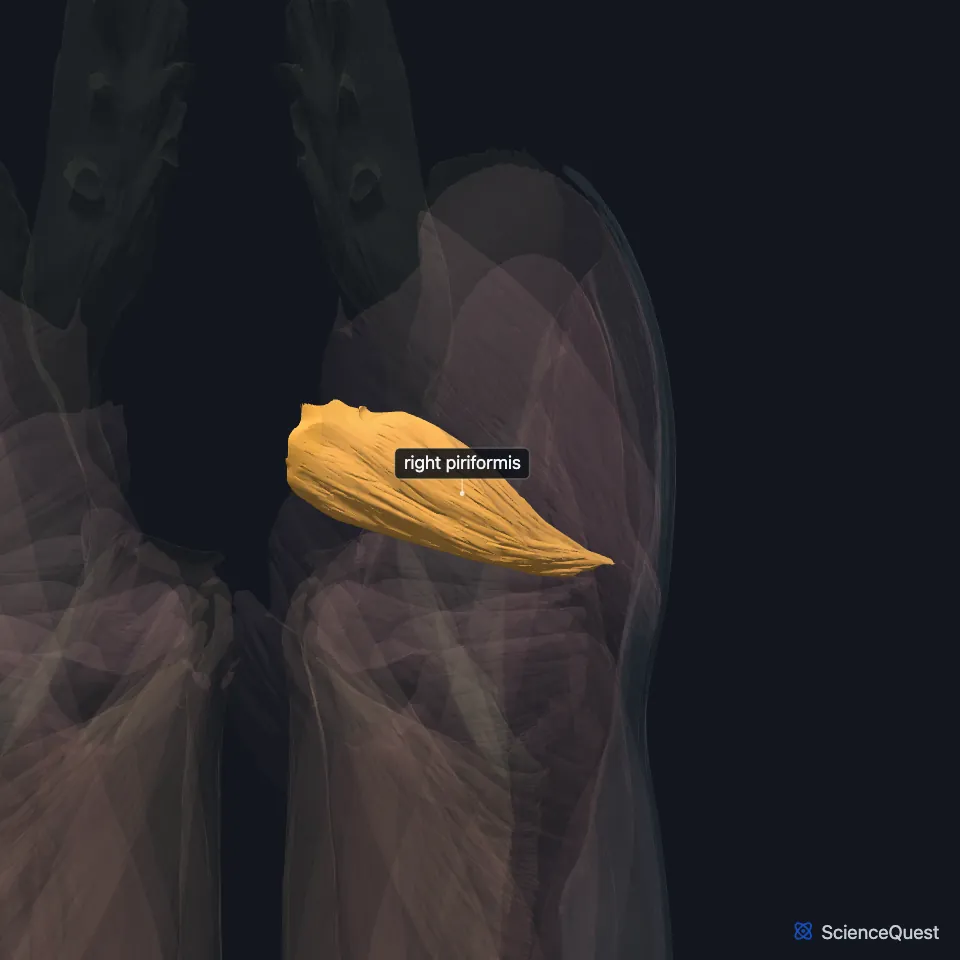
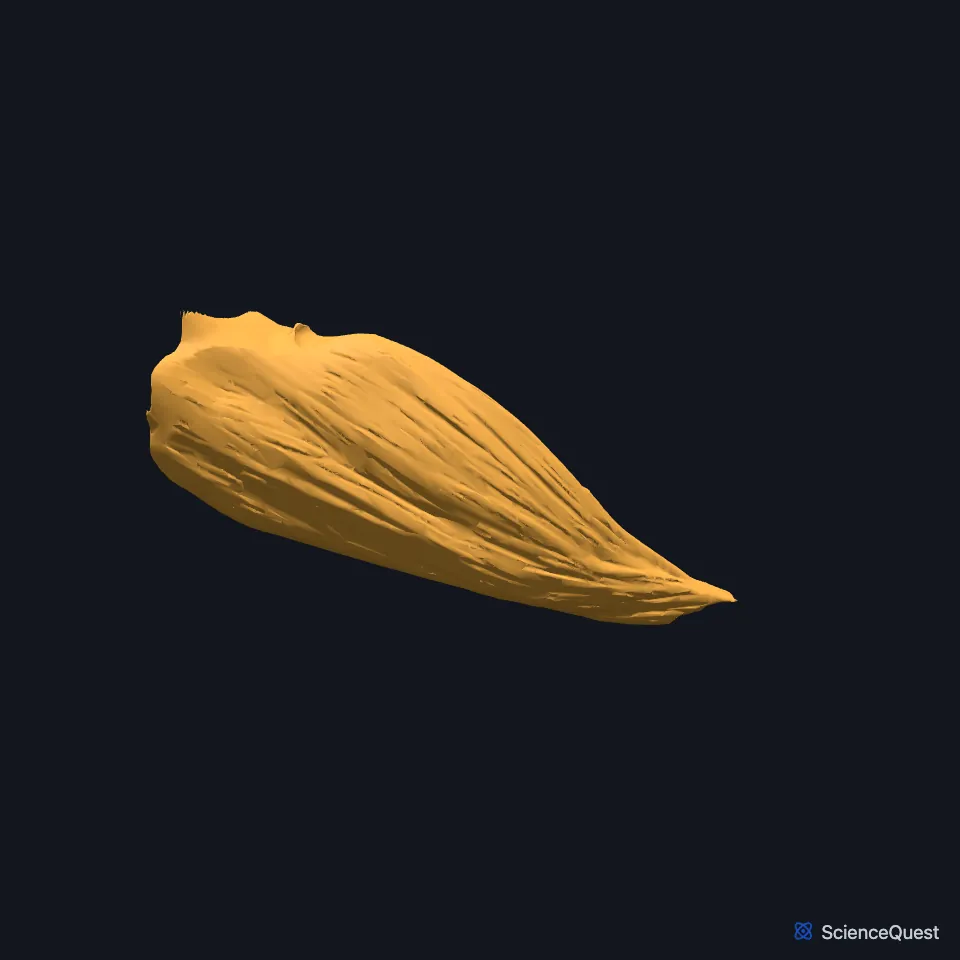
Open it in the Lower Limb Muscles Explorer See it alone in 3D
Where is the piriformis?
It arises inside the pelvis on the front of the sacrum, leaves through the greater sciatic notch, and runs deep to the gluteus maximus, parallel to the back edge of the gluteus medius. (StatPearls, Piriformis Muscle)
It lies partly on the back wall of the lesser pelvis and partly behind the hip joint. (StatPearls, Piriformis Muscle)
Where does the piriformis attach?
Besides the sacrum, it takes origin from the gluteal surface of the ilium near the greater sciatic notch, from the capsule of the sacroiliac joint and sometimes from the sacrotuberous ligament. (StatPearls, Piriformis Muscle)
Its tendon fuses with those of obturator internus and the two gemelli, and they insert together on the upper border of the greater trochanter of the femur. (StatPearls, Piriformis Muscle)
What does the piriformis do?
It rotates the femur laterally when the hip is extended and abducts it when the hip is flexed. (StatPearls, Piriformis Muscle)
Beneath the gluteus maximus, it works with the obturator internus, gemellus superior and gemellus inferior, quadratus femoris and obturator externus to turn the thigh outward. (OpenStax A&P 2e, 11.6; Gray’s Anatomy (1918), Muscles of the Gluteal Region)
Which nerves pass the piriformis?
It nearly fills the greater sciatic foramen and divides it into an upper and a lower part. The superior gluteal nerve and vessels pass above it; the inferior gluteal nerve and vessels, and the other nerves and vessels leaving the pelvis there, usually pass below. (StatPearls, Piriformis Muscle and Inferior Gluteal Nerve)
The sciatic nerve usually leaves the pelvis below it, but the whole nerve may pass above it or through it. (StatPearls, Piriformis Muscle)
Branches of the anterior rami of S1 and S2 supply it. (StatPearls, Piriformis Muscle)
How does the piriformis vary?
In some people only S2 supplies it, and in others L5 to S2. In some its outline is hard to make out, because it has merged with the gluteus medius or minimus. (StatPearls, Piriformis Muscle)
Where the sources differ
Sources give different figures for sciatic nerve variants at the piriformis. The StatPearls piriformis article says the nerve pierces the muscle in at least a fifth of people. Its sciatic nerve article, describing the variant types, gives 10% for the nerve passing through or above it. (StatPearls, Piriformis Muscle and Sciatic Nerve)
| Feature | Detail and source |
|---|---|
| Origin | Front of the sacrum; gluteal surface of the ilium near the greater sciatic notch; sacroiliac joint capsule; sometimes the sacrotuberous ligament (StatPearls, Piriformis Muscle) |
| Insertion | Upper border of the greater trochanter, with obturator internus and the gemelli (StatPearls, Piriformis Muscle) |
| Action | Laterally rotates the extended thigh; abducts the flexed thigh (StatPearls, Piriformis Muscle) |
| Nerve | Branches of the anterior rami of S1 and S2 (StatPearls, Piriformis Muscle) |
Touches in this model
Measured on the BodyParts3D meshes: surfaces within 2 mm of the piriformis, nearest first.
- Right gemellus superior in contact
- Right gluteus minimus in contact
- Right femur in contact
- Right hip bone in contact
- Sacrum in contact
- Skin in contact
- Right gluteus medius 0.3 mm away
- Right internal iliac vein 0.3 mm away
Sources
- StatPearls, Anatomy, Bony Pelvis and Lower Limb: Piriformis Muscle. Carol Chang; Susan H. Jeno; Matthew A. Varacallo. Last update November 13, 2023. CC BY-NC-ND 4.0. Read 2026-10-25.
- OpenStax Anatomy and Physiology 2e, section 11.6, Appendicular Muscles of the Pelvic Girdle and Lower Limbs. CC BY-NC-SA 4.0. Read 2026-10-25.
- Anatomy of the Human Body (Gray’s Anatomy), 20th US edition, 1918, Myology, The Muscles and Fasciae of the Thigh, 3. The Muscles of the Gluteal Region, pages 474 to 478; Internet Archive scan of the 1918 Lea and Febiger printing, terminology of 1918. Henry Gray; edited by Warren H. Lewis. Public domain. Read 2026-10-25.
- StatPearls, Anatomy, Abdomen and Pelvis: Inferior Gluteal Nerve. Justin Merryman; Edinen Asuka; Asa C. Black; Matthew A. Varacallo. Last update July 30, 2023. CC BY-NC-ND 4.0. Read 2026-10-25.
- StatPearls, Anatomy, Sciatic Nerve. Brittney A. Giuffre; Asa C. Black; Rebecca Jeanmonod. Last update November 16, 2023. CC BY-NC-ND 4.0. Read 2026-10-25.
The values are facts and free to use; this page’s selection and presentation are © 2026 ScienceQuest.