Gluteus medius
The gluteus medius is a broad gluteal muscle between the gluteus maximus and the gluteus minimus, and a primary abductor of the hip. (StatPearls, Gluteus Medius Muscle)
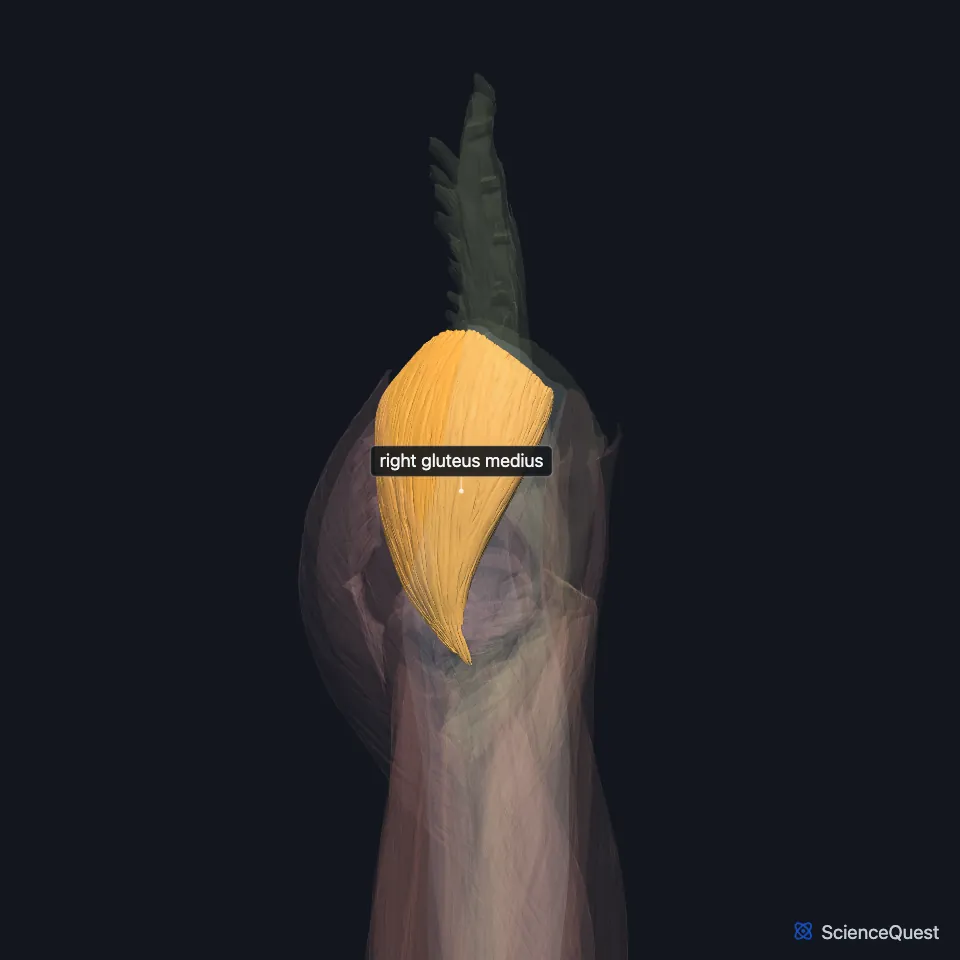
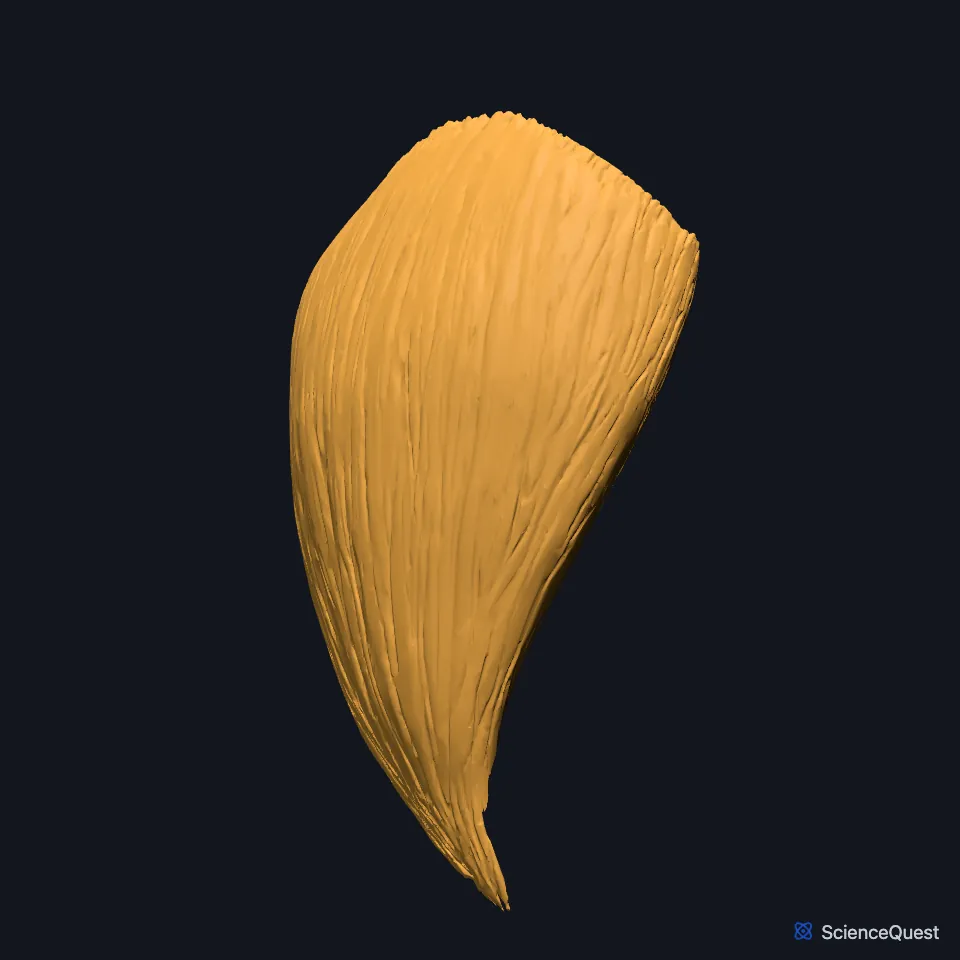
Open it in the Lower Limb Muscles Explorer See it alone in 3D
Where is the gluteus medius?
It covers the outer surface of the ilium between the anterior and posterior gluteal lines. The gluteus maximus covers its back third, and its front two-thirds lie under only a strong layer of deep fascia. (StatPearls, Gluteus Medius Muscle)
It is the middle layer of the three gluteal muscles: it lies on the gluteus minimus and covers it. (OpenStax A&P 2e, 11.6; StatPearls, Gluteus Medius Muscle)
Where does the gluteus medius attach?
It is a thick, fan-shaped muscle that arises from the outer surface of the ilium and runs down and outward to the greater trochanter of the femur. (StatPearls, Superior Gluteal Nerve)
Its back fibers gather into a flat tendon that slants toward the upper back of the greater trochanter, and its front outer part runs toward the side of the trochanter. Both parts insert on the lateral surface of the trochanter through fibrocartilage. (StatPearls, Gluteus Medius Muscle)
What does the gluteus medius do?
With the gluteus minimus it abducts the thigh and rotates it medially. Its front fibers help medial rotation, and its back fibers help lateral rotation when the knee is straight. (StatPearls, Gluteus Medius Muscle)
It keeps the pelvis level when one foot is off the ground. Your weight tends to drop the pelvis on the unsupported side, and the gluteus medius and minimus of the standing side pull on the hip bone to stop it. (StatPearls, Gluteus Medius Muscle)
When these muscles or their nerve fail, the pelvis sinks on the unsupported side as the person stands on the affected limb. Examiners call this the Trendelenburg sign. (StatPearls, Gluteus Medius Muscle)
Which nerve and muscles work with the gluteus medius?
The superior gluteal nerve supplies it. The nerve comes from L4, L5 and S1 and leaves the pelvis through the greater sciatic foramen above the piriformis. (StatPearls, Gluteus Medius Muscle)
The tensor fasciae latae helps the gluteus medius abduct the thigh and turn it inward. (OpenStax A&P 2e, 11.6; Gray’s Anatomy (1918), Muscles of the Gluteal Region)
The superior gluteal artery, the largest branch of the internal iliac artery, supplies it. (StatPearls, Gluteus Medius Muscle)
| Feature | Detail and source |
|---|---|
| Origin | Outer surface of the ilium, between the anterior and posterior gluteal lines (StatPearls, Superior Gluteal Nerve and Gluteus Medius Muscle) |
| Insertion | Lateral surface of the greater trochanter of the femur (StatPearls, Gluteus Medius Muscle) |
| Action | Abducts and medially rotates the thigh; holds the pelvis level in single-leg stance (StatPearls, Gluteus Medius Muscle) |
| Nerve | Superior gluteal nerve (L4, L5, S1) (StatPearls, Gluteus Medius Muscle) |
Touches in this model
Measured on the BodyParts3D meshes: surfaces within 2 mm of the gluteus medius, nearest first.
- Right gluteus maximus in contact
- Right gluteus minimus in contact
- Right iliotibial tract in contact
- Right femur in contact
- Right hip bone in contact
- Skin in contact
- Right piriformis 0.3 mm away
- Right transversus abdominis 1.8 mm away
Sources
- StatPearls, Anatomy, Bony Pelvis and Lower Limb, Gluteus Medius Muscle. Aashin Shah; Bruno Bordoni. Last update February 17, 2023. CC BY-NC-ND 4.0. Read 2026-10-25.
- OpenStax Anatomy and Physiology 2e, section 11.6, Appendicular Muscles of the Pelvic Girdle and Lower Limbs. CC BY-NC-SA 4.0. Read 2026-10-25.
- StatPearls, Anatomy, Abdomen and Pelvis: Superior Gluteal Nerve. Kirsten Lung; Forshing Lui. Last update August 14, 2023. CC BY-NC-ND 4.0. Read 2026-10-25.
- Anatomy of the Human Body (Gray’s Anatomy), 20th US edition, 1918, Myology, The Muscles and Fasciae of the Thigh, 3. The Muscles of the Gluteal Region, pages 474 to 478; Internet Archive scan of the 1918 Lea and Febiger printing, terminology of 1918. Henry Gray; edited by Warren H. Lewis. Public domain. Read 2026-10-25.
The values are facts and free to use; this page’s selection and presentation are © 2026 ScienceQuest.