Midbrain
The midbrain is the smallest and highest part of the brain stem, about 1.5 cm long, between the diencephalon above and the pons below. (StatPearls, Mesencephalon Midbrain)
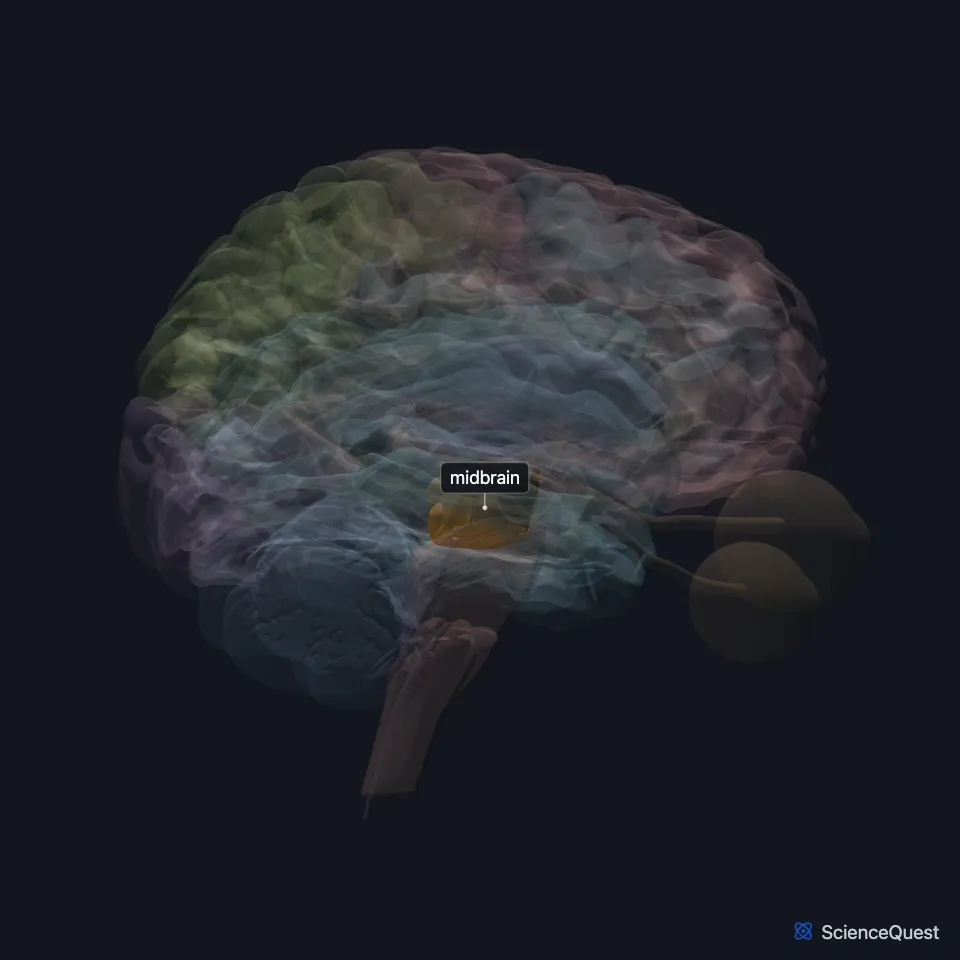
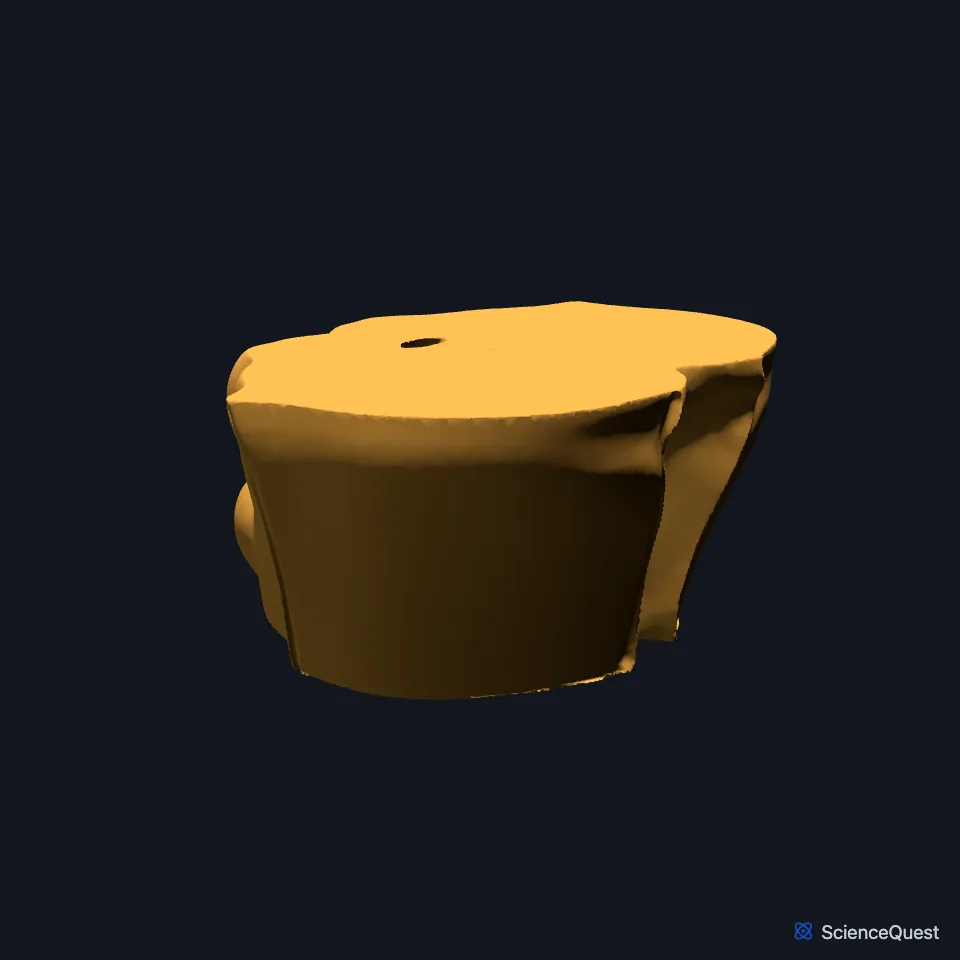
Where is the midbrain?
It lies between the thalamus and the pons, and with the pons and the medulla it makes up the brain stem. (OpenStax A&P 2e, 13.2; StatPearls, Mesencephalon Midbrain)
At the back, the superior cerebellar peduncles join it to the cerebellum. On its front surface, the crus cerebri carries corticospinal fibers. (StatPearls, Mesencephalon Midbrain)
How does the midbrain develop?
In the embryo, the prosencephalon splits into the telencephalon and the diencephalon, and the rhombencephalon into the metencephalon and the myelencephalon. The mesencephalon changes far less and becomes the midbrain. (OpenStax A&P 2e, 13.1; StatPearls, Thalamus, Medulla Oblongata and Embryology, Central Nervous System)
How is the midbrain built?
The cerebral aqueduct runs through its center, carrying cerebrospinal fluid from the third ventricle to the fourth ventricle. (OpenStax A&P 2e, 13.2; StatPearls, Mesencephalon Midbrain)
The tectum, the dorsal part, lies behind the aqueduct and forms its roof; the tegmentum, the ventral part, lies in front of it. (OpenStax A&P 2e, 13.2 and 13.3; StatPearls, Mesencephalon Midbrain)
The tectum is four bumps, the colliculi. The inferior colliculi lie on the hearing pathway; the superior colliculi combine maps of visual, auditory and touch space and turn the eyes toward a sound or touch. (OpenStax A&P 2e, 13.2; StatPearls, Mesencephalon Midbrain, Thalamus and Superior Colliculus)
The tegmentum holds the upper reticular formation, the nuclei of cranial nerves that move the eyes, the periaqueductal gray, the red nucleus, the substantia nigra and the ventral tegmental area. (StatPearls, Mesencephalon Midbrain)
What does the midbrain do?
Sight, hearing and touch all feed the deeper layers of its superior colliculi, which line up these senses' maps of the space around you. (OpenStax A&P 2e, 13.2; StatPearls, Superior Colliculus)
The substantia nigra pars compacta sends dopamine to the striatum, the caudate nucleus and putamen, and switches the basal nuclei between their two pathways. Loss of its pathway to the putamen, the nigrostriatal pathway, underlies the movement problems of Parkinson’s disease. (OpenStax A&P 2e, 13.2; OpenStax Psychology 2e, 3.4; StatPearls, Substantia Nigra and Basal Ganglia)
The periaqueductal gray around the aqueduct is the main control center for descending pain modulation. (StatPearls, Mesencephalon Midbrain)
In the pupillary light reflex, the optic nerve signals the pretectal nucleus in the upper midbrain, which projects to the Edinger-Westphal nuclei on both sides; their parasympathetic fibers constrict both pupils. Dilation in dim light is the work of the sympathetic nervous system. The oculomotor nucleus of the midbrain controls the medial rectus muscle of the eye. (OpenStax A&P 2e, 16.3; StatPearls, Pupillary Light Reflexes and Pathway and Cranial Nerve 3 (Oculomotor))
What passes through the midbrain?
The corticospinal tract runs through it as the cerebral peduncles on its way down to the pons. (OpenStax A&P 2e, 14.3; StatPearls, Pyramidal Tract)
The cerebellum’s interposed nuclei project to the red nucleus, which sends signals on to the spinal cord along the rubrospinal tract. (OpenStax A&P 2e, 14.3; StatPearls, Red Nucleus)
The spinothalamic tract, which carries pain and temperature, passes through the midbrain on its way to the thalamus. (StatPearls, Mesencephalon Midbrain)
Touches in this model
Measured on the BodyParts3D meshes: surfaces within 2 mm of the midbrain, nearest first, 12 of 33.
- Brachium of left inferior colliculus in contact
- Brachium of left superior colliculus in contact
- Brachium of right inferior colliculus in contact
- Brachium of right superior colliculus in contact
- Cerebral aqueduct in contact
- Fourth ventricle in contact
- Hypothalamus in contact
- Interpeduncular fossa in contact
- Left fornix of forebrain in contact
- Left inferior colliculus in contact
- Left superior colliculus in contact
- Left thalamus in contact
Sources
- StatPearls, Neuroanatomy, Mesencephalon Midbrain. Francheska Caminero; Marco Cascella. Last update September 10, 2024. CC BY-NC-ND 4.0. Read 2026-10-25.
- OpenStax Anatomy and Physiology 2e, section 13.2, The Central Nervous System. CC BY-NC-SA 4.0. Read 2026-10-25.
- OpenStax Anatomy and Physiology 2e, section 13.1, The Embryologic Perspective. CC BY-NC-SA 4.0. Read 2026-10-25.
- StatPearls, Neuroanatomy, Thalamus. Tyler J. Torrico; Sunil Munakomi. Last update July 24, 2023. CC BY-NC-ND 4.0. Read 2026-10-25.
- StatPearls, Neuroanatomy, Medulla Oblongata. Radostina Iordanova; Anil Kumar Reddy Reddivari. Last update July 24, 2023. CC BY-NC-ND 4.0. Read 2026-10-25.
- StatPearls, Embryology, Central Nervous System. Mohamed Elshazzly; Michael J. Lopez; Vamsi Reddy; Omar Caban. Last update April 3, 2023. CC BY-NC-ND 4.0. Read 2026-10-25.
- OpenStax Anatomy and Physiology 2e, section 13.3, Circulation and the Central Nervous System. CC BY-NC-SA 4.0. Read 2026-10-25.
- StatPearls, Neuroanatomy, Superior Colliculus. Ryan D. Zubricky; Joe M. Das. Last update January 30, 2024. CC BY-NC-ND 4.0. Read 2026-10-25.
- OpenStax Psychology 2e, section 3.4, The Brain and Spinal Cord. CC BY-NC-SA 4.0. Read 2026-10-25.
- StatPearls, Neuroanatomy, Substantia Nigra. James Sonne; Vamsi Reddy; Morris R. Beato. Last update September 10, 2024. CC BY-NC-ND 4.0. Read 2026-10-25.
- StatPearls, Neuroanatomy, Basal Ganglia. Carly B. Young; Vamsi Reddy; James Sonne. Last update July 24, 2023. CC BY-NC-ND 4.0. Read 2026-10-25.
- OpenStax Anatomy and Physiology 2e, section 16.3, The Cranial Nerve Exam. CC BY-NC-SA 4.0. Read 2026-10-25.
- StatPearls, Neuroanatomy, Pupillary Light Reflexes and Pathway. Umut Akova; Hannah Yoo; Marjorie V. Launico. Last update September 15, 2025. CC BY-NC-ND 4.0. Read 2026-10-25.
- StatPearls, Neuroanatomy, Cranial Nerve 3 (Oculomotor). Christopher Joyce; Patrick H. Le; Diana C. Peterson. Last update March 27, 2023. CC BY-NC-ND 4.0. Read 2026-10-25.
- OpenStax Anatomy and Physiology 2e, section 14.3, Motor Responses. CC BY-NC-SA 4.0. Read 2026-10-25.
- StatPearls, Neuroanatomy, Pyramidal Tract. Qais AbuHasan; Sunil Munakomi. Last update July 4, 2023. CC BY-NC-ND 4.0. Read 2026-10-25.
- StatPearls, Neuroanatomy, Red Nucleus. Jason Vadhan; Joe M. Das. Last update July 24, 2023. CC BY-NC-ND 4.0. Read 2026-10-25.
The values are facts and free to use; this page’s selection and presentation are © 2026 ScienceQuest.