Pineal body
The pineal body, or pineal gland, is a tiny endocrine gland. Its cells, the pinealocytes, make and secrete melatonin, a hormone made from serotonin. (OpenStax A&P 2e, 17.7; StatPearls, Physiology, Pineal Gland)
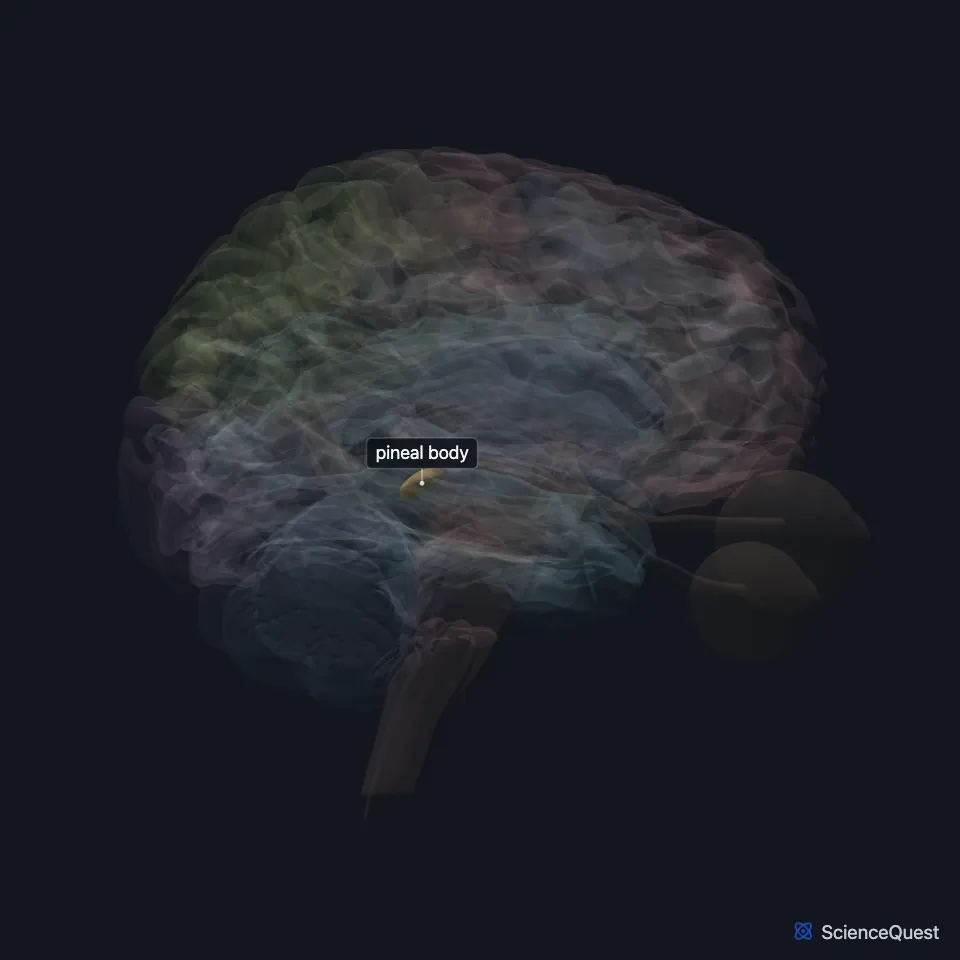
Where is the pineal body?
It belongs to the epithalamus and sits at the back of the third ventricle, below and behind the thalamus. (OpenStax A&P 2e, 17.7 and 13.2; StatPearls, Physiology, Pineal Gland)
This unpaired gland sits between the two thalami, behind the habenular commissure, near the superior and inferior colliculi behind the third ventricle. (StatPearls, Physiology, Pineal Gland)
The thalamus and the habenular commissure lie in front of and above it, the splenium of the corpus callosum above it, and the colliculi below it. Cerebrospinal fluid reaches it through the pineal recess of the third ventricle, a small pouch that extends into its stalk. (StatPearls, Physiology, Pineal Gland and Ventricular System)
What does the pineal body do?
Light sets its output. Light on the retina sends a signal to the suprachiasmatic nucleus of the hypothalamus and on, by way of the spinal cord, to the pineal gland, which then makes less melatonin, and blood melatonin falls. (OpenStax A&P 2e, 17.7; StatPearls, Physiology, Pineal Gland and Nucleus Suprachiasmatic)
As light fades in the evening, melatonin production rises and promotes sleep. Blood melatonin is low by day and peaks at night, and secretion lasts as long as the dark does. (OpenStax A&P 2e, 17.7; StatPearls, Physiology, Pineal Gland and Melatonin)
Melatonin helps set the circadian rhythm of sleep. A pineal tumor in childhood can upset other hormones and bring on early pseudopuberty. (OpenStax A&P 2e, 17.7; StatPearls, Physiology, Pineal Gland)
The enzyme serotonin N-acetyltransferase controls the rate-limiting step from serotonin to melatonin, and its level is low in daylight. (StatPearls, Physiology, Pineal Gland)
What is the pineal body made of, and how does it form?
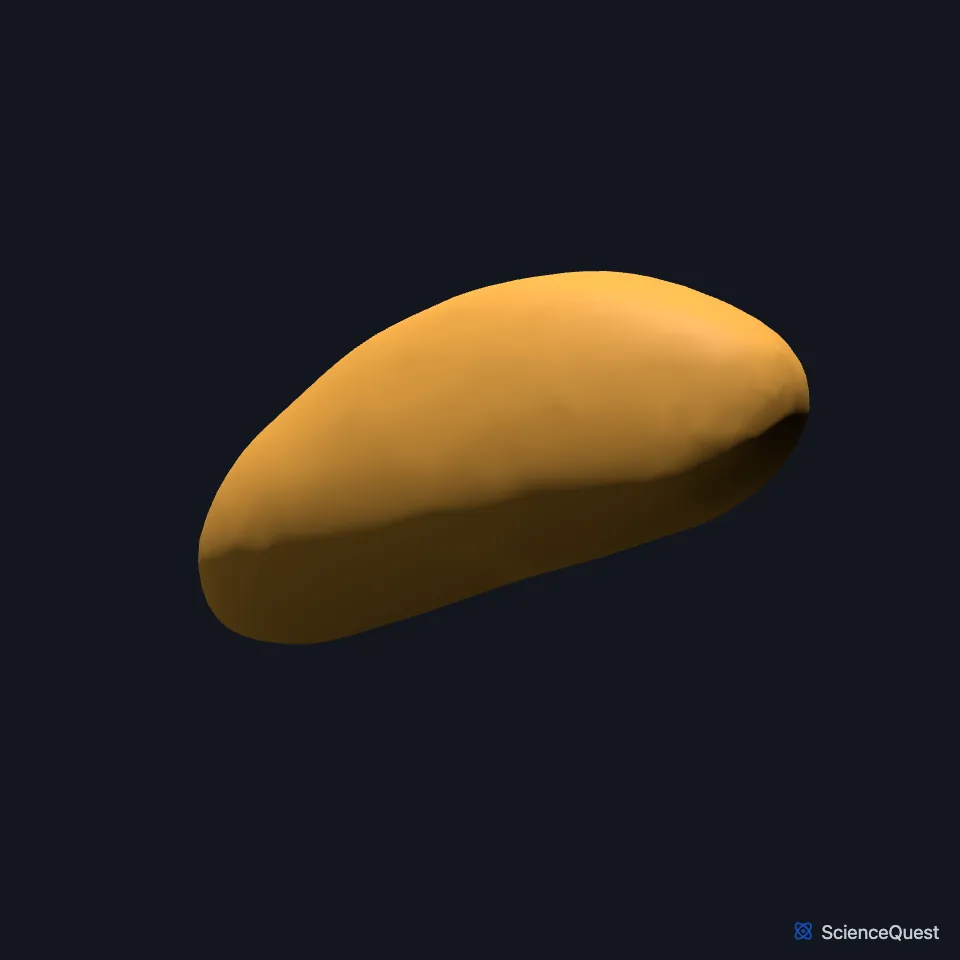
It is shaped like a pine cone, about 0.8 cm long and about 0.1 g in an adult, and made of pinealocytes and supporting cells. (StatPearls, Physiology, Pineal Gland)
It holds calcium deposits called corpora arenacea, or brain sand. They calcify more with age and show on X-rays, where the gland serves as a landmark. (StatPearls, Physiology, Pineal Gland)
It develops from the back of the roof of the third ventricle, where the lining thickens in the seventh week of development. (StatPearls, Physiology, Pineal Gland)
What lies around the pineal body, and what supplies it?
The cerebral aqueduct and the posterior commissure lie in front of and below it. A pineal tumor or cyst can compress the aqueduct, block the flow of cerebrospinal fluid and cause hydrocephalus. (StatPearls, Physiology, Pineal Gland)
Its blood comes from choroidal branches of the posterior cerebral artery and drains to the internal cerebral vein. (StatPearls, Physiology, Pineal Gland)
Touches in this model
Measured on the BodyParts3D meshes: surfaces within 2 mm of the pineal body, nearest first.
- Habenula in contact
- Left stria medullaris of thalamus in contact
- Right stria medullaris of thalamus in contact
- Third ventricle in contact
- Choroid plexus of left cerebral hemisphere 0.4 mm away
- Choroid plexus of right cerebral hemisphere 0.4 mm away
- Midbrain 0.5 mm away
- Posterior commissure 1.0 mm away
- Left superior colliculus 1.8 mm away
Sources
- OpenStax Anatomy and Physiology 2e, section 17.7, The Pineal Gland. CC BY-NC-SA 4.0. Read 2026-10-25.
- StatPearls, Physiology, Pineal Gland. Sadia Ilahi; Nitya Beriwal; Tahir B. Ilahi. Last update April 24, 2023. CC BY-NC-ND 4.0. Read 2026-10-25.
- OpenStax Anatomy and Physiology 2e, section 13.2, The Central Nervous System. CC BY-NC-SA 4.0. Read 2026-10-25.
- StatPearls, Neuroanatomy, Ventricular System. Saraswati Satyanarayan Shenoy; Forshing Lui. Last update July 24, 2023. CC BY-NC-ND 4.0. Read 2026-10-25.
- StatPearls, Neuroanatomy, Nucleus Suprachiasmatic. Joe M. Das; Marjorie V. Launico. Last update September 14, 2026. CC BY-NC-ND 4.0. Read 2026-10-25.
- StatPearls, Melatonin. Rosemary A. Savage; Nowera Zafar; Sandesh Yohannan; John-Mark M. Miller. Last update February 9, 2024. CC BY-NC-ND 4.0. Read 2026-10-25.
The values are facts and free to use; this page’s selection and presentation are © 2026 ScienceQuest.