Thalamus
The thalamus is the brain’s main relay station, passing sensory and motor signals between the body and the cerebral cortex. It is paired, one on each side of the midline, near the center of the brain. (OpenStax A&P 2e, 13.2; StatPearls, Thalamus and Thalamic Nuclei)
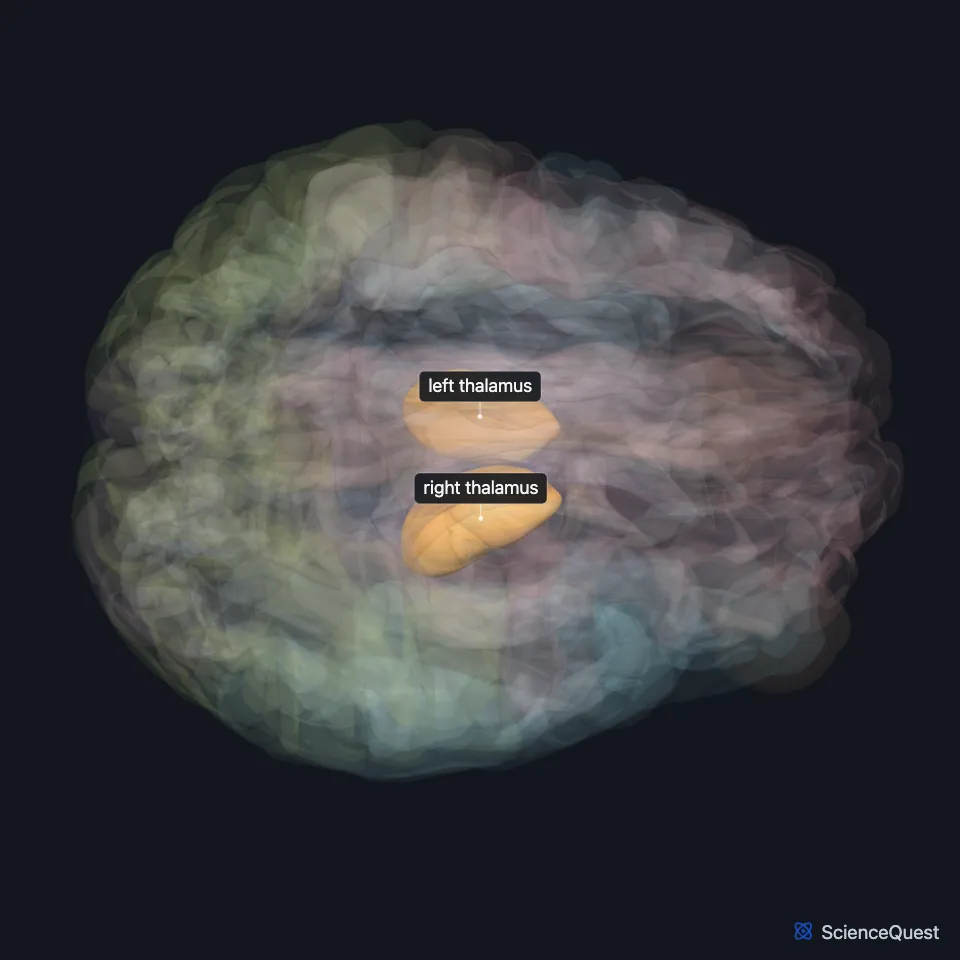
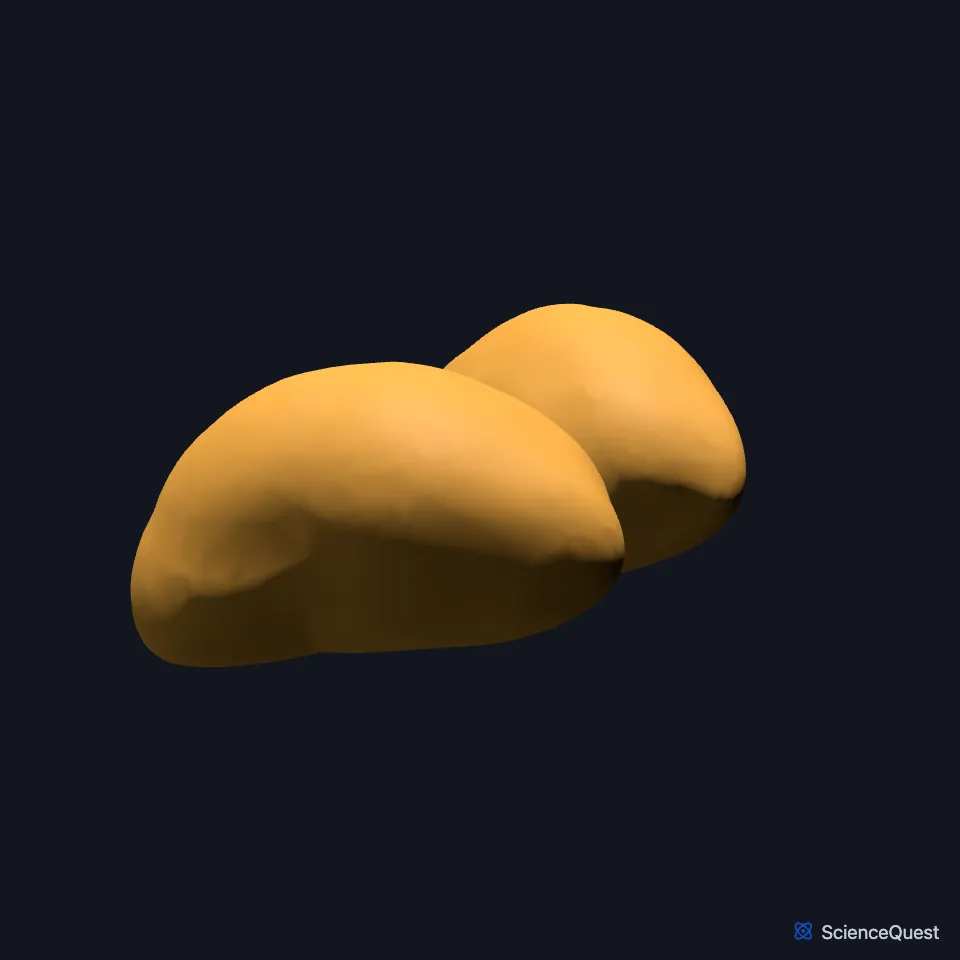
Where is the thalamus?
Each thalamus is mostly gray matter, part of the diencephalon near the center of the brain, and it sits above the midbrain. (StatPearls, Thalamus)
The two thalami form the side walls of the third ventricle. In most brains they touch across it as the massa intermedia, or interthalamic adhesion, which StatPearls says is absent in about 30% of brains. (StatPearls, Thalamus and Ventricular System; OpenStax A&P 2e, 13.3)
The hypothalamus and the subthalamus lie below it. The upper surface of the thalamus forms part of the floor of the body of the lateral ventricle. (OpenStax A&P 2e, 13.2; StatPearls, Thalamus)
On its outer side it borders the posterior limb of the internal capsule, and in front and to the side it meets the head of the caudate nucleus. (StatPearls, Thalamus)
What does the thalamus do?
Every sense except smell has a thalamic nucleus that takes in its signals and passes them on to the cerebral cortex. (OpenStax A&P 2e, 13.2; StatPearls, Thalamus)
The thalamus filters and processes what it relays, and it has a part in controlling alertness and attention. (OpenStax A&P 2e, 13.2; StatPearls, Thalamus and Thalamic Nuclei)
It carries motor traffic as well. The main output of the basal nuclei, from the internal segment of the globus pallidus and the substantia nigra pars reticulata, goes to the thalamus, which relays it to the cerebral cortex. (OpenStax A&P 2e, 13.2; StatPearls, Basal Ganglia)
Output from the cerebellum leaves through the superior cerebellar peduncle to the red nucleus and the thalamus, and the thalamus returns it to the motor cortex. (OpenStax A&P 2e, 16.5; StatPearls, Cerebellar Dysfunction)
It also takes part in regulating sleep and wakefulness, and, through limbic connections to its anterior nuclei, in learning and episodic memory. (StatPearls, Thalamus)
How is the thalamus divided?
Sheets of white matter inside it, the internal medullary laminae, split each thalamus into anterior, medial and lateral groups of nuclei. (OpenStax A&P 2e, 14.2; StatPearls, Thalamus)
Limbic structures connect to the anterior nuclei, which brings the thalamus into learning and episodic memory. The lateral group holds the nuclei that pass vision, hearing and body sensation on to their sensory areas of the cortex. (OpenStax A&P 2e, 14.2; StatPearls, Thalamus and Thalamic Nuclei)
The reticular nucleus wraps the outer side of the thalamus like a capsule. It sends nothing to the cortex and instead modulates the other thalamic nuclei. (StatPearls, Thalamus)
What connects to the thalamus?
Hearing reaches it from the inferior colliculi of the midbrain. Its medial geniculate nucleus takes that input on to the primary auditory cortex in the temporal lobe. (OpenStax A&P 2e, 13.2; StatPearls, Thalamus)
Visual fibers reach it in the optic tract, which runs on from the optic chiasm and ends mostly in the lateral geniculate nucleus; this model shows that nucleus as the lateral geniculate body. (OpenStax A&P 2e, 14.2 and 14.1; StatPearls, Visual Pathway and Optic Tract)
| Feature | Detail and source |
|---|---|
| Vision | Lateral geniculate nucleus, then the visual cortex of the occipital lobe (StatPearls, Thalamus) |
| Hearing | Medial geniculate nucleus, then the primary auditory cortex of the temporal lobe (StatPearls, Thalamus) |
| Pain, temperature and crude touch from the body | Ventral posterolateral nucleus, from the spinothalamic tract (StatPearls, Thalamus) |
| Sensation from the face | Ventral posteromedial nucleus, from the trigeminal nerve (StatPearls, Thalamus) |
| Taste | Ventral posterior nucleus, from the solitary nucleus of the brain stem (OpenStax A&P 2e, 14.2; StatPearls, Nucleus Gustatory) |
| Smell | No thalamic relay; smell reaches the cerebral cortex directly (OpenStax A&P 2e, 14.1; StatPearls, Thalamus and Physiology, Olfactory) |
Touches in this model
Measured on the BodyParts3D meshes: surfaces within 2 mm of the thalamus, nearest first, 12 of 35.
- Anterior limb of left internal capsule in contact
- Anterior limb of right internal capsule in contact
- Brachium of left inferior colliculus in contact
- Brachium of left superior colliculus in contact
- Brachium of right inferior colliculus in contact
- Brachium of right superior colliculus in contact
- Left caudate nucleus in contact
- Left fornix of forebrain in contact
- Left hippocampus in contact
- Left lateral geniculate body in contact
- Left medial geniculate body in contact
- Left stria medullaris of thalamus in contact
Sources
- OpenStax Anatomy and Physiology 2e, section 13.2, The Central Nervous System. CC BY-NC-SA 4.0. Read 2026-10-25.
- StatPearls, Neuroanatomy, Thalamus. Tyler J. Torrico; Sunil Munakomi. Last update July 24, 2023. CC BY-NC-ND 4.0. Read 2026-10-25.
- StatPearls, Neuroanatomy, Thalamic Nuclei. Nicholas Sheridan; Prasanna Tadi. Last update July 24, 2023. CC BY-NC-ND 4.0. Read 2026-10-25.
- OpenStax Anatomy and Physiology 2e, section 13.3, Circulation and the Central Nervous System. CC BY-NC-SA 4.0. Read 2026-10-25.
- StatPearls, Neuroanatomy, Ventricular System. Saraswati Satyanarayan Shenoy; Forshing Lui. Last update July 24, 2023. CC BY-NC-ND 4.0. Read 2026-10-25.
- StatPearls, Neuroanatomy, Basal Ganglia. Carly B. Young; Vamsi Reddy; James Sonne. Last update July 24, 2023. CC BY-NC-ND 4.0. Read 2026-10-25.
- OpenStax Anatomy and Physiology 2e, section 16.5, The Coordination and Gait Exams. CC BY-NC-SA 4.0. Read 2026-10-25.
- StatPearls, Neuroanatomy, Cerebellar Dysfunction. Mahmut Unverdi; Khalid Alsayouri. Last update July 25, 2023. CC BY-NC-ND 4.0. Read 2026-10-25.
- OpenStax Anatomy and Physiology 2e, section 14.2, Central Processing. CC BY-NC-SA 4.0. Read 2026-10-25.
- OpenStax Anatomy and Physiology 2e, section 14.1, Sensory Perception. CC BY-NC-SA 4.0. Read 2026-10-25.
- StatPearls, Neuroanatomy, Visual Pathway. Mohit Gupta; Ashley C. Ireland; Adekunle E. Omole; Bruno Bordoni. Last update March 23, 2026. CC BY-NC-ND 4.0. Read 2026-10-25.
- StatPearls, Neuroanatomy, Optic Tract. Divy Mehra; Majid Moshirfar. Last update July 24, 2023. CC BY-NC-ND 4.0. Read 2026-10-25.
- StatPearls, Neuroanatomy, Nucleus Gustatory. Steven Obiefuna; Charles Donohoe. Last update January 23, 2023. CC BY-NC-ND 4.0. Read 2026-10-25.
- StatPearls, Physiology, Olfactory. Benjamin Branigan; Prasanna Tadi. Last update May 1, 2023. CC BY-NC-ND 4.0. Read 2026-10-25.
The values are facts and free to use; this page’s selection and presentation are © 2026 ScienceQuest.