Globus pallidus
The globus pallidus is one of the basal nuclei: a layered, triangular mass of cells on the medial side of the putamen. (OpenStax A&P 2e, 13.2; StatPearls, Globus Pallidus)
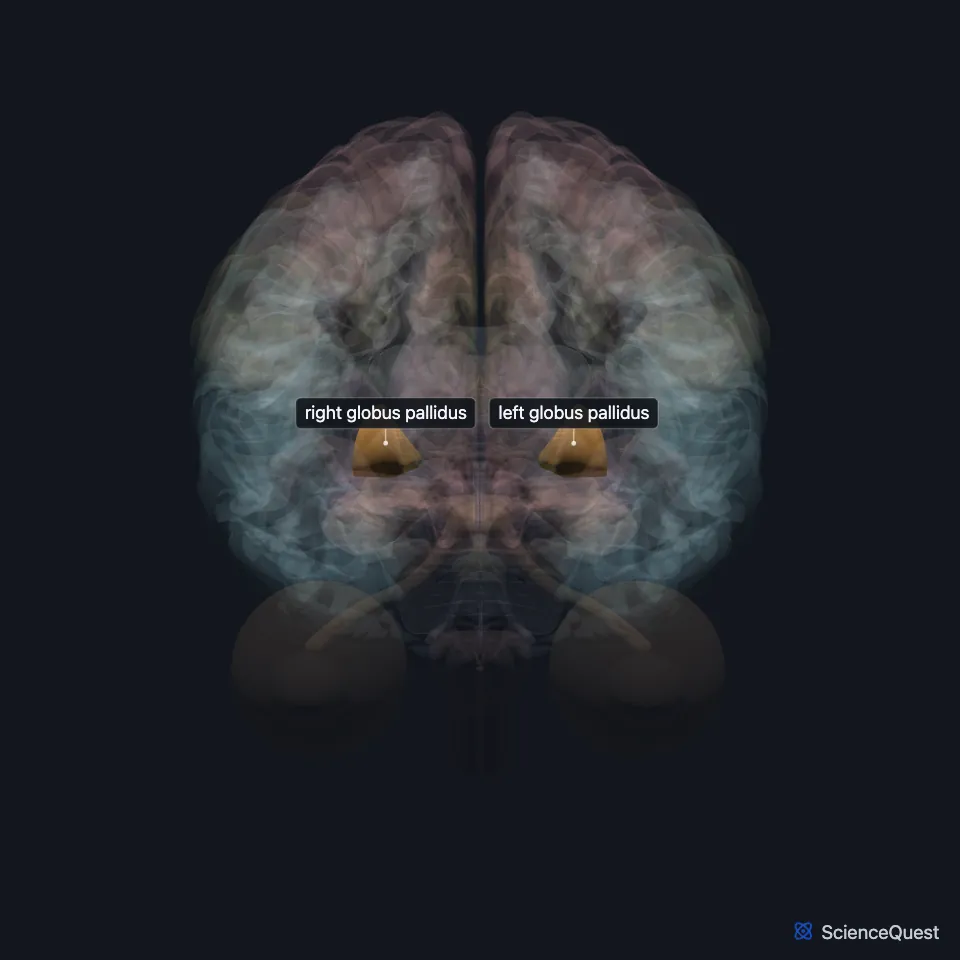
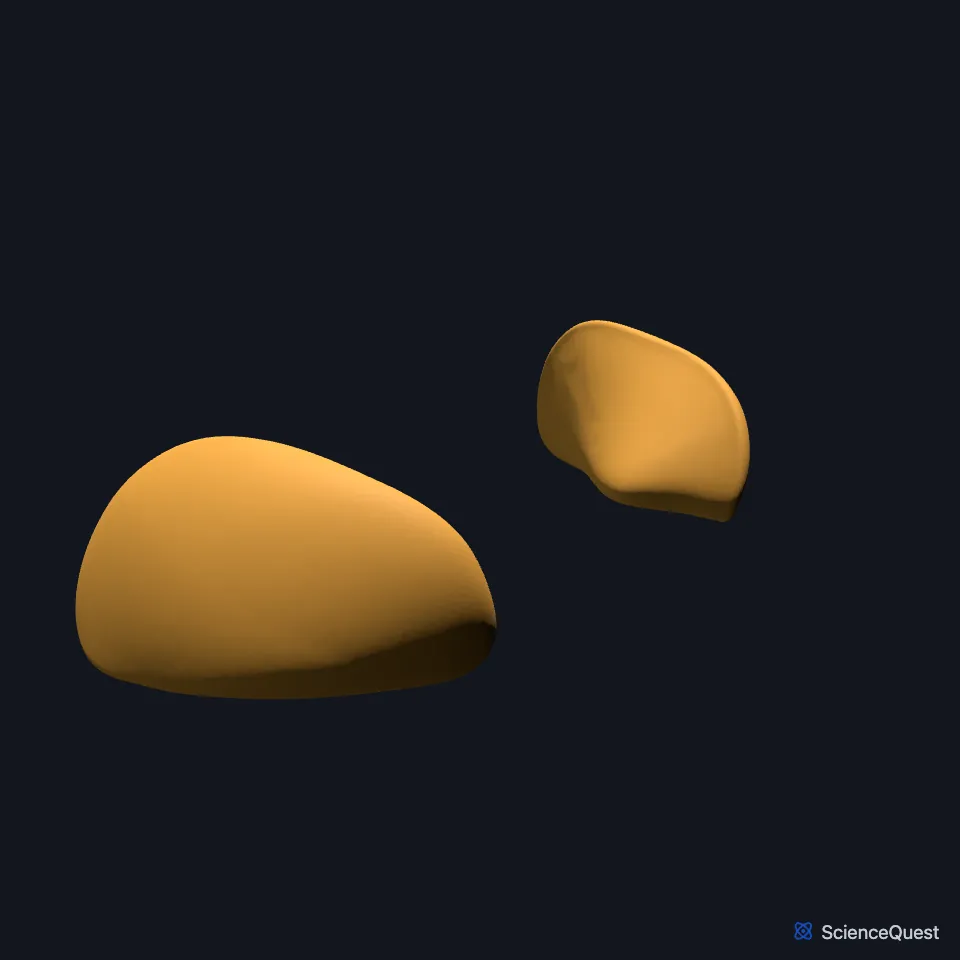
Where is the globus pallidus?
It lies on the medial side of the putamen, and the curve of the internal capsule borders it further in. (StatPearls, Globus Pallidus)
With the putamen it forms the lentiform, or lenticular, nucleus beneath the insula. (OpenStax A&P 2e, 13.2; StatPearls, Globus Pallidus)
What are the two parts of the globus pallidus?
A sheet of white matter, the medial medullary lamina, divides it into an internal segment (GPi), the medial one, and an external segment (GPe), the lateral one. (OpenStax A&P 2e, 13.2; StatPearls, Globus Pallidus)
Its name is Latin for “pale globe”. Its myelinated axons make it look lighter than the striatum beside it. (StatPearls, Globus Pallidus)
What does the globus pallidus do?
The internal segment, with the substantia nigra pars reticulata, is the target of the striatum’s direct pathway, and it projects to the thalamus. (OpenStax A&P 2e, 13.2; StatPearls, Basal Ganglia)
The external segment lies on the indirect pathway, which runs from the striatum to it, then to the subthalamic nucleus, then to the internal segment. (OpenStax A&P 2e, 13.2; StatPearls, Basal Ganglia)
The output to the thalamus is inhibitory and uses GABA. The direct pathway lifts that inhibition from the thalamus; the indirect pathway keeps or strengthens it. (OpenStax A&P 2e, 13.2; StatPearls, Basal Ganglia)
The internal segment is the final output of both pathways. (StatPearls, Globus Pallidus)
What connects to the globus pallidus?
Most of its inhibitory GABA input comes from the striatum, the caudate nucleus and putamen. Its output nucleus, the internal segment, sends mainly to the thalamus. (StatPearls, Globus Pallidus; OpenStax A&P 2e, 13.2)
The reticular nucleus of the thalamus receives disinhibitory input from the globus pallidus, which allows voluntary movement to begin. (StatPearls, Thalamus)
Touches in this model
Measured on the BodyParts3D meshes: surfaces within 2 mm of the globus pallidus, nearest first.
- Anterior limb of left internal capsule in contact
- Anterior limb of right internal capsule in contact
- White matter structure of cerebral hemisphere in contact
- Left putamen 0.5 mm away
- Right putamen 0.5 mm away
- Anterior commissure 1.2 mm away
- Right caudate nucleus 1.4 mm away
- Left caudate nucleus 1.5 mm away
Sources
- OpenStax Anatomy and Physiology 2e, section 13.2, The Central Nervous System. CC BY-NC-SA 4.0. Read 2026-10-25.
- StatPearls, Neuroanatomy, Globus Pallidus. Nismat Javed; Marco Cascella. Last update February 20, 2023. CC BY-NC-ND 4.0. Read 2026-10-25.
- StatPearls, Neuroanatomy, Basal Ganglia. Carly B. Young; Vamsi Reddy; James Sonne. Last update July 24, 2023. CC BY-NC-ND 4.0. Read 2026-10-25.
- StatPearls, Neuroanatomy, Thalamus. Tyler J. Torrico; Sunil Munakomi. Last update July 24, 2023. CC BY-NC-ND 4.0. Read 2026-10-25.
The values are facts and free to use; this page’s selection and presentation are © 2026 ScienceQuest.