Hypothalamus
The hypothalamus is a paired collection of nuclei in the diencephalon, below the thalamus. Its nuclei work to keep the body in homeostasis. (OpenStax A&P 2e, 13.2; StatPearls, Hypothalamus, Mesencephalon Midbrain and Thalamus)
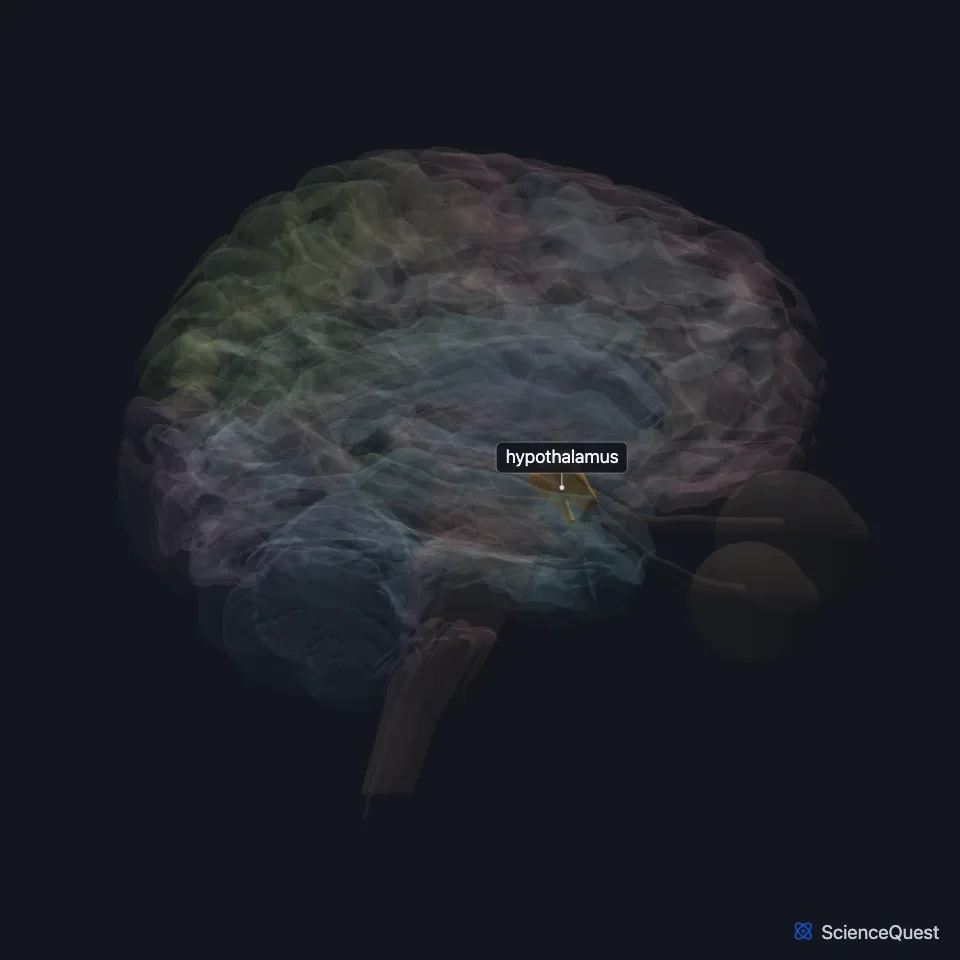
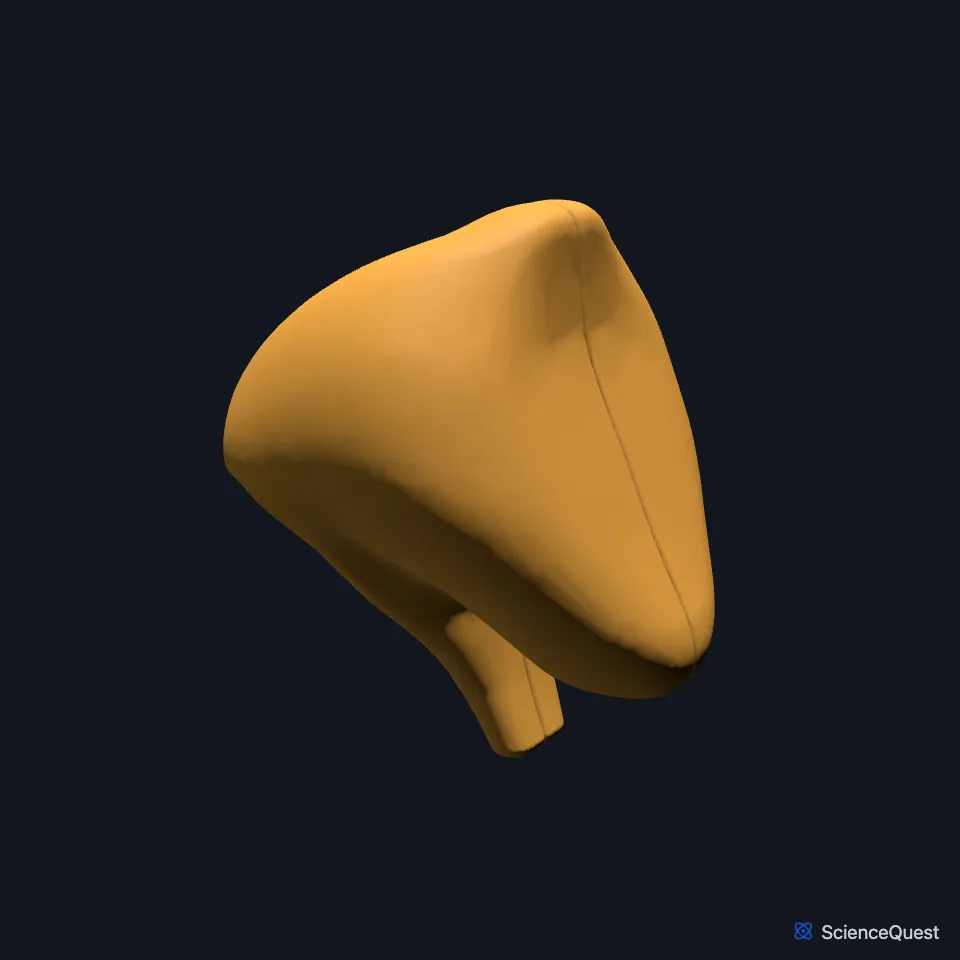
Where is the hypothalamus?
With the thalamus, it bounds the third ventricle. Below, a stalk, the infundibulum, joins it to the pituitary gland. (OpenStax A&P 2e, 13.2; StatPearls, Ventricular System, Pituitary Gland and Thalamus)
Its nuclei, on both sides, fall into 3 zones around the third ventricle and the mammillary bodies. With the lamina terminalis, the pituitary gland and the hypothalamic sulcus, the mammillary bodies serve as landmarks for its regions. (StatPearls, Hypothalamus and Ventricular System)
The optic chiasm lies under it, at the base of the hypothalamus. (StatPearls, Optic Chiasm)
What does the hypothalamus do?
Its output regulates the autonomic nervous system, and it controls much of the endocrine system through the anterior pituitary. (OpenStax A&P 2e, 13.2 and 15.3; StatPearls, Hypothalamus and Physiology, Anterior Pituitary)
Its homeostatic jobs include body temperature and appetite, and it shapes sexual behavior. (OpenStax Psychology 2e, 3.4; StatPearls, Physiology, Hypothalamus and Hypothalamus)
Osmoreceptors in the hypothalamus track the solute concentration of the blood. When it rises, as in dehydration, they activate the paraventricular and supraoptic nuclei, whose axons release antidiuretic hormone (ADH) in the posterior pituitary, and the kidneys reabsorb more water. (OpenStax A&P 2e, 17.3; StatPearls, Physiology, Pituitary Gland and Hypothalamus)
Hypothalamic neurons send releasing and inhibiting hormones to the anterior pituitary through the hypophyseal portal system, capillaries that carry them straight there instead of through the general circulation. (OpenStax A&P 2e, 17.3; StatPearls, Physiology, Anterior Pituitary)
How does the hypothalamus reach the posterior pituitary?
The posterior lobe of the pituitary is an extension of hypothalamic neurons. Their cell bodies sit in the paraventricular and supraoptic nuclei, and their axons run down the infundibulum as the hypothalamic-hypophyseal tract. (OpenStax A&P 2e, 17.3; StatPearls, Physiology, Pituitary Gland and Pituitary Gland)
What connects to the hypothalamus?
Named tracts link it to the rest of the brain: the brainstem through the dorsal longitudinal fasciculus, the cerebral cortex through the medial forebrain bundle, the hippocampus through the fornix, the amygdala through the stria terminalis, the thalamus through the mammillothalamic tract, the pituitary through the median eminence and the retina through the retinohypothalamic tract. (StatPearls, Hypothalamus)
The amygdala, which takes part in fear and anxiety, sends output to the hypothalamus. The hypothalamus then acts through the autonomic nervous system and through stress hormones from the pituitary and the adrenal cortex. (OpenStax A&P 2e, 15.3; StatPearls, Amygdala, Hypothalamus, Physiology, Anterior Pituitary and Physiology, Pituitary Gland)
The dorsal longitudinal fasciculus links it to the brain stem. (OpenStax A&P 2e, 15.3; StatPearls, Hypothalamus)
Where the sources differ
The sources split on which nuclei make which posterior pituitary hormone. OpenStax A&P 2e gives oxytocin to the paraventricular nuclei and ADH to the supraoptic nuclei; StatPearls says both nuclei make both. (OpenStax A&P 2e, 17.3; StatPearls, Hypothalamus)
The sources name different routes from the amygdala to the hypothalamus. StatPearls gives the stria terminalis; OpenStax A&P 2e says the amygdala projects into the hypothalamus through the medial forebrain bundle. (StatPearls, Hypothalamus; OpenStax A&P 2e, 15.3)
The sources describe the medial forebrain bundle differently. StatPearls says it connects the hypothalamus to the cerebral cortex; OpenStax A&P 2e says that it and the dorsal longitudinal fasciculus carry hypothalamic output to the parasympathetic nuclei of the brain stem and the preganglionic neurons of the thoracolumbar spinal cord. (StatPearls, Hypothalamus; OpenStax A&P 2e, 15.3)
| Feature | Detail and source |
|---|---|
| Paraventricular and supraoptic nuclei | Oxytocin and ADH, released from their axons in the posterior pituitary (StatPearls, Hypothalamus) |
| Suprachiasmatic nucleus | Daily timing of hormone release and behavior, set by light through the eyes (StatPearls, Hypothalamus) |
| Preoptic, anterior and posterior nuclei | Body temperature (StatPearls, Hypothalamus) |
| Ventromedial nucleus | Feeding; satiety sensed here reduces eating (StatPearls, Hypothalamus) |
| Lateral hypothalamus | Hunger, which increases eating (StatPearls, Hypothalamus) |
| Arcuate nucleus | Hormones into the portal system that control anterior pituitary release (StatPearls, Hypothalamus) |
Touches in this model
Measured on the BodyParts3D meshes: surfaces within 2 mm of the hypothalamus, nearest first, 12 of 25.
- Anterior commissure in contact
- Corpus callosum in contact
- Interpeduncular fossa in contact
- Lamina terminalis in contact
- Left fornix of forebrain in contact
- Left optic nerve in contact
- Left optic tract in contact
- Left stria medullaris of thalamus in contact
- Left stria terminalis in contact
- Mammillary body in contact
- Midbrain in contact
- Optic chiasm in contact
Sources
- OpenStax Anatomy and Physiology 2e, section 13.2, The Central Nervous System. CC BY-NC-SA 4.0. Read 2026-10-25.
- StatPearls, Neuroanatomy, Hypothalamus. Matthew H. Bear; Vamsi Reddy; Pradeep C. Bollu. Last update October 10, 2022. CC BY-NC-ND 4.0. Read 2026-10-25.
- StatPearls, Neuroanatomy, Mesencephalon Midbrain. Francheska Caminero; Marco Cascella. Last update September 10, 2024. CC BY-NC-ND 4.0. Read 2026-10-25.
- StatPearls, Neuroanatomy, Thalamus. Tyler J. Torrico; Sunil Munakomi. Last update July 24, 2023. CC BY-NC-ND 4.0. Read 2026-10-25.
- StatPearls, Neuroanatomy, Ventricular System. Saraswati Satyanarayan Shenoy; Forshing Lui. Last update July 24, 2023. CC BY-NC-ND 4.0. Read 2026-10-25.
- StatPearls, Anatomy, Head and Neck, Pituitary Gland. Muthu Kuzhali Ganapathy; Prasanna Tadi. Last update July 24, 2023. CC BY-NC-ND 4.0. Read 2026-10-25.
- StatPearls, Neuroanatomy, Optic Chiasm. Ashley C. Ireland; Iverson B. Carter. Last update May 1, 2023. CC BY-NC-ND 4.0. Read 2026-10-25.
- OpenStax Anatomy and Physiology 2e, section 15.3, Central Control. CC BY-NC-SA 4.0. Read 2026-10-25.
- StatPearls, Physiology, Anterior Pituitary. Antony D. Rawindraraj; Hajira Basit; Ishwarlal Jialal. Last update May 1, 2023. CC BY-NC-ND 4.0. Read 2026-10-25.
- OpenStax Psychology 2e, section 3.4, The Brain and Spinal Cord. CC BY-NC-SA 4.0. Read 2026-10-25.
- StatPearls, Physiology, Hypothalamus. Zainab Shahid; Edinen Asuka; Gurdeep Singh. Last update May 1, 2023. CC BY-NC-ND 4.0. Read 2026-10-25.
- OpenStax Anatomy and Physiology 2e, section 17.3, The Pituitary Gland and Hypothalamus. CC BY-NC-SA 4.0. Read 2026-10-25.
- StatPearls, Physiology, Pituitary Gland. Suzan A. Kamel-ElSayed; Janice Schwartz. Last update May 1, 2023. CC BY-NC-ND 4.0. Read 2026-10-25.
- StatPearls, Neuroanatomy, Amygdala. Qais AbuHasan; Vamsi Reddy; Waquar Siddiqui. Last update July 17, 2023. CC BY-NC-ND 4.0. Read 2026-10-25.
The values are facts and free to use; this page’s selection and presentation are © 2026 ScienceQuest.