Pituitary gland
The pituitary gland, or hypophysis, is a small endocrine gland, about 500 mg in an adult, that hangs from the hypothalamus on a stalk called the infundibulum. (OpenStax A&P 2e, 17.3; StatPearls, Pituitary Gland and Physiology, Pituitary Gland)
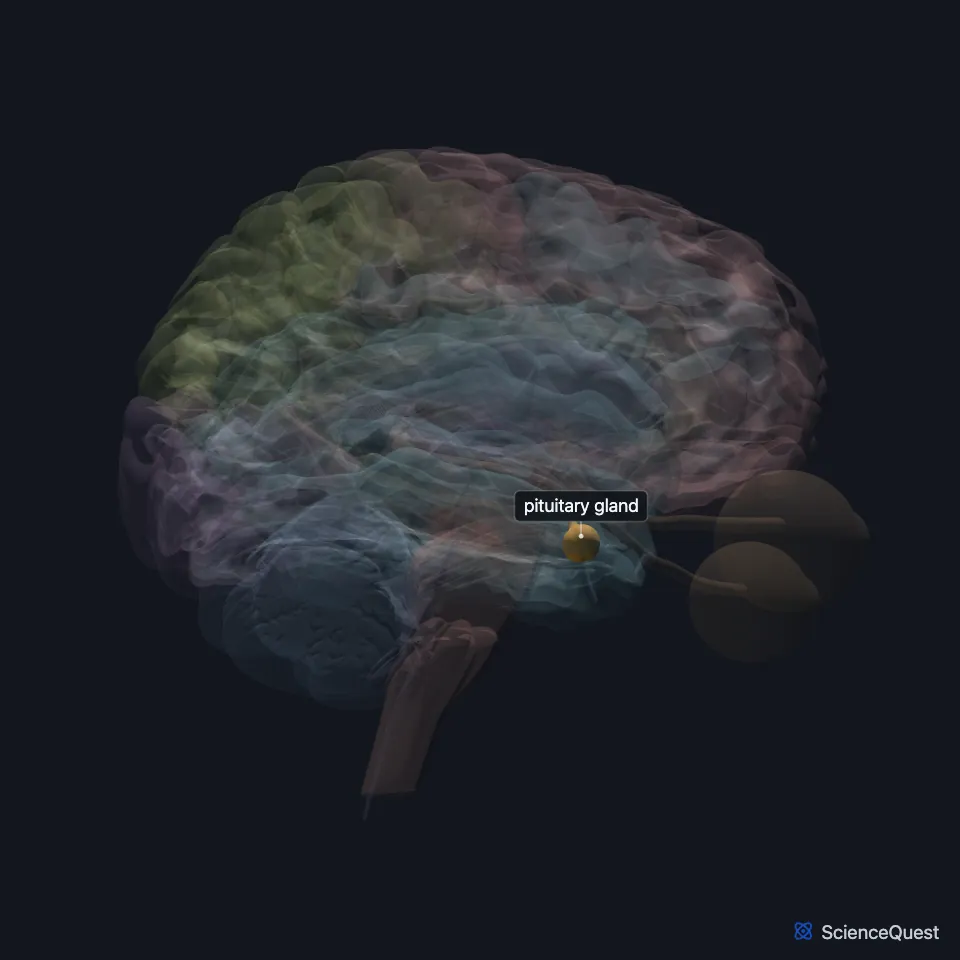
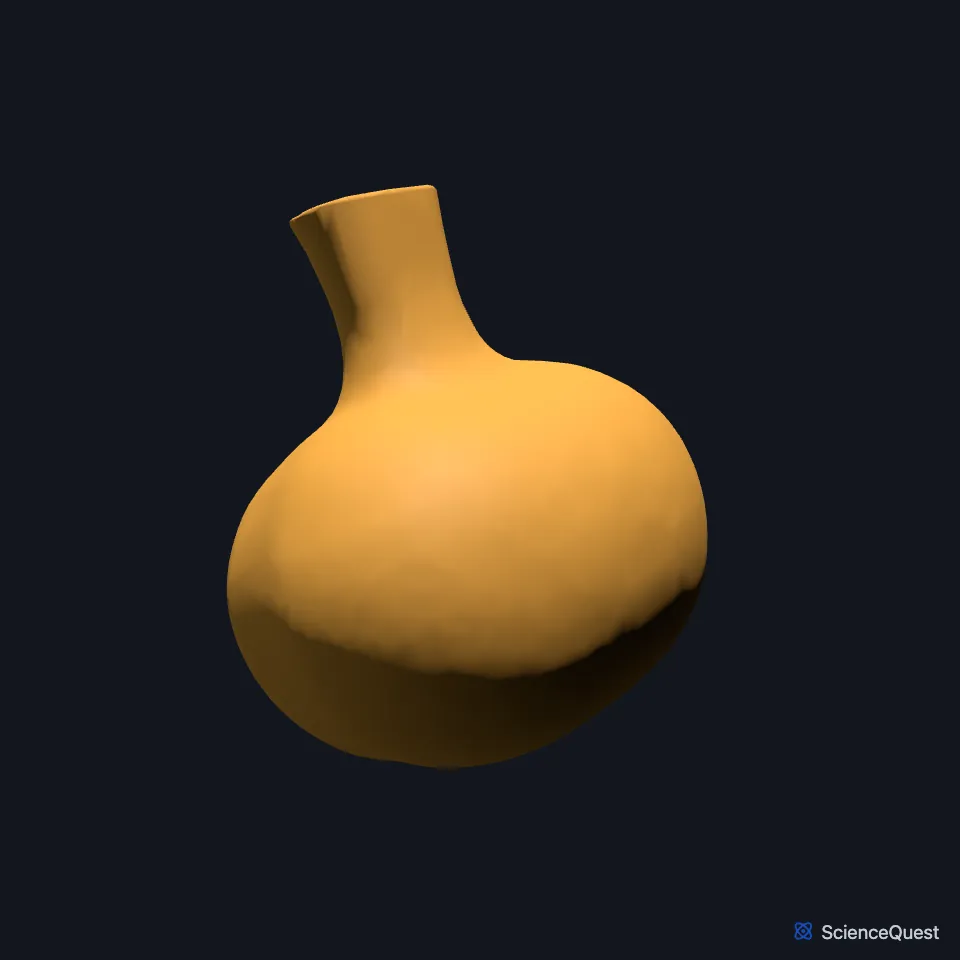
Where is the pituitary gland?
It sits in the sella turcica, a hollow in the sphenoid bone near the center of the base of the skull. (OpenStax A&P 2e, 17.3; StatPearls, Pituitary Gland)
A fold of dura, the diaphragma sellae, roofs it. The sphenoid sinus lies in front of and below it, and a cavernous sinus lies on each side. (StatPearls, Pituitary Gland)
What are the lobes of the pituitary gland?
Its two lobes come from different embryonic tissue. The posterior lobe (neurohypophysis) grows down from the neural ectoderm of the diencephalon; the anterior lobe (adenohypophysis) grows up from the oral ectoderm as Rathke’s pouch. (OpenStax A&P 2e, 17.3; StatPearls, Pituitary Gland and Physiology, Pituitary Gland)
Most anterior lobe hormones come from the pars distalis, the distal part of the gland. The pars intermedia lies between it and the posterior lobe, and the pars tuberalis encircles the infundibular stem. (OpenStax A&P 2e, 17.3; StatPearls, Pituitary Gland)
The adult gland weighs 500 mg and measures 8 mm front to back and 12 mm across. In pregnancy it almost doubles in size as the pars distalis grows. (StatPearls, Pituitary Gland)
What does the pituitary gland do?
The posterior lobe makes no hormones of its own. It stores and releases two made in the hypothalamus, oxytocin and antidiuretic hormone (ADH). (OpenStax A&P 2e, 17.3; StatPearls, Physiology, Posterior Pituitary and Physiology, Anterior Pituitary)
The anterior lobe makes its own hormones: growth hormone, thyroid-stimulating hormone, adrenocorticotropic hormone, follicle-stimulating hormone, luteinizing hormone and prolactin. StatPearls counts these six; OpenStax also counts beta endorphin, which StatPearls describes as cut from the same precursor as ACTH. (OpenStax A&P 2e, 17.3; StatPearls, Physiology, Anterior Pituitary, Physiology, Pituitary Hormones and Pituitary Gland)
Cells of the pars intermedia, between the pars distalis and the posterior lobe, secrete melanocyte-stimulating hormone (MSH). (OpenStax A&P 2e, 17.3; StatPearls, Pituitary Gland)
TSH, ACTH, FSH and LH each drive another endocrine gland: TSH the thyroid, ACTH the adrenal cortex, and FSH and LH the ovaries and testes. (OpenStax A&P 2e, 17.3; StatPearls, Physiology, Pituitary Gland)
The hypothalamus controls the anterior lobe with releasing and inhibiting hormones, carried to it through the hypophyseal portal system. (OpenStax A&P 2e, 17.3; StatPearls, Physiology, Anterior Pituitary)
What lies around the pituitary gland?
Its stalk, the infundibulum, arises from the tuber cinereum and median eminence of the hypothalamus and passes through a central opening in the diaphragma sellae. (StatPearls, Pituitary Gland)
Each cavernous sinus beside it carries the internal carotid artery with its sympathetic plexus, cranial nerves III, IV and VI, and two divisions of the trigeminal nerve, the ophthalmic (V1) and the maxillary (V2). (StatPearls, Pituitary Gland and Cavernous Sinus)
A growth of the pituitary can press on the fibers crossing in the optic chiasm and take away the outer part of the visual field on both sides. (OpenStax A&P 2e, 14.2 and 16.3; StatPearls, Optic Chiasm)
Where the sources differ
The sources disagree on where the optic chiasm sits. OpenStax A&P 2e puts the pituitary directly below it; StatPearls puts the chiasm in front of and above the gland, about 10 mm above the pituitary fossa. (OpenStax A&P 2e, 16.3; StatPearls, Pituitary Gland and Optic Chiasm)
| Feature | Detail and source |
|---|---|
| Growth hormone (GH) | Anterior lobe; promotes growth of body tissues (OpenStax A&P 2e, 17.3; StatPearls, Physiology, Pituitary Gland) |
| Prolactin (PRL) | Anterior lobe; promotes milk production from the mammary glands (OpenStax A&P 2e, 17.3; StatPearls, Physiology, Pituitary Gland) |
| Thyroid-stimulating hormone (TSH) | Anterior lobe; stimulates thyroid hormone release from the thyroid (OpenStax A&P 2e, 17.3; StatPearls, Physiology, Pituitary Gland) |
| Adrenocorticotropic hormone (ACTH) | Anterior lobe; stimulates hormone release by the adrenal cortex (OpenStax A&P 2e, 17.3; StatPearls, Physiology, Pituitary Gland) |
| Follicle-stimulating hormone (FSH) | Anterior lobe; stimulates gamete production in the gonads (OpenStax A&P 2e, 17.3; StatPearls, Physiology, Pituitary Gland) |
| Luteinizing hormone (LH) | Anterior lobe; stimulates androgen production by the gonads (OpenStax A&P 2e, 17.3; StatPearls, Physiology, Pituitary Gland) |
| Antidiuretic hormone (ADH) | Posterior lobe; stimulates water reabsorption by the kidneys (OpenStax A&P 2e, 17.3; StatPearls, Physiology, Pituitary Gland) |
| Oxytocin | Posterior lobe; stimulates uterine contractions during childbirth (OpenStax A&P 2e, 17.3; StatPearls, Physiology, Pituitary Gland) |
| Melanocyte-stimulating hormone | Pars intermedia, between the lobes; stimulates melanin formation in melanocytes (OpenStax A&P 2e, 17.3; StatPearls, Pituitary Gland and Hypopigmented Macules) |
Touches in this model
Measured on the BodyParts3D meshes: surfaces within 2 mm of the pituitary gland, nearest first.
- Hypothalamus in contact
- Tuber cinereum in contact
- Skin 0.1 mm away
- Sphenoid bone 0.2 mm away
- Left optic nerve 1.7 mm away
- Optic chiasm 1.7 mm away
- Right optic nerve 1.7 mm away
- Left optic tract 1.8 mm away
- Right optic tract 1.8 mm away
Sources
- OpenStax Anatomy and Physiology 2e, section 17.3, The Pituitary Gland and Hypothalamus. CC BY-NC-SA 4.0. Read 2026-10-25.
- StatPearls, Anatomy, Head and Neck, Pituitary Gland. Muthu Kuzhali Ganapathy; Prasanna Tadi. Last update July 24, 2023. CC BY-NC-ND 4.0. Read 2026-10-25.
- StatPearls, Physiology, Pituitary Gland. Suzan A. Kamel-ElSayed; Janice Schwartz. Last update May 1, 2023. CC BY-NC-ND 4.0. Read 2026-10-25.
- StatPearls, Physiology, Posterior Pituitary. Hiran Patel; Rishita Jessu; Vivekanand Tiwari. Last update April 24, 2023. CC BY-NC-ND 4.0. Read 2026-10-25.
- StatPearls, Physiology, Anterior Pituitary. Antony D. Rawindraraj; Hajira Basit; Ishwarlal Jialal. Last update May 1, 2023. CC BY-NC-ND 4.0. Read 2026-10-25.
- StatPearls, Physiology, Pituitary Hormones. Nazia M. Sadiq; Prasanna Tadi. Last update May 1, 2023. CC BY-NC-ND 4.0. Read 2026-10-25.
- StatPearls, Neuroanatomy, Cavernous Sinus. Ruben Ngnitewe Massa; Katrina Minutello; Fassil B. Mesfin. Last update July 24, 2023. CC BY-NC-ND 4.0. Read 2026-10-25.
- OpenStax Anatomy and Physiology 2e, section 14.2, Central Processing. CC BY-NC-SA 4.0. Read 2026-10-25.
- OpenStax Anatomy and Physiology 2e, section 16.3, The Cranial Nerve Exam. CC BY-NC-SA 4.0. Read 2026-10-25.
- StatPearls, Neuroanatomy, Optic Chiasm. Ashley C. Ireland; Iverson B. Carter. Last update May 1, 2023. CC BY-NC-ND 4.0. Read 2026-10-25.
- StatPearls, Hypopigmented Macules. Sowmya Madireddy; Jonathan S. Crane. Last update June 28, 2023. CC BY-NC-ND 4.0. Read 2026-10-25.
The values are facts and free to use; this page’s selection and presentation are © 2026 ScienceQuest.