Fornix of forebrain
The fornix is a C-shaped fiber tract that connects the hippocampus with the hypothalamus and with the septal and preoptic nuclei. (Neuroscience Online, Limbic System: Hippocampus and Hypothalamus: Structural Organization; OpenStax Behavioral Neuroscience, 1.4)
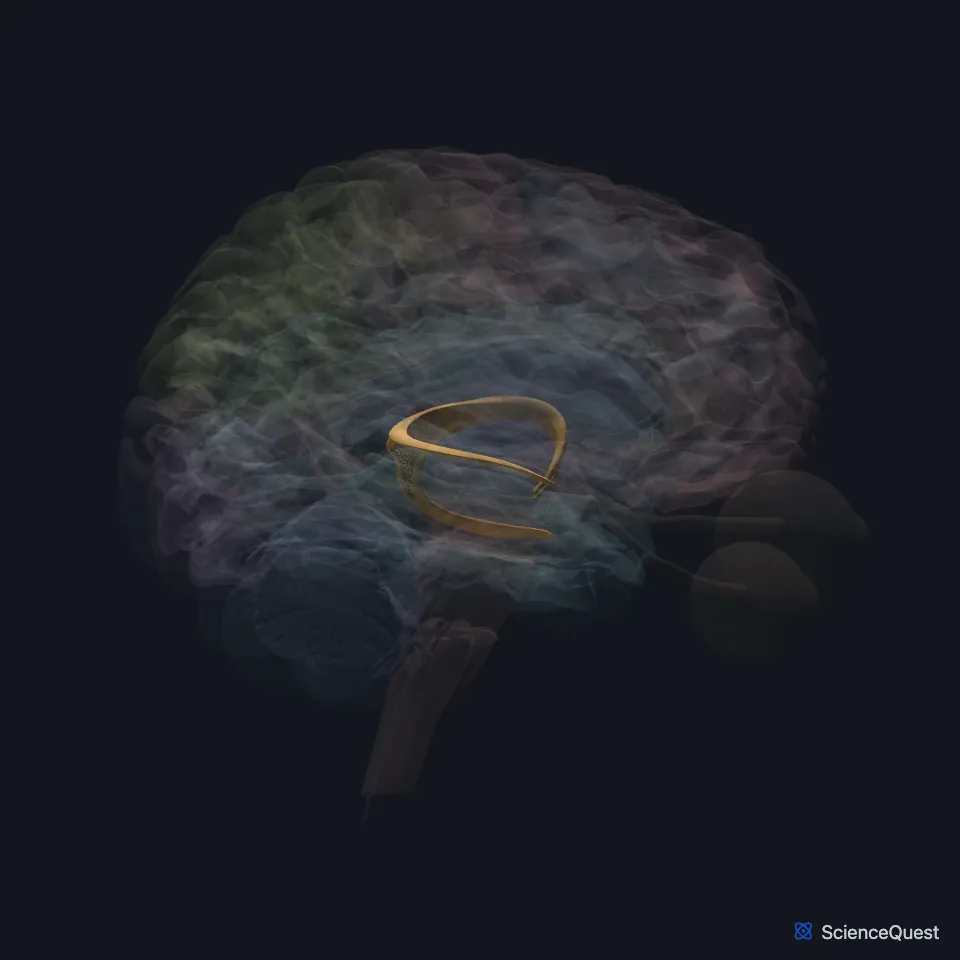
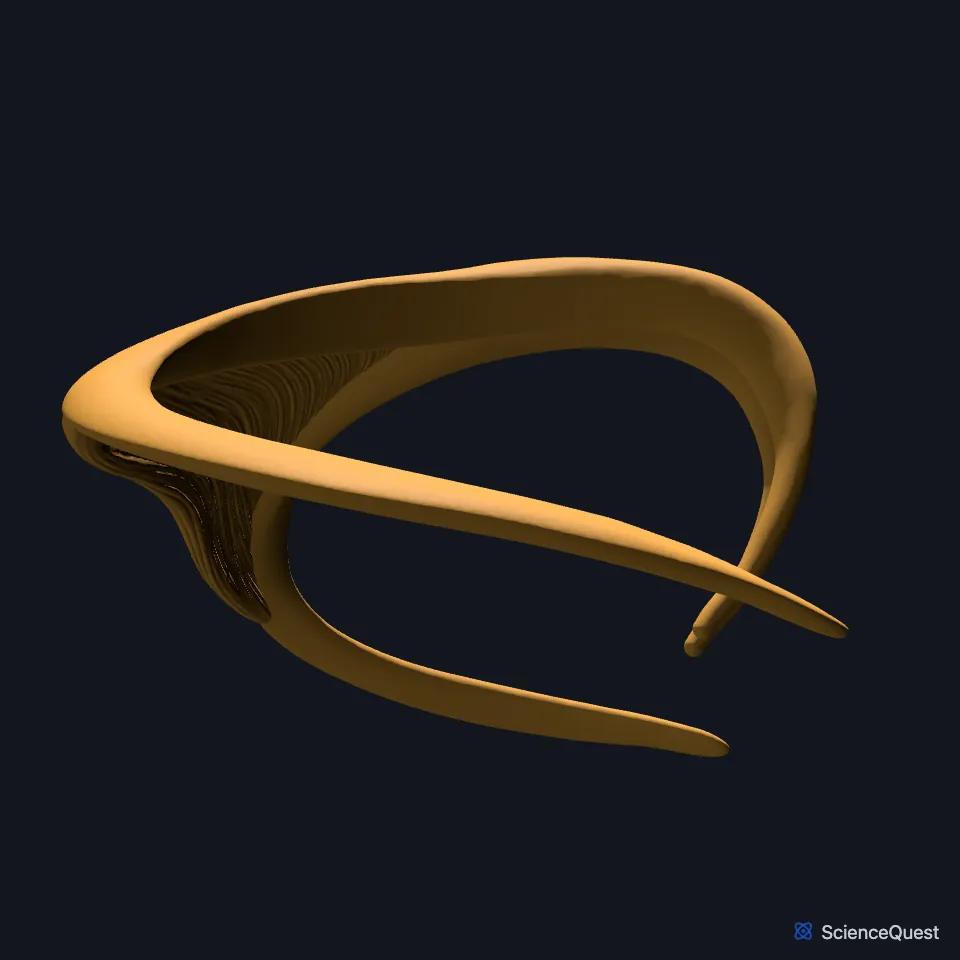
How does the fornix form?
It begins as the alveus, white matter made of myelinated fibers running to and from the hippocampus. As the fibers run back, they gather toward the midline into the fimbria, which thickens as it goes. (Neuroscience Online, Limbic System: Hippocampus)
Each fimbria then leaves its hippocampus as a crus, and the two crura join to form the hippocampal commissure. (Neuroscience Online, Limbic System: Hippocampus)
Where does the fornix run?
Past the hippocampal commissure the single bundle is the fornix proper, which arcs forward to the anterior commissure. (Neuroscience Online, Limbic System: Hippocampus)
At the anterior commissure it splits three ways: the precommissural fornix curves down in front of the commissure, the postcommissural fornix passes behind it, and some fibers cross in the commissure to the hippocampus of the other side. (Neuroscience Online, Limbic System: Hippocampus; Uberon, precommissural fornix and postcommissural fornix)
What does the fornix do?
It is one of the two main routes into and out of the hippocampus, and it carries incoming and outgoing fibers together. (Neuroscience Online, Limbic System: Hippocampus)
The precommissural fornix goes to the septal nuclei, the ventral striatum and the cingulate cortex. The postcommissural fornix goes to the mammillary bodies and the anterior nuclei of the thalamus. (Neuroscience Online, Limbic System: Hippocampus)
How does the fornix fit into the Papez circuit?
The postcommissural fornix carries hippocampal output to the mammillary bodies. The mammillothalamic tract continues to the anterior thalamic nucleus, which connects to the cingulate cortex. (Neuroscience Online, Limbic System: Hippocampus)
The stria terminalis of the amygdala follows the same plan, with precommissural and postcommissural branches. (Neuroscience Online, Limbic System: Amygdala)
Touches in this model
Measured on the BodyParts3D meshes: surfaces within 2 mm of the fornix of forebrain, nearest first, 12 of 33.
- Anterior commissure in contact
- Choroid plexus of left cerebral hemisphere in contact
- Choroid plexus of right cerebral hemisphere in contact
- Hypothalamus in contact
- Interventricular foramen in contact
- Left amygdala in contact
- Left caudate nucleus in contact
- Left hippocampus in contact
- Left lateral ventricle in contact
- Left stria medullaris of thalamus in contact
- Left stria terminalis in contact
- Left thalamus in contact
Sources
- Neuroscience Online, McGovern Medical School, Section 4, Chapter 5, Limbic System: Hippocampus. Anthony Wright, Ph.D.. Last update Revised 07 July 2026. Open access; no reuse licence stated. Read 2026-10-25.
- OpenStax Introduction to Behavioral Neuroscience, section 1.4, The Brain: Structure and Function. CC BY-NC-SA 4.0. Read 2026-10-25.
- Neuroscience Online, McGovern Medical School, Section 4, Chapter 1, Hypothalamus: Structural Organization. Patrick Dougherty, Ph.D.. Last update Last Review 20 July 2026. Open access; no reuse licence stated. Read 2026-10-25.
- Uberon anatomy ontology, UBERON:0014539, precommissural fornix of forebrain (read on EBI OLS). CC BY 3.0. Read 2026-10-25.
- Uberon anatomy ontology, UBERON:0003016, postcommissural fornix of brain (read on EBI OLS). CC BY 3.0. Read 2026-10-25.
- Neuroscience Online, McGovern Medical School, Section 4, Chapter 6, Limbic System: Amygdala. Anthony Wright, Ph.D.. Last update Revised 20 July 2026. Open access; no reuse licence stated. Read 2026-10-25.
The values are facts and free to use; this page’s selection and presentation are © 2026 ScienceQuest.