Subclavian artery
The subclavian arteries lie just below the clavicles and supply both upper limbs, with branches to the head and neck. Each becomes the axillary artery at the outer border of the first rib. (StatPearls, Thorax, Subclavian Arteries)
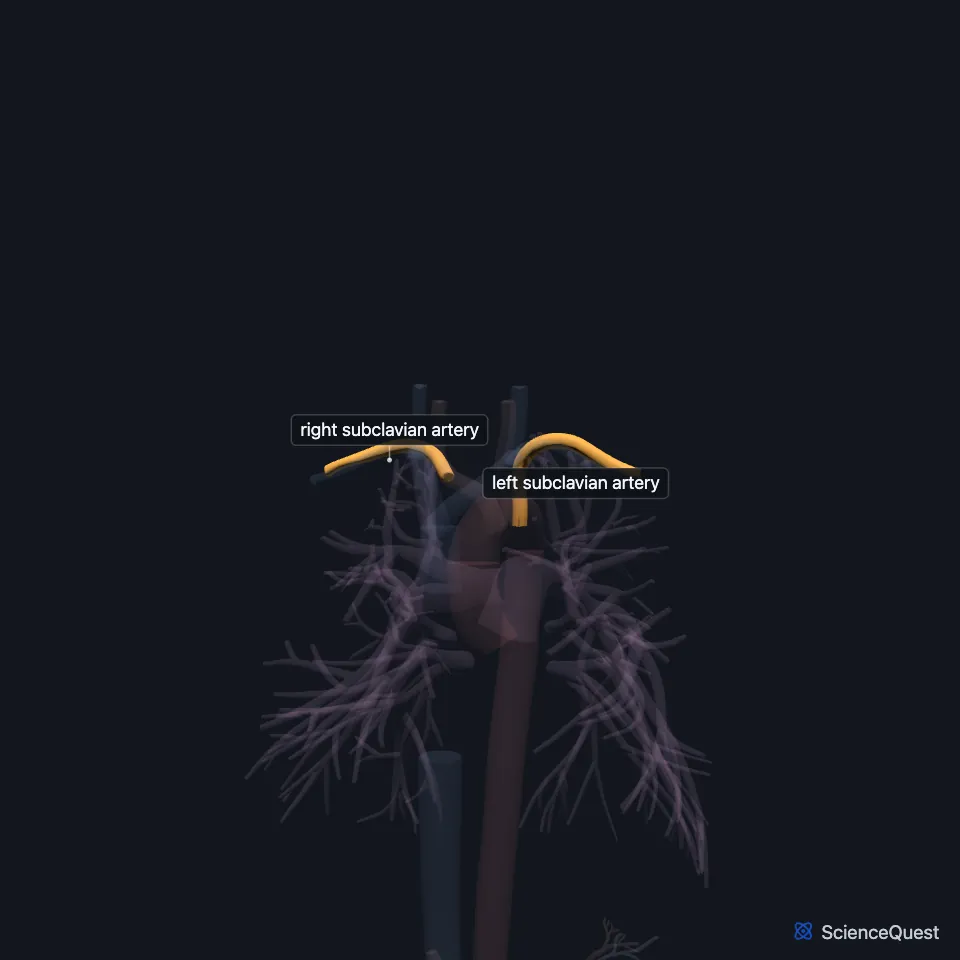
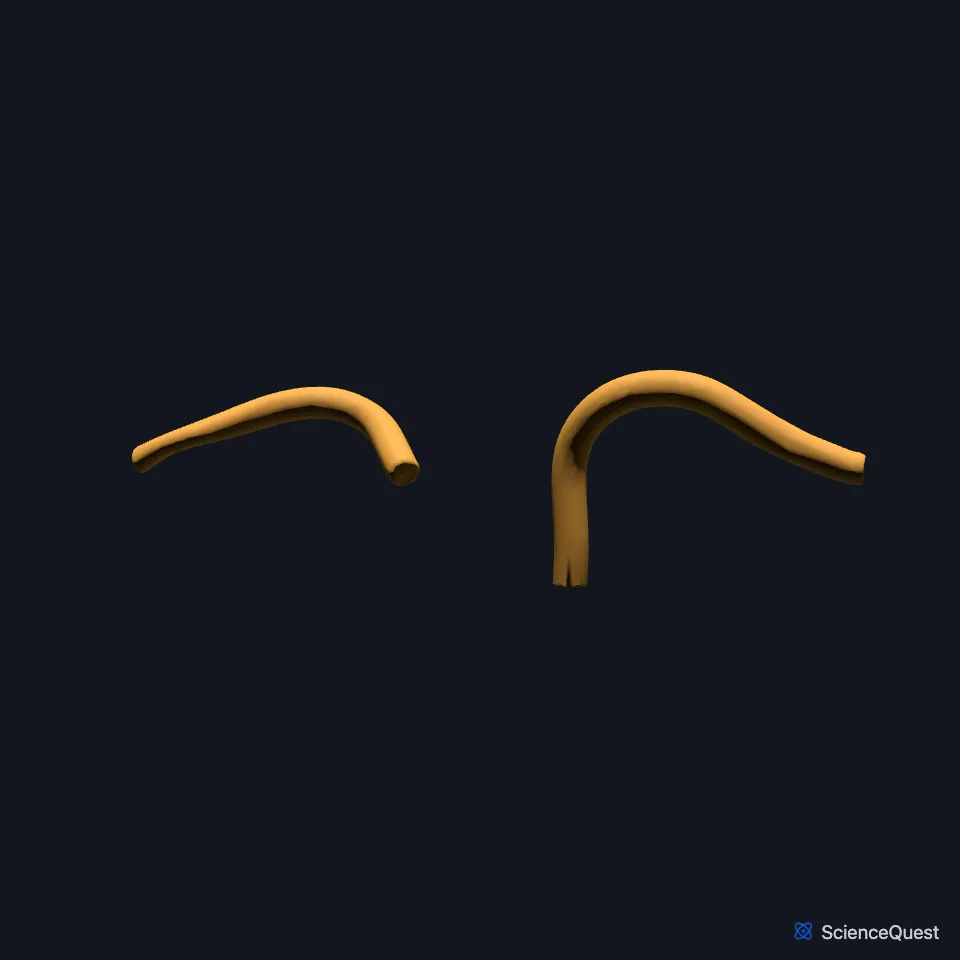
Where do the subclavian arteries start?
The right subclavian arises from the brachiocephalic artery. The left arises on its own from the aortic arch. (OpenStax A&P 2e, 20.5; StatPearls, Thorax, Subclavian Arteries)
Each runs out to the side between the anterior and middle scalene muscles, then passes the first rib. (StatPearls, Thorax, Subclavian Arteries)
What are the parts of the subclavian artery?
StatPearls (Subclavian Arteries) divides it into three parts by the edges of the scalene muscles, without naming which scalene. The first runs from its origin to their medial edge, the second lies between their edges, and the third runs from their lateral edge to the outer tip of the first rib. StatPearls (Brachiocephalic Veins) has the artery pass behind the anterior scalene, with the subclavian vein in front of it. (StatPearls, Thorax, Subclavian Arteries and Thorax, Brachiocephalic (Innominate) Veins)
Its major branches include the internal thoracic and vertebral arteries and the thyrocervical trunk. The vertebral artery climbs through the transverse foramina of the cervical vertebrae and enters the skull through the foramen magnum to supply the brain and spinal cord. (OpenStax A&P 2e, 20.5; StatPearls, Thorax, Subclavian Arteries)
What does the subclavian artery supply?
Each supplies the upper limb on its side and sends branches to the head and neck. (OpenStax A&P 2e, 20.5; StatPearls, Thorax, Subclavian Arteries)
Its name changes along the limb: it becomes the axillary artery, then the brachial artery, and in the forearm the radial and ulnar arteries. (StatPearls, Thorax, Subclavian Arteries)
Which nerves pass the subclavian arteries?
On the right, the vagus nerve runs in front of the artery’s root and the recurrent laryngeal nerve behind it. On the left, the vagus and phrenic nerves both run in front. (StatPearls, Thorax, Subclavian Arteries)
The subclavian arteries run below the trunks of the brachial plexus. (StatPearls, Thorax, Subclavian Arteries)
How does the subclavian artery vary?
The commonest aberrant origin is a right subclavian that arises straight from the arch as its last branch. It runs backward and may wrap around the esophagus, forming a vascular ring. (StatPearls, Thorax, Subclavian Arteries)
Where the sources differ
OpenStax names three major branches: the internal thoracic, vertebral and thyrocervical arteries (StatPearls: thyrocervical trunk). StatPearls also lists the costocervical trunk and the dorsal scapular artery. (OpenStax A&P 2e, 20.5; StatPearls, Thorax, Subclavian Arteries)
| Feature | Detail and source |
|---|---|
| Right arises from | Brachiocephalic artery (OpenStax A&P 2e, 20.5; StatPearls, Thorax, Subclavian Arteries) |
| Left arises from | Arch of aorta (OpenStax A&P 2e, 20.5; StatPearls, Thorax, Subclavian Arteries) |
| Becomes | Axillary artery, at the lateral border of the first rib (StatPearls, Thorax, Subclavian Arteries) |
Touches in this model
Measured on the BodyParts3D meshes: surfaces within 2 mm of the subclavian artery, nearest first, 12 of 23.
- Arch of aorta in contact
- Brachiocephalic artery in contact
- Pulmonary artery in contact
- Pulmonary vein in contact
- Right common carotid artery in contact
- Bronchus in contact
- External intercostal muscle in contact
- Left clavicle in contact
- Left first rib in contact
- Left scalenus anterior in contact
- Left serratus anterior in contact
- Left subclavius in contact
Sources
- StatPearls, Anatomy, Thorax, Subclavian Arteries. Osman Rahimi; Zachary Geiger. Last update July 24, 2023. CC BY-NC-ND 4.0. Read 2026-10-25.
- OpenStax Anatomy and Physiology 2e, section 20.5, Circulatory Pathways. CC BY-NC-SA 4.0. Read 2026-10-25.
- StatPearls, Anatomy, Thorax, Brachiocephalic (Innominate) Veins. Bruno Bordoni; Adekunle E. Omole. Last update December 9, 2025. CC BY-NC-ND 4.0. Read 2026-10-25.
The values are facts and free to use; this page’s selection and presentation are © 2026 ScienceQuest.