How long caffeine lasts: half-life for smokers, average adults, the pill and late pregnancy
A 150 mg coffee falls below 50 mg in the body after 4.2 hours in a smoker, 8.1 in an average adult, 16.1 on the pill and 24.0 in the third trimester. Drunk at 3 p.m., it leaves 22.6 mg at a 10 p.m. bedtime for a smoker, 58.2 for an average adult and 109.4 in the third trimester.
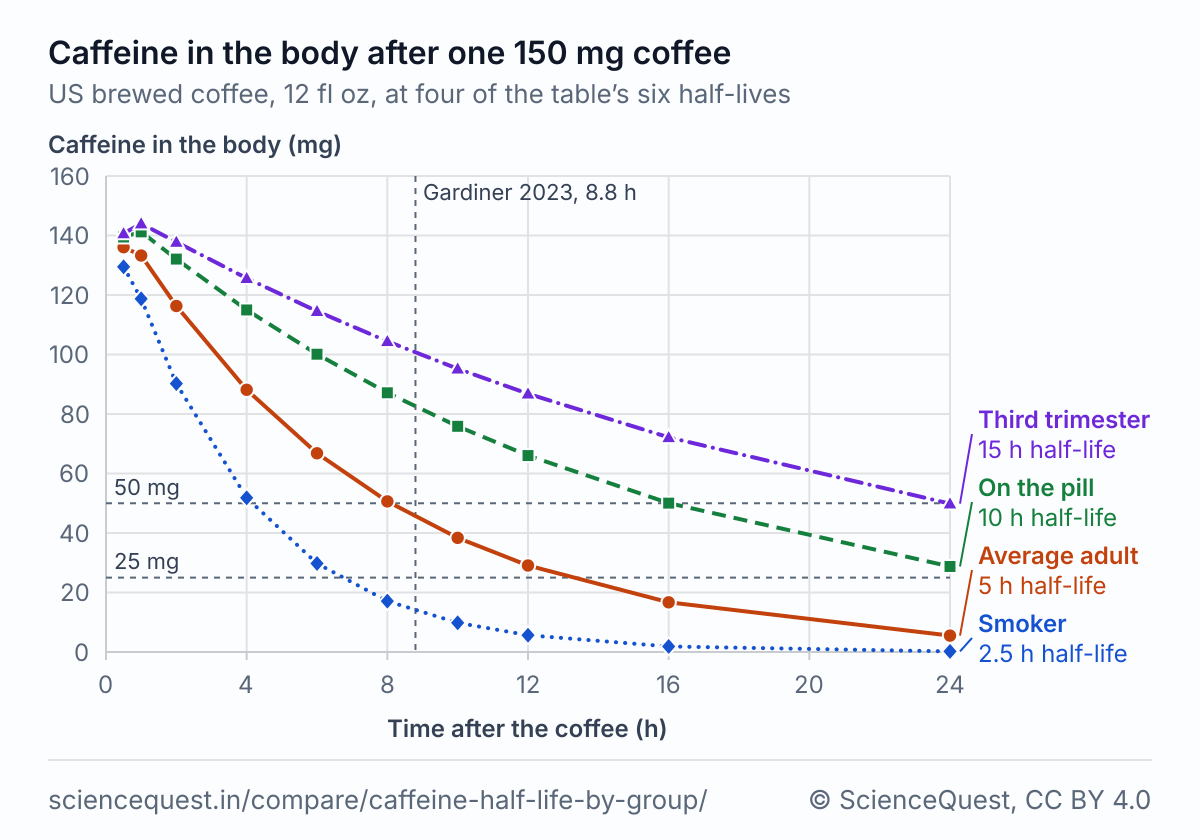
Caffeine in the body, hour by hour
| Hours after the coffee | Smoker | Fast | Average adult | Slow | On the pill | Third trimester |
|---|---|---|---|---|---|---|
| 2.5 h | 3 h | 5 h | 7 h | 10 h | 15 h | |
| 0.5 | 129.5 | 131.6 | 136.1 | 138.0 | 139.5 | 140.7 |
| 1 | 118.7 | 123.4 | 133.3 | 137.8 | 141.2 | 144.0 |
| 2 | 90.2 | 98.2 | 116.3 | 125.1 | 132.1 | 137.8 |
| 4 | 51.8 | 61.9 | 88.1 | 102.6 | 115.0 | 125.6 |
| 6 | 29.8 | 39.0 | 66.8 | 84.2 | 100.1 | 114.5 |
| 8 | 17.1 | 24.5 | 50.6 | 69.0 | 87.1 | 104.4 |
| 10 | 9.8 | 15.5 | 38.4 | 56.6 | 75.9 | 95.2 |
| 12 | 5.6 | 9.7 | 29.1 | 46.5 | 66.0 | 86.8 |
| 16 | 1.9 | 3.9 | 16.7 | 31.3 | 50.0 | 72.2 |
| 24 | 0.2 | 0.6 | 5.5 | 14.2 | 28.7 | 49.9 |
The FDA gives 113 to 247 mg for 12 fl oz of regular brewed coffee; 150 mg is the simulator’s starting figure inside that range. Each cell scales with the dose: a 71 mg black tea leaves 0.47 of each figure, and a 37 mg green tea 0.25.
Hours until it falls below 50 and 25 mg
| Group, half-life | One coffee | Two coffees, 4 h apart | ||
|---|---|---|---|---|
| Below 50 mg | Below 25 mg | Below 50 mg | Below 25 mg | |
| Smoker, 2.5 h | 4.2 | 6.7 | 9.2 | 11.7 |
| Fast, 3 h | 5.0 | 8.0 | 10.4 | 13.4 |
| Average adult, 5 h | 8.1 | 13.1 | 15.4 | 20.4 |
| Slow, 7 h | 11.3 | 18.3 | 20.5 | 27.5 |
| On the pill, 10 h | 16.1 | 26.1 | 28.2 | 38.2 |
| Third trimester, 15 h | 24.0 | 39.0 | 41.1 | 56.1 |
Rounded up to the next tenth of an hour, so the amount is below the level at the time printed. Once a coffee is absorbed the amount halves every half-life, so after one coffee the fall from 50 to 25 mg takes exactly one half-life in each row.
Left at a 10 p.m. bedtime
| Group, half-life | Coffee drunk at | |||
|---|---|---|---|---|
| 8 a.m. | Noon | 3 p.m. | 5 p.m. | |
| Smoker, 2.5 h | 3.2 | 9.8 | 22.6 | 39.3 |
| Fast, 3 h | 6.1 | 15.5 | 30.9 | 49.1 |
| Average adult, 5 h | 22.0 | 38.4 | 58.2 | 76.7 |
| Slow, 7 h | 38.1 | 56.6 | 76.2 | 92.9 |
| On the pill, 10 h | 57.5 | 75.9 | 93.4 | 107.3 |
| Third trimester, 15 h | 79.1 | 95.2 | 109.4 | 120.0 |
Gardiner and colleagues advise drinking a 107 mg coffee at least 8.8 hours before bed to keep your total sleep time, which for a 10 p.m. bedtime means 1:12 p.m. or earlier. That rule gives a time for a smaller coffee, and none of the sources here gives an amount at bedtime that is safe for sleep.
The half-lives are population averages, and the smoker, pill and pregnancy rows are the 5-hour average multiplied by a published factor. Your own half-life can sit anywhere in the 1.5 to 9.5 hours the Institute of Medicine gives as caffeine’s range [1], so each column describes a typical body in its group. If you are pregnant, the FDA recommends “talking to your health care provider about whether you need to limit caffeine consumption” [7].
Why the groups differ
Your liver clears caffeine. One enzyme, cytochrome P450 1A2, carries out the first step, which the Institute of Medicine puts at 75 to 80 percent of caffeine metabolism [1]. Smoking, the pill and pregnancy change how fast the liver works. Smoking “doubles the rate of caffeine clearance” [2], so a smoker’s half-life is about half a nonsmoker’s [4]. Oral contraceptives can double the half-life [1], and in the third trimester clearance falls to about a third of the usual rate [3].
The simulator multiplies its 5-hour average by those factors, and so does this page: 2.5 hours for a smoker, 10 on the pill and 15 in the third trimester. Late pregnancy can run longer: James gives about 18 hours by the 38th week [3], and Brent and colleagues 10 to 20 hours in pregnant women [4].
Once the coffee is absorbed, the amount halves every half-life. So in the second table the fall from 50 to 25 mg after one coffee takes 2.5 hours for a smoker and 15 in the third trimester. With a second coffee 4 hours later, an average adult’s caffeine falls below 50 mg 15.4 hours after the first, against 8.1 with one coffee; in the third trimester it takes 41.1 hours.
Gardiner and colleagues pooled 24 studies and concluded that a 107 mg coffee “should be consumed at least 8.8 h prior to bedtime” [6]. With a 10 p.m. bedtime the latest time for it is 1:12 p.m., and a 150 mg coffee at noon, a little earlier, still leaves 38.4 mg at bedtime in an average adult, 9.8 mg in a smoker and 95.2 mg in the third trimester.
The formulas
- Caffeine in the body, one compartment [1]
-
- Clearance and absorption rates [1]
-
- Half-life in each group [1]
-
A is the caffeine in the body in mg, and Dᵢ the caffeine in coffee i, 150 mg here, drunk at tᵢ hours. F, the share that reaches the blood, is 1, from a measured absolute bioavailability of 108.3 ± 3.6 percent [5]. ka is the absorption rate at which your body takes up 99 percent of a drink in 45 minutes [1]. m is 0.5 for a smoker [2][4], 2 on the pill [1] and 3 in the third trimester [3]; the fast and slow rows use 3 and 7 h, the ends of Temple’s adult range [2].
Where each half-life holds
| Half-life | Based on | Holds for | Not for |
|---|---|---|---|
| Average adult, 5 h | The Institute of Medicine’s mean of about 5 hours for healthy individuals; it gives caffeine’s range as 1.5 to 9.5 hours [1] | A typical healthy, nonpregnant adult | One person’s own half-life, which can sit anywhere in that range; liver disease, which lengthens it [2] |
| Fast and slow, 3 and 7 h | Temple and colleagues’ 3 to 7 hours for adults [2] | The usual spread among healthy adults | The extremes: Blanchard and Sawers measured 2.7 to 9.9 hours in 10 healthy men [5] |
| Smoker, 2.5 h | Smoking doubles caffeine clearance [2]; the half-life in smokers is about half that in nonsmokers [4] | People who smoke now | Someone who has quit, since stopping returns clearance to nonsmoking values [1] |
| On the pill, 10 h | Oral contraceptive use can double the half-life [1], and Temple and colleagues say the pill tends to double it [2] | Women taking oral contraceptives, as an average | Newer pills, whose effect on the half-life had not been studied by 2001 [1] |
| Third trimester, 15 h | Clearance falls to about one third in the third trimester [3] | The third trimester only | The first trimester, where clearance is close to the nonpregnant rate, or the second, where it is about half [3]. By the 38th week the half-life reaches about 18 hours, longer than the 15 here [3] |
| The model | First-order elimination in one compartment [1], 99 percent absorbed in 45 minutes [1], and all of it reaching the blood [5] | Adults at 1 to 5 mg of caffeine per kg of body weight, over which it follows first-order kinetics [4]; one 150 mg coffee is 2.1 mg per kg at 70 kg | Newborns, whose half-life runs to 65 to 130 hours [2]; how alert you feel or how well you sleep, which the model does not predict |
Calculators and simulators
Sources
- Institute of Medicine. Caffeine for the Sustainment of Mental Task Performance: Formulations for Military Operations. Washington, DC: National Academies Press; 2001. Chapter 2, Pharmacology of Caffeine, pages 25 to 28. doi:10.17226/10219
- Temple JL, Bernard C, Lipshultz SE, Czachor JD, Westphal JA, Mestre MA. The safety of ingested caffeine: a comprehensive review. Frontiers in Psychiatry 2017;8:80. doi:10.3389/fpsyt.2017.00080
- James JE. Maternal caffeine consumption and pregnancy outcomes: a narrative review with implications for advice to mothers and mothers-to-be. BMJ Evidence-Based Medicine 2021;26(3):114 to 115. doi:10.1136/bmjebm-2020-111432
- Brent RL, Christian MS, Diener RM. Evaluation of the reproductive and developmental risks of caffeine. Birth Defects Research Part B: Developmental and Reproductive Toxicology 2011;92(2):152 to 187. doi:10.1002/bdrb.20288
- Blanchard J, Sawers SJ. The absolute bioavailability of caffeine in man. European Journal of Clinical Pharmacology 1983;24(1):93 to 98. doi:10.1007/BF00613933
- Gardiner C, Weakley J, Burke LM, Roach GD, Sargent C, Maniar N, Townshend A, Halson SL. The effect of caffeine on subsequent sleep: a systematic review and meta-analysis. Sleep Medicine Reviews 2023;69:101764. doi:10.1016/j.smrv.2023.101764
- US Food and Drug Administration. Spilling the Beans: How Much Caffeine Is Too Much? Consumer update, content current as of . https://www.fda.gov/consumers/consumer-updates/spilling-beans-how-much-caffeine-too-much
The values are facts and free to use; this table’s selection and presentation are © 2026 ScienceQuest.