Cockcroft-Gault by body weight: actual vs ideal vs adjusted, beside de-indexed CKD-EPI
For a 60-year-old man of 175 cm and 120 kg with creatinine 1.0 mg/dL, Cockcroft-Gault gives 133 mL/min on actual weight, 100 on adjusted weight and 78 on ideal weight. CKD-EPI 2021 de-indexed to his body surface area gives 120 mL/min. The weight you choose moves his estimated clearance by 55 mL/min.
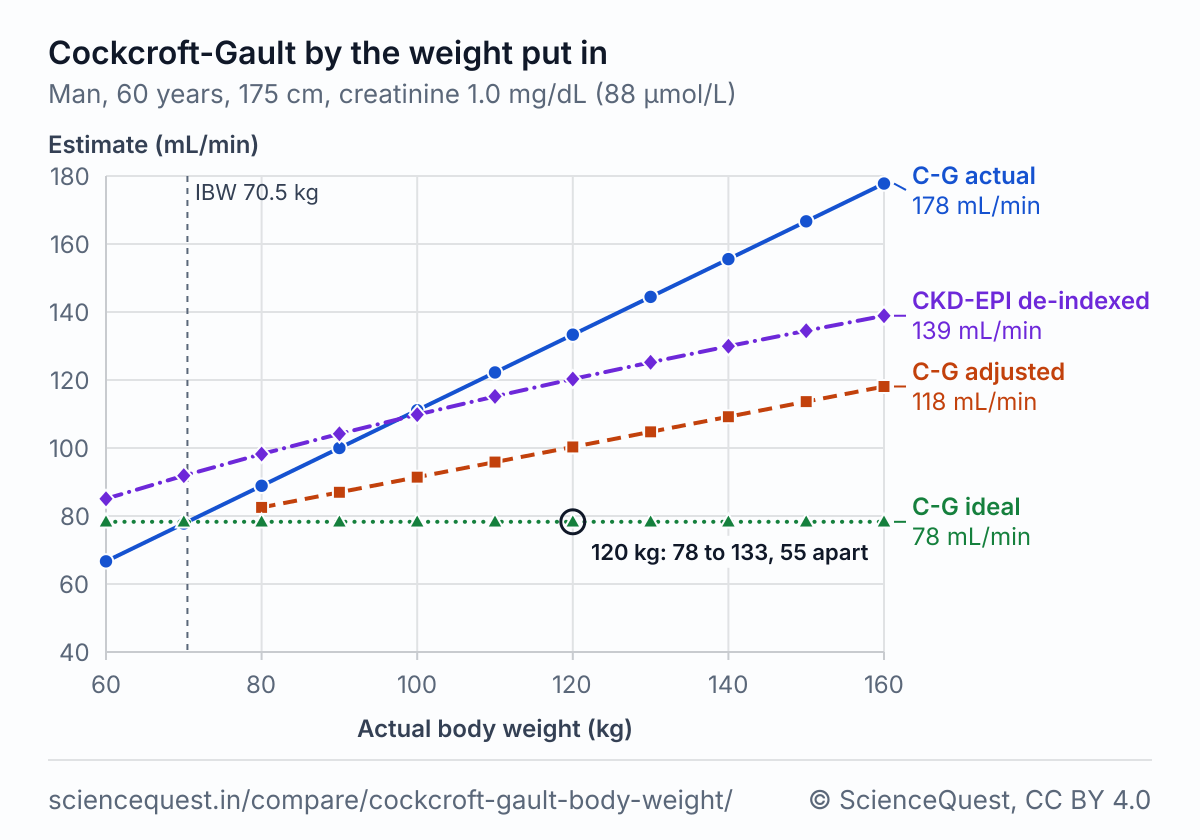
Man, 175 cm, by actual weight
| Actual weight (kg) | Body | Cockcroft-Gault on body weight | CKD-EPI 2021 | |||
|---|---|---|---|---|---|---|
| BMI kg/m² | Actual mL/min | Adjusted mL/min | Ideal mL/min | Indexed mL/min/1.73 m² | De-indexed mL/min | |
| 60 | 19.6 | 67 | None | 78 | 86 | 85 |
| 70 | 22.9 | 78 | None | 78 | 86 | 92 |
| 80 | 26.1 | 89 | 83 | 78 | 86 | 98 |
| 90 | 29.4 | 100 | 87 | 78 | 86 | 104 |
| 100 | 32.7 | 111 | 91 | 78 | 86 | 110 |
| 110 | 35.9 | 122 | 96 | 78 | 86 | 115 |
| 120 | 39.2 | 133 | 100 | 78 | 86 | 120 |
| 130 | 42.4 | 144 | 105 | 78 | 86 | 125 |
| 140 | 45.7 | 156 | 109 | 78 | 86 | 130 |
| 150 | 49.0 | 167 | 114 | 78 | 86 | 134 |
| 160 | 52.2 | 178 | 118 | 78 | 86 | 139 |
None: at 60 and 70 kg he weighs less than his ideal 70.5 kg, so the 0.4 has no excess to act on and the ideal body weight calculator gives no adjusted weight. De-indexed: CKD-EPI × BSA ÷ 1.73, with BSA by Mosteller.
Woman, 163 cm, by actual weight
| Actual weight (kg) | Body | Cockcroft-Gault on body weight | CKD-EPI 2021 | |||
|---|---|---|---|---|---|---|
| BMI kg/m² | Actual mL/min | Adjusted mL/min | Ideal mL/min | Indexed mL/min/1.73 m² | De-indexed mL/min | |
| 60 | 22.6 | 57 | 54 | 52 | 64 | 61 |
| 70 | 26.3 | 66 | 58 | 52 | 64 | 66 |
| 80 | 30.1 | 76 | 61 | 52 | 64 | 71 |
| 90 | 33.9 | 85 | 65 | 52 | 64 | 75 |
| 100 | 37.6 | 94 | 69 | 52 | 64 | 79 |
| 110 | 41.4 | 104 | 73 | 52 | 64 | 83 |
| 120 | 45.2 | 113 | 77 | 52 | 64 | 87 |
| 130 | 48.9 | 123 | 80 | 52 | 64 | 90 |
| 140 | 52.7 | 132 | 84 | 52 | 64 | 94 |
| 150 | 56.5 | 142 | 88 | 52 | 64 | 97 |
| 160 | 60.2 | 151 | 92 | 52 | 64 | 100 |
De-indexed: CKD-EPI × BSA ÷ 1.73, with BSA by Mosteller.
Man, 175 cm and 120 kg, by creatinine
| Creatinine, mg/dL (µmol/L) | Cockcroft-Gault on body weight | CKD-EPI 2021 | Gap between the four | ||
|---|---|---|---|---|---|
| Actual | Adjusted | Ideal | De-indexed | Spread | |
| 0.6 (53) | 222 | 167 | 130 | 154 | 92 |
| 0.7 (62) | 190 | 143 | 112 | 147 | 78 |
| 0.8 (71) | 167 | 125 | 98 | 141 | 69 |
| 0.9 (80) | 148 | 111 | 87 | 137 | 61 |
| 1.0 (88) | 133 | 100 | 78 | 120 | 55 |
| 1.2 (106) | 111 | 84 | 65 | 97 | 46 |
| 1.5 (133) | 89 | 67 | 52 | 74 | 37 |
| 2.0 (177) | 67 | 50 | 39 | 52 | 28 |
| 2.5 (221) | 53 | 40 | 31 | 40 | 22 |
| 3.0 (265) | 44 | 33 | 26 | 32 | 18 |
Spread: the highest of the four printed estimates less the lowest. µmol/L is mg/dL × 88.4, rounded to the whole number.
Why the weight changes the answer
Cockcroft and Gault built their formula on 24-hour creatinine excretion per kg in 249 patients aged 18 to 92, so weight multiplies the result. Double the weight you enter and you double the clearance. For the 175 cm man at 1.0 mg/dL, actual weight takes Cockcroft-Gault from 67 mL/min at 60 kg to 178 at 160 kg. His ideal weight of 70.5 kg, from height alone, holds it at 78. Adjusted weight adds back 0.4 of the excess, so its line climbs at 0.4 times the actual-weight slope: 100 mL/min at 120 kg. The 163 cm woman at 120 kg gets 113, 77 and 52 mL/min on the three weights.
Winter and colleagues checked each choice against a measured 24-hour clearance in 3,678 patients with stable kidney function. Actual weight gave an unbiased estimate in underweight patients, and ideal weight in patients of normal weight. In overweight, obese and morbidly obese patients none of the weights came out unbiased, and adjusted weight with the 0.4 factor was the least biased and the most accurate. The FDA’s 2024 guidance on renal impairment studies is less specific: in overweight or obese people, ideal or adjusted weight is likely to give a more accurate Cockcroft-Gault than actual weight. At 120 kg and a BMI of 39.2, actual weight puts the man 33 mL/min above his adjusted-weight figure.
CKD-EPI 2021 reports a GFR per 1.73 m², so it reads 86 for the man at every weight. For a label’s recommended dose in renal impairment, the FDA asks for the eGFR in mL/min: multiply by the person’s body surface area and divide by 1.73. KDIGO 2024 adds that the non-indexed eGFR may be indicated at extremes of body weight, most of all for drugs with a narrow therapeutic range. De-indexed, the man’s CKD-EPI climbs with the square root of his weight, from 85 mL/min at 60 kg to 139 at 160 kg. Raise his creatinine and the spread at 120 kg narrows in mL/min, from 92 at 0.6 mg/dL to 18 at 3.0. At every creatinine, actual weight gives the highest and ideal weight the lowest, so the highest is 120 ÷ 70.5 = 1.70 times the lowest. At 3.0 mg/dL ideal weight gives 26 mL/min, under the 30 mL/min line the FDA draws for severe impairment when a study enrolls patients, while actual weight gives 44.
The formulas
- Cockcroft-Gault [1]
-
- Devine ideal body weight [3]
-
- Adjusted body weight [6]
-
- CKD-EPI 2021 [9]
-
- De-indexing, with BSA by Mosteller [12]
-
SCr is serum creatinine in mg/dL, age in years, weight in kg and height in cm, or in inches (cm ÷ 2.54) for Devine. Cockcroft-Gault gives mL/min, CKD-EPI mL/min/1.73 m² until de-indexed.
Where each formula holds
| Formula | Fitted in | Holds for | Not for |
|---|---|---|---|
| Cockcroft-Gault | 24-hour creatinine excretion per kg in 249 patients aged 18 to 92, for adult men, with 15% less for women; checked against measured clearance in 236. Developed before creatinine assays were standardized, and without women or Black participants (KDIGO 2024) | Adults within the paper’s 18 to 92, as a creatinine clearance in mL/min for the weight put in, not adjusted to 1.73 m² | Kidney function or creatinine not in a steady state (KDIGO 2024 Practice Point 4.2.5); a weight swollen by edema or raised by obesity, which KDIGO 2024 names as a concern; any figure read as a GFR per 1.73 m² |
| Devine ideal body weight | No fitted sample that we could confirm: McCarron and Devine gave it in 1974 in a case study of gentamicin therapy, and Pai and Paloucek (2000) find it consistent with an older rule from height-weight tables | Adults 5 ft (152.4 cm) and taller: it counts 2.3 kg for each inch over 5 ft | Anyone under 5 ft, who has no inches over 5 ft to count, so the ideal body weight calculator gives no number; children |
| Adjusted body weight (0.4) | An aminoglycoside dosing weight, not fitted to creatinine clearance. Velissaris 2014 credits it to Bauer 1983, a study of 30 normal-weight and 30 morbidly obese patients (over 90% overweight) with normal kidney function, and its Table 1 also lists Schwartz 1978 with the same 0.4 | Actual weight above IBW. In Cockcroft-Gault, Winter 2012 found it the least biased and most accurate weight in overweight, obese and morbidly obese patients | Weight at or below IBW, where there is no excess to adjust; a drug whose own label or guidance names another weight |
| CKD-EPI 2021, de-indexed | 8,254 adults in 10 studies, 31.5% of them Black, refitted without race; validated in 4,050 adults in 12 other studies | Adults with a stable creatinine, as a GFR in mL/min once multiplied by body surface area ÷ 1.73, the figure the FDA asks for in a dose recommendation | Kidney function or creatinine not in a steady state (KDIGO 2024 Practice Point 4.2.5); a drug decision that needs more accuracy, where KDIGO 2024 (4.2.3) points to creatinine with cystatin C or a measured GFR |
Calculators and simulators
Related comparisons
Sources
- Cockcroft DW, Gault MH. Prediction of creatinine clearance from serum creatinine. Nephron. 1976;16(1):31-41. Only the abstract was accessible to us, and it reads “(see article)” where the formula goes; the next source prints it. doi:10.1159/000180580, read
- Awdishu L, Connor AI, Bouchard J, Macedo E, Chertow GM, Mehta RL. Use of estimating equations for dosing antimicrobials in patients with acute kidney injury not receiving renal replacement therapy. J Clin Med. 2018;7(8):211. Table 1 prints Cockcroft-Gault as CLcr = ((140 − age) × weight (kg))/(72 × Scr (mg/dL)), multiplied by 0.85 if female. doi:10.3390/jcm7080211, read
- McCarron MM, Devine BJ. Clinical pharmacy: case studies. Case number 25: gentamicin therapy. Drug Intell Clin Pharm. 1974;8(11):650-655. The paper usually cited as Devine 1974; it was not accessible to us, and the ARDS Network protocol card below prints the same line, 50 or 45.5 + 2.3 [height (inches) − 60]. doi:10.1177/106002807400801104
- NIH NHLBI ARDS Clinical Network. Mechanical ventilation protocol summary. 2008. Its first step prints predicted body weight as 50 + 2.3 [height (inches) − 60] for men and 45.5 + 2.3 [height (inches) − 60] for women. https://www.ardsnet.org/files/ventilator_protocol_2008-07.pdf, read
- Pai MP, Paloucek FP. The origin of the “ideal” body weight equations. Ann Pharmacother. 2000;34(9):1066-1069. doi:10.1345/aph.19381, read
- Bauer LA, Edwards WA, Dellinger EP, Simonowitz DA. Influence of weight on aminoglycoside pharmacokinetics in normal weight and morbidly obese patients. Eur J Clin Pharmacol. 1983;24(5):643-647. Only the abstract was accessible to us, and it does not give the 0.4; Velissaris 2014 below prints the formula and credits it to this study. doi:10.1007/BF00542215, read
- Velissaris D, Karamouzos V, Marangos M, Pierrakos C, Karanikolas M. Pharmacokinetic changes and dosing modification of aminoglycosides in critically ill obese patients: a literature review. J Clin Med Res. 2014;6(4):227-233. Prints ABW = IBW + 0.4 × (TBW − IBW) and credits it to Bauer 1983; its Table 1 also lists Schwartz 1978 with the same 0.4, for the volume of distribution of gentamicin and tobramycin. doi:10.14740/jocmr1858w, read
- Winter MA, Guhr KN, Berg GM. Impact of various body weights and serum creatinine concentrations on the bias and accuracy of the Cockcroft-Gault equation. Pharmacotherapy. 2012;32(7):604-612. doi:10.1002/j.1875-9114.2012.01098.x, read
- Inker LA, Eneanya ND, Coresh J, et al. New creatinine- and cystatin C-based equations to estimate GFR without race. N Engl J Med. 2021;385(19):1737-1749. doi:10.1056/NEJMoa2102953, read
- Mosteller RD. Simplified calculation of body-surface area. N Engl J Med. 1987;317(17):1098. The letter was not accessible to us; the next source prints its formula. doi:10.1056/NEJM198710223171717
- Mohamed AAA, van Londen M, Stevens J, Heerspink HJL, Gansevoort RT. Indexing for body surface area when assessing kidney function. Nephrol Dial Transplant. 2026;41(9):1595-1605. Table 1 gives Mosteller’s formula as (weight^0.5 × height^0.5)/60, the square root above. doi:10.1093/ndt/gfag063, read
- US Food and Drug Administration, CDER. Pharmacokinetics in patients with impaired renal function: study design, data analysis, and impact on dosing. Guidance for industry. March 2024. Section IV.A on eGFR in mL/min and on ideal or adjusted weight in Cockcroft-Gault; Table 1 for the study groups. https://www.fda.gov/media/78573/download, read
- KDIGO CKD Work Group. KDIGO 2024 clinical practice guideline for the evaluation and management of chronic kidney disease. Kidney Int. 2024;105(4S):S117-S314. Section 4.2, Practice Points 4.2.1 to 4.2.5, on drug dosing and nonindexed eGFR. doi:10.1016/j.kint.2023.10.018, read
The values are facts and free to use; this table’s selection and presentation are © 2026 ScienceQuest.