Ideal body weight chart: Devine vs ARDSNet vs BMI 18.5 to 24.9
At 5 ft 10 in, Devine gives a man 160.9 lb and a woman 151.0 lb, both inside the BMI 18.5 to 24.9 range of 129 to 174 lb. ARDSNet’s predicted weights are 0.3 lb higher. From 5 ft to 6 ft 6 in, Devine’s weights equal BMI 21.5 to 23.3 for men and 19.6 to 22.1 for women.
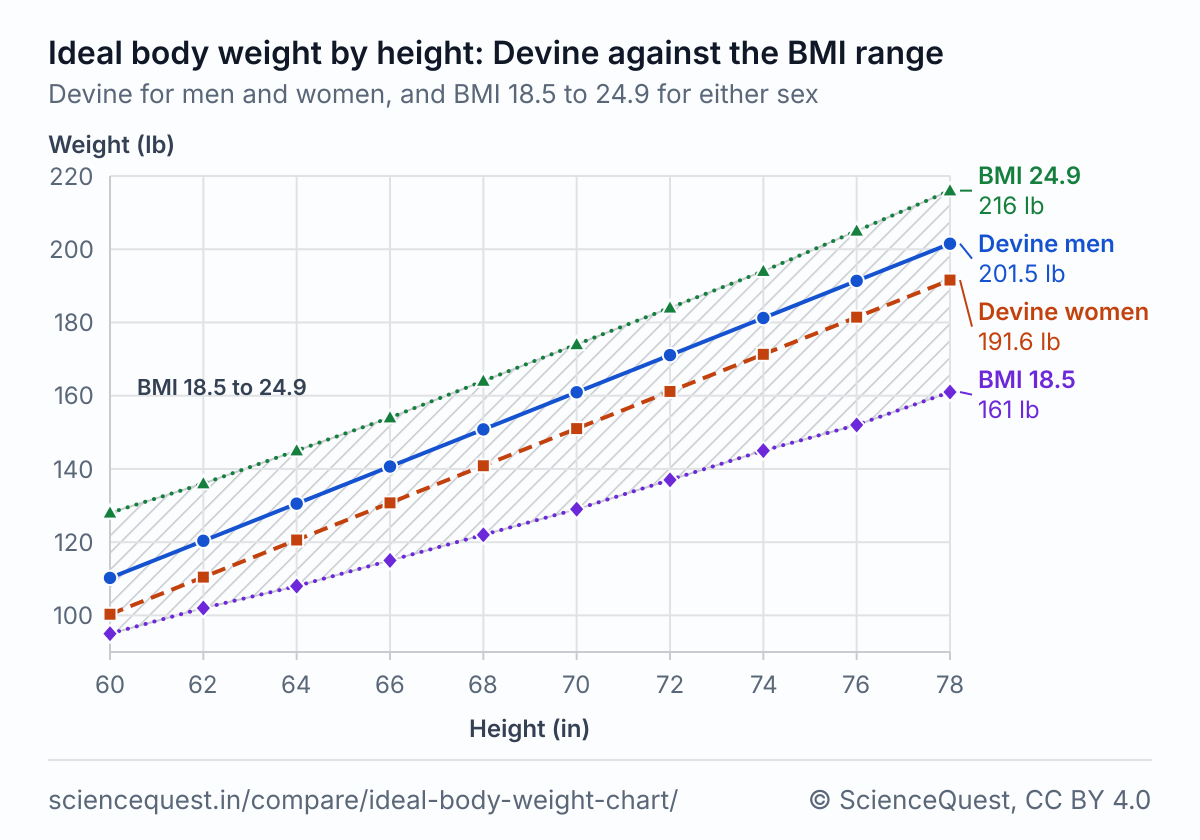
Ideal body weight by height, 5 ft 0 in to 6 ft 6 in
| Height | Women | Men | BMI 18.5 to 24.9, either sex | |||
|---|---|---|---|---|---|---|
| Devine | ARDSNet | Devine | ARDSNet | Lowest | Highest | |
| 5 ft 0 in (152.4 cm) | 100.3 | 100.3 | 110.2 | 110.2 | 95 | 128 |
| 5 ft 2 in (157.5 cm) | 110.5 | 110.5 | 120.4 | 120.4 | 102 | 136 |
| 5 ft 4 in (162.6 cm) | 120.6 | 120.7 | 130.5 | 130.6 | 108 | 145 |
| 5 ft 6 in (167.6 cm) | 130.7 | 130.9 | 140.7 | 140.8 | 115 | 154 |
| 5 ft 8 in (172.7 cm) | 140.9 | 141.1 | 150.8 | 151.0 | 122 | 164 |
| 5 ft 10 in (177.8 cm) | 151.0 | 151.3 | 160.9 | 161.2 | 129 | 174 |
| 6 ft 0 in (182.9 cm) | 161.2 | 161.5 | 171.1 | 171.4 | 137 | 184 |
| 6 ft 2 in (188.0 cm) | 171.3 | 171.7 | 181.2 | 181.6 | 145 | 194 |
| 6 ft 4 in (193.0 cm) | 181.4 | 181.8 | 191.4 | 191.8 | 152 | 205 |
| 6 ft 6 in (198.1 cm) | 191.6 | 192.0 | 201.5 | 202.0 | 161 | 216 |
At 5 ft 10 in (177.8 cm) Devine gives 68.5 kg for a woman and 73.0 kg for a man, ARDSNet 68.6 and 73.1 kg, and the BMI range is 58.5 to 79.0 kg. The BMI columns are the whole pounds the BMI calculator prints: the first at or above BMI 18.5 and the last below 25. One pound is 0.45359237 kg.
Devine minus ARDSNet at 5 ft, 6 ft and 7 ft
| Height | Women | Men | Devine minus ARDSNet | |||
|---|---|---|---|---|---|---|
| Devine kg | ARDSNet kg | Devine kg | ARDSNet kg | Weight kg | Tidal volume mL | |
| 5 ft (152.4 cm) | 45.50 | 45.50 | 50.00 | 50.00 | 0.00 | 0.0 |
| 6 ft (182.9 cm) | 73.10 | 73.24 | 77.60 | 77.74 | −0.14 | −0.8 |
| 7 ft (213.4 cm) | 100.70 | 100.97 | 105.20 | 105.47 | −0.27 | −1.6 |
The gap is the same for both sexes.
Adjusted body weight from 150 to 350 lb
| Actual weight | Man, 5 ft 10 in, IBW 160.9 lb | Woman, 5 ft 4 in, IBW 120.6 lb | ||||
|---|---|---|---|---|---|---|
| BMI kg/m² | Of IBW % | AdjBW lb | BMI kg/m² | Of IBW % | AdjBW lb | |
| 150 lb (68.0 kg) | 21.5 | 93 | None | 25.7 | 124 | 132.4 |
| 175 lb (79.4 kg) | 25.1 | 109 | 166.6 | 30.0 | 145 | 142.4 |
| 200 lb (90.7 kg) | 28.7 | 124 | 176.6 | 34.3 | 166 | 152.4 |
| 225 lb (102.1 kg) | 32.3 | 140 | 186.6 | 38.6 | 187 | 162.4 |
| 250 lb (113.4 kg) | 35.9 | 155 | 196.6 | 42.9 | 207 | 172.4 |
| 275 lb (124.7 kg) | 39.5 | 171 | 206.6 | 47.2 | 228 | 182.4 |
| 300 lb (136.1 kg) | 43.0 | 186 | 216.6 | 51.5 | 249 | 192.4 |
| 325 lb (147.4 kg) | 46.6 | 202 | 226.6 | 55.8 | 270 | 202.4 |
| 350 lb (158.8 kg) | 50.2 | 217 | 236.6 | 60.1 | 290 | 212.4 |
Of IBW is the actual weight as a percentage of Devine IBW. None: at 150 lb the man weighs less than his IBW, so there is no excess for the 0.4 to act on and the calculator gives no adjusted weight. Above IBW, each 25 lb of actual weight adds 10 lb of adjusted weight. The calculator adjusts any weight above IBW; Traynor and colleagues proposed a corrected weight for 125% of IBW and over, which the man reaches at 225 lb and the woman at 175 lb.
This page is for study, not clinical decision support, and must not be used to treat anybody. A row in these tables is not a patient: it is worked at the figures its caption gives, so work a patient’s own measured height and weight in the calculator. Check the units before you trust a weight: Devine counts inches above 60 and ARDSNet centimeters above 152.4, the chart and the first and third tables give pounds and the second kilograms, and a weight in pounds entered as kilograms comes out 2.2 times too high, since a pound is 0.45359237 kg exactly (NIST). Which weight a drug dose or a ventilator setting uses is set by its own guidance, and Devine’s, from height and sex alone, is not a weight to aim for.
Where the three weights come from
The ARDS Network trial wrote predicted body weight in centimeters, adding 0.91 kg for each cm above 152.4. Devine’s 2.3 kg per inch works out to 0.9055 kg per cm, so the trial’s line gains 0.0045 kg per cm on Devine’s: 0.14 kg by 6 ft and 0.27 kg by 7 ft. At 6 mL/kg that comes to under 2 mL of tidal volume. The network’s protocol card writes the formula in inches with 2.3, which matches Devine.
Devine adds a fixed 2.3 kg for each inch, a straight line. A BMI edge is the BMI times height squared, so the BMI 18.5 to 24.9 range curves upward and widens, from 33 lb across at 5 ft to 55 lb at 6 ft 6 in. Both Devine lines stay inside it. A woman’s comes closest to the floor at 5 ft, where her 100.3 lb sits 5.3 lb above the range’s lowest weight.
McCarron and Devine gave the equations in 1974, in a gentamicin case study. Pai and Paloucek trace their use to drug kinetics that track IBW, and found them consistent with an older rule drawn from height-weight tables; later regressions on height-weight data gave similar lines. Schwartz and colleagues used the adjusted weight’s 0.4 in 1978, before Bauer’s group based aminoglycoside loading doses on it in 1983.
The formulas
- Devine ideal body weight [1]
-
- ARDSNet predicted body weight [4]
-
- Weight at a BMI, for 18.5 and 25 [9]
-
- Adjusted body weight [8]
-
B is 50 kg for men and 45.5 kg for women; h_in is height in inches, h_cm in cm and h_m in meters. Every weight is in kg.
Where each formula holds
| Formula | Fitted in | Holds for | Not for |
|---|---|---|---|
| Devine ideal body weight (1974) | No sample could be confirmed: the equations appeared in a gentamicin case study. Pai and Paloucek (2000) find them consistent with an older rule drawn from height-weight tables | Adults 5 ft (60 in) and taller, as a weight to work out drug doses from | Heights under 5 ft, where the site’s calculator gives no number; children; a weight to aim for, since it uses height and sex alone |
| ARDSNet predicted body weight (2000) | No fitted sample: the same base weights as Devine, 50 and 45.5 kg, with 0.91 kg per cm in the trial and 2.3 kg per inch on the protocol card | Adults 5 ft and taller, for setting tidal volume per kg on a ventilator (6 mL/kg in the trial’s lower volume group) | Heights under 5 ft, where the site’s calculator gives no number, although the network’s 2005 reference table runs the inch form down to 4 ft |
| BMI 18.5 to 24.9 (CDC) | No fitted sample: cut-offs the CDC applies to adults regardless of age, sex or race, 18.5 to less than 25 for healthy weight | Adults 20 and older, as a screening measure | Children and teens under 20, whom the adult categories do not cover; a judgment of health on BMI alone |
| Adjusted body weight (Bauer 1983) | Aminoglycoside kinetics in 30 normal weight and 30 morbidly obese patients, more than 90 percent overweight | Aminoglycoside loading doses in obesity, the use Bauer’s group gave it | Weights at or below IBW, where the calculator gives none; weights under 125% of IBW, below the cut-off Traynor and colleagues proposed; drugs whose own guidance names another weight |
Calculators and simulators
Related comparisons
Sources
- McCarron MM, Devine BJ. Clinical Pharmacy: Case Studies: Case Number 25, Gentamicin Therapy. Drug Intelligence and Clinical Pharmacy 1974;8(11):650 to 655. doi:10.1177/106002807400801104
- Pai MP, Paloucek FP. The origin of the “ideal” body weight equations. Annals of Pharmacotherapy 2000;34(9):1066 to 1069. doi:10.1345/aph.19381, read
- Acute Respiratory Distress Syndrome Network. Ventilation with lower tidal volumes as compared with traditional tidal volumes for acute lung injury and the acute respiratory distress syndrome. New England Journal of Medicine 2000;342(18):1301 to 1308. doi:10.1056/NEJM200005043421801, read
- Grieco DL, Stronati A, Robba C, et al. Respiratory mechanics modifies the impact of ventilator settings on clinical outcome in patients with acute brain injury. Intensive Care Medicine 2026;52(10):2071 to 2084. It gives the trial’s centimeter form of predicted body weight and cites the trial for it. doi:10.1007/s00134-026-08562-8, read
- NIH NHLBI ARDS Clinical Network. Mechanical Ventilation Protocol Summary, with predicted body weight in inches. File dated July 2008. https://www.ardsnet.org/files/ventilator_protocol_2008-07.pdf, read
- NIH NHLBI ARDS Clinical Network. PBW and Tidal Volume for Females and for Males, ARDSNet Studies: predicted body weight from 4 ft 0 in to 7 ft 0 in. File dated . https://www.ardsnet.org/files/pbwtables_2005-02-02.pdf, read
- Bauer LA, Edwards WA, Dellinger EP, Simonowitz DA. Influence of weight on aminoglycoside pharmacokinetics in normal weight and morbidly obese patients. European Journal of Clinical Pharmacology 1983;24(5):643 to 647. doi:10.1007/BF00542215, read
- Velissaris D, Karamouzos V, Marangos M, Pierrakos C, Karanikolas M. Pharmacokinetic Changes and Dosing Modification of Aminoglycosides in Critically Ill Obese Patients: A Literature Review. Journal of Clinical Medicine Research 2014;6(4):227 to 233. Its Table 1 gives the 0.4 of Schwartz 1978 and Bauer 1983, and Traynor 1995’s 1.25 ratio of actual weight to IBW. doi:10.14740/jocmr1858w, read
- Centers for Disease Control and Prevention. Adult BMI Categories. For adults 20 and older. https://www.cdc.gov/bmi/adult-calculator/bmi-categories.html, read
- National Institute of Standards and Technology. NIST Guide to the SI, Footnotes: footnote 22, “The exact conversion factor is 4.535 923 7 E-01”, from the avoirdupois pound to the kilogram. https://www.nist.gov/physical-measurement-laboratory/nist-guide-si-footnotes, read
The values are facts and free to use; this table’s selection and presentation are © 2026 ScienceQuest.