Palmar interossei of hand
The palmar interossei are small intrinsic hand muscles on the palm side of the metacarpal bones, and they bring the fingers together. (Gray’s Anatomy (1918), Intermediate Muscles of the Hand; StatPearls, Hand Palmar Interosseous Muscle)
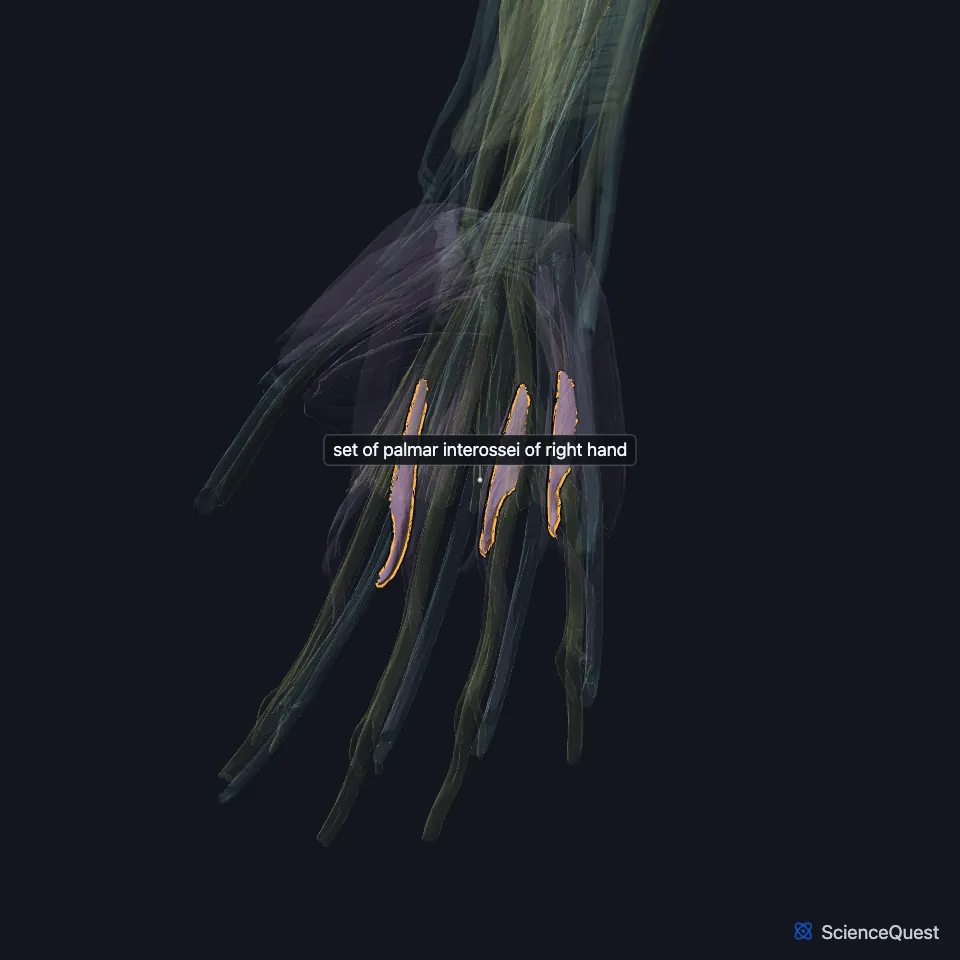
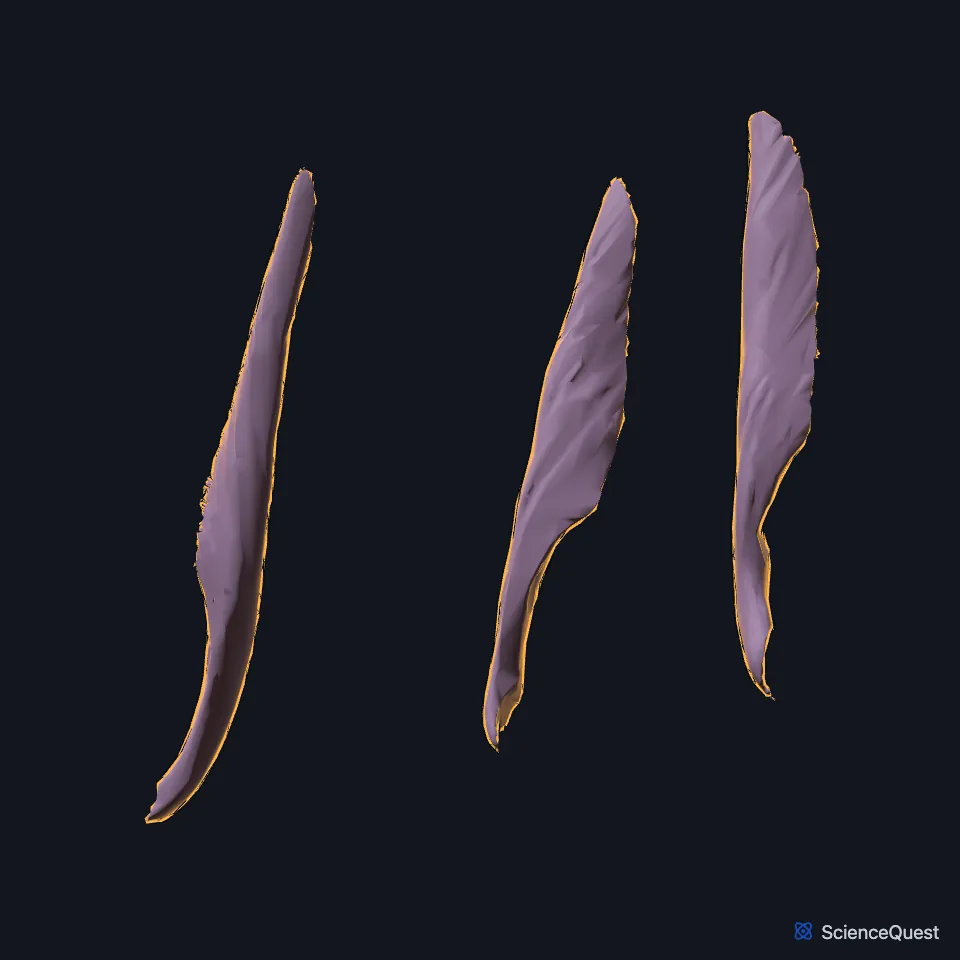
Open it in the Upper Limb Muscles Explorer See it alone in 3D
Where are the palmar interossei?
Each lies on, and arises from, the metacarpal of a single finger. The dorsal interossei arise from two metacarpals each. (Gray’s Anatomy (1918), Intermediate Muscles of the Hand)
How do the palmar interossei attach?
In Gray’s 1918 the first arises from the ulnar side of the second metacarpal and joins the index finger, the second from the radial side of the fourth metacarpal and joins the ring finger, and the third from the radial side of the fifth and joins the little finger. Each inserts on the same side of its finger, at the base of the proximal phalanx and into the extensor expansion. (Gray’s Anatomy (1918), Intermediate Muscles of the Hand)
StatPearls describes them as unipennate, though it reports a retrospective study that found only 62% of palmar interossei unipennate. (StatPearls, Hand Muscles and Hand Palmar Interosseous Muscle)
What do the palmar interossei do?
They adduct the fingers at the metacarpophalangeal joints, toward a line through the middle finger. They also help flex those joints and extend the interphalangeal joints. (StatPearls, Hand Palmar Interosseous Muscle)
In Gray’s 1918 each finger has two interossei except the little finger, where the abductor digiti minimi takes the place of one. (Gray’s Anatomy (1918), Intermediate Muscles of the Hand)
Which nerve supplies the palmar interossei, and how are they tested?
The deep branch of the ulnar nerve supplies them. To test them, a clinician asks you to hold a sheet of paper between the fingers; if it falls, the palmar interossei may be weak. (StatPearls, Hand Palmar Interosseous Muscle)
In the Wartenberg sign the little finger drifts away when the person tries to bring all the fingers together, pulled by the extensor digiti minimi with nothing to oppose it. It points to weakness of the palmar interosseous of the little finger (the third in a count of three) and the fourth lumbrical. (StatPearls, Hand Palmar Interosseous Muscle and Intrinsic Hand Deformity; Gray’s Anatomy (1918), Intermediate Muscles of the Hand)
Where the sources differ
Sources disagree on their number. Gray’s 1918 and the StatPearls hand muscles article count three; the StatPearls palmar interosseous article counts four, sometimes three, adding a first palmar interosseous at the thumb that many references fold into the adductor pollicis or flexor pollicis brevis. (Gray’s Anatomy (1918), Intermediate Muscles of the Hand; StatPearls, Hand Muscles and Hand Palmar Interosseous Muscle)
| Feature | Detail and source |
|---|---|
| Origin | The metacarpal of their own finger: second, fourth and fifth (Gray’s Anatomy (1918), Intermediate Muscles of the Hand; StatPearls, Hand Muscles) |
| Insertion | Base of the proximal phalanx and extensor expansion of the same finger (Gray’s Anatomy (1918), Intermediate Muscles of the Hand) |
| Action | Adduct the fingers toward the middle finger (StatPearls, Hand Palmar Interosseous Muscle) |
| Nerve | Deep branch of the ulnar nerve (C8, T1) (StatPearls, Hand Palmar Interosseous Muscle) |
Touches in this model
Measured on the BodyParts3D meshes: surfaces within 2 mm of the palmar interossei of hand, nearest first.
- Right flexor digitorum profundus in contact
- Set of lumbricals of right hand in contact
- Transverse head of right adductor pollicis in contact
- Proximal phalanx of right index finger in contact
- Proximal phalanx of right little finger in contact
- Proximal phalanx of right ring finger in contact
- Right fifth metacarpal bone in contact
- Right fourth metacarpal bone in contact
- Right second metacarpal bone in contact
- Skin in contact
- Set of dorsal interossei of right hand 0.8 mm away
- Humeroulnar head of right flexor digitorum superficialis 1.5 mm away
Sources
Sources read between and
- Anatomy of the Human Body (Gray’s Anatomy), 20th US edition, 1918, Myology, The Muscles and Fasciae of the Hand, 3. The Intermediate Muscles (Lumbricales, Interossei), pages 464 to 465; Internet Archive scan of the 1918 Lea and Febiger printing, terminology of 1918. Henry Gray; edited by Warren H. Lewis. Public domain. Read .
- StatPearls, Anatomy, Shoulder and Upper Limb, Hand Palmar Interosseous Muscle. Michael Valenzuela; Bruno Bordoni. Last update . CC BY-NC-ND 4.0. Read .
- StatPearls, Anatomy, Shoulder and Upper Limb, Hand Muscles. Ebubechi Okwumabua; Margaret A. Sinkler; Bruno Bordoni. Last update . CC BY-NC-ND 4.0. Read .
- StatPearls, Intrinsic Hand Deformity. Bryan G. Beutel; Charles Worley; Shayan Hosseinzadeh. Last update . CC BY-NC-ND 4.0. Read .
The values are facts and free to use; this page’s selection and presentation are © 2026 ScienceQuest.