Serratus posterior superior
The serratus posterior superior is a thin, four-sided muscle at the upper back of the chest. It runs from the spines of the lowest neck and upper thoracic vertebrae down and outward to the upper ribs. (Gray 1918, 6c. Muscles of the Thorax; StatPearls, Back, Extrinsic Muscles)
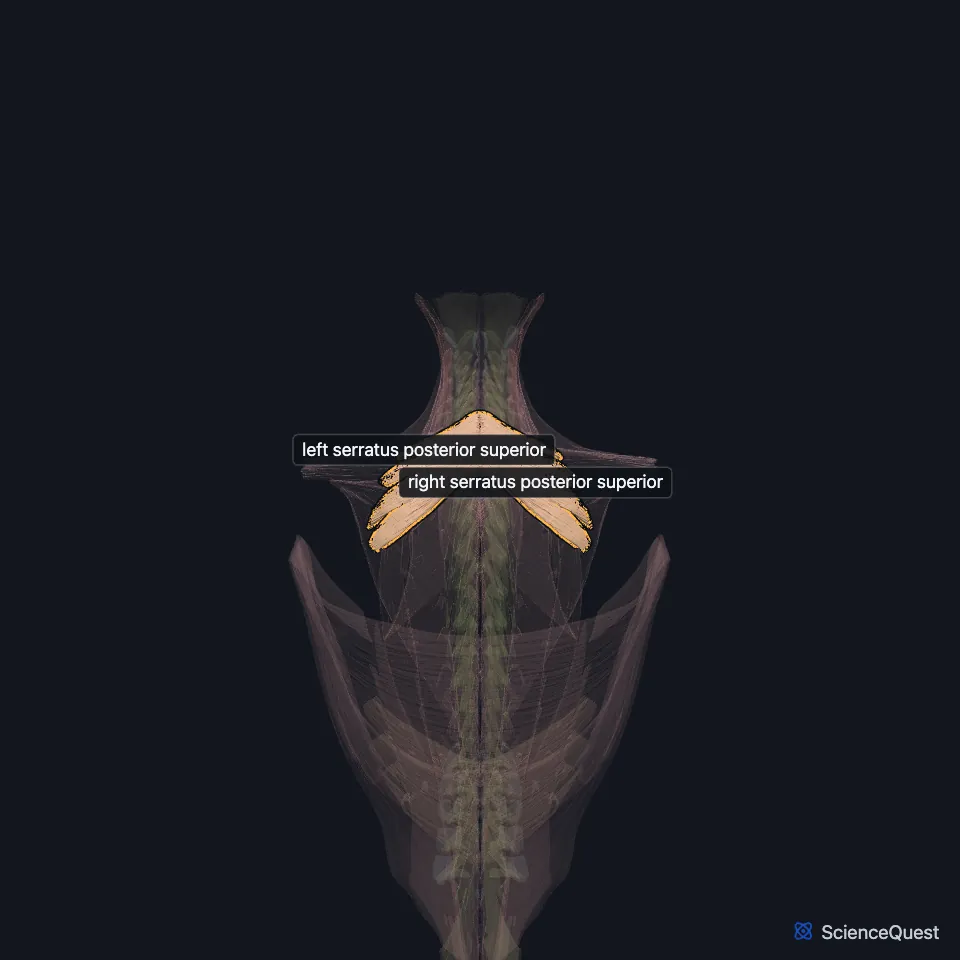
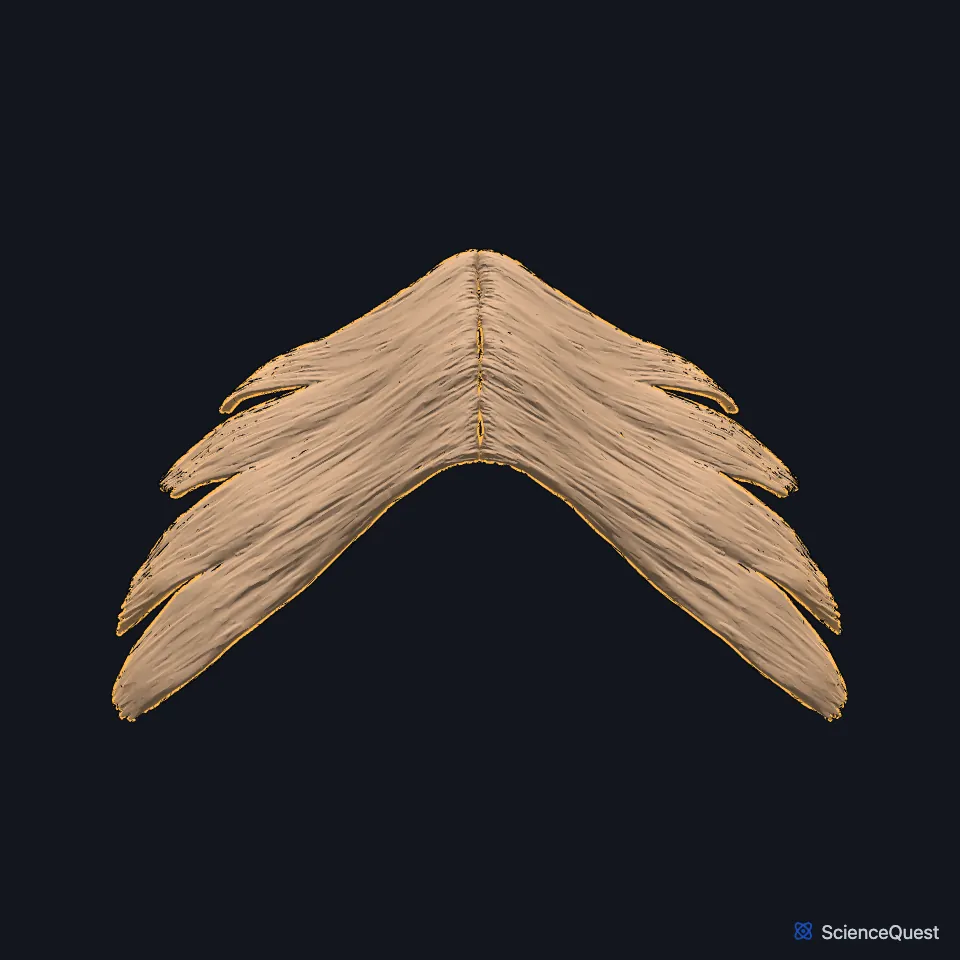
Where is the serratus posterior superior?
It arises from the lower part of the ligamentum nuchae, the spines of C7 and the upper two or three thoracic vertebrae, and the supraspinous ligament. It slopes down and outward and ends in four fleshy slips on the upper borders of ribs 2 to 5, a little beyond their angles. Gray’s 1918 text calls it the serratus posticus superior. (Gray 1918, 6c. Muscles of the Thorax)
The splenius cervicis runs deep to it, and also deep to the rhomboids and the trapezius. (StatPearls, Back, Muscles)
Gray’s 1918 text has the lumbodorsal fascia, the thoracolumbar fascia of StatPearls, passing in front of the muscle on its way up to join the nuchal fascia of the neck. (Gray 1918, 6a. Deep Muscles of the Back; StatPearls, Back)
Which group of muscles is it in?
StatPearls groups both serratus posterior muscles with the extrinsic back muscles, alongside the trapezius, latissimus dorsi, rhomboids and levator scapulae. The intrinsic muscles, which StatPearls counts as the true back muscles, lie deeper. (StatPearls, Back, Extrinsic Muscles, Back, Muscles and Back)
It attaches to the thoracic wall from behind without forming part of it, as the levatores costarum and the serratus posterior inferior do. (StatPearls, Thorax, Muscles)
What does the serratus posterior superior do?
StatPearls and Gray’s 1918 text both say it raises the ribs, which makes it a muscle of inspiration. StatPearls lists it among the accessory muscles of breathing. (StatPearls, Back, Extrinsic Muscles and Thorax, Muscles; Gray 1918, 6c. Muscles of the Thorax)
Gray’s 1918 text also counts it among the deeper back muscles called on in deep inspiration, when the thoracic curve of the spine partly straightens. (Gray 1918, 6c. Muscles of the Thorax)
What supplies the serratus posterior superior?
Muscular branches of the intercostal nerves supply it. StatPearls names the 2nd to 5th intercostal nerves. (StatPearls, Back, Extrinsic Muscles and Intercostal Nerves; Gray 1918, 6c. Muscles of the Thorax)
The intercostal arteries bring its blood, as they do for the serratus posterior inferior. (StatPearls, Back, Extrinsic Muscles)
Is the serratus posterior superior always there?
Gray’s 1918 text records muscles larger or smaller than usual, with more or fewer slips, and some people with no muscle at all. (Gray 1918, 6c. Muscles of the Thorax)
Where the sources differ
StatPearls and Gray’s 1918 text give it a role in inspiration, reasoning from its attachments. A 2001 review in Clinical Anatomy found no evidence for a breathing role, cited electromyographic data against one, and proposed proprioception as the main work of both serratus posterior muscles. (StatPearls, Back, Extrinsic Muscles; Gray 1918, 6c. Muscles of the Thorax; Vilensky et al. 2001, Clin Anat)
StatPearls’ article on the extrinsic back muscles ends it on ribs 2 to 4. Its article on the thoracic muscles, like Gray’s 1918 text, gives ribs 2 to 5. (StatPearls, Back, Extrinsic Muscles and Thorax, Muscles; Gray 1918, 6c. Muscles of the Thorax)
| Feature | Detail and source |
|---|---|
| Origin | Ligamentum nuchae and the spines of C7 to T3 (StatPearls, Back, Extrinsic Muscles; Gray 1918, 6c. Muscles of the Thorax) |
| Insertion | Upper borders of ribs 2 to 5, beyond their angles; ribs 2 to 4 in one StatPearls article (Gray 1918, 6c. Muscles of the Thorax; StatPearls, Thorax, Muscles and Back, Extrinsic Muscles) |
| Action | Raises the ribs, by its attachments; its role in breathing is disputed (StatPearls, Back, Extrinsic Muscles; Vilensky et al. 2001, Clin Anat) |
| Nerve | Intercostal nerves 2 to 5 (StatPearls, Back, Extrinsic Muscles) |
| Blood supply | Intercostal arteries (StatPearls, Back, Extrinsic Muscles) |
Touches in this model
Measured on the BodyParts3D meshes: surfaces within 2 mm of the serratus posterior superior, nearest first, 12 of 50.
- Ascending part of left trapezius in contact
- Ascending part of right trapezius in contact
- Descending part of left trapezius in contact
- Descending part of right trapezius in contact
- Left iliocostalis cervicis in contact
- Left iliocostalis thoracis in contact
- Left levator scapulae in contact
- Left longissimus thoracis in contact
- Left rhomboid major in contact
- Left rhomboid minor in contact
- Left splenius capitis in contact
- Left splenius cervicis in contact
Sources
Sources read
- Gray’s Anatomy of the Human Body, 20th US edition (1918), IV. Myology, 6c. The Muscles of the Thorax (1918 terms: Intercostales externi and interni for the external and internal intercostals, anterior intercostal membranes for external intercostal membranes). Henry Gray. Public domain. Read .
- StatPearls, Anatomy, Back, Extrinsic Muscles. Brittney Mitchell; Onyebuchi Imonugo; Justine E. Tripp. Last update . CC BY-NC-ND 4.0. Read .
- StatPearls, Anatomy, Back, Muscles. Brandi Henson; Bhavana Kadiyala; Mary Ann Edens. Last update . CC BY-NC-ND 4.0. Read .
- Gray’s Anatomy of the Human Body, 20th US edition (1918), IV. Myology, 6a. The Deep Muscles of the Back (1918 terms: Sacrospinalis for erector spinae, Iliocostalis dorsi for iliocostalis thoracis, Longissimus dorsi for longissimus thoracis). Henry Gray. Public domain. Read .
- StatPearls, Anatomy, Back. Robert J. Modes; Sevda Lafci Fahrioglu. Last update . CC BY-NC-ND 4.0. Read .
- StatPearls, Anatomy, Thorax, Muscles. Alex Tang; Bruno Bordoni. Last update . CC BY-NC-ND 4.0. Read .
- StatPearls, Anatomy, Thorax, Intercostal Nerves. Niklas L. Glenesk; Sajedur Rahman; Peter P. Lopez. Last update . CC BY-NC-ND 4.0. Read .
- Clinical Anatomy, Serratus posterior muscles: anatomy, clinical relevance, and function, Clin Anat 14, pages 237 to 241 (abstract, PMID 11424195). Vilensky JA, Baltes M, Weikel L, Fortin JD, Fourie LJ. Abstract read on Europe PMC; no reuse licence stated. Read .
The values are facts and free to use; this page’s selection and presentation are © 2026 ScienceQuest.